
Dates: July 14-19, 2026
Places: Sibiu and Timișoara, Romania
There is a particular feeling to the last laps of a very long journey, and these six days were soaked in it. In under two weeks we fly home to Reno, and the trip has started visibly turning toward that fact: earlier bedtimes on purpose, new morning routines built to survive contact with school and work, the hunt for the one souvenir that will carry all of this home. We are trying hard to stay planted in the present, because these final days abroad deserve to be lived and not just endured, while also being honest that home is now pulling at us like gravity. Being present, being reflective, and being excited all at once is a narrow target to hit. We think we are hitting it, more or less, and this is what it looked like.
It looked, first, like war. Our Mediaș apartment had no air conditioning and no fans, so we slept with the windows open, which cooled the room beautifully and also issued a formal invitation to every mosquito in the city. At four in the morning, after the sixth wake-up, one of them delivered by that unmistakable buzz from literally inside our ears, Max flipped on the lights and commenced the hunt. Two enemies were dispatched immediately—red explosions against the white wall in satisfying little eruptions. A third waged a successful guerrilla campaign, and Max eventually surrendered, wrapped his head in a T-shirt, and reclaimed a couple of fitful hours before giving up and caffeinating the tiredness away.
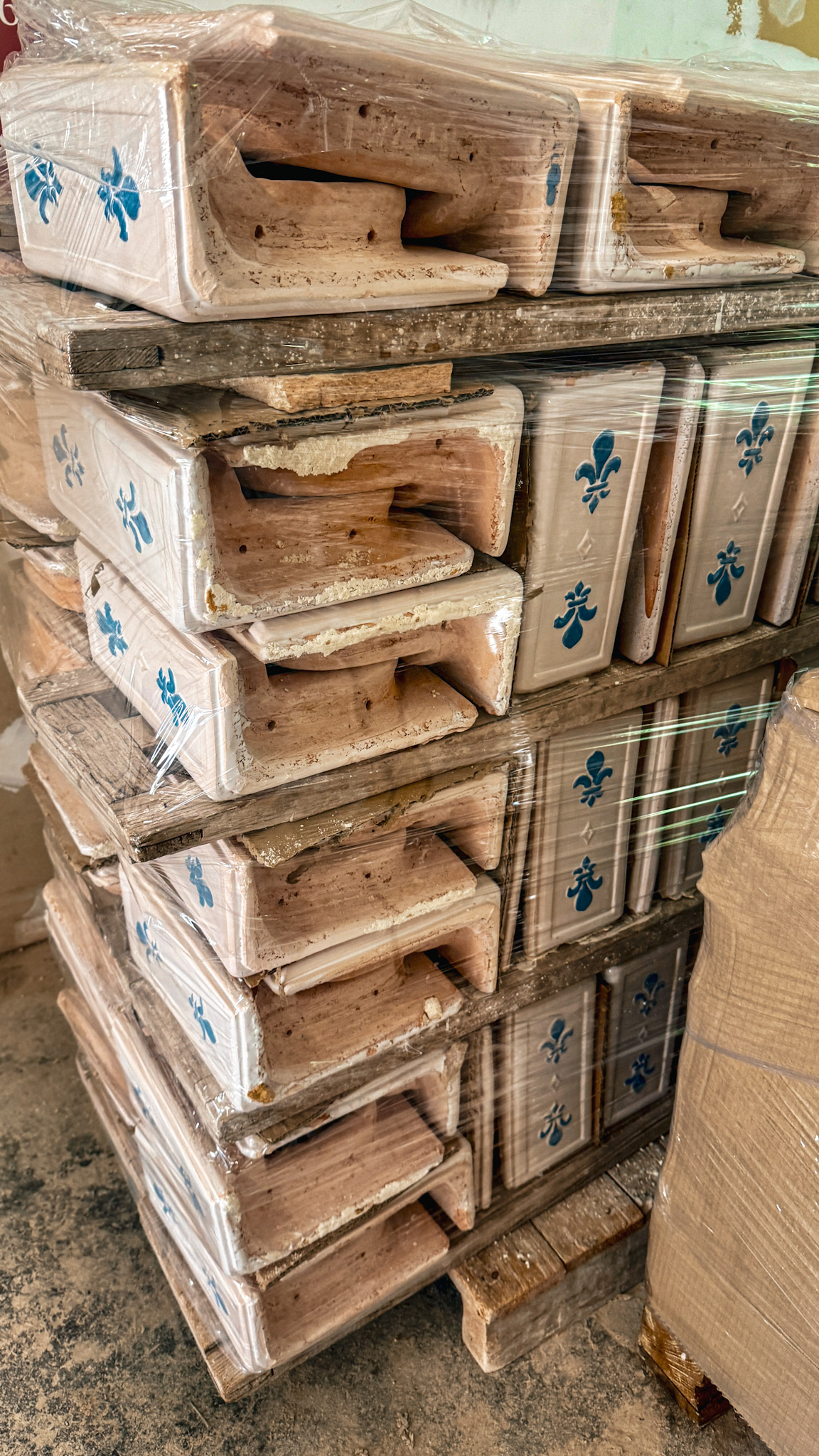
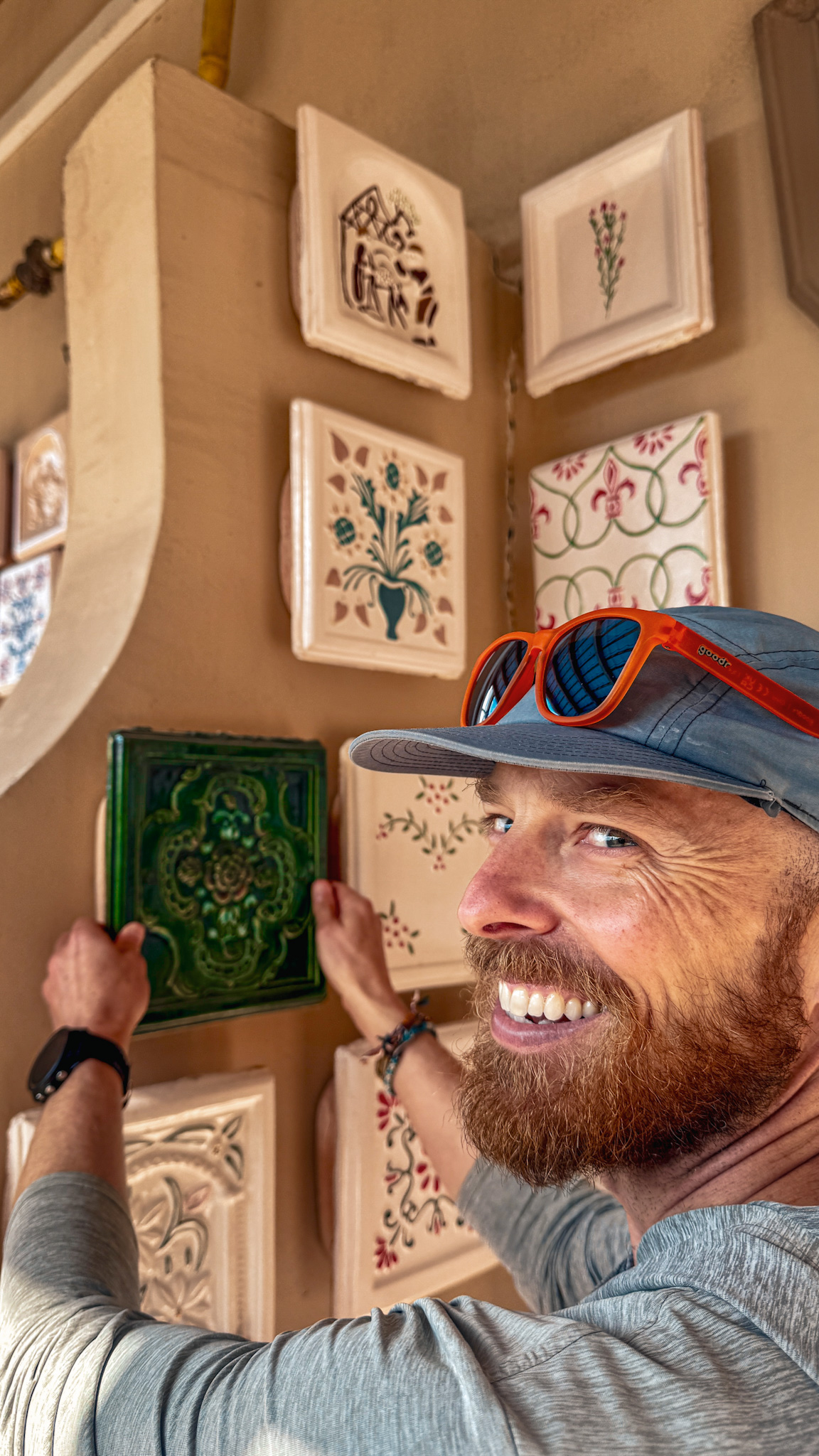
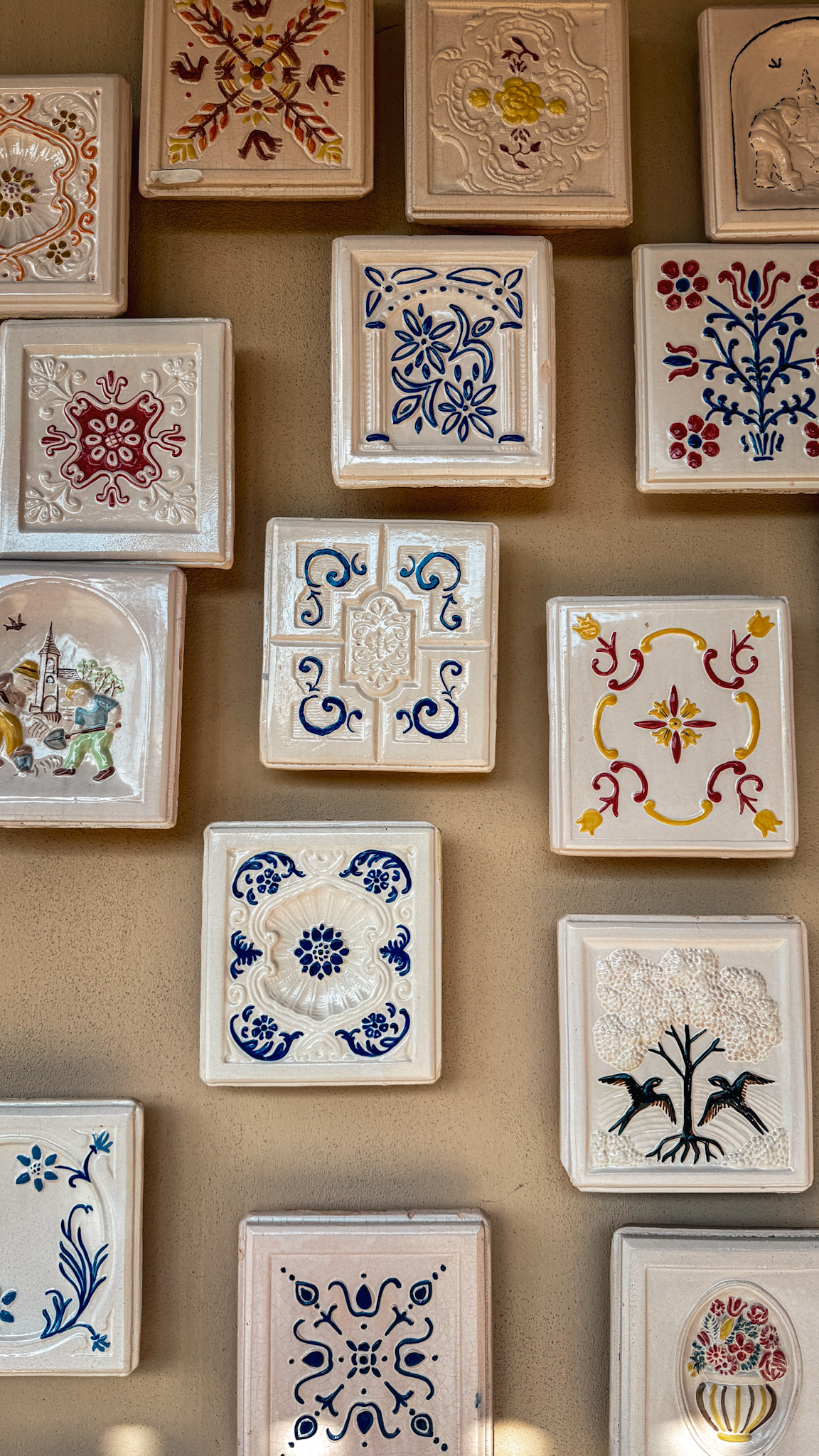
The morning’s real business, though, was the souvenir, and this one had been brewing for weeks. All across Romania we had been admiring the beautiful tile-clad fireplaces in nearly every guesthouse. These traditional wood-burning masonry stoves, faced in glazed ceramic tiles called cahle, have been the heart of Transylvanian homes for centuries. The tiles are thick, deep-backed slabs of fired clay, engineered so the stove heats fast and then radiates warmth for hours after the fire dies, and historically the designs on their faces advertised the wealth and status of the family that owned them. Then, in a couple of guesthouses, we noticed a single tile hung on the wall as a piece of art, and it clicked. We had been struggling to think of the right keepsake from Romania. This was it.
On our first morning where we didn’t have to pack up and head out on a 15-20km walk, we found ourselves walking anyway, hand in hand through a perfect Mediaș morning to Teracota Mediaș. It was only 3km away, a stone’s throw as of late, so why not walk instead of taking a taxi or bus? The enjoyable course through the old town and out into the suburbs led us to stumble into something genuinely special. Founded in 1906 by a Transylvanian Saxon, it is the last factory in Romania still producing hand-pressed, hand-painted stove tiles, using the same clay recipe, century-old kilns, and techniques handed down from the original craftsmen. Every tile is pressed, polished, glazed, and painted by hand. We browsed the showroom and both fell instantly for the same piece, a green tile, the only one in the room where otherwise blues and whites dominated. For us, this deep green with tiny flecks of blue and red buried deep in the glaze had us captivated. Here is the thing about a souvenir that actually means something: it holds a little bit of magic. A tangible object that can transport you back to a place and a time the way almost nothing else can. The tile is beautiful on its own, but that is not really what we are bringing home. What we are bringing home is the Via Transilvanica, the muddy days and the elderflower syrup and the villages and the people, all of it soaked into a deceptively heavy slab of fired clay that we now get to lug around for two more weeks. It will hang somewhere easy to reach, because half the fun will be watching someone think it looks kind of cool, pick it up, and discover just how dense and robust it actually is.
Fittingly, the tile shop morning ended with the official close of our trail. We stopped at St. Margaret’s Church, the massive 15th-century fortified church at the center of Mediaș, to collect the final stamp in our Via Transilvanica passports. The church’s famous Trumpeters’ Tower leans noticeably off vertical, the sandy soil beneath having slowly given way under its weight until the top now sits more than two meters off-plumb, making it one of the most tilted towers in Europe. Local lore adds a garnish: Vlad Țepeș himself, the historical man who inspired the character Dracula, was reportedly imprisoned in this tower in 1476. A leaning tower with a Dracula footnote felt like exactly the right place to close the book on our 125 kilometers through Transylvania.
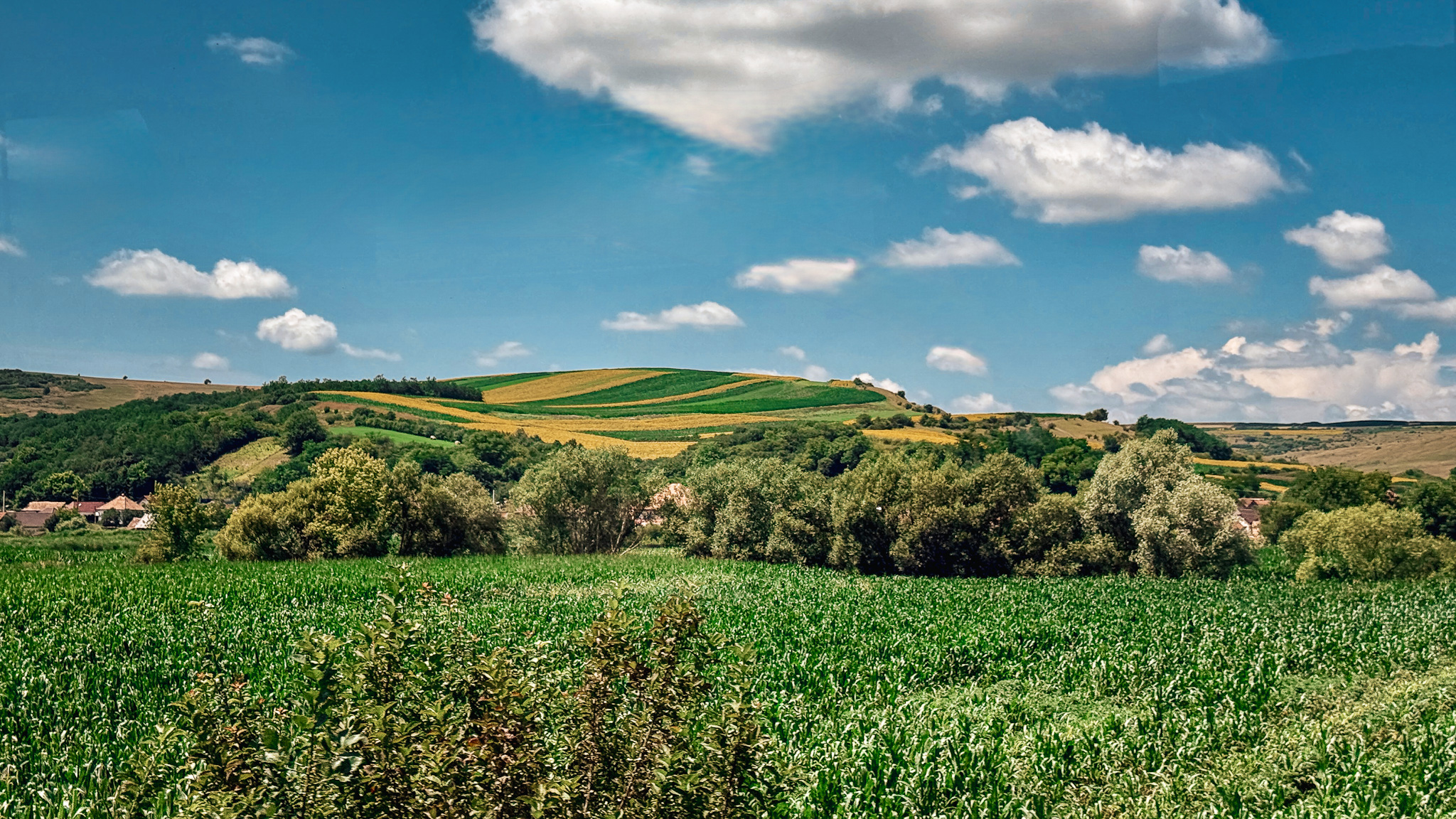
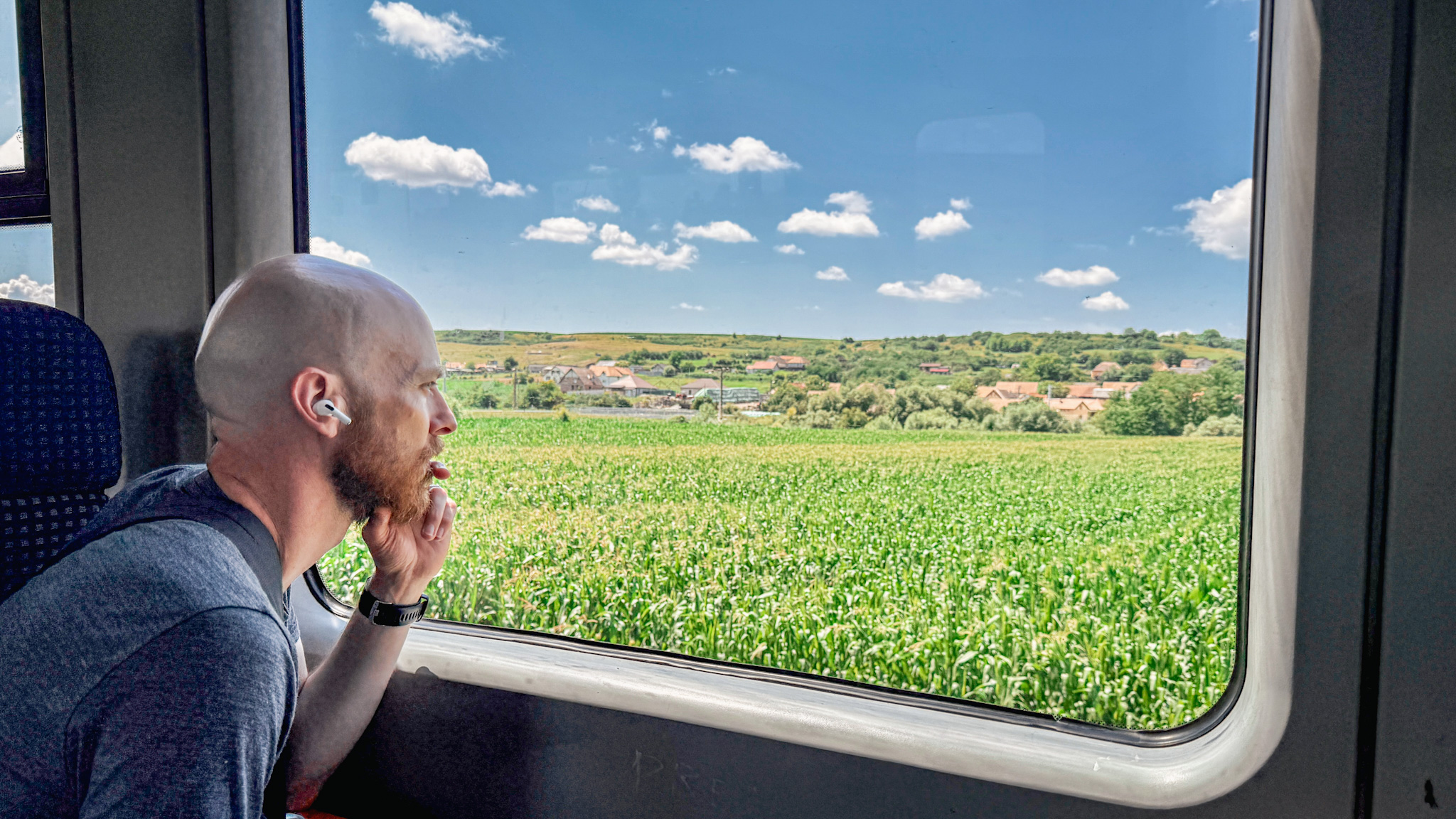
Then it was on to Sibiu by train, though we very nearly weren’t. At the station we met Andrea, an American from Portland by way of Huntington Beach, a tattooed, sixty-something solo traveler, teacher, and two-time Camino veteran, who listened with genuine attention for a solid thirty minutes while the girls recounted every country and major activity of the entire year. She was so engaging that we failed to notice our train sitting at the platform the whole time, and made it aboard with literal minutes to spare.
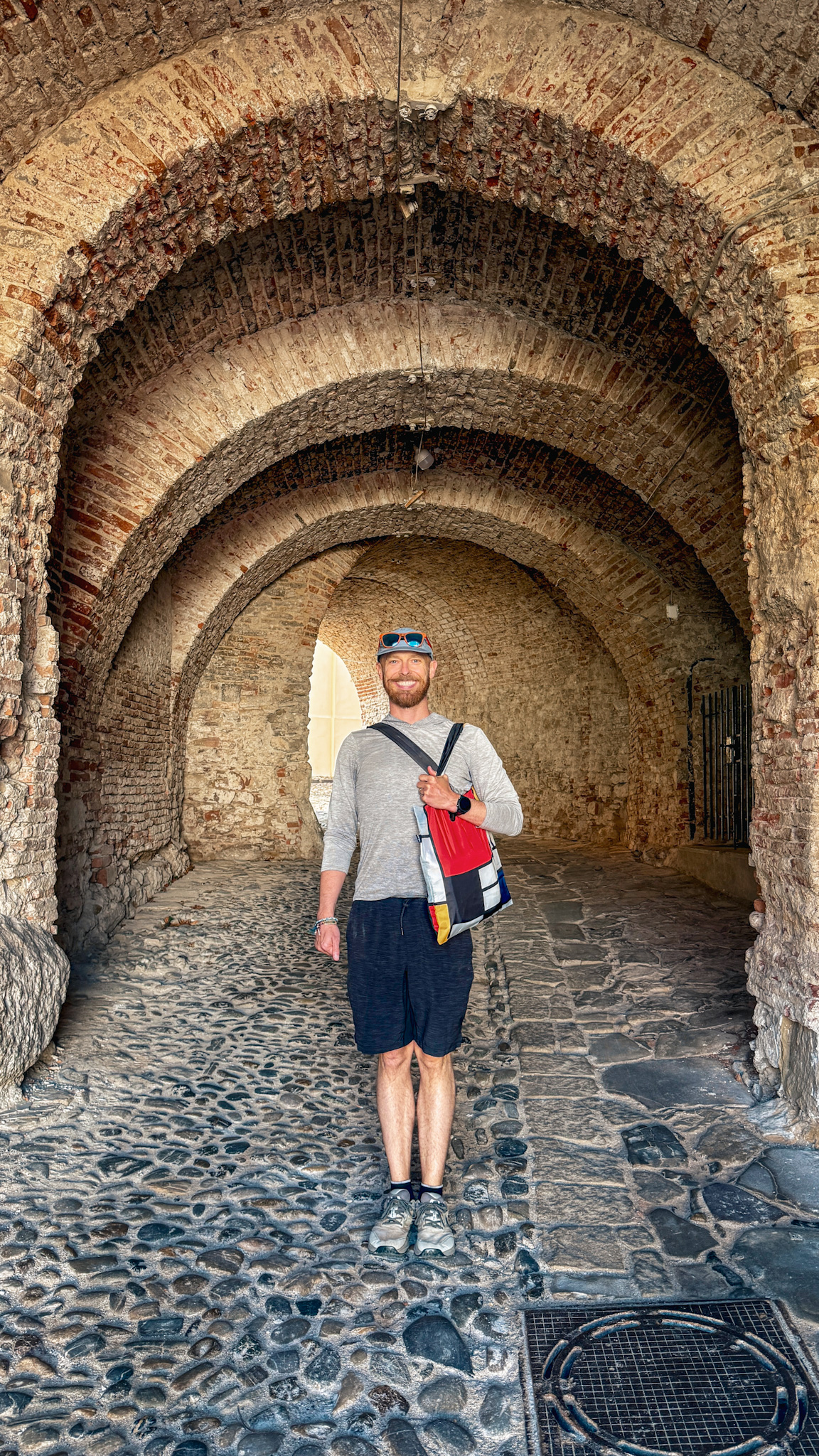
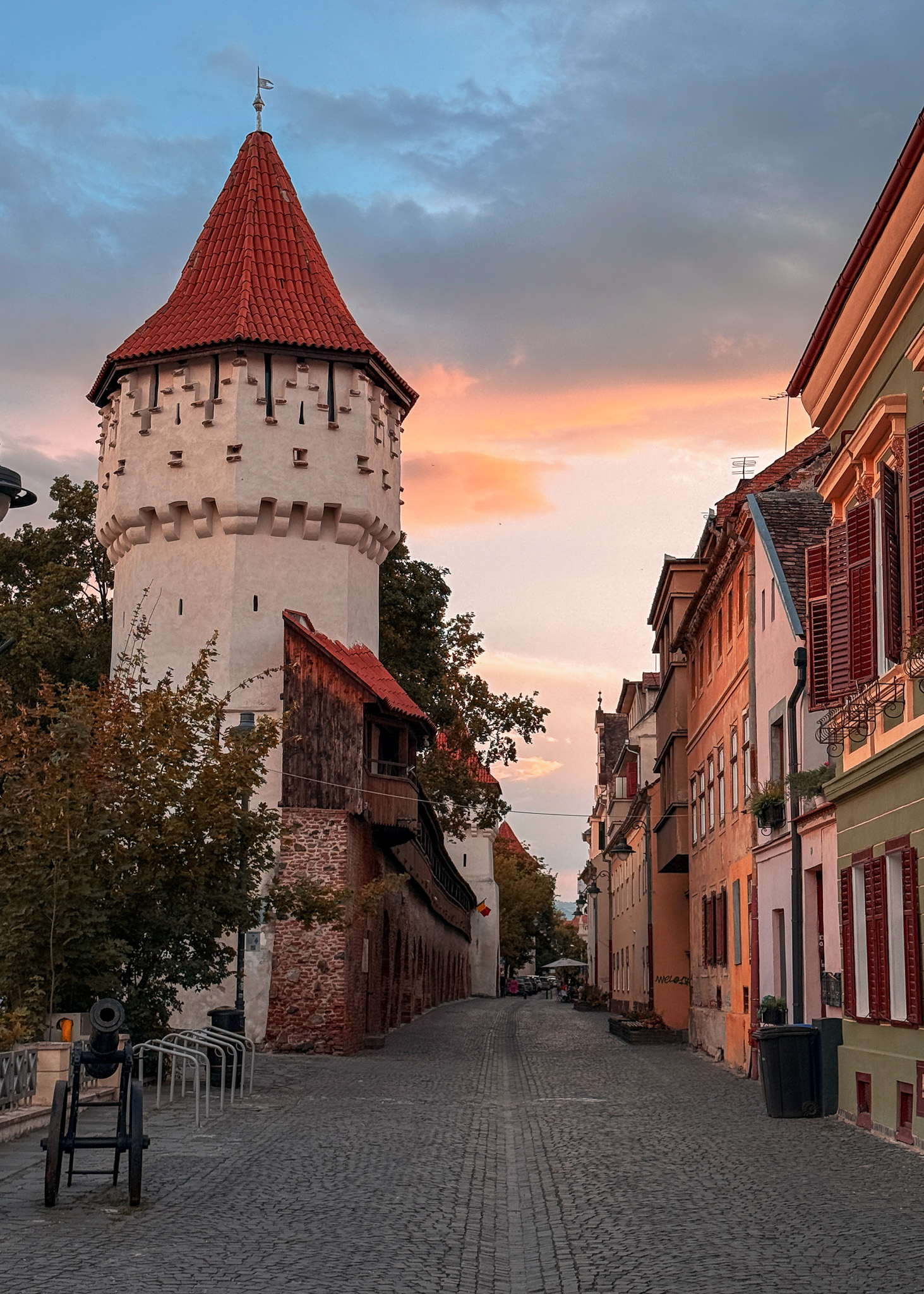
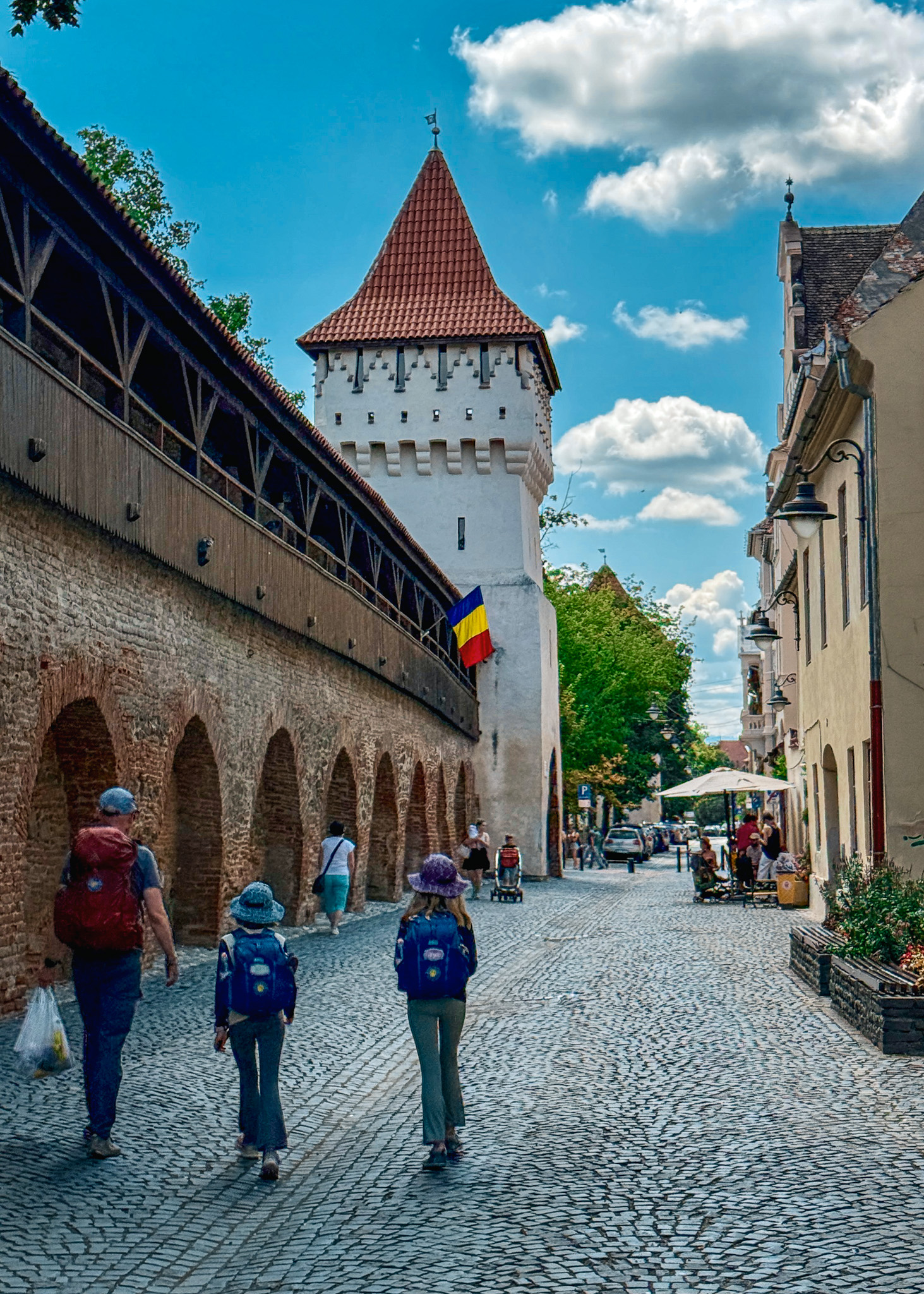
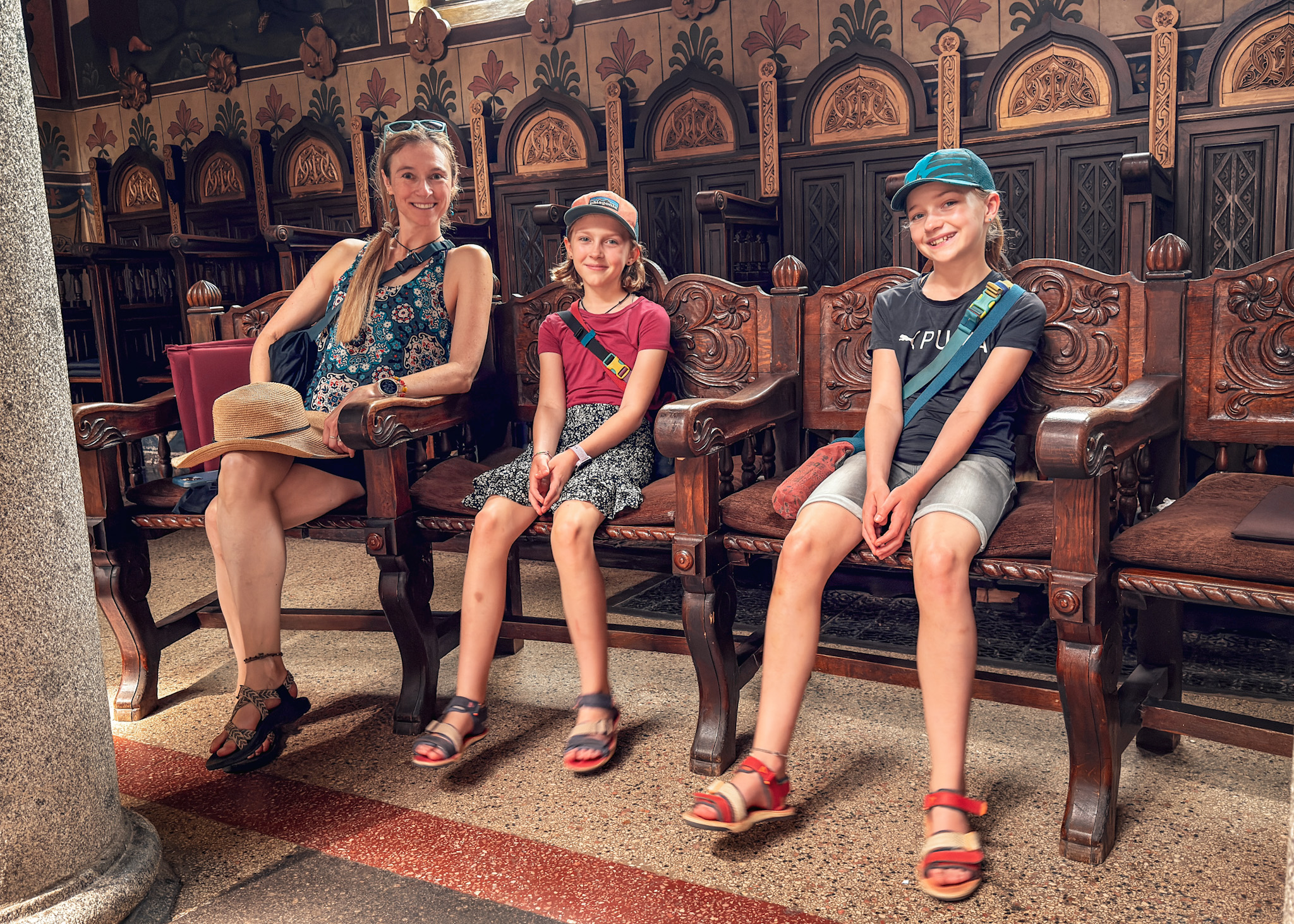
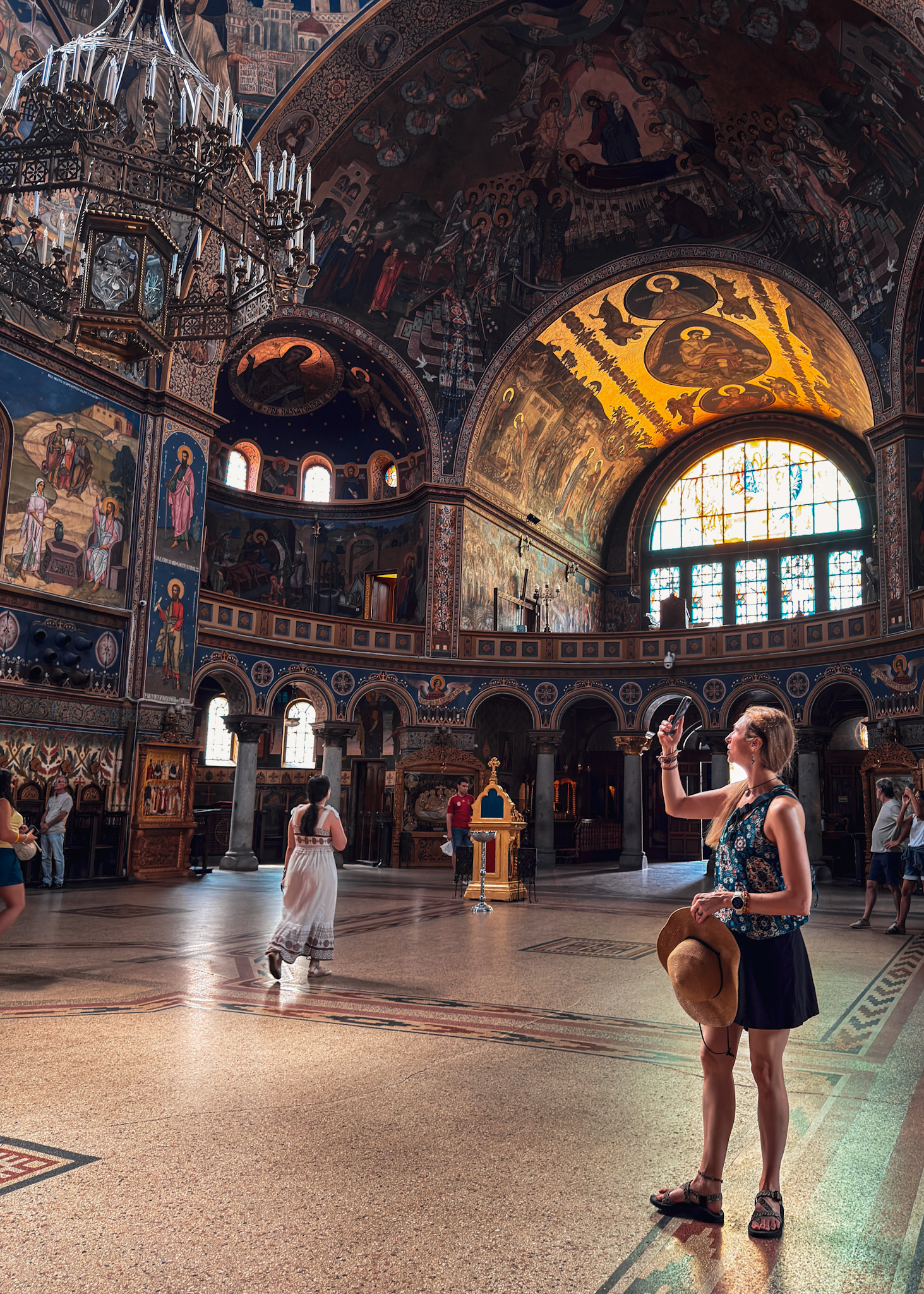
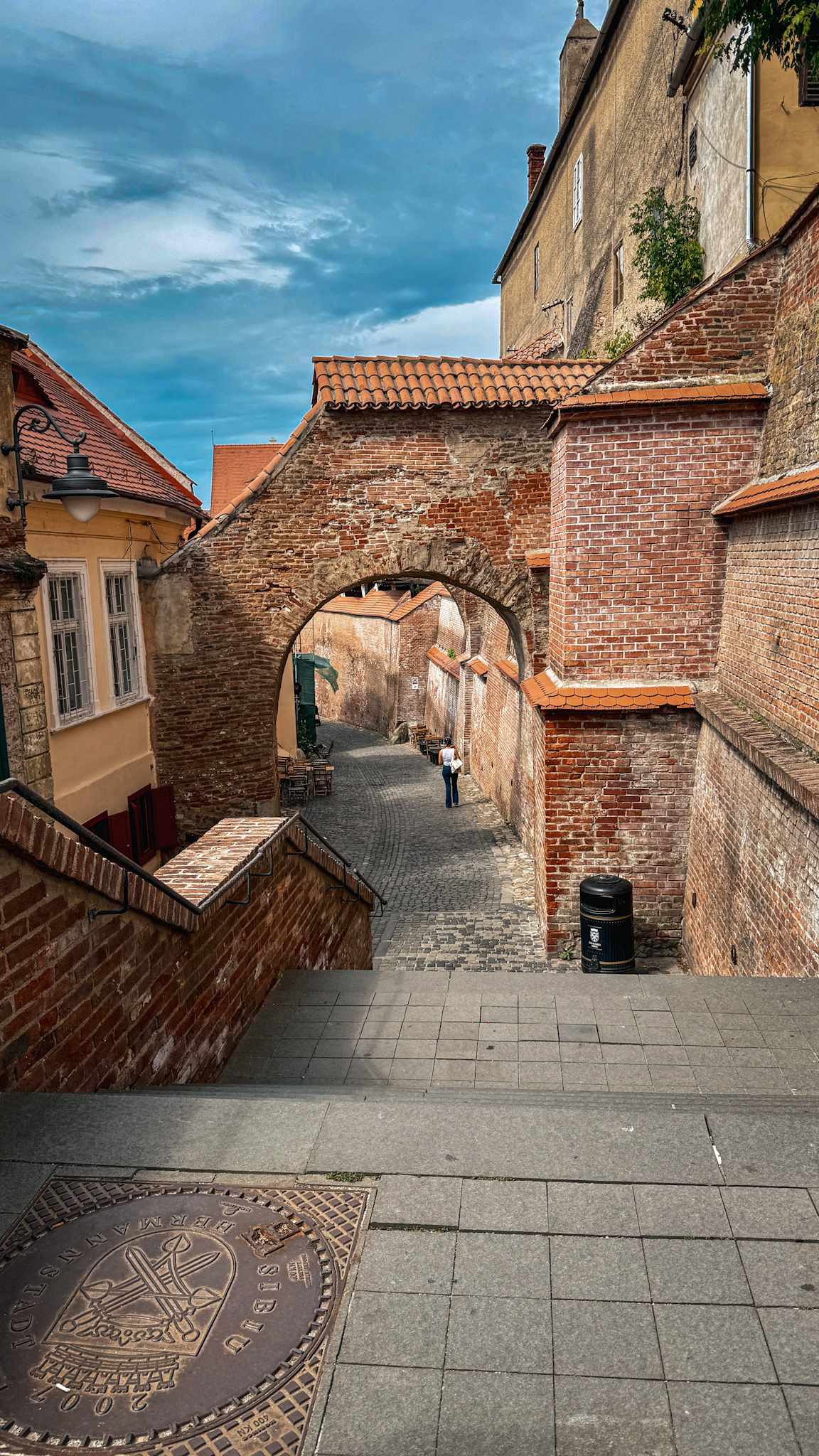
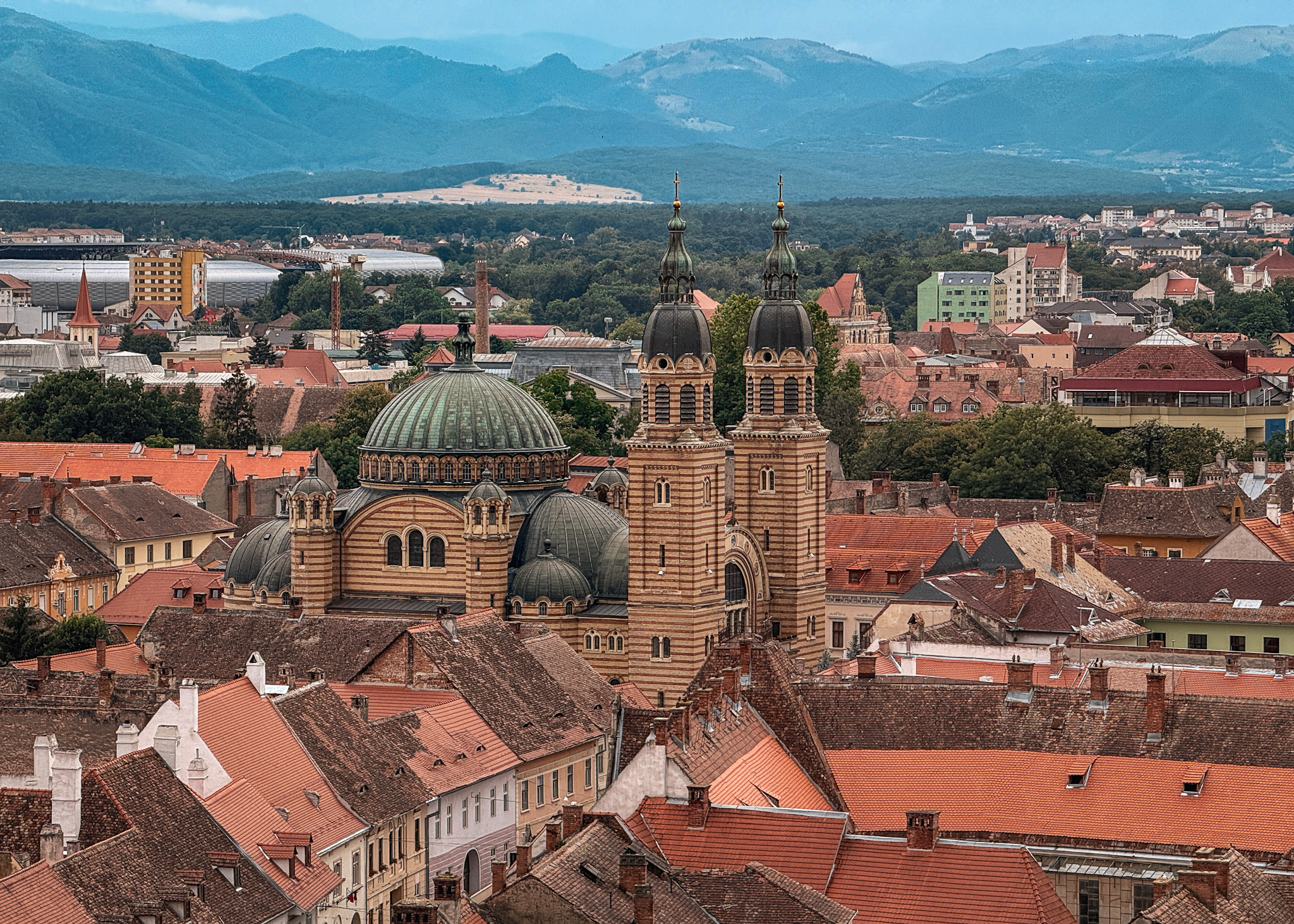
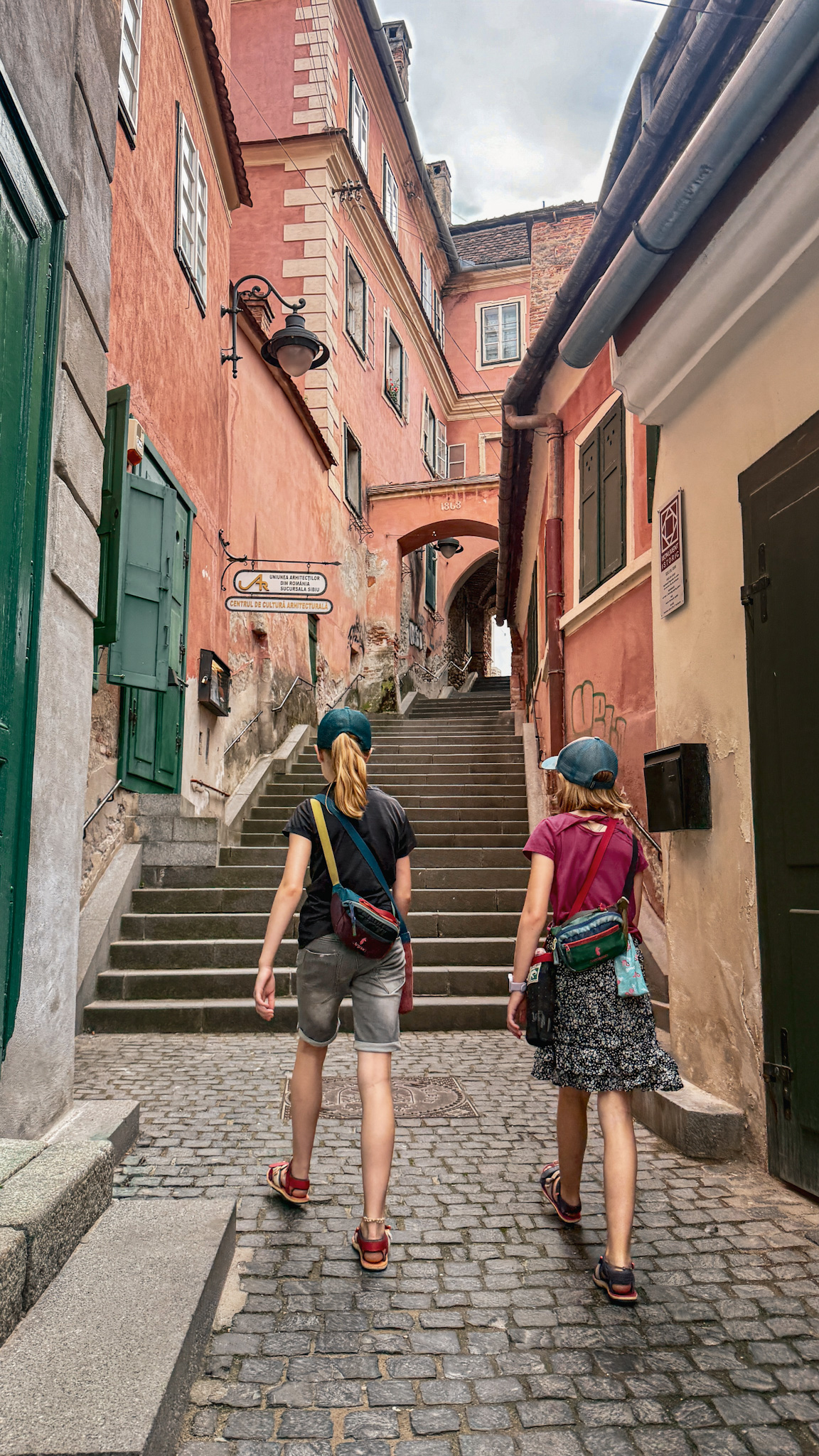
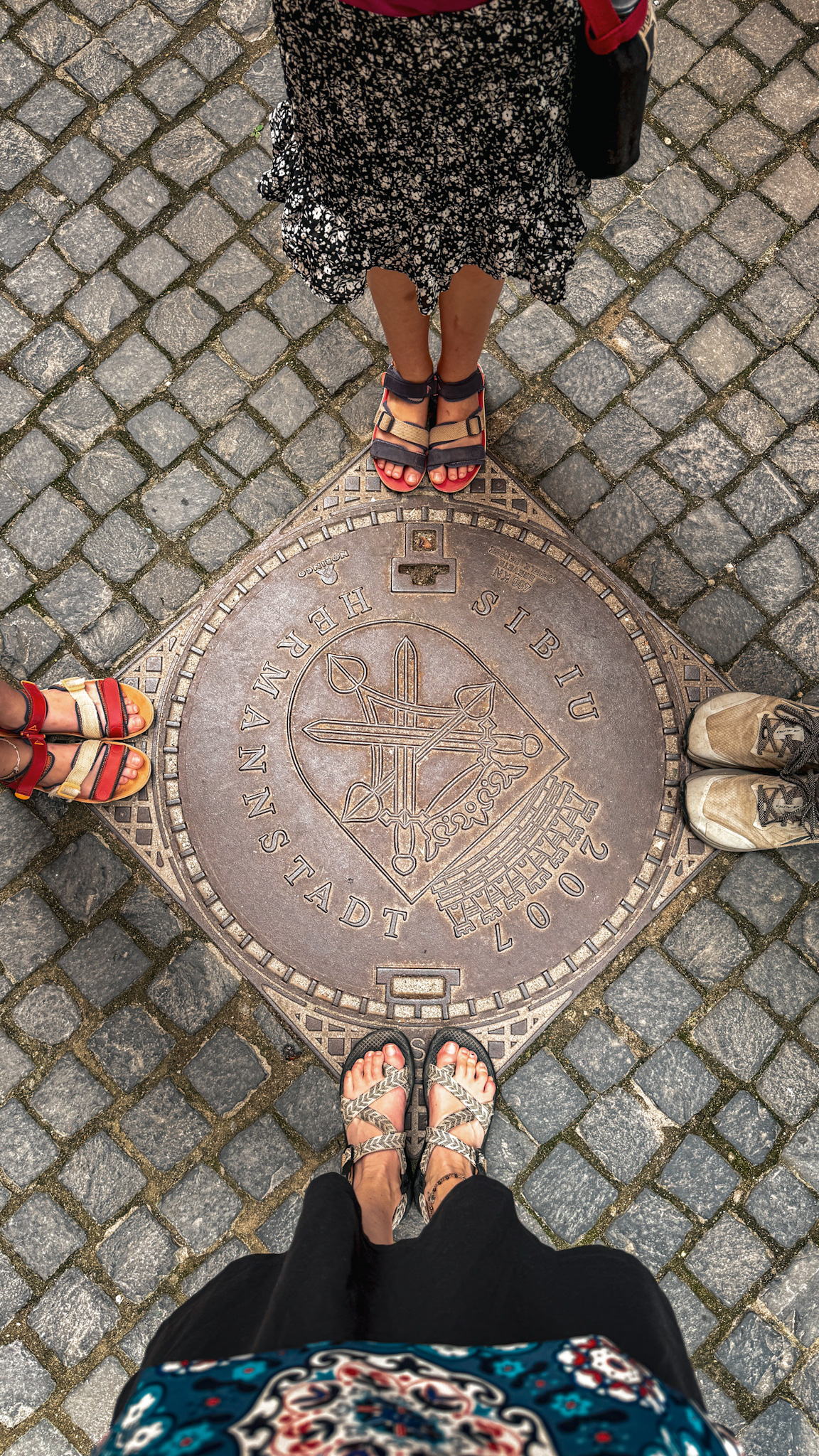
Sibiu earned its reputation quickly. Founded by German Saxon colonists in the 12th century, it grew into one of the most heavily fortified guild towns in Transylvania, and its old town is stacked with the evidence. We gave it a full day, built around a walking tour we had put together ourselves, eight stops spiraling through the city, with Max reading a narrated script at each one and quizzing the girls afterward. More on the fine art of the family walking tour in a moment, because Timișoara would test it. Sibiu’s version went down easy. We walked the surviving stretch of the old defensive walls, where each trade’s guild maintained and defended its own tower—a medieval example of “teamwork makes the dream work”—one of our family mantras on this trip. We stepped into the Holy Trinity Orthodox Cathedral, built in the early 1900s, as the girls confidently declared aloud that “it looks like a mosque from Türkiye!” In fact, those discerning eyes were on point, as it was built as a conscious homage to the Hagia Sophia. Inside we watched the girls go quiet under a dome where every single interior surface glittered with gold mosaic and painted color. We looked down the Passage of Stairs, the medieval stepped passageway tumbling from the Upper Town to the Lower Town beneath brick archways, over a view of red rooftops that belongs on a postcard.
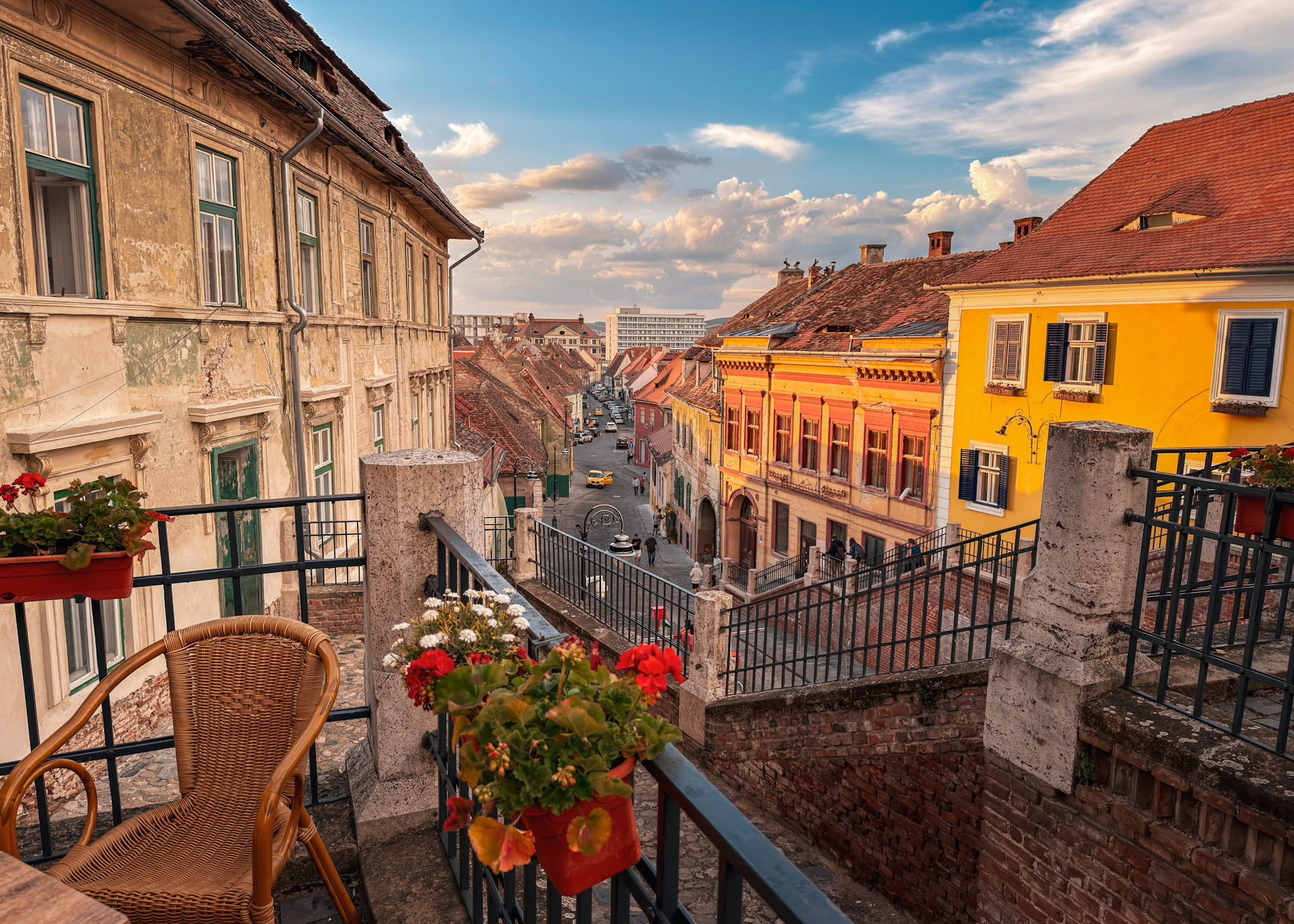
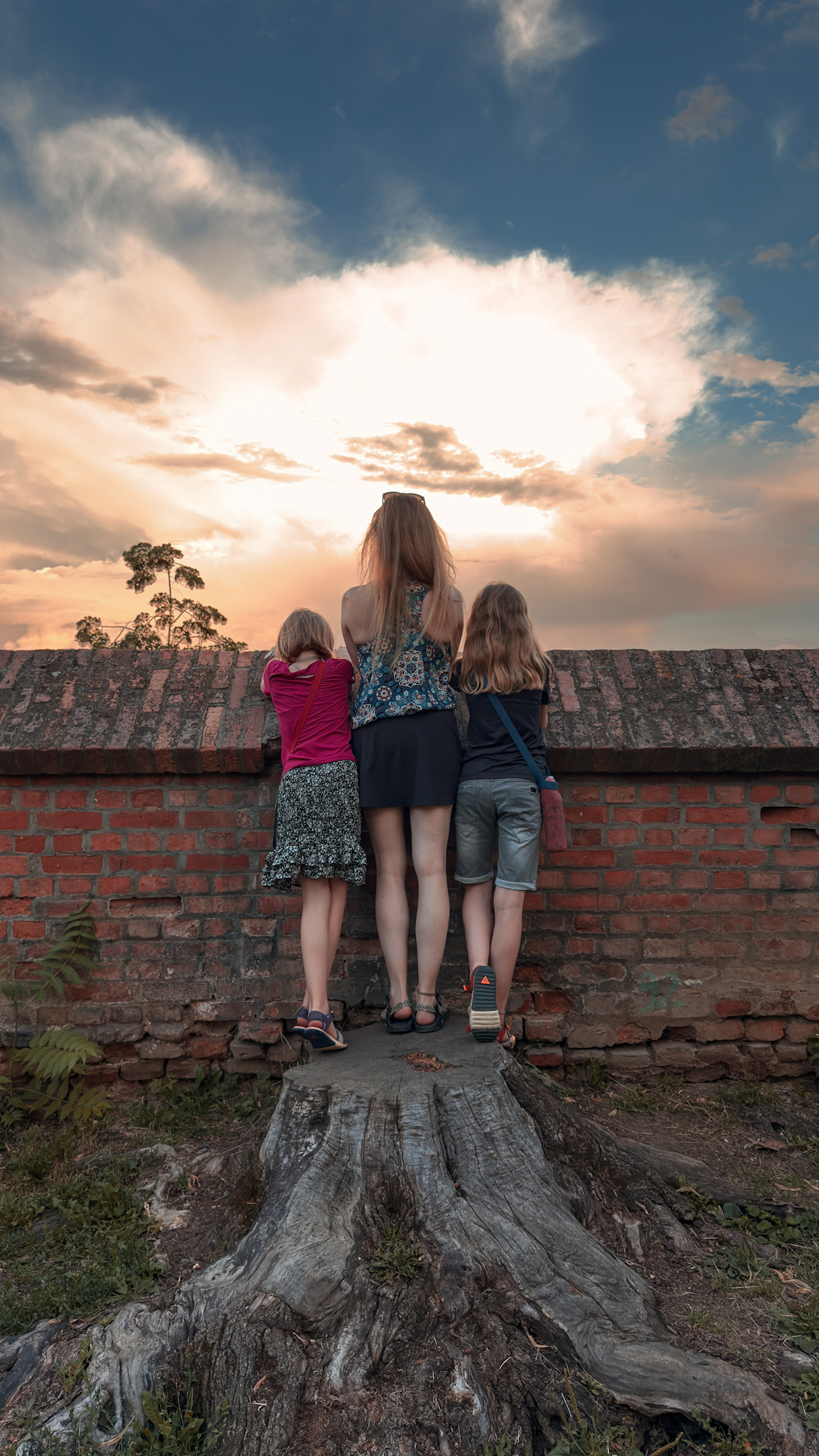
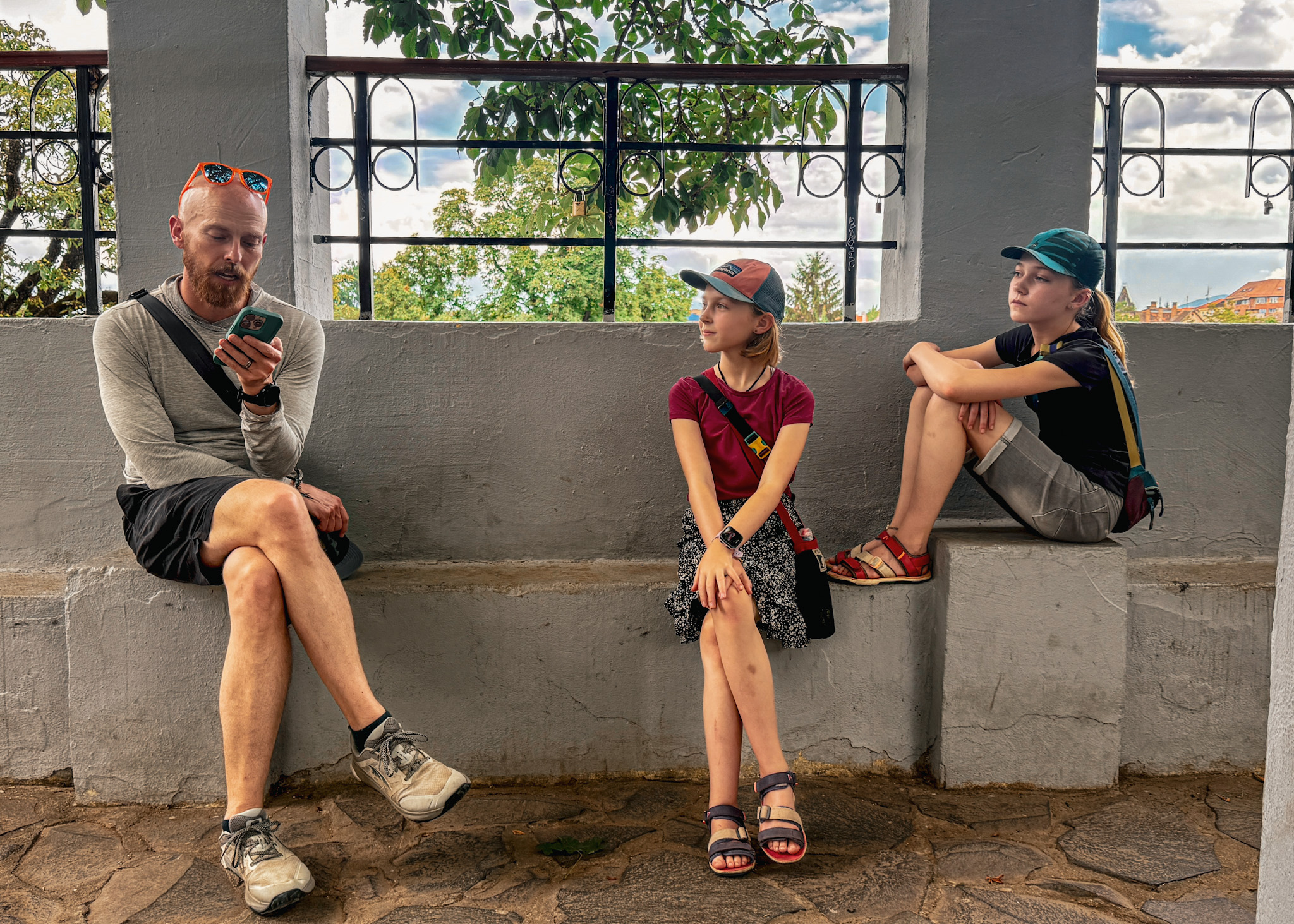
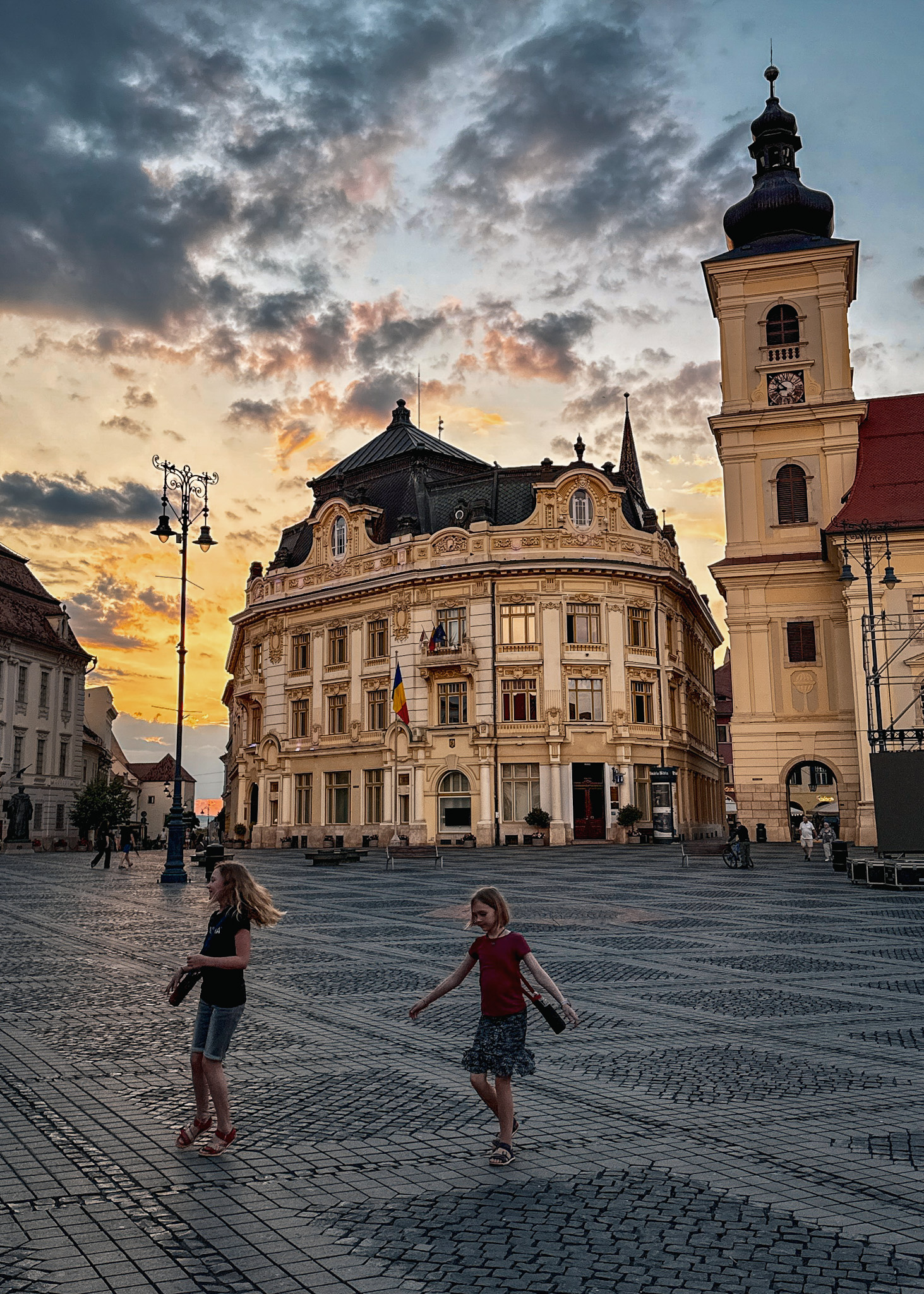
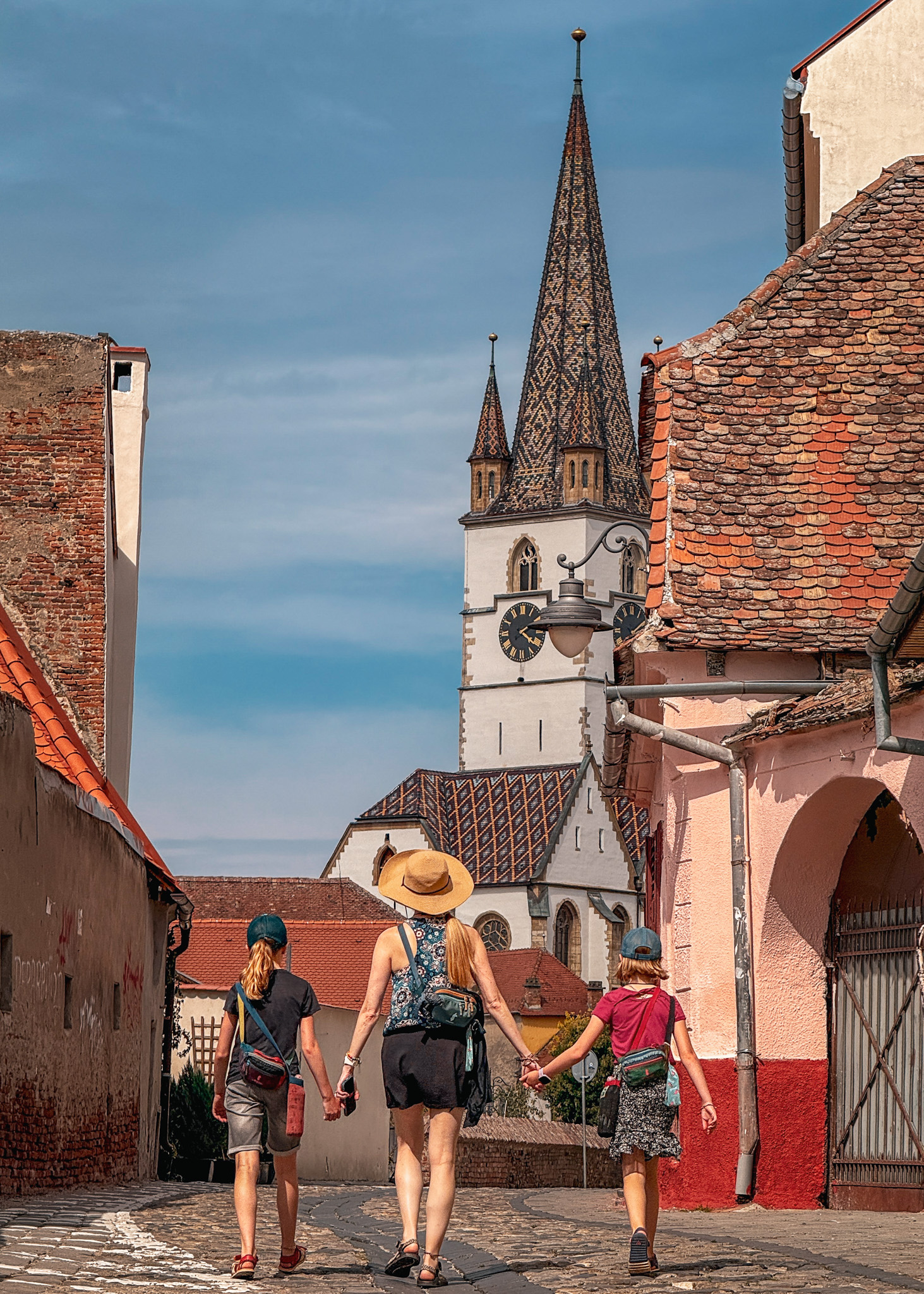
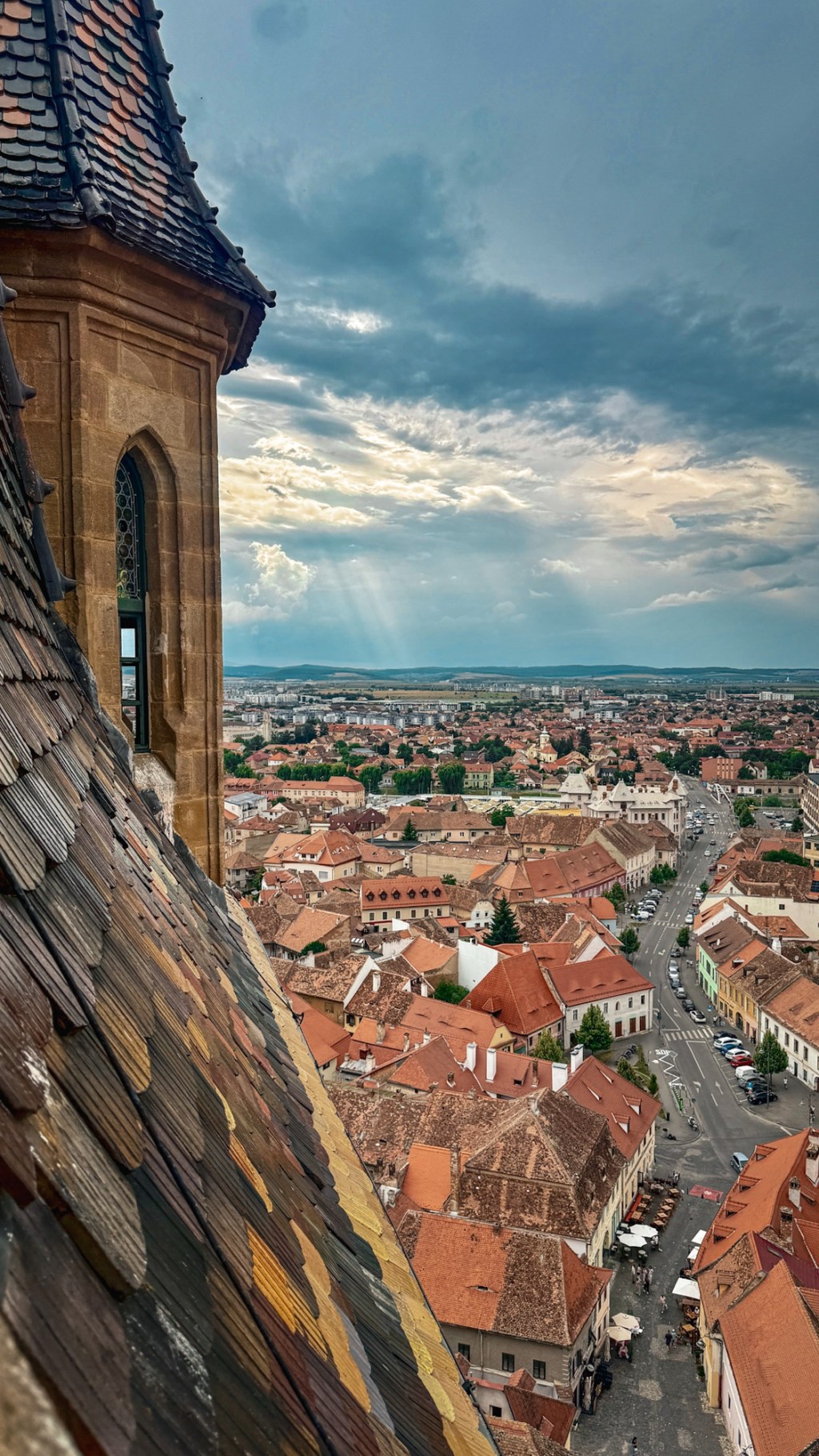
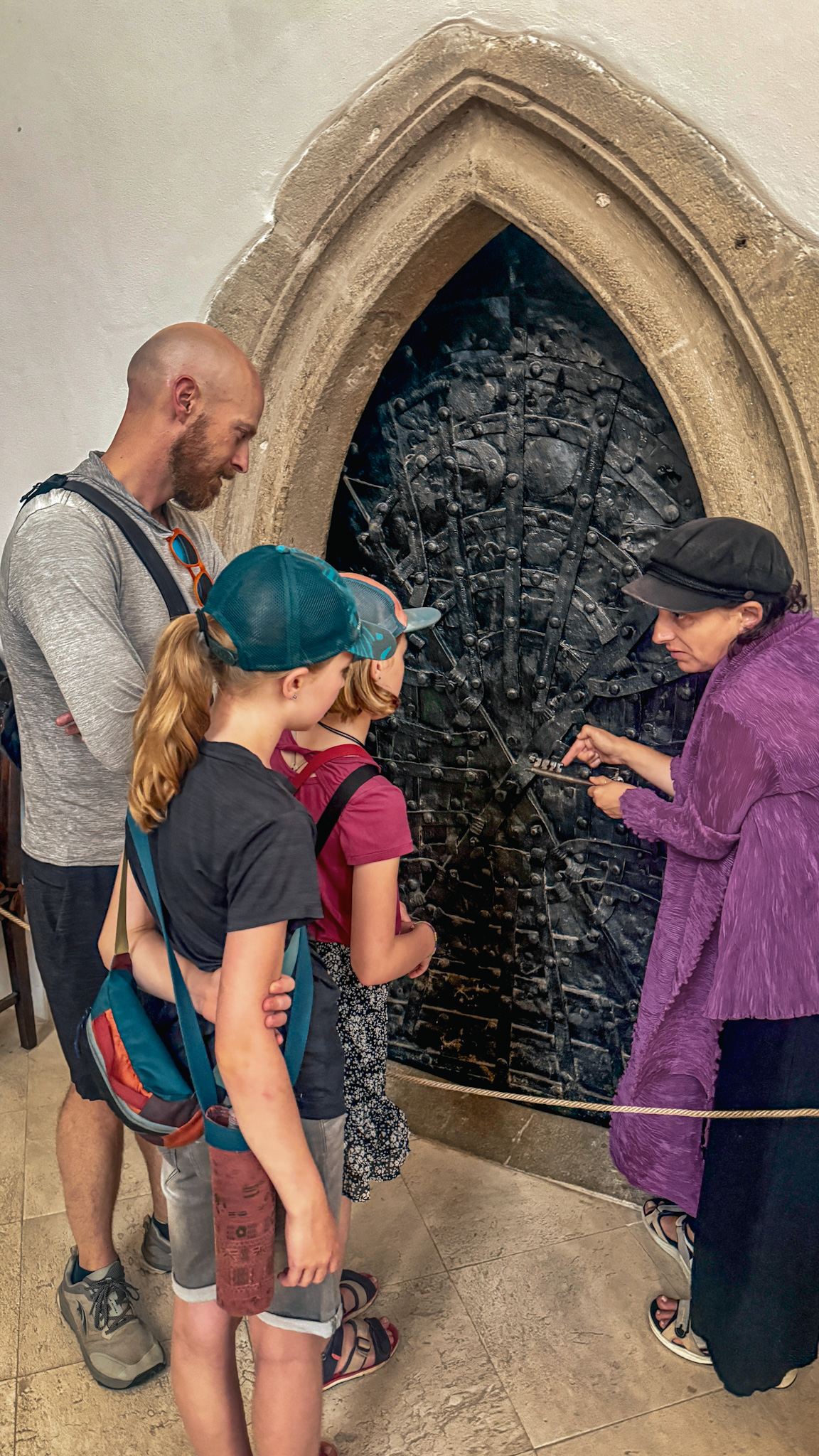
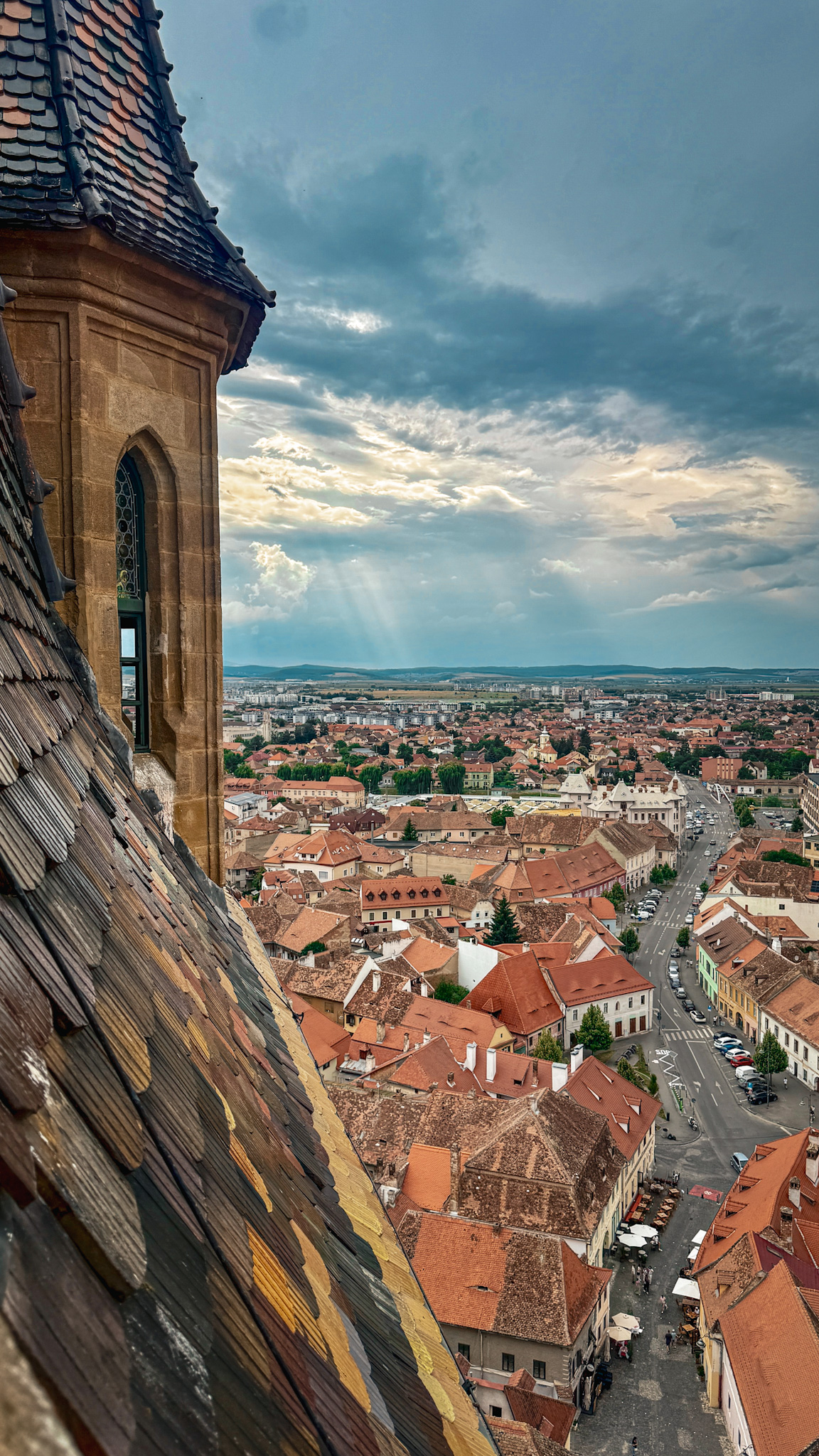
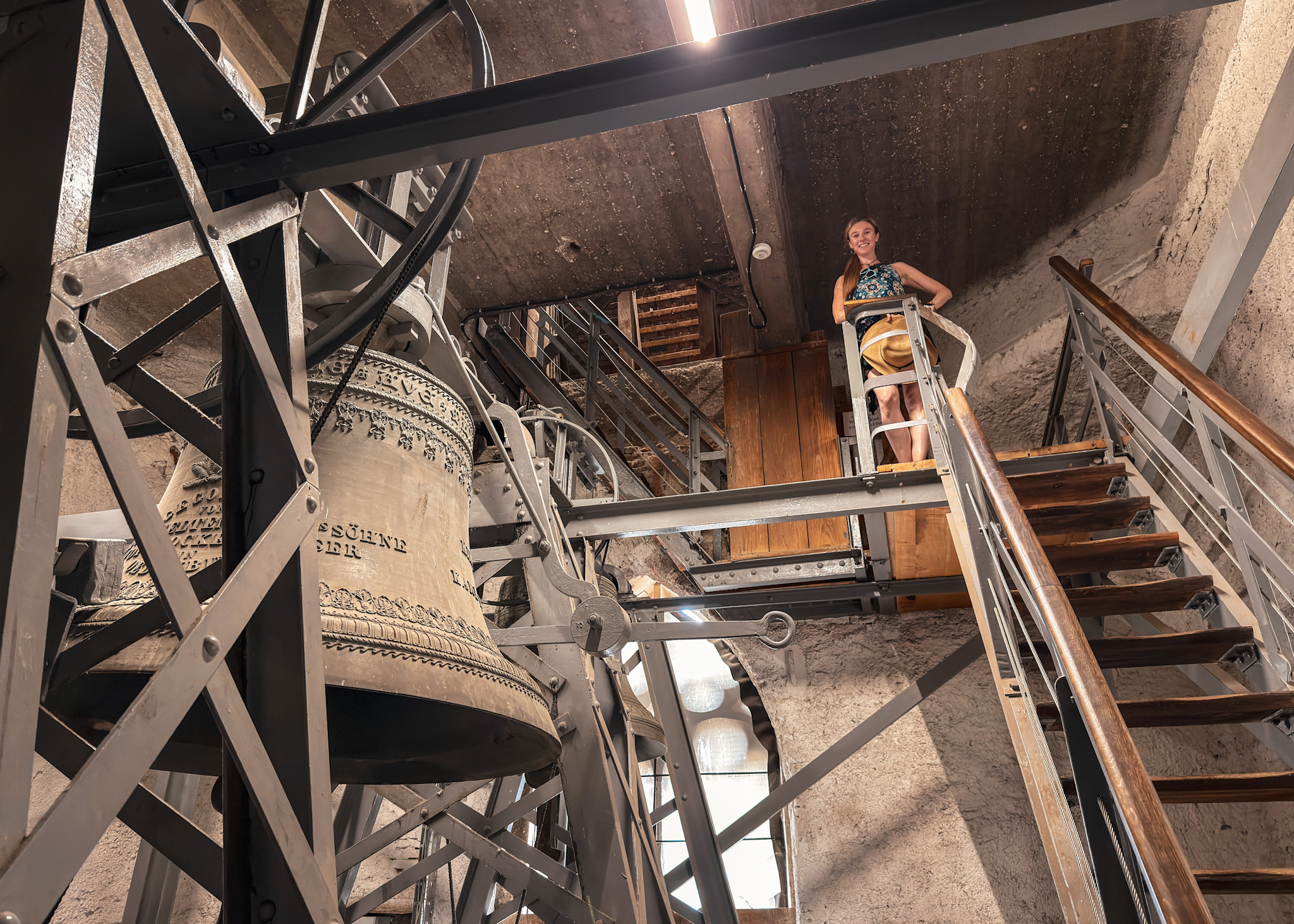
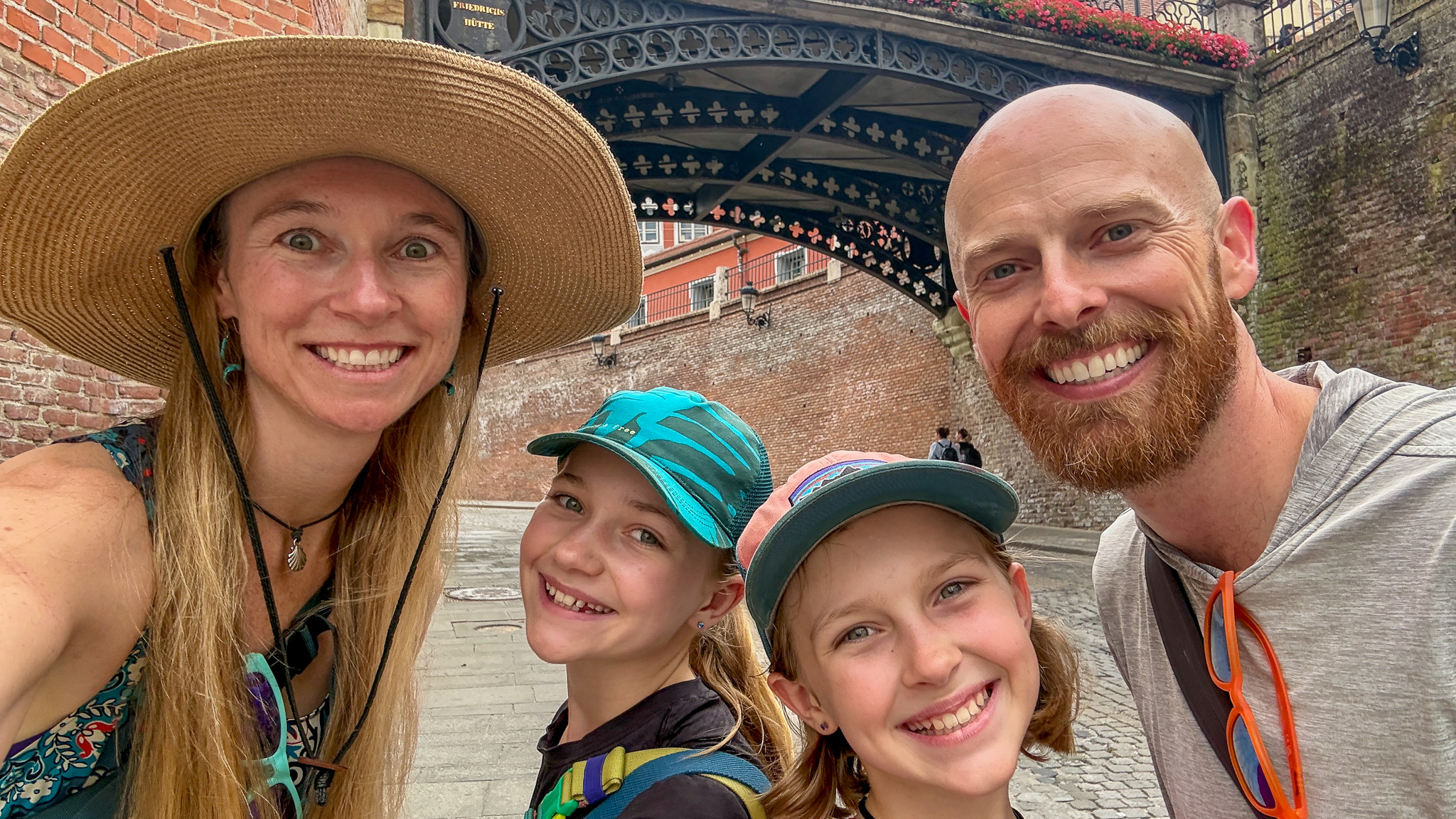
The highlight, though, was the Evangelical Cathedral, the towering Gothic Lutheran church that has presided over Sibiu’s German community for centuries. For an extra five lei each, we climbed the 220 steps of its tower, essentially unsupervised, which felt like being handed all-access passes to the building’s inner workings—the original ginormous bronze bell still in place, now defunct but still impressive due to its sheer size. We hit the top at golden hour, and the entire city glowed beneath us in every direction. On the way down we crossed the Bridge of Lies, Sibiu’s famous cast-iron footbridge from 1859, the oldest of its kind in Romania, said to creak or outright collapse if anyone standing on it tells a lie. This little tidbit, of course, has made it a favorite testing ground for nervous merchants and unfaithful lovers for a century and a half. We each tested it. It held every time. Draw your own conclusions.
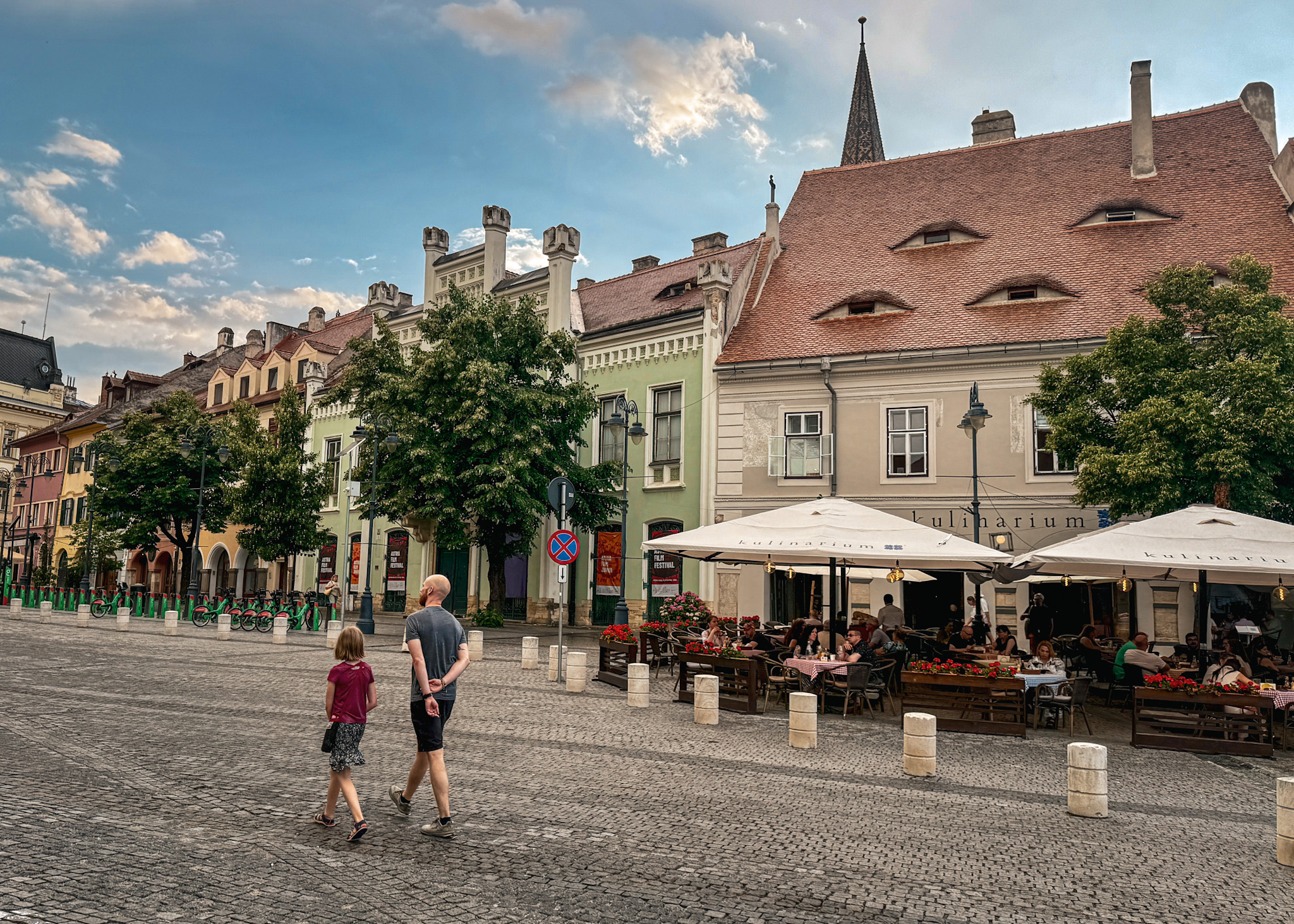
We finished in the grand Piața Mare beneath the iconic “eyes of Sibiu,” the hooded, eyelid-shaped attic windows that peer down from rooftops all over town, and walked ourselves conveniently into dinner at a restaurant whose entire concept was schnitzel. The girls had somehow never had schnitzel, and since it is essentially deep-fried breaded chicken, the outcome was never in doubt. Meanwhile the World Cup wound itself toward its ending in the background of these days: Spain dispatched France 2-0 with complete control, to Arya’s heartbreak, and Argentina survived a dismal first half against England to win 2-1, which means the final will be Spain against Argentina. We knew that if both teams showed up as their true selves, it would be something special, and we couldn’t wait to watch.
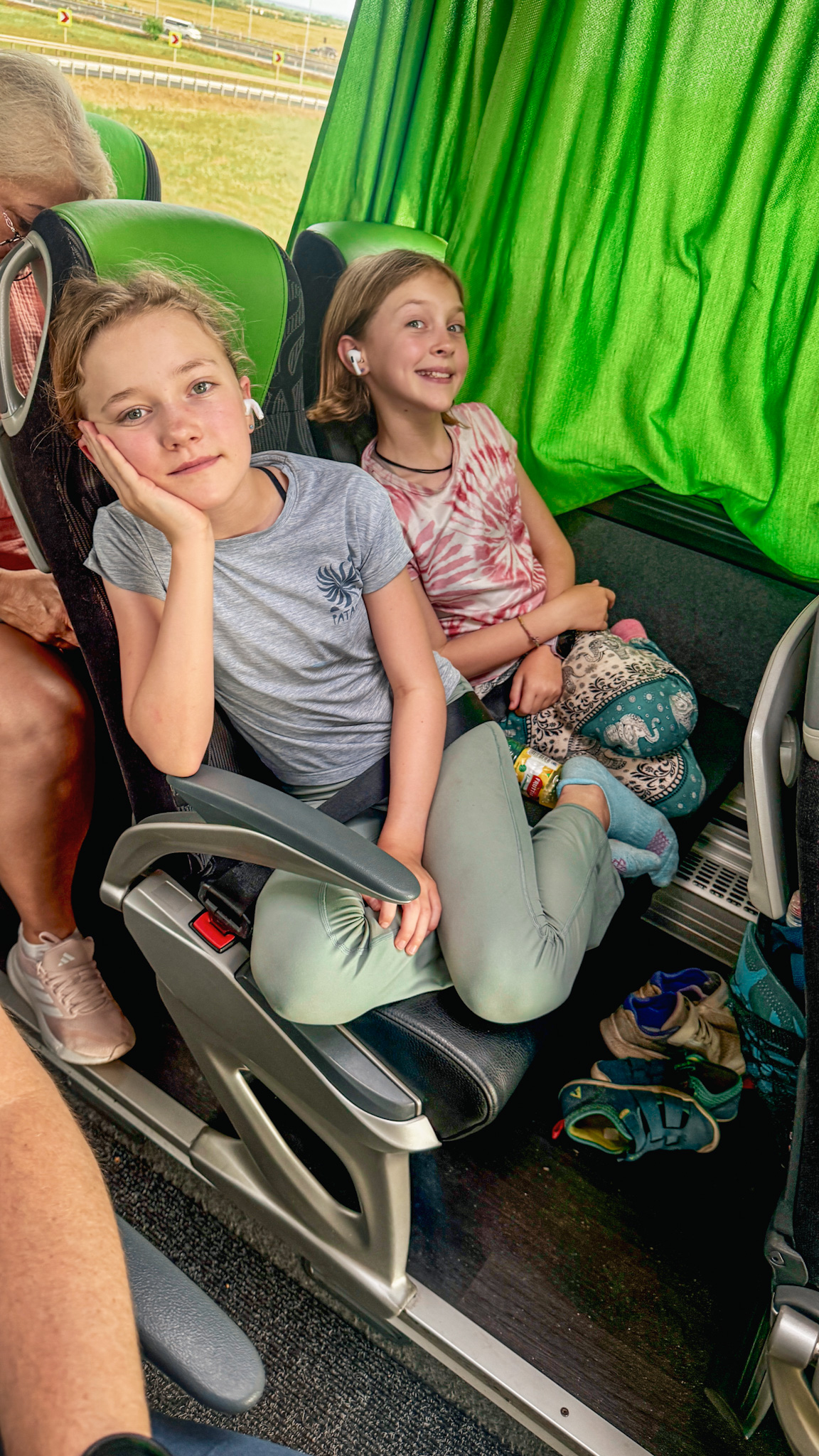
The trip from Sibiu to Timișoara was a travel day with a sense of humor. Lunch featured the saddest, most pathetic french fries any of us has ever encountered, abandoned after three bites, a near-never-event in our girls lives. Then the bus, when it finally arrived ninety minutes late, turned out to be clean, comfortable, modern, and entirely without functioning air conditioning on a 90-degree afternoon. A rolling sauna. For four hours we read, sweated, and pressed on with our family audiobook, and rolled into Timișoara as Alex and his friends escaped the cavern of the Traveler. This will mean nothing to you unless you are also deep into the fantasy book Mark of the Fool, in which case you understand the stakes completely.
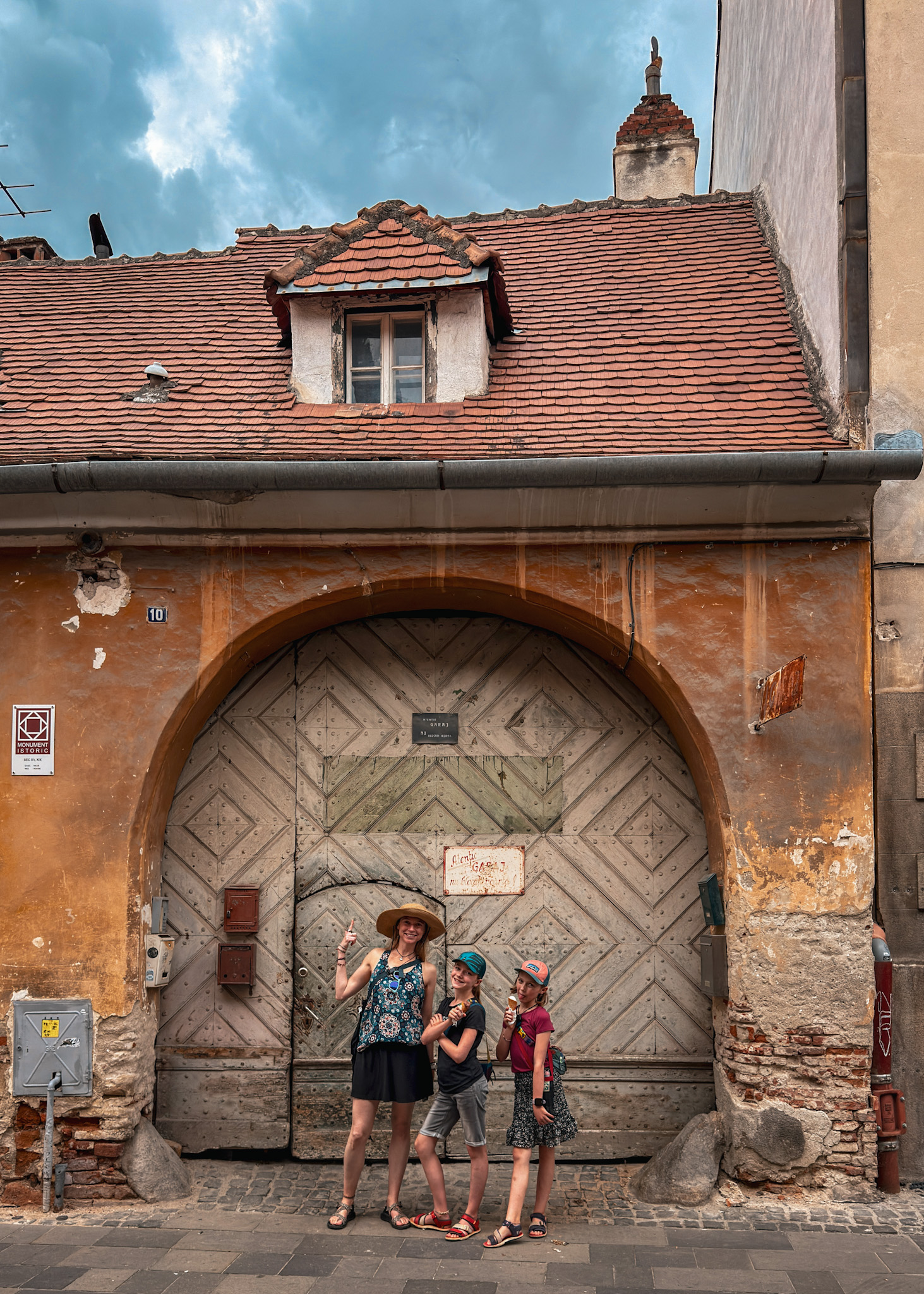
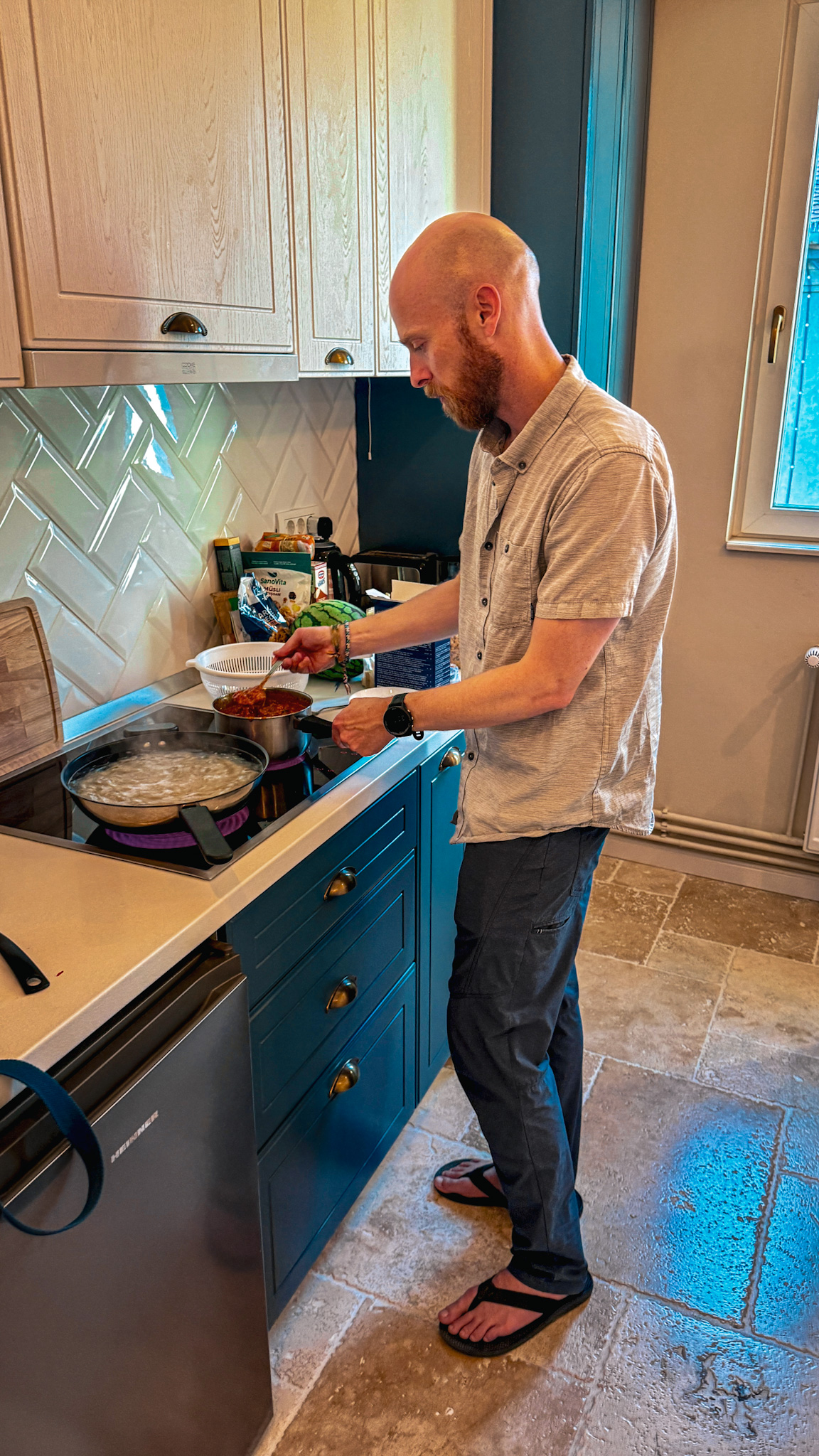
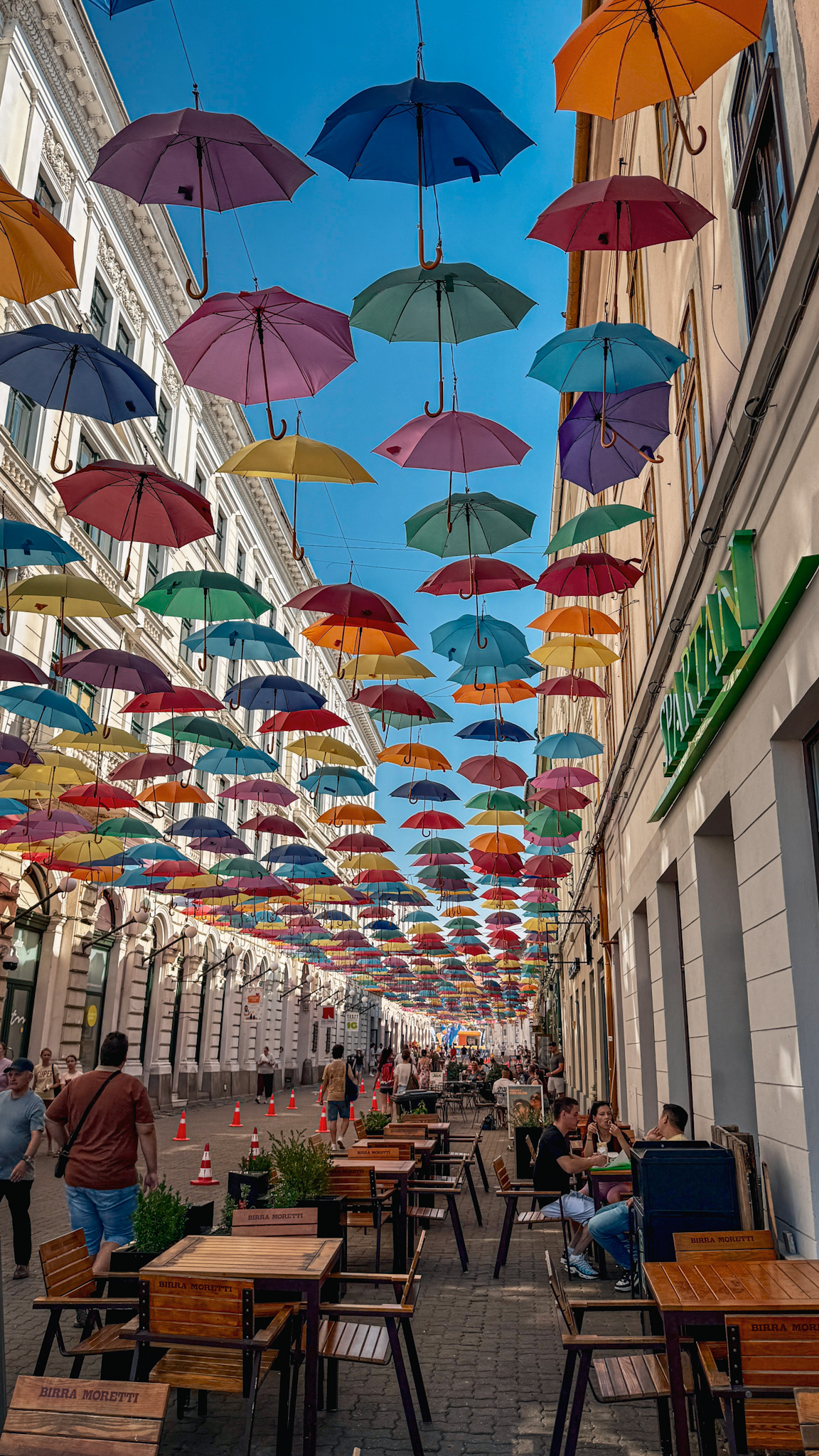
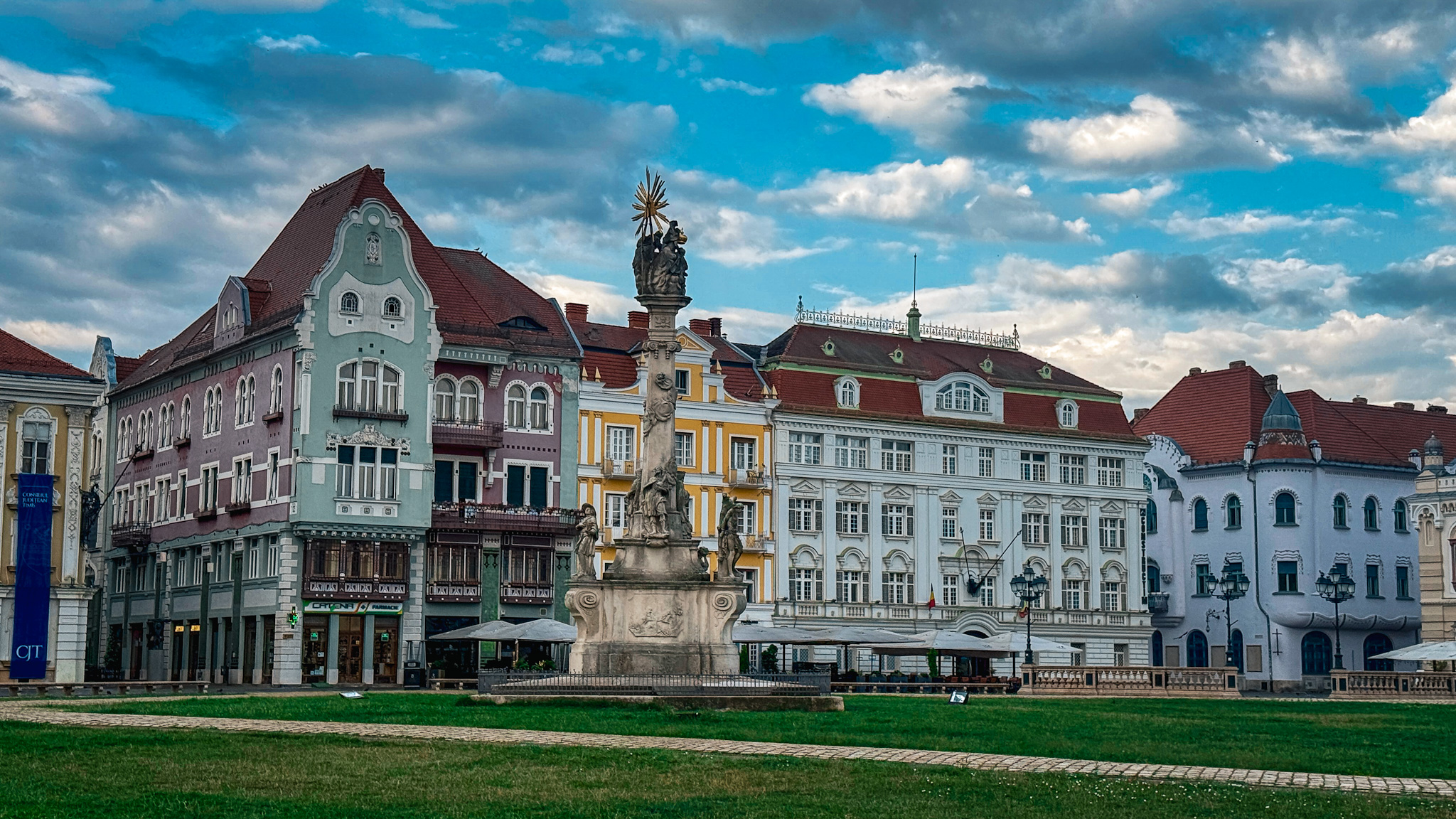
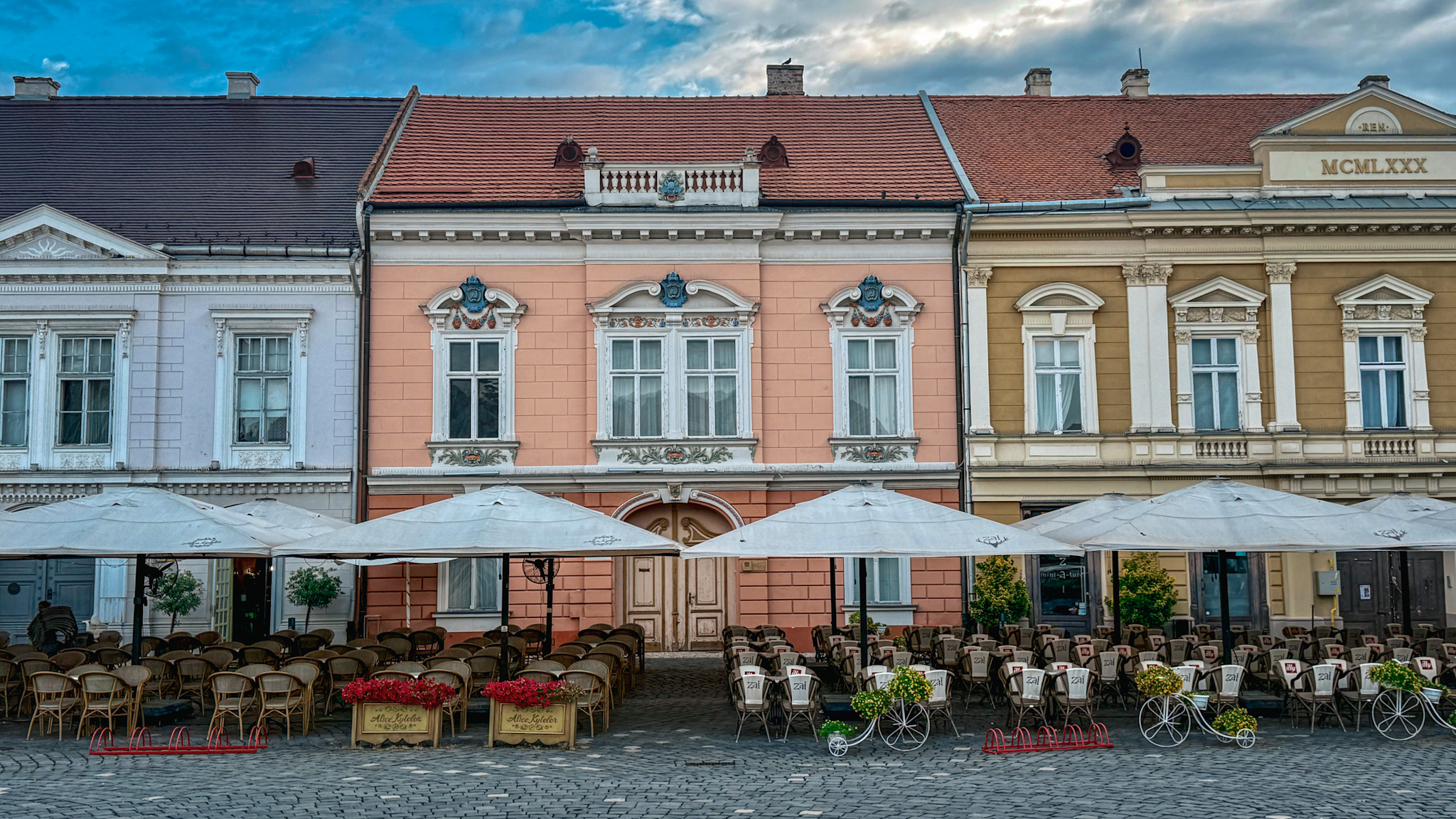
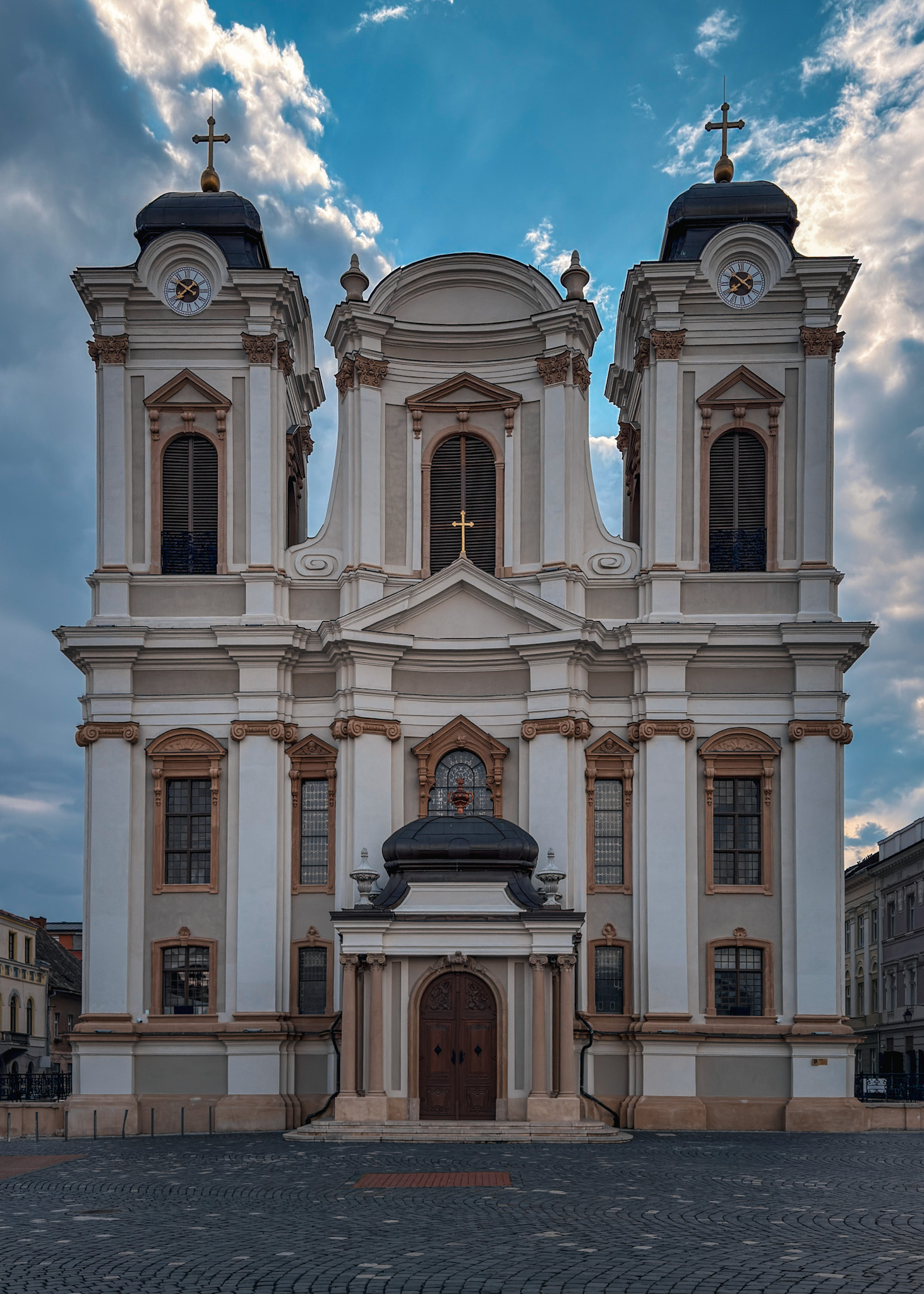
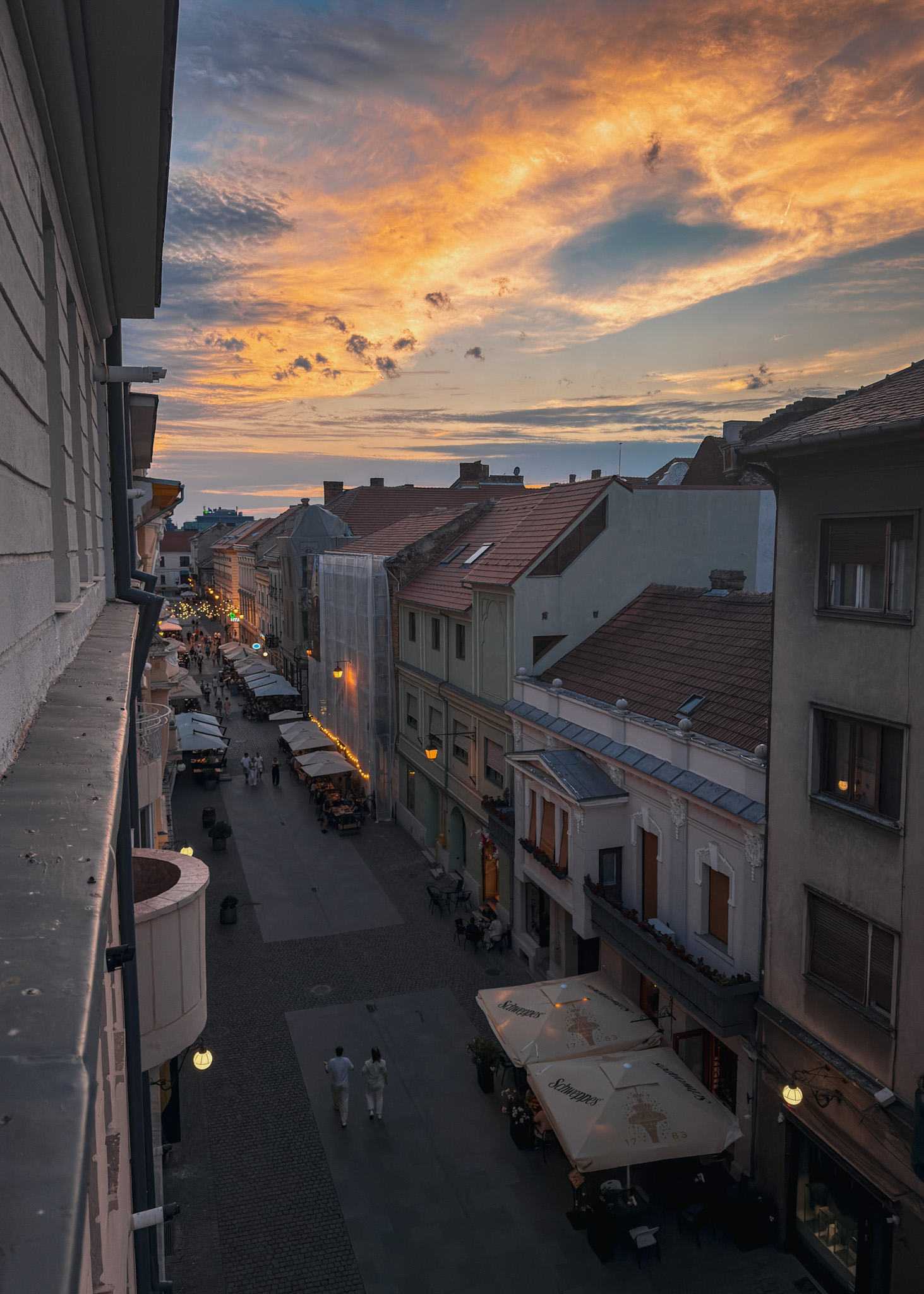
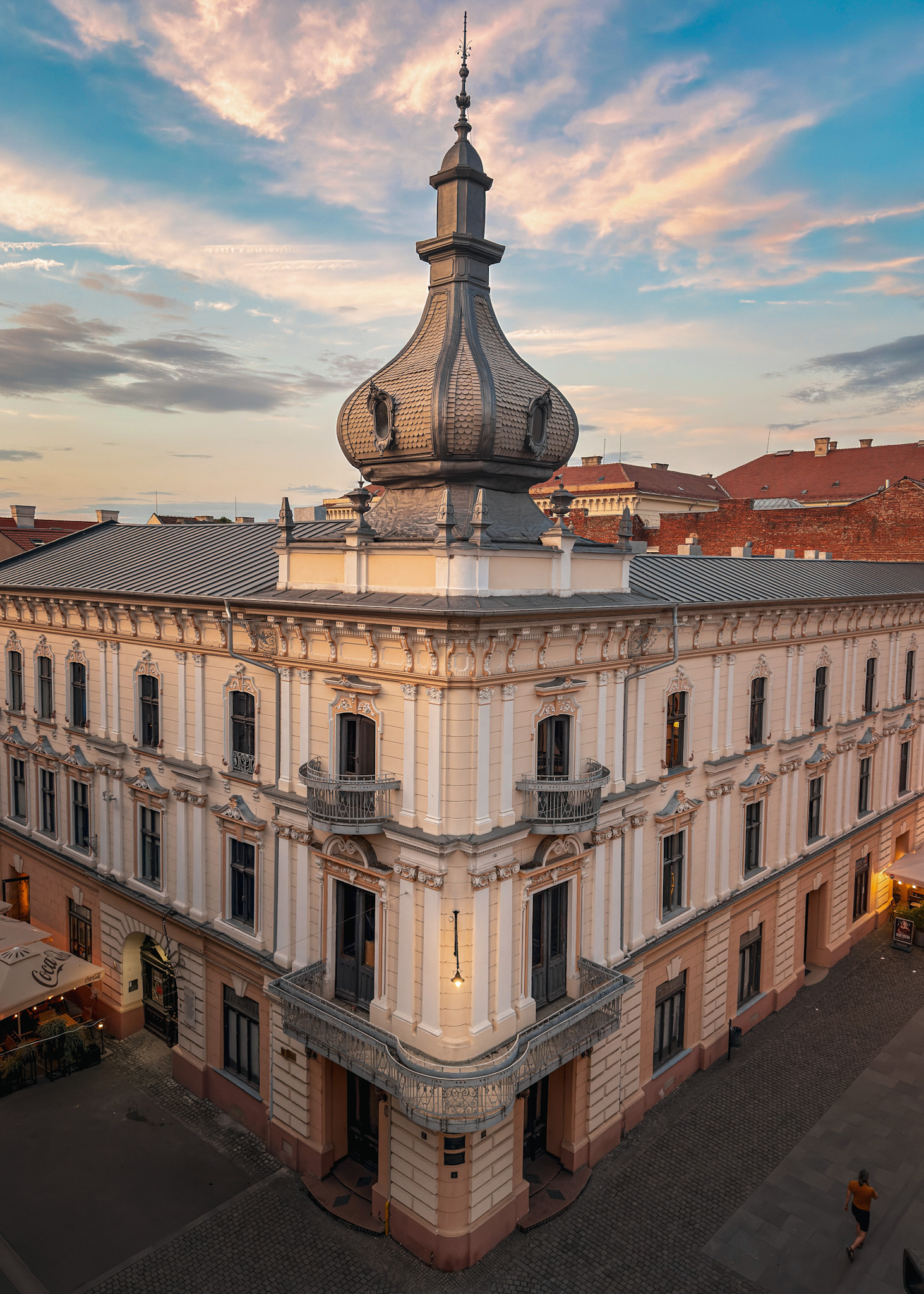
Timișoara won us over almost immediately. The historic center is a knot of cobblestones, tile roofs, and French-looking façades, and most of the streets in our quarter are pedestrian-only, which makes wandering a genuine pleasure rather than an exercise in not being run over. Our fourth-floor 72-stair climb thankfully had AC in the bedrooms, a washing machine, and a kitchen good enough for Max to manage. And on arrival he immediately got to work—a Bolognese built on zacuscă, the beloved Romanian spread of roasted eggplant, peppers, and tomatoes, extended with marinara and meatballs and simmered down into something hearty and delicious. The evening errand was charmingly analog. We wanted to see Christopher Nolan’s brand-new film The Odyssey on opening day, but buying tickets on an all-Romanian website felt like a gamble we’d lost once before, so we walked the kilometer and a half to the theater and bought them in person, at the counter, like it was 1995. Four tickets, 2 p.m. the next day, confirmed to be in English. Done and done.
The movie day came with homework. In the morning, while Shaina and Max exercised and walked at the park, the girls stayed back and studied a condensed version of Homer’s Odyssey, and over breakfast we quizzed them on it. Then when the lights went down in the theater they would actually know who Odysseus, Penelope, and the suitors were. It paid off completely. Nolan told the story in his usual fractured, time-jumping style, with an enormous budget, IMAX cameras, and a cast list like an awards-show seating chart—Matt Damon anchoring it as Odysseus, and the girls tracked every timeline jump without a wobble. We hate to give spoilers, but the man did eventually make it home to Penelope. It was also, not coincidentally, the day our family re-entry program officially began: early bedtimes, deliberately practiced, so that the school-and-work mornings waiting on the other side of this trip won’t hit like a truck. Going to bed at a reasonable hour in July so that August doesn’t hurt. As much.
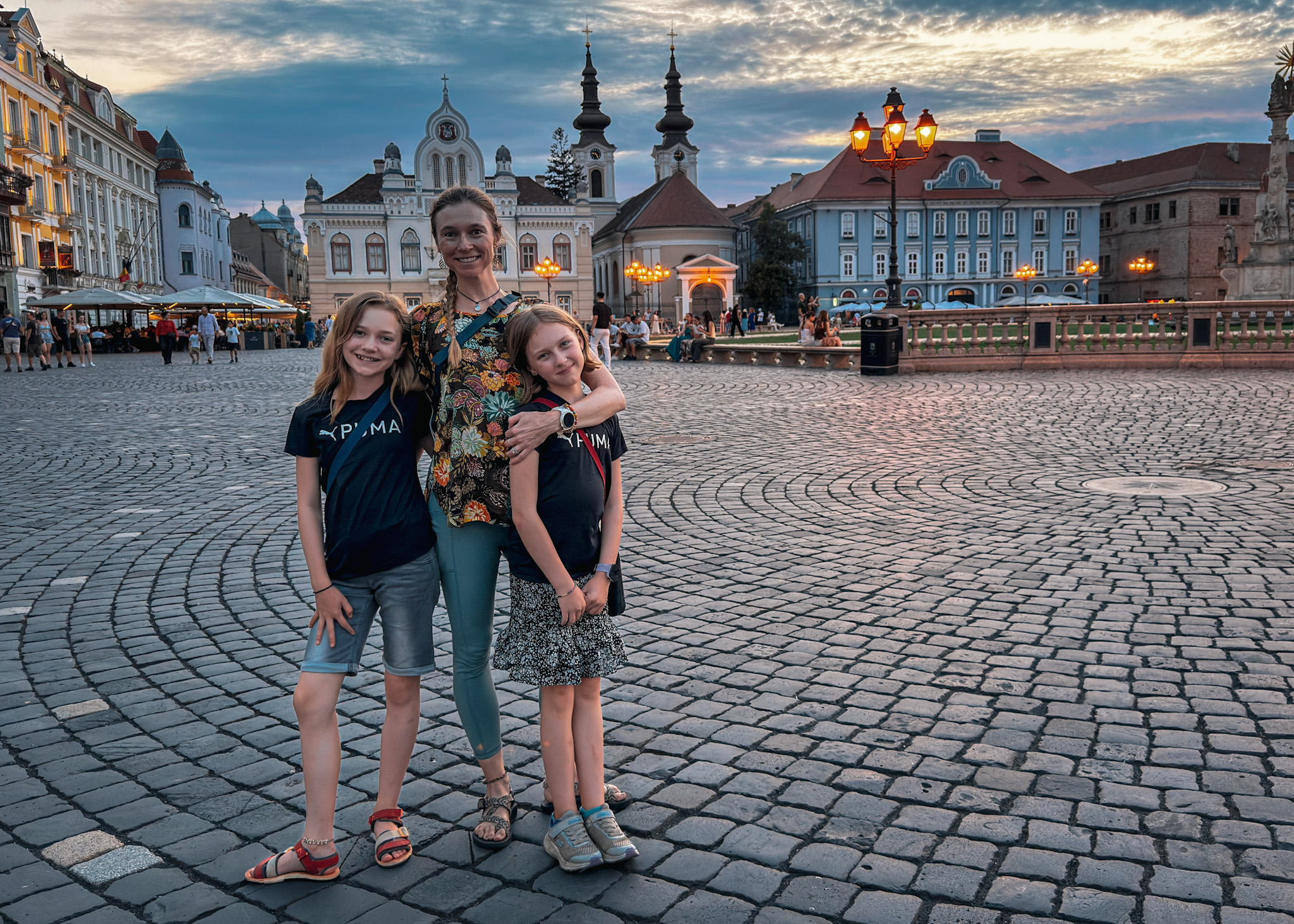
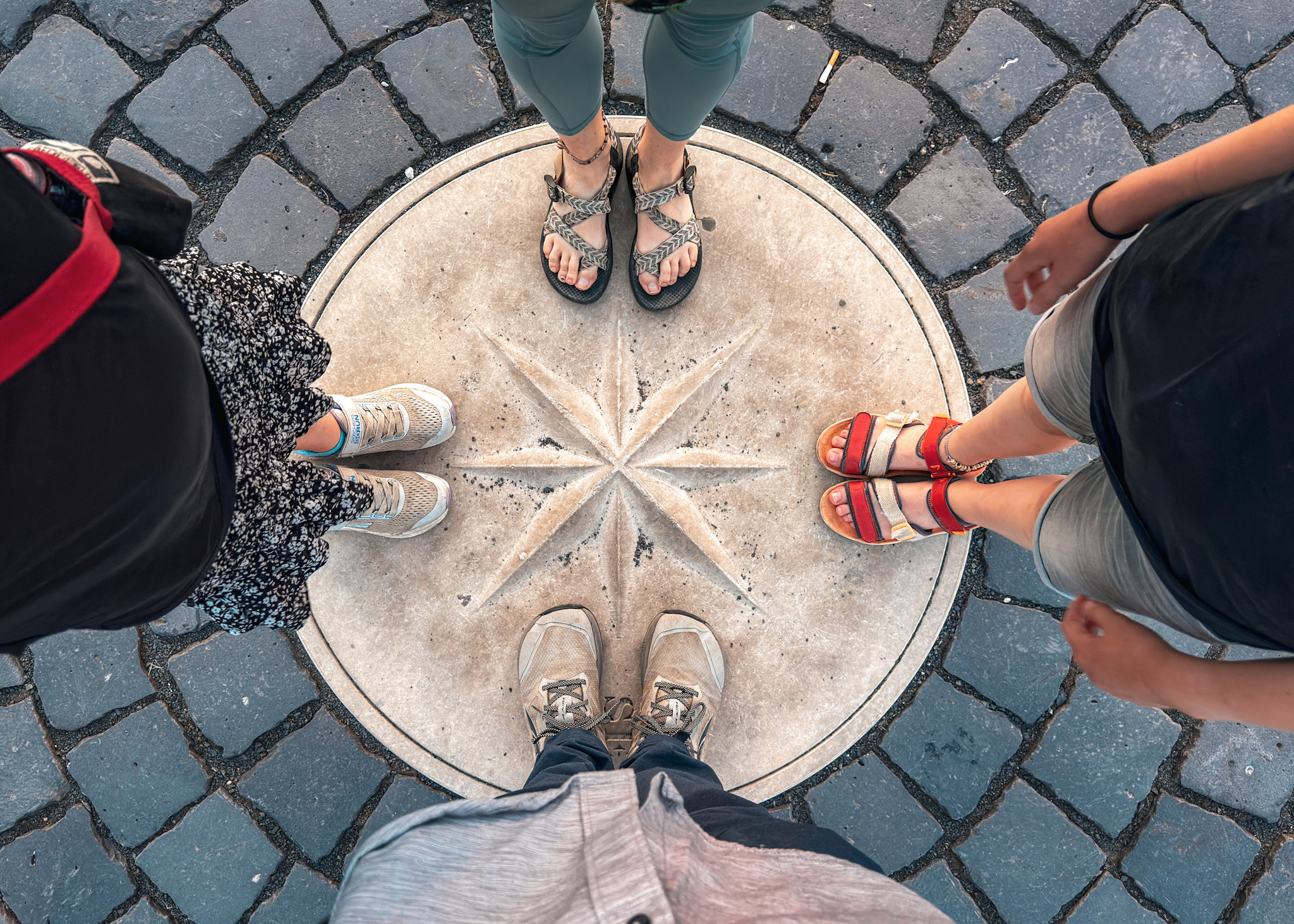
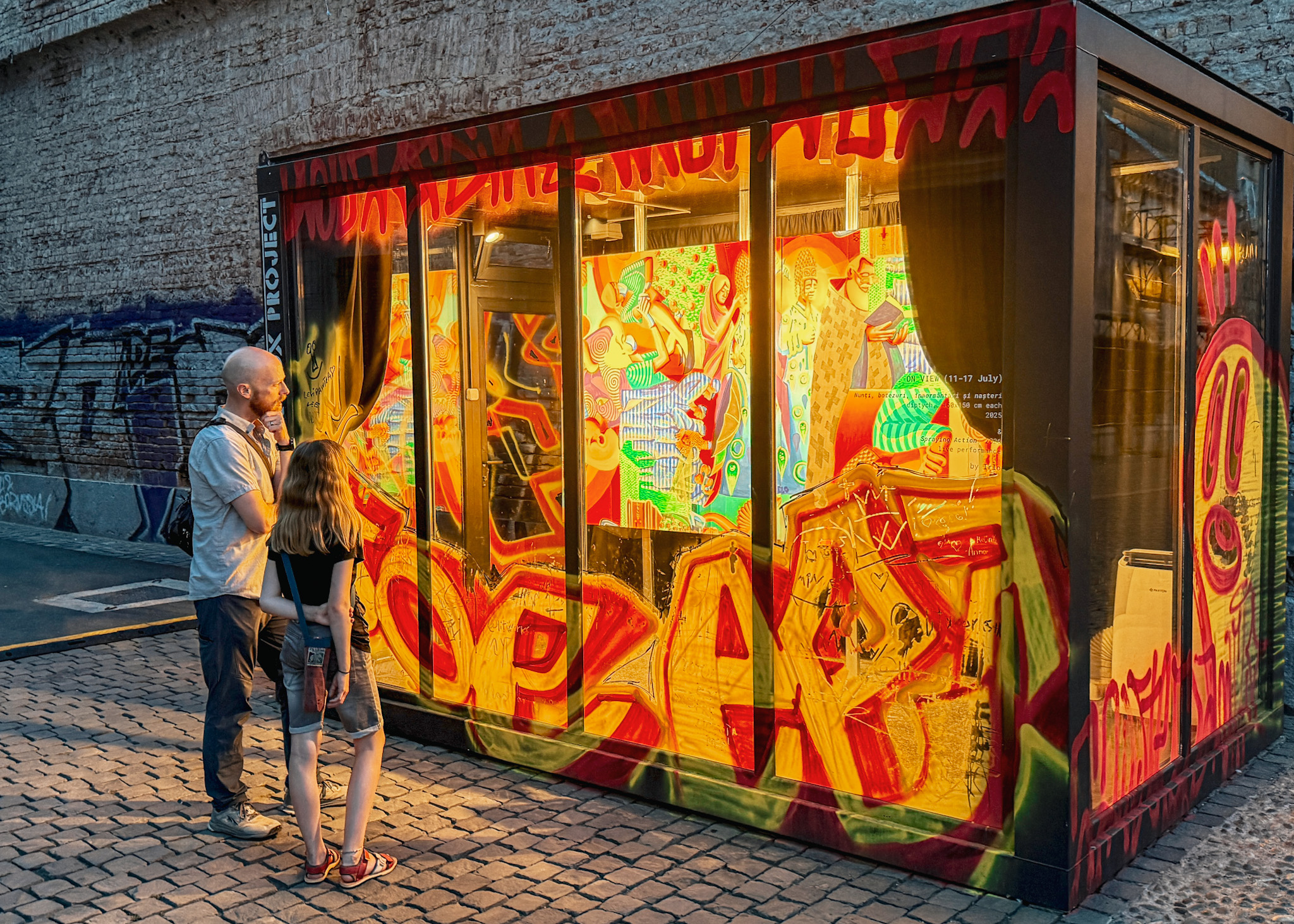
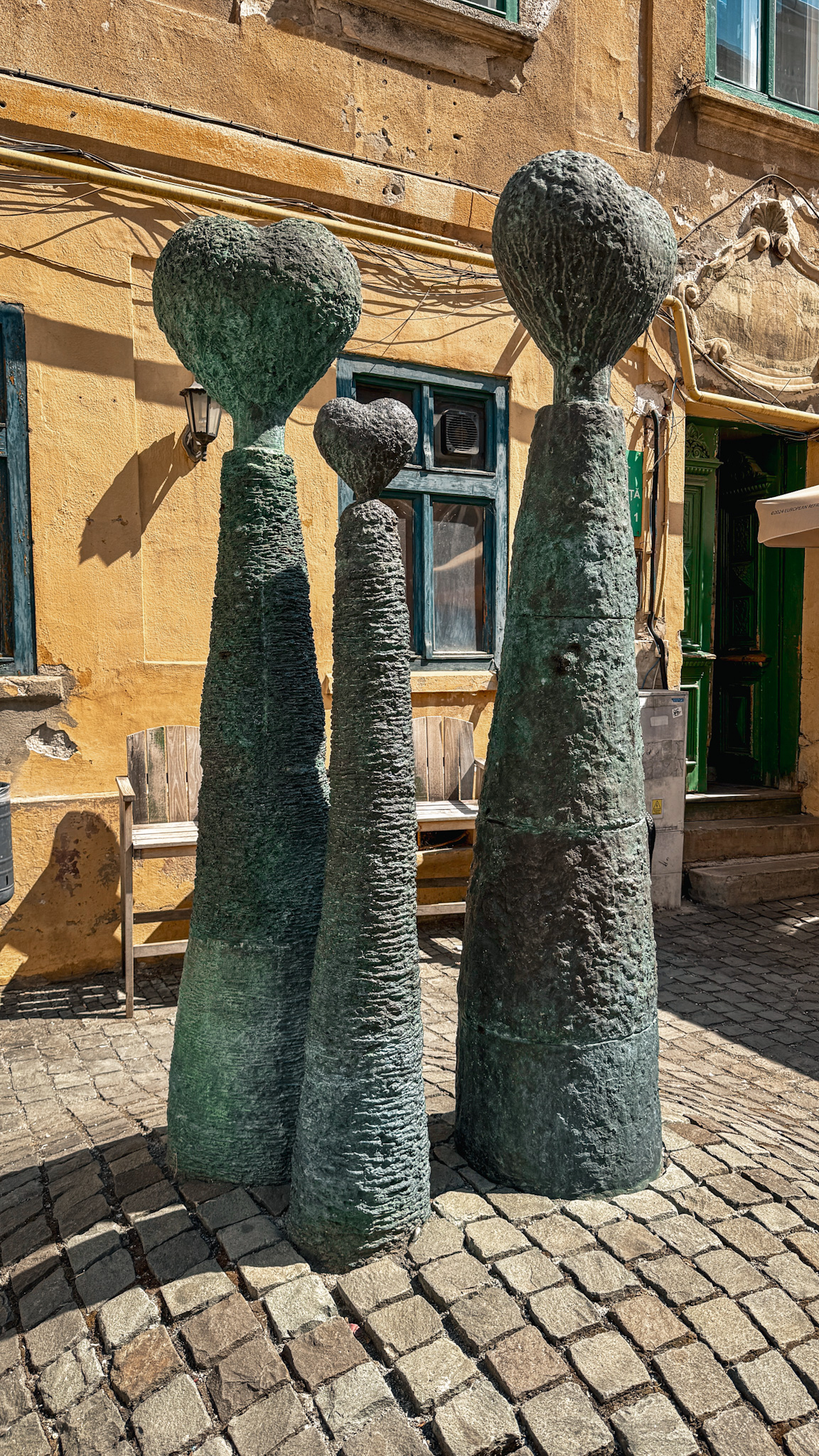
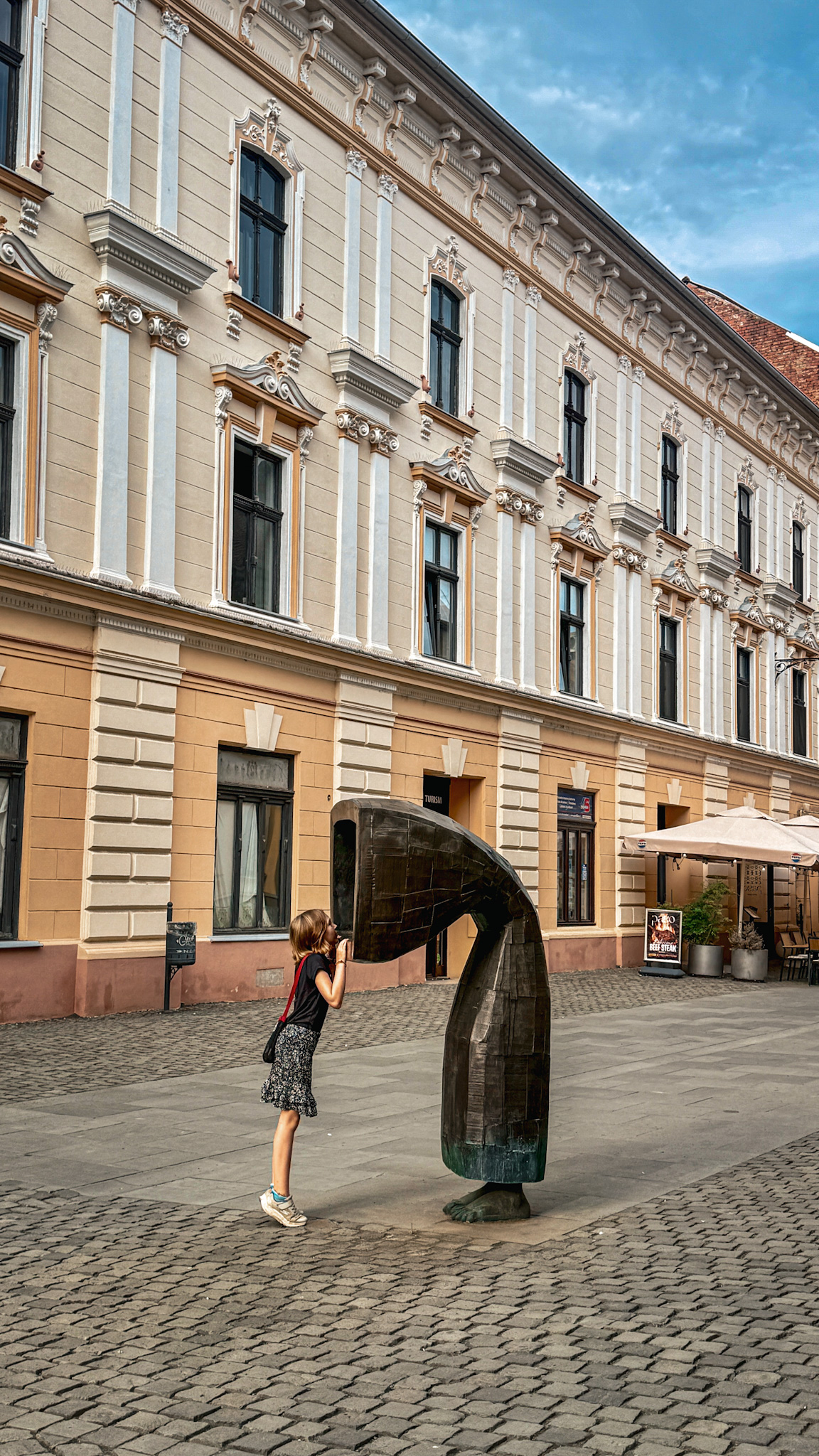
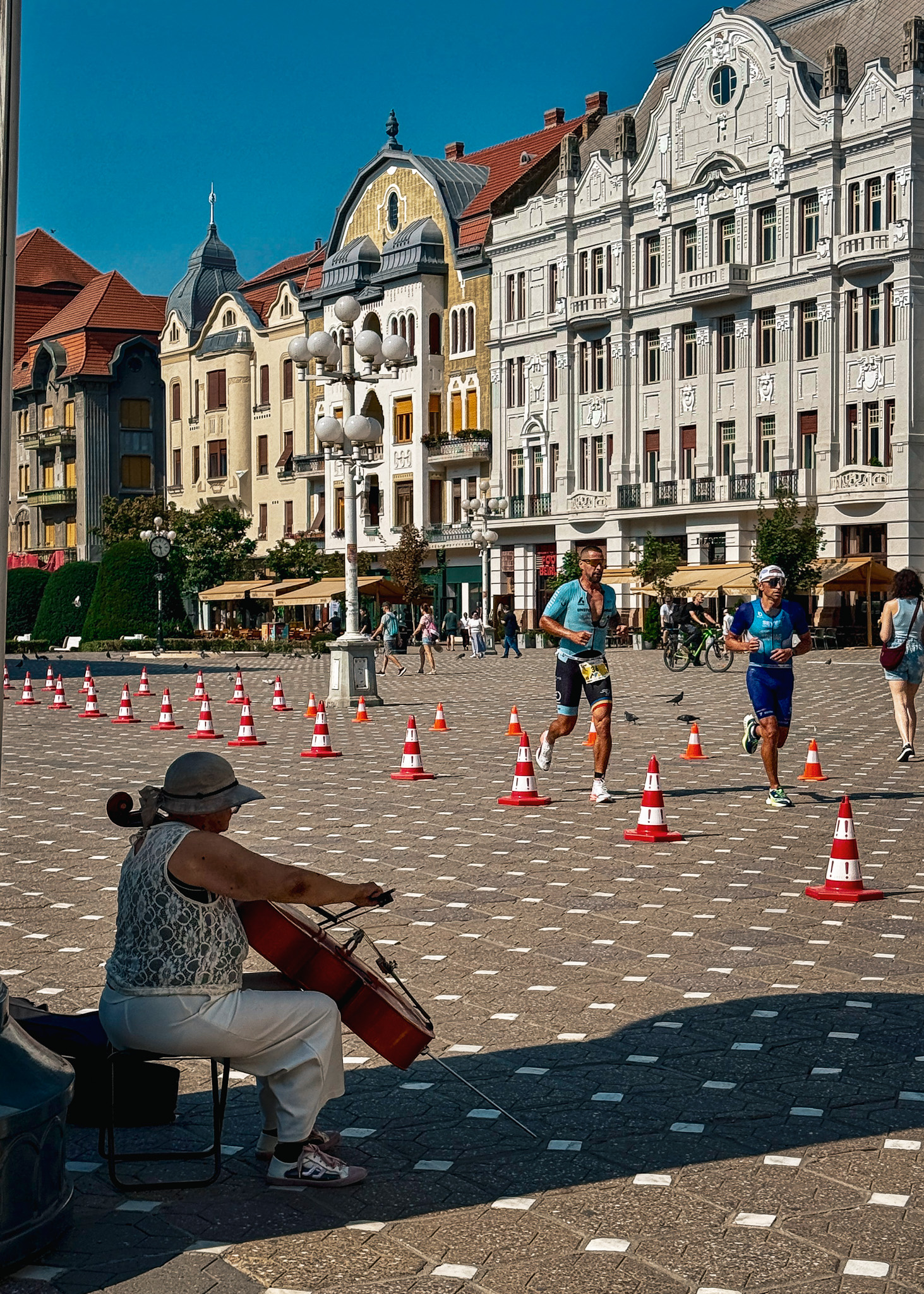
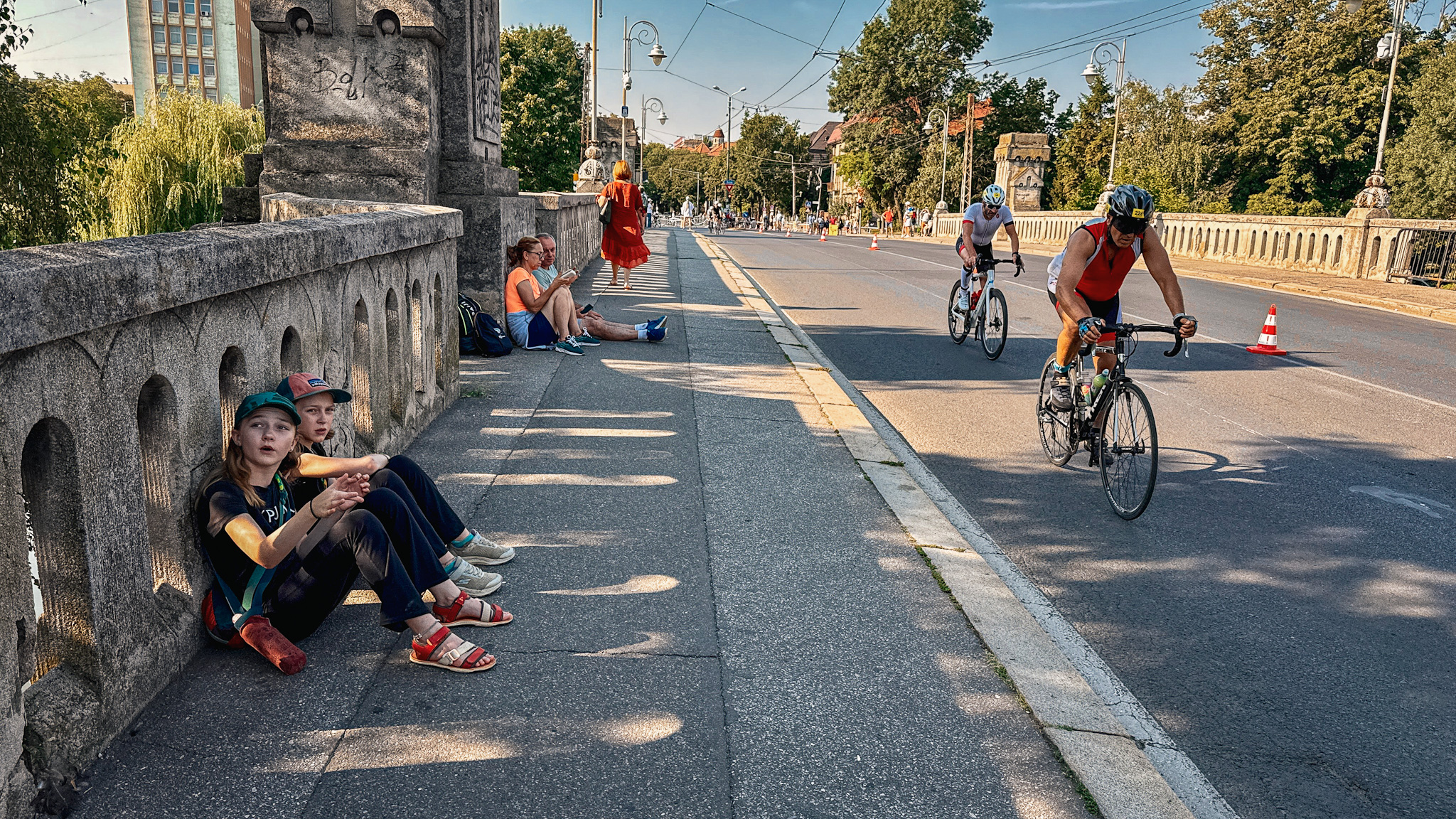
Our big Timișoara day was the walking tour, and this one deserves some honesty about the craft. We built another self-guided spiral, ten stops over five and a half kilometers with zero backtracking, script and quizzes included, and the girls have come to expect the quizzes now. We would like to think they secretly enjoy them. But there is a genuinely tough balance in this exercise, or two balances really. The tour itself has to educate and entertain at the same time, and the quizzes have to check whether anyone is actually learning without turning a family outing into school. This time, we’ll admit, the material came out a little too dense, and by the back stretch everyone’s attention was visibly flagging. The save is knowing when to pivot to the fun stuff, and Timișoara offered a a couple perfect pivots: cycling and sulfur. Cycling, the thing Maxell is most eager to reinsert into his life back home, was all around us in the form of the Timișoara Triathlon, happening alongside much of our walking route tour. Whenever we needed a break from the dense or depressing history lesson, we stopped to watch the competitors, cheering them on as they criss-crossed the city center. And at one point, we came across the artesian well in Piața Unirii that burbles up naturally sulfurous water, which we all bravely sampled and which tastes precisely how rotten eggs smell. The girls’ faces alone were worth three stops of dense history.
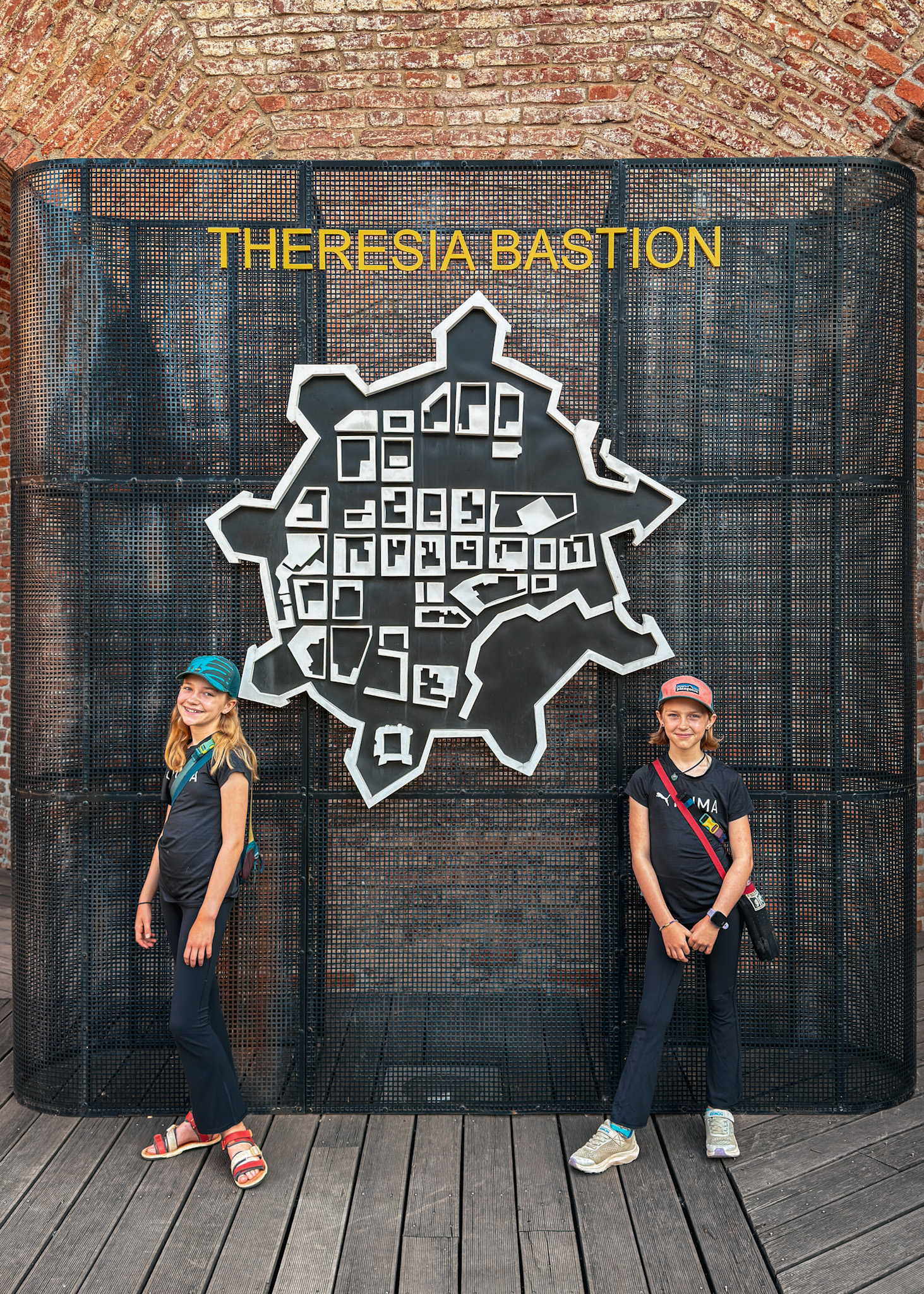
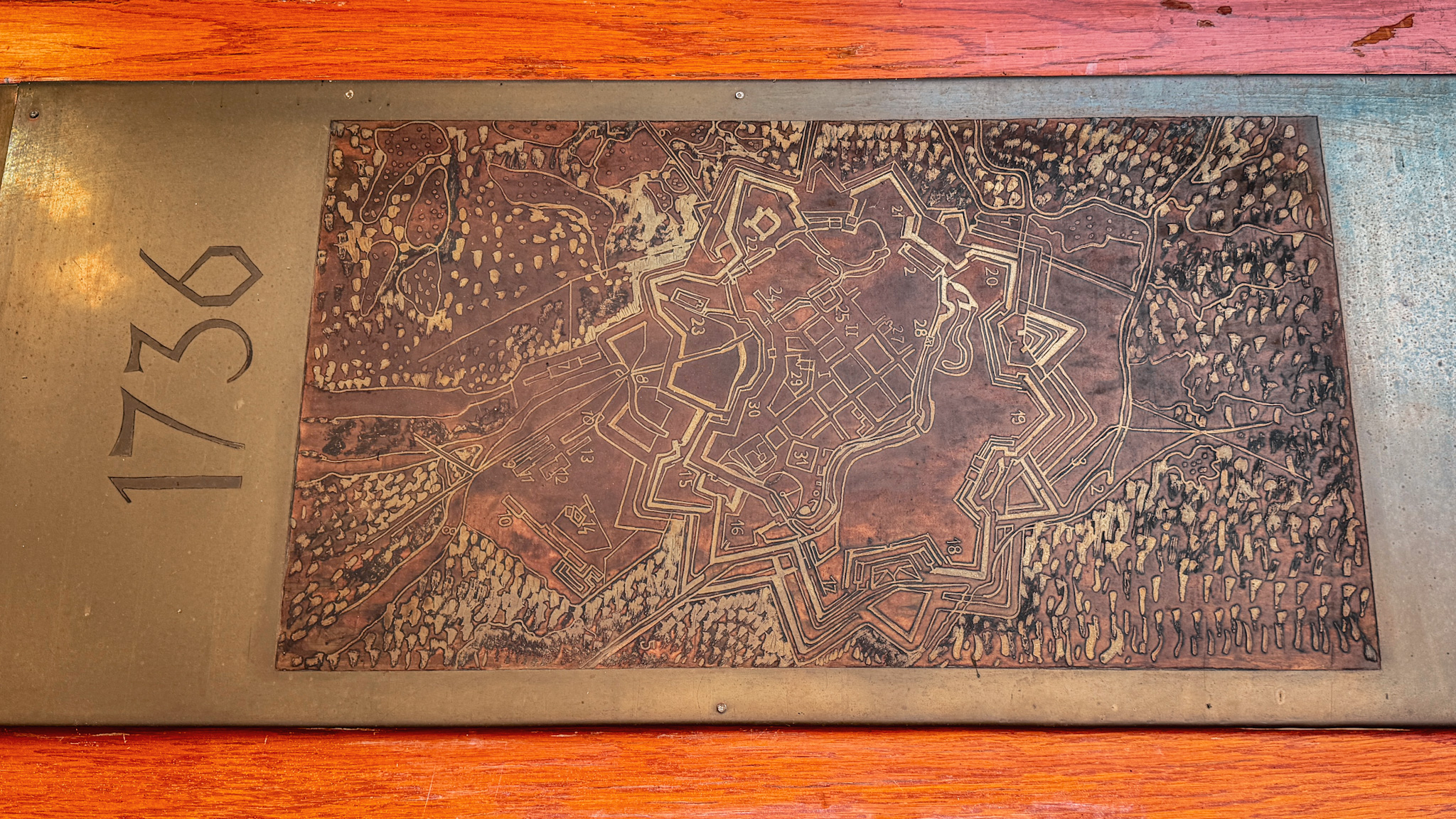
And yet the history here is worth the density, because Timișoara is where modern Romania turned. The city grew from a Habsburg fortress in the shape of a 9-pointed star, built at massive scale after the empire took back the region from the Ottomans. But when modern warfare made the walls obsolete, the freed-up land was rebuilt with Paris, Vienna, and Budapest as the explicit models. To this day people call it Little Vienna, and despite our family having never heard of this city before this trip, it was a powerhouse throughout the 19th century, becoming the first city in continental Europe to light its streets with electric lamps, way back in 1884.
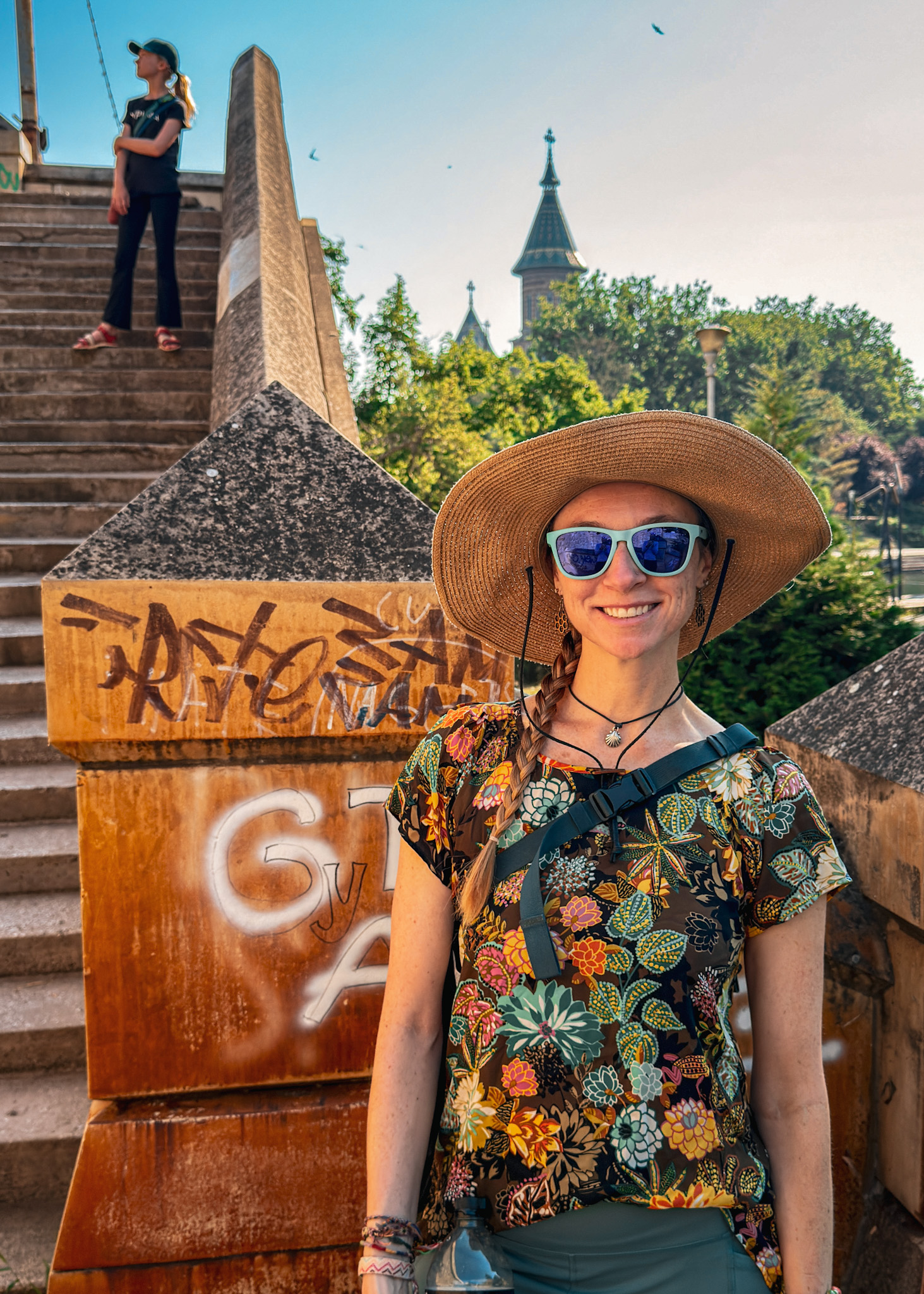
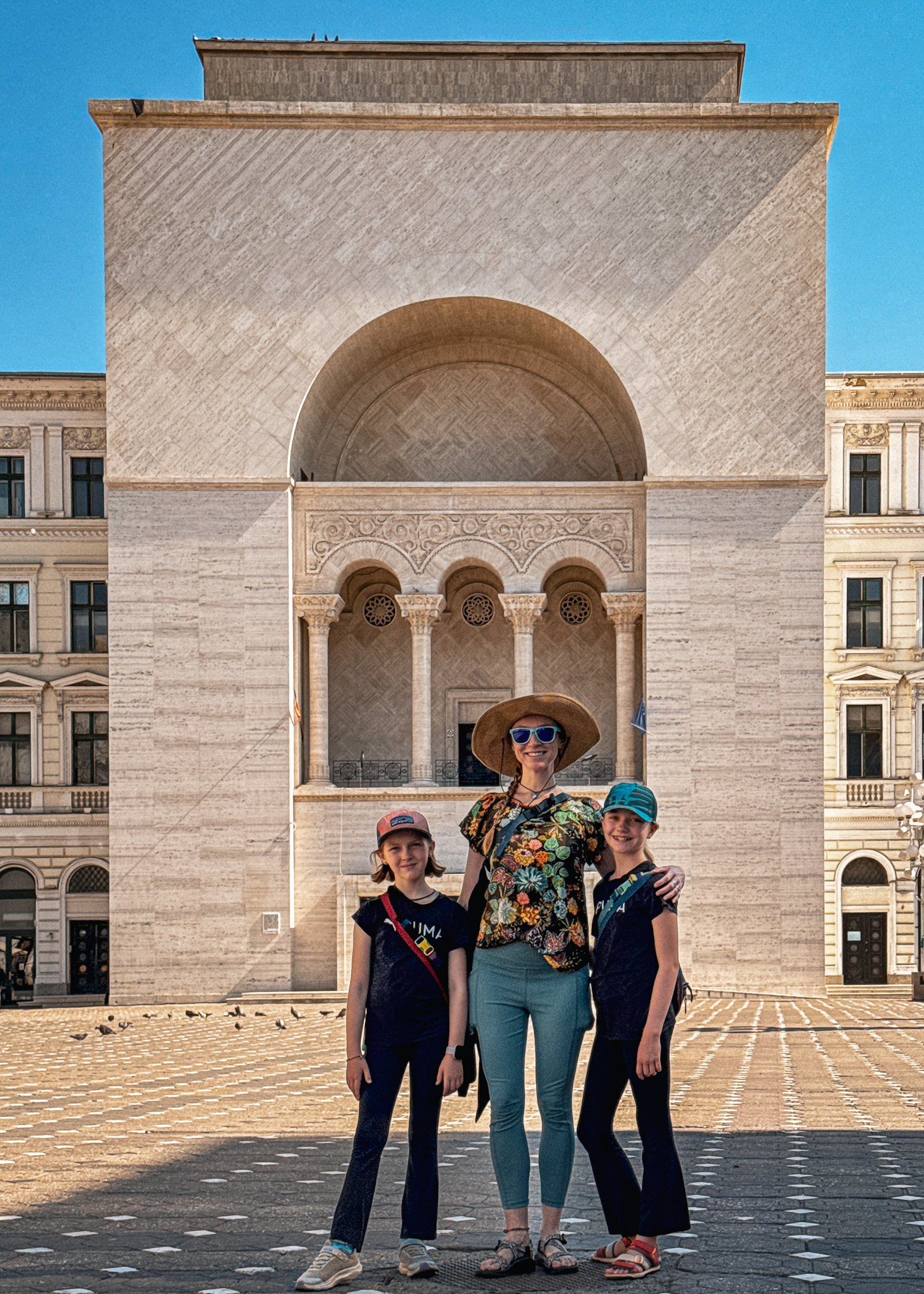
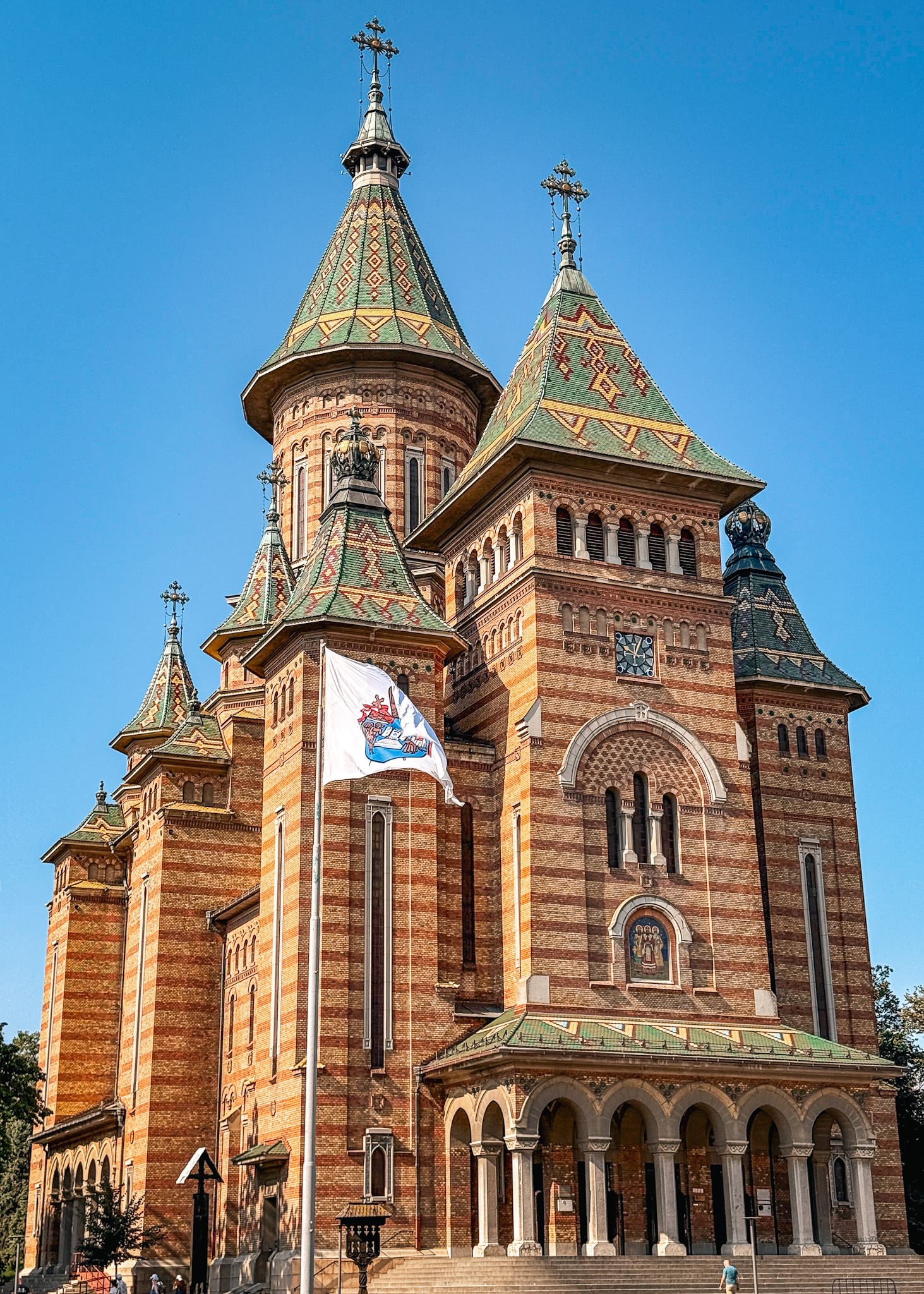
The day’s strongest goosebumps came at the Metropolitan Cathedral, the massive, brooding Orthodox cathedral with eleven towers and colorful glazed Moldavian roof tiles. It was on these steps, in December 1989, that young protesters were intimidated by tanks and shot by police, the spark that ignited the Romanian Revolution. And only a few minutes’ walk away, from the balcony of the Opera House, Timișoara was proclaimed Romania’s first free city on December 20, 1989. Within days the revolution swept the country, and by Christmas, the Soviet dictator Ceaușescu, whose story we had learned while in Bucharest at the Palace of the Parliament, was gone. Standing in 90-degree heat on the exact spots where all of it happened, we had goosebumps anyway. That is what pivotal places do.
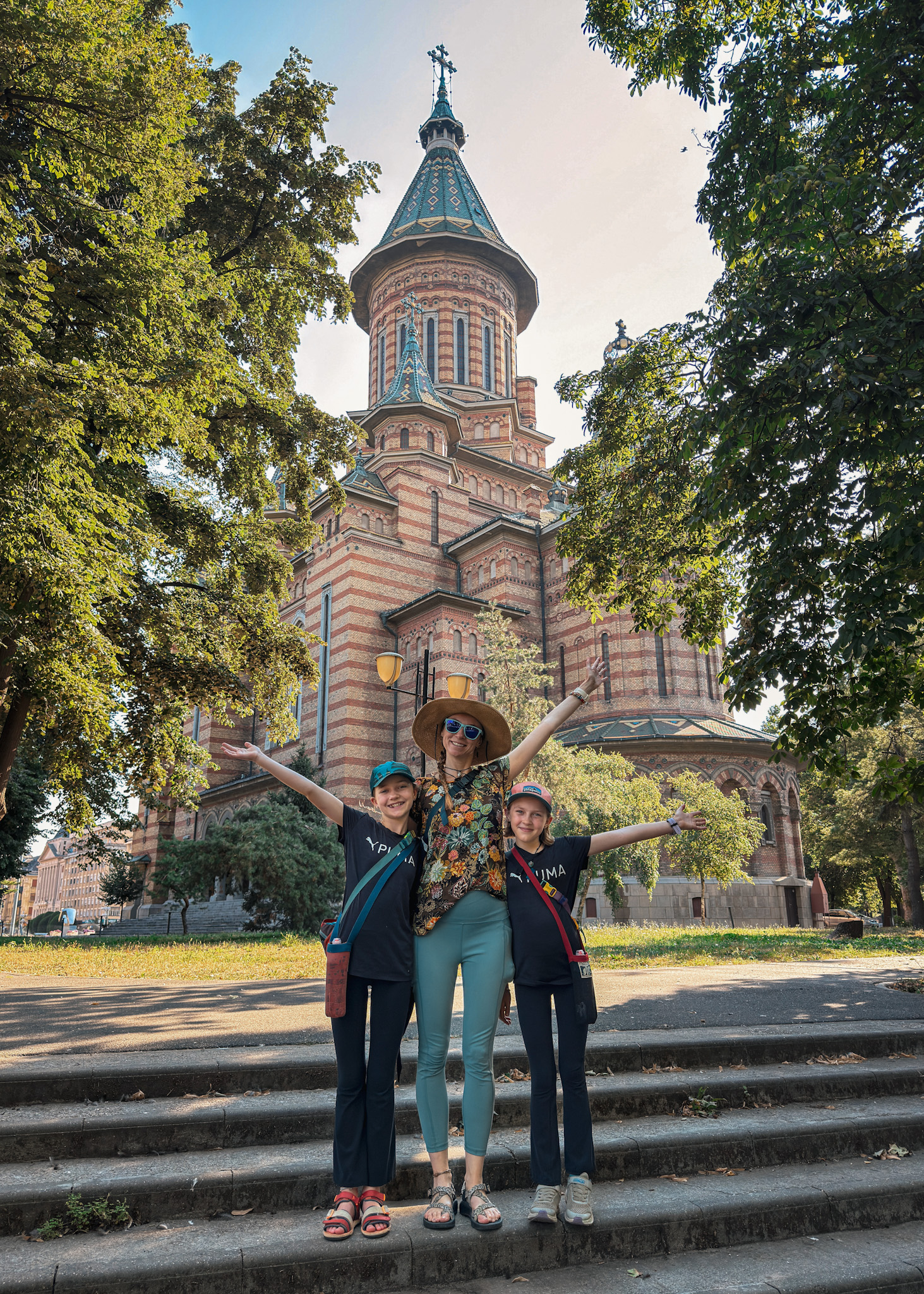
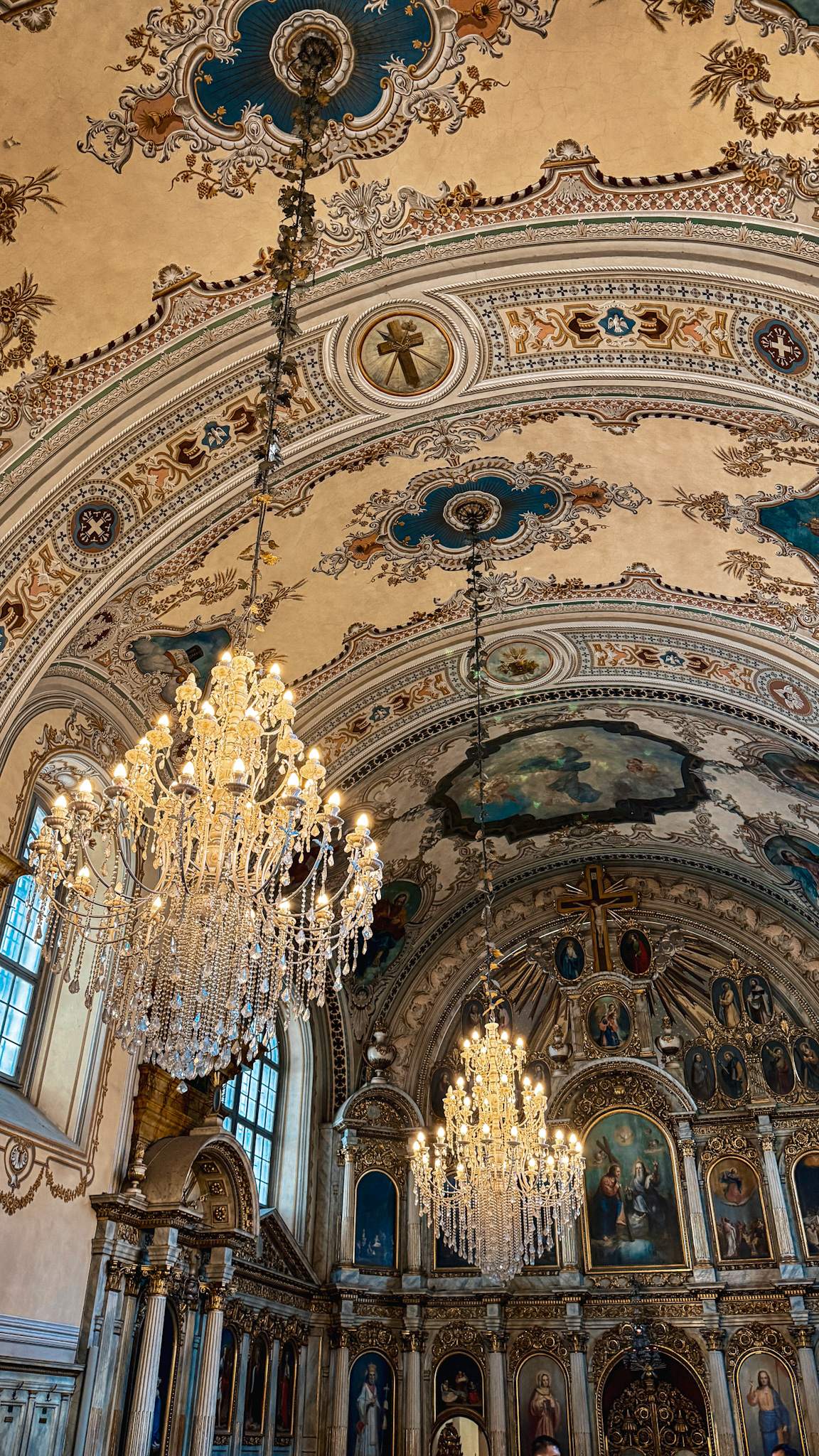
We talked about it as a family, and it is a hard thing to hold. Revolution is equal parts terrifying and inspiring, maybe even more so when we try to distill it down to 5th- and 7th-grade levels. Terrifying because of the bloodshed and because nothing about it guarantees things improve; inspiring because when a regime has impoverished its people to the point that the country can barely feed itself or keep the heat on through winter, something has gone so far off the rails that revolution may genuinely be the only door left. It certainly seems that it was here. The heartache that poured out of those days touched families across this country, and we cannot begin to put ourselves in those shoes. What we can see, walking through this bright, lively, pedestrianized city thirty-seven years later, is a population that persevered through it and came out somewhere they would never trade back. Inside the cathedral, by pure chance, we caught three clergy chanting and swinging the censer, incensed smoke circling around as one deep voice belted out a prayer with an almost tangible passion. We don’t share the beliefs behind it, but we keep finding that belief’s power to move people to create art and music this beautiful is its own kind of wonder.
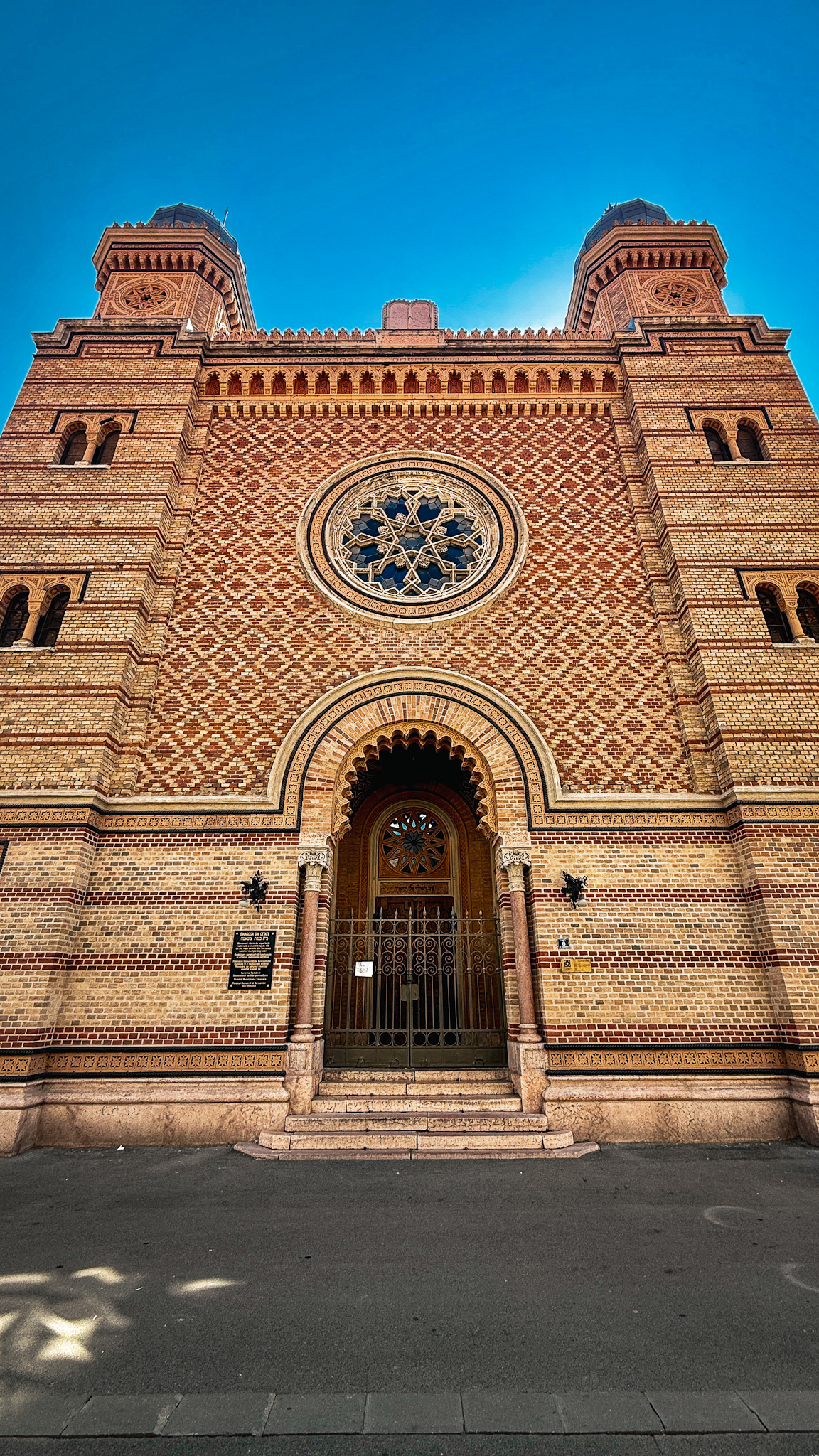
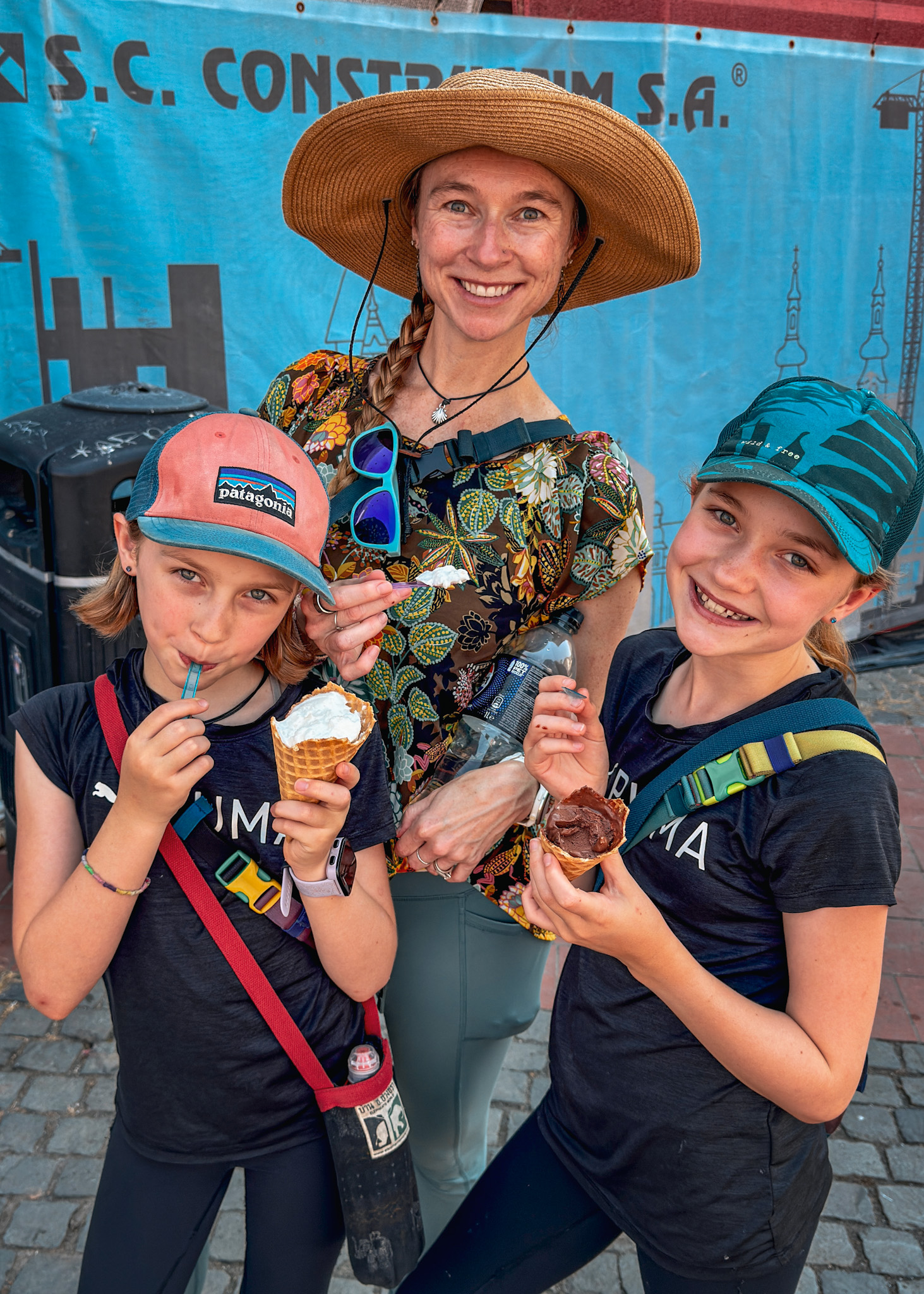
The tour’s back half lightened things up, taking us through Piața Libertății (Liberty Square), where we clapped for the racers as they crossed the finish line in almost incomprehensible heat for the mid-morning. We aren’t sure if they appreciated our cheers or silently cursed us as we ate possibly the best gelato of the trip—massive frozen scoops of heaven in giant waffle cones. We’ll assume it was the former since our intentions were good. Finally, we finished the tour in the the gorgeously restored Moorish Revival synagogue and the baroque showpiece of Piața Unirii. Five and a half kilometers later, we finally made it to dinner, and it outdid itself: duck confit with charred cabbage for Max, a schnitzel topped with marinara and mozzarella that the girls declared outstanding, and a refreshing steak salad for Shaina. We all shared Romania’s signature dessert, papanaşi, essentially fancy donut balls stuffed with lightly sweetened crème fraîche and covered in a blueberry compote that we are prepared to call transcendent.
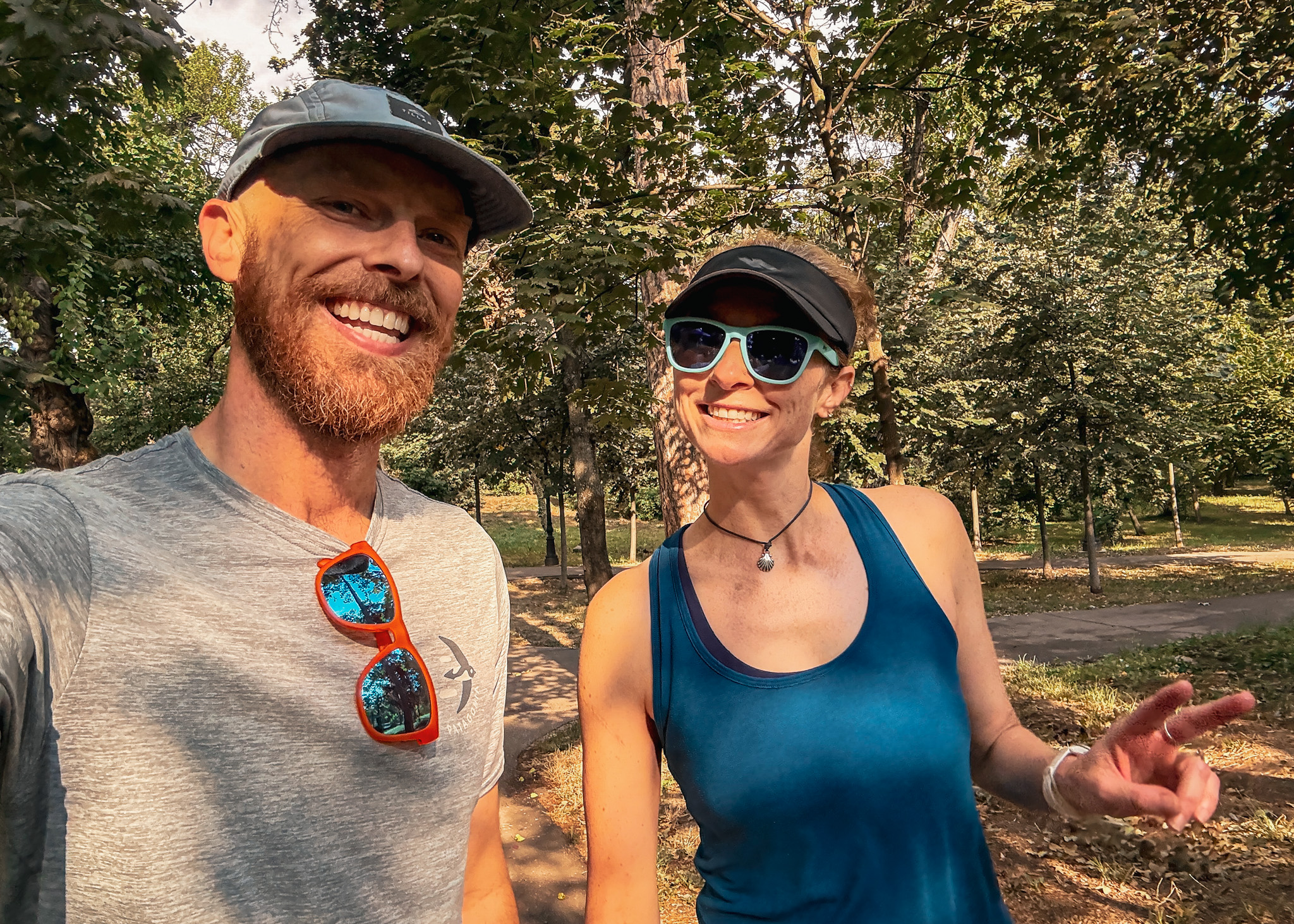
Our last day in Romania started at the park, the re-entry program in full healthy swing. We were up early with the kids to cement the new family morning workout routine, and once there, the girls got set up with their own new audiobook. The Mystwick School of Musicraft was about a girl at a school where musicians spin music into actual magic. They were hooked within four minutes, which is exactly what you hope for when you hand a kid a book and walk away. And walk away is precisely what they wanted us to do. The girls requested their audiobook time be sans parents, so they set off around the park clockwise while Shaina and Max plugged into an Ezra Klein interview and walked counterclockwise. Everyone got their own laps, their own listening, and a wave at every crossing. It was a marvelous arrangement, and we are genuinely not sure why it took us this long to think of it.
That is the shape of the last laps. One eye on the cobblestones in front of us, one eye on Reno, a green tile wrapped carefully in the luggage, and a World Cup final waiting. Romania has one more thing to give us, a bus ride west across the border to Serbia. The year has one final chapter left—eight days in Belgrade, our last city—before the long journey home begins.
We are savoring it, all of it, the being here and the going home alike, as best we know how.
 Pause and Wander
Leave a comment