
Dates: April 23rd-26th, 2026
Place: Khiva, Uzbekistan
The alarm went off at 4:15. This is a time of day that exists, apparently, and we were required to be in it. That is not to say that any of us were happy about it. Nonetheless, we were out the door by 4:45, and a brief comedy involving a cab the size of a Smart car ensued. It could not have accommodated our luggage without strapping it to the roof, thus a replacement cab was called. The “comfort plus” cab arrived, but the trunk only had room enough for two of our bags. Backpacks on laps, we squeezed in and 20 minutes later we arrived at the train station. After six hours of a mostly forgettable ride on an old Soviet train, we were pulling into the outskirts of Khiva. We gathered our bags, and called a taxi for the final stretch into the old city.
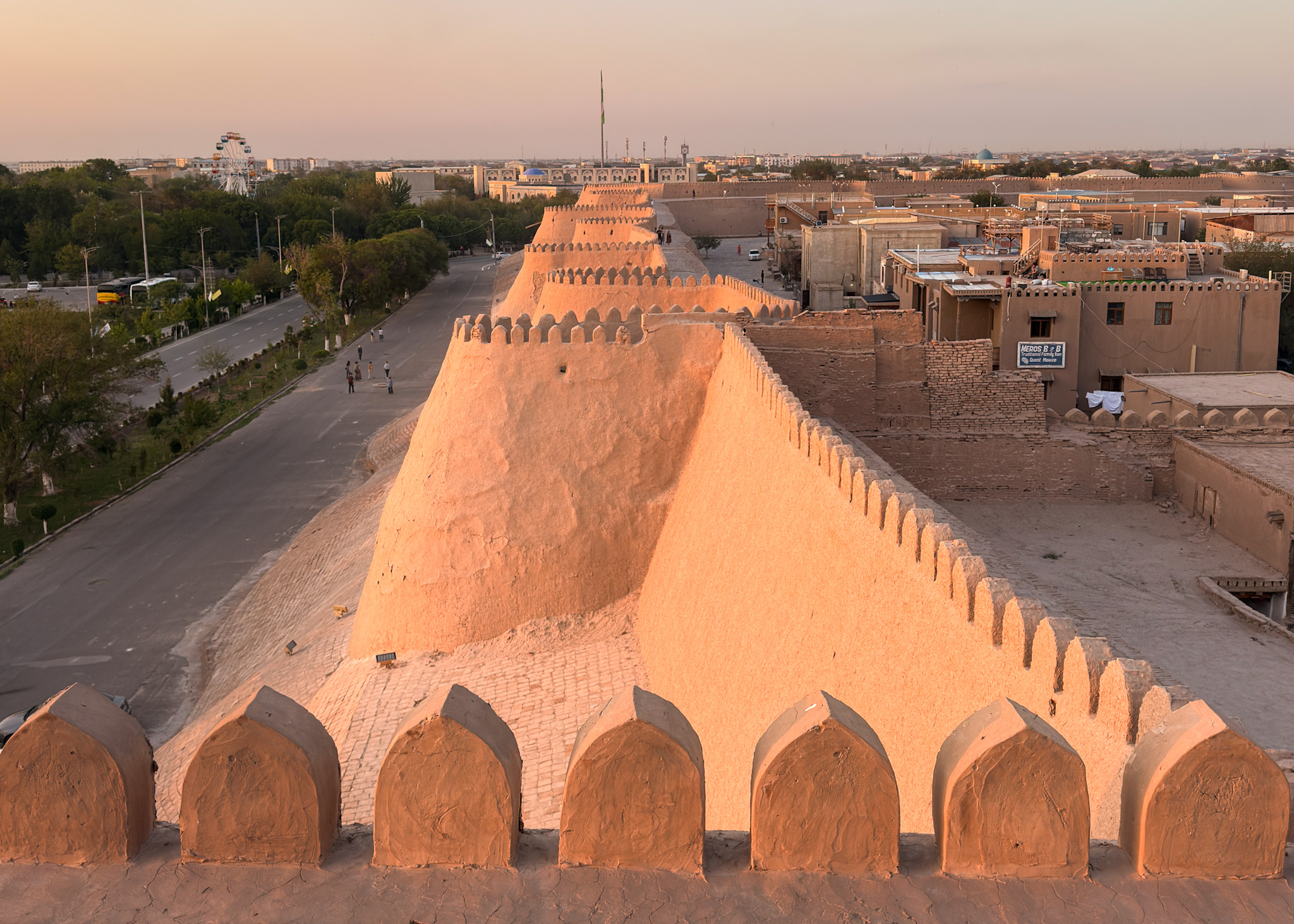
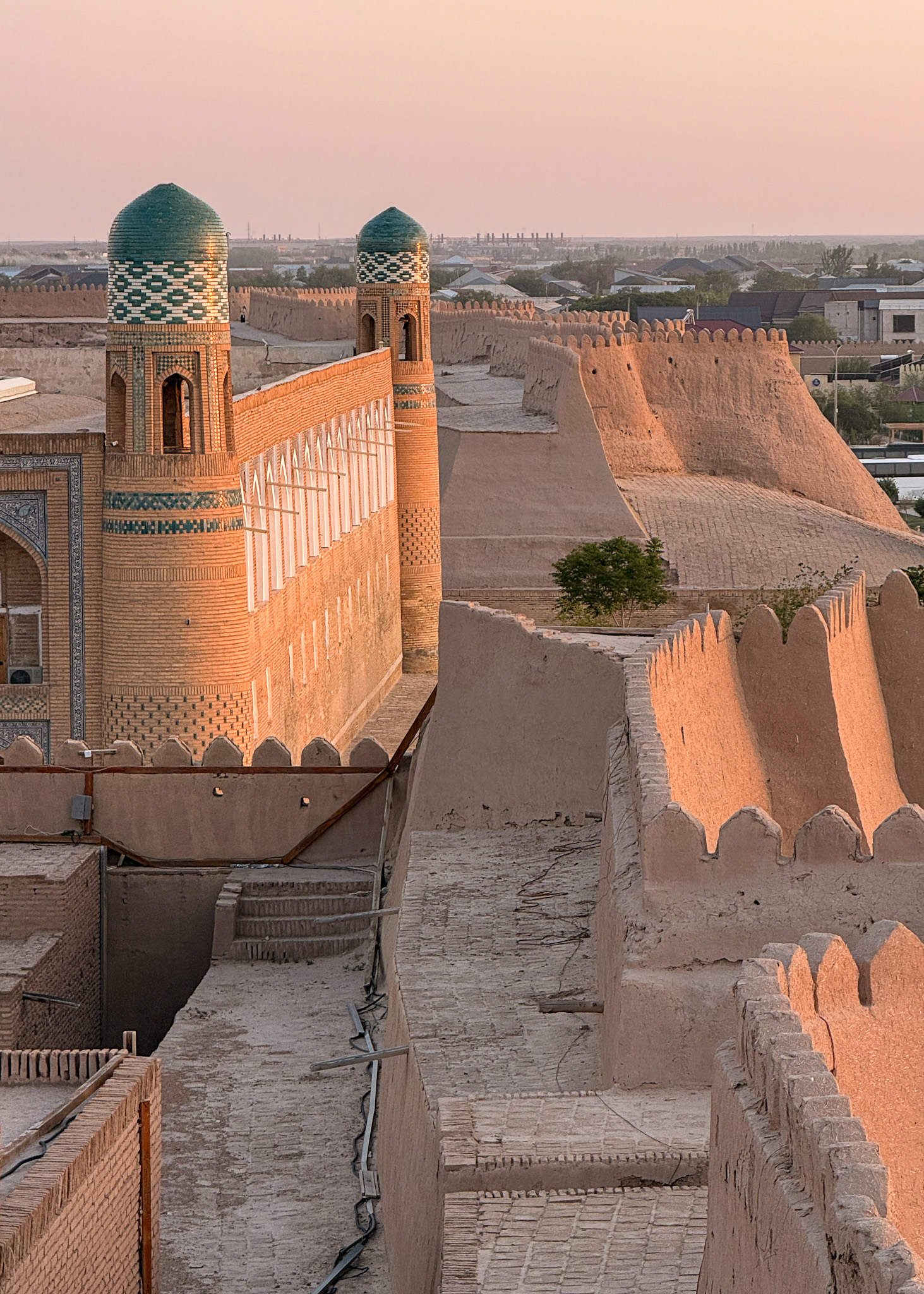
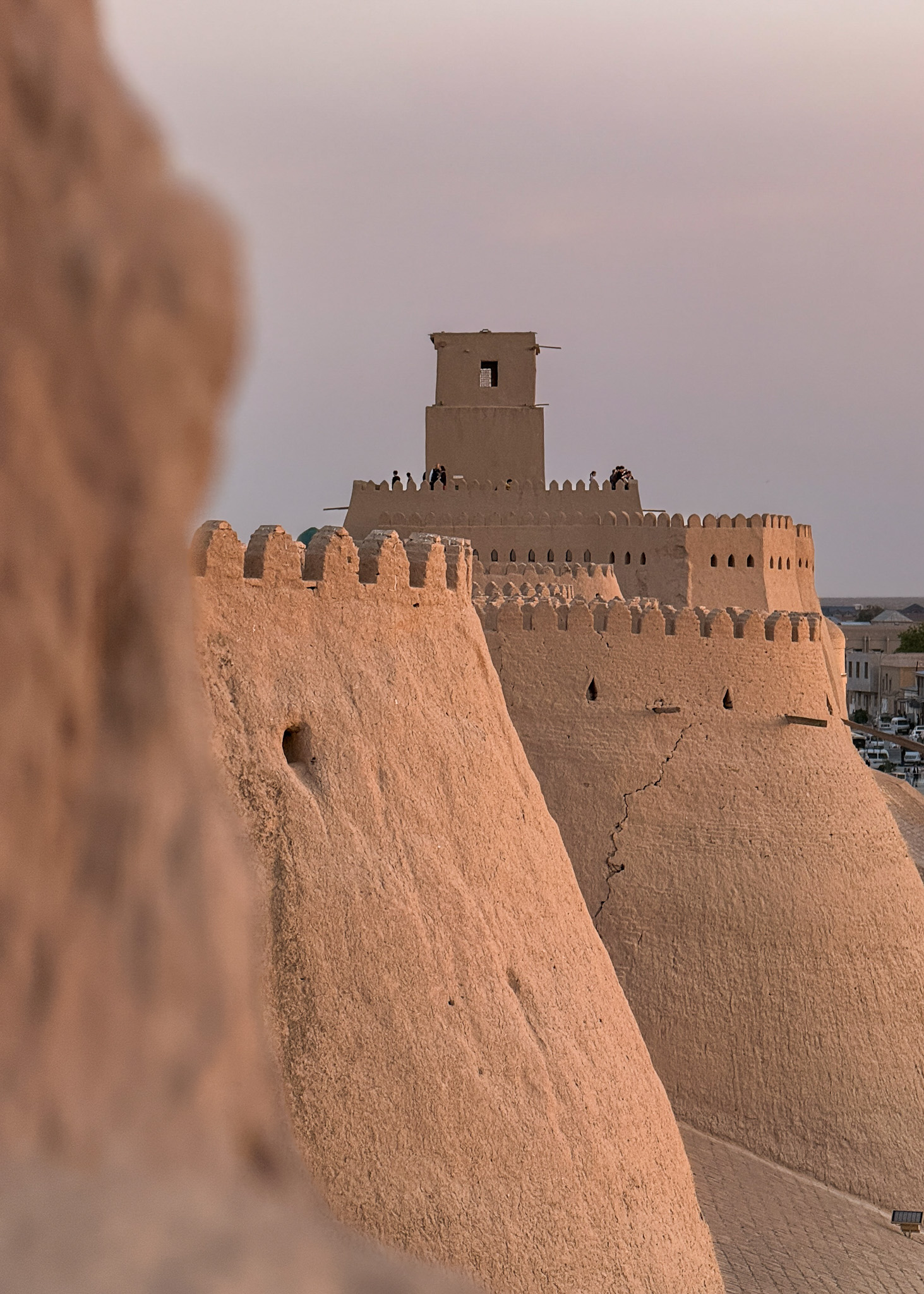
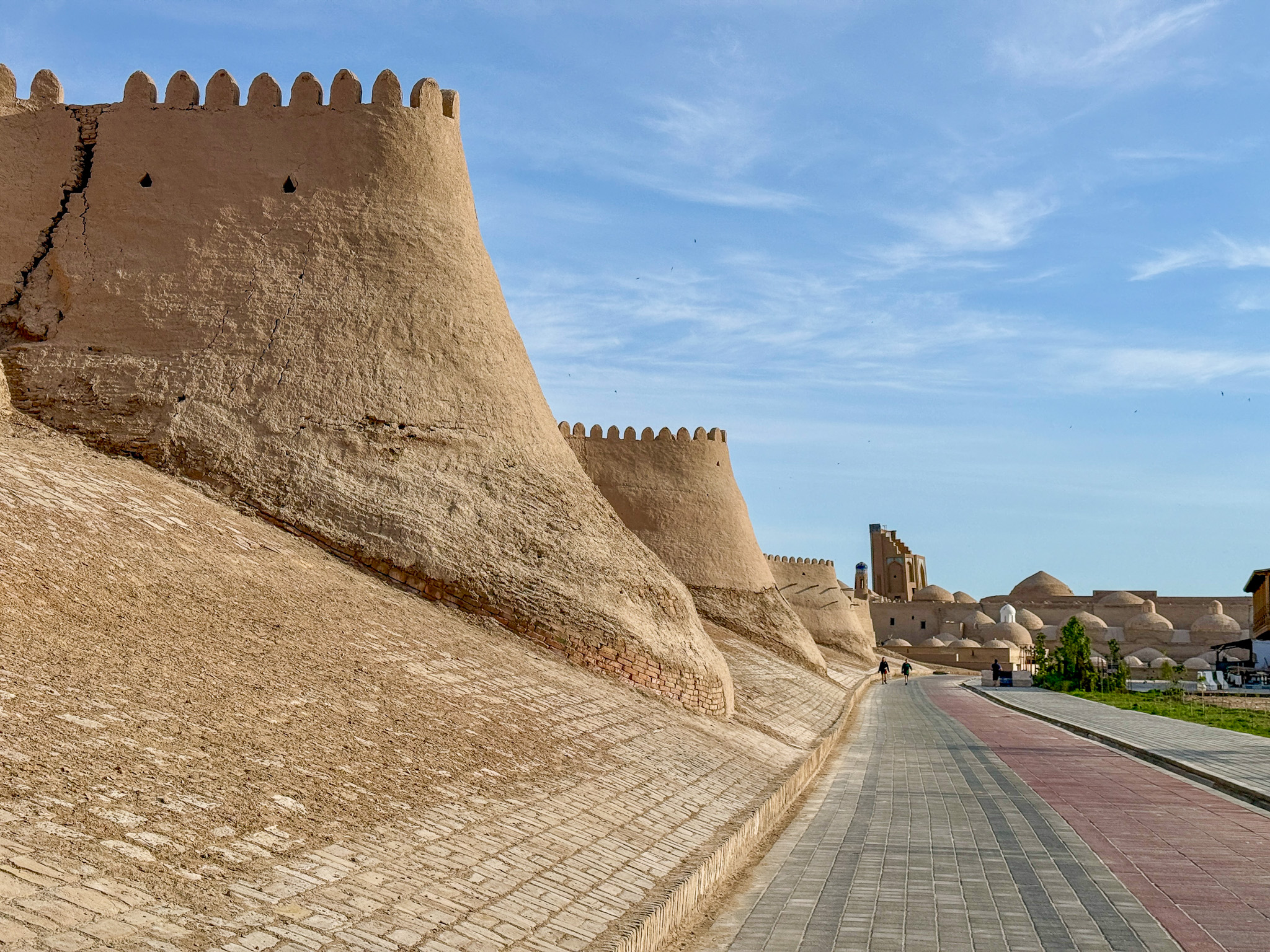
Our first view of the Itchan Kala, the historic walled inner city of Khiva, was the walls themselves. Massive tapered mud brick walls, at a thickness of eight to ten meters, running roughly 2.5 kilometers around the entire perimeter, unbroken, essentially intact. As far as we know, Khiva is the only city center in Uzbekistan still completely enclosed within its original ancient walls, which earned it the first UNESCO World Heritage designation in the country back in 1990. Standing outside and looking up at them, you get an immediate sense that whoever built this place took the idea of keeping other people out very seriously.
We checked into the Khiva Ibrohim Guest House, a small family-run homestay inside the walls. The host mentioned that the house had been in his family for roughly 300 years, or so the story goes. Most buildings change hands. This one, through conquest and empire, Soviet rule and independence, had stayed in the same family for three hundred years. We found that genuinely hard to wrap our heads around.
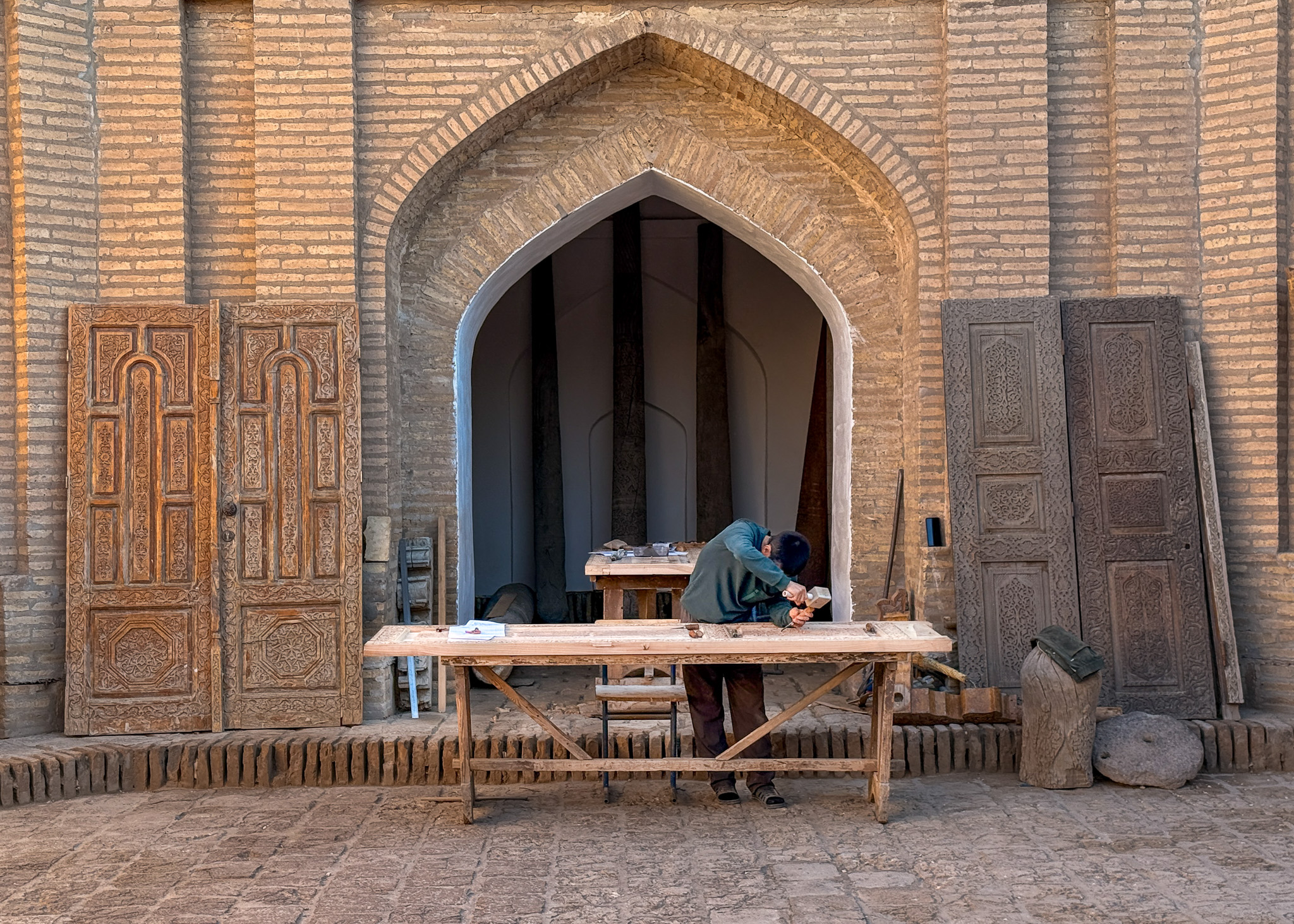
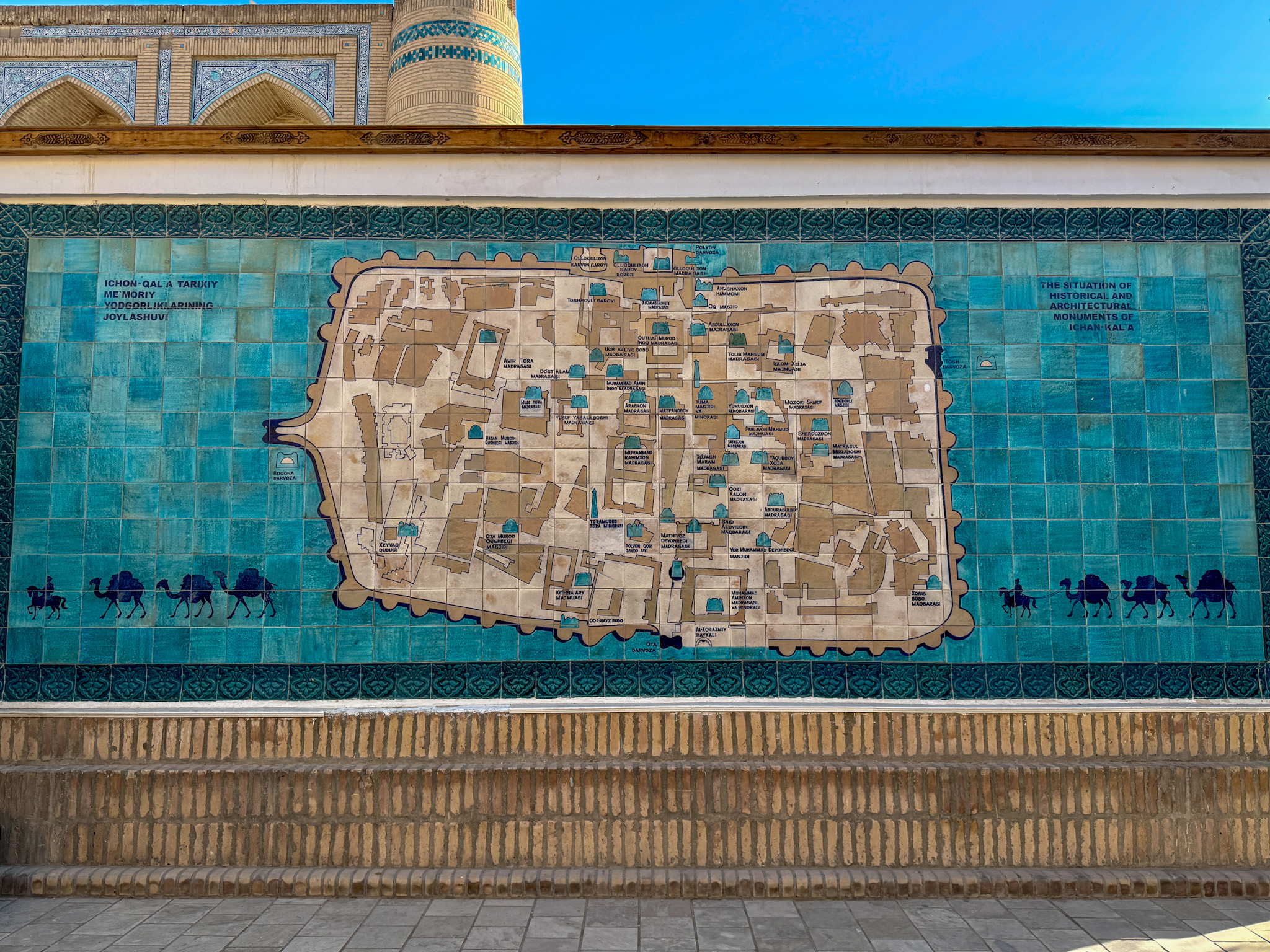
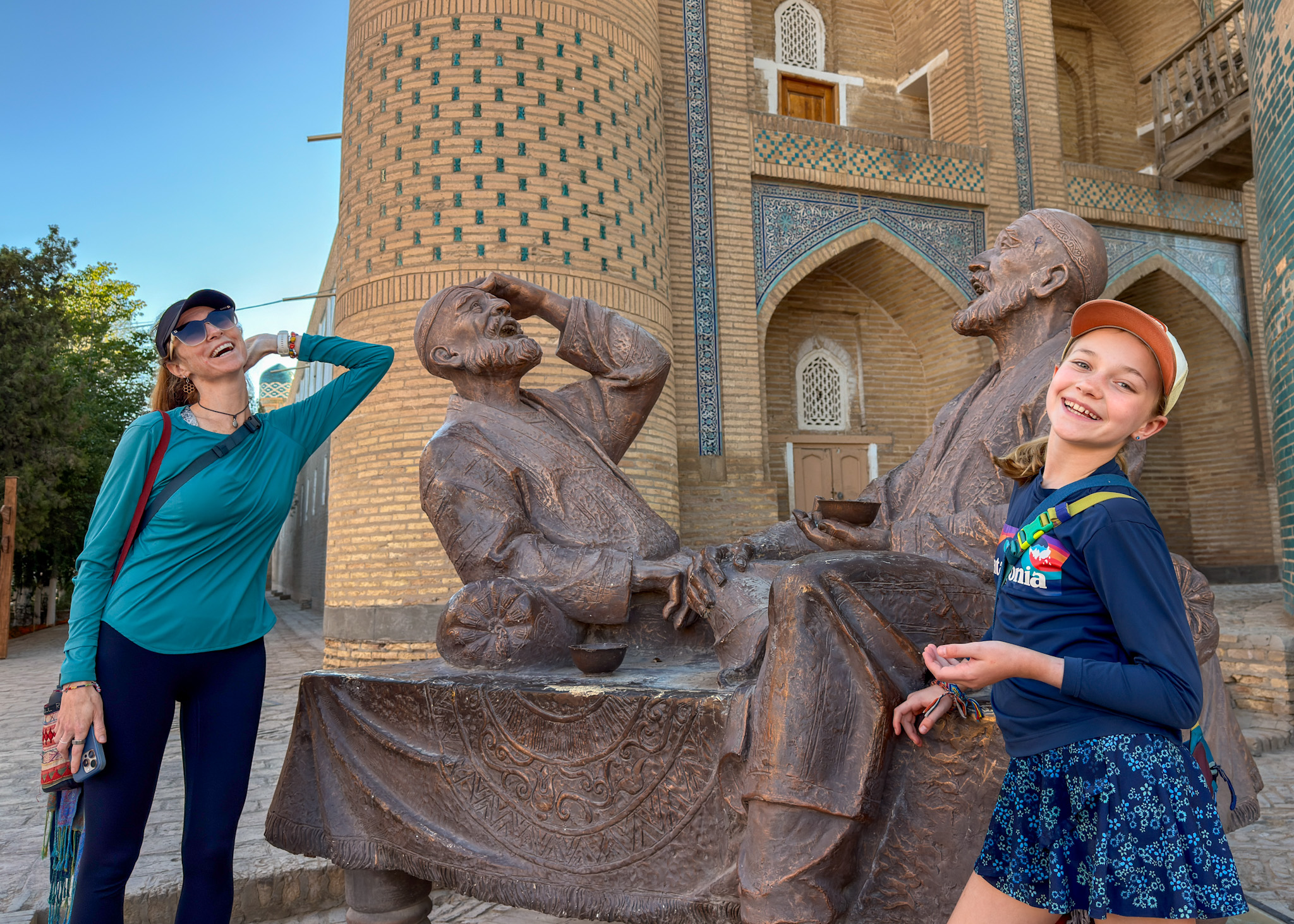
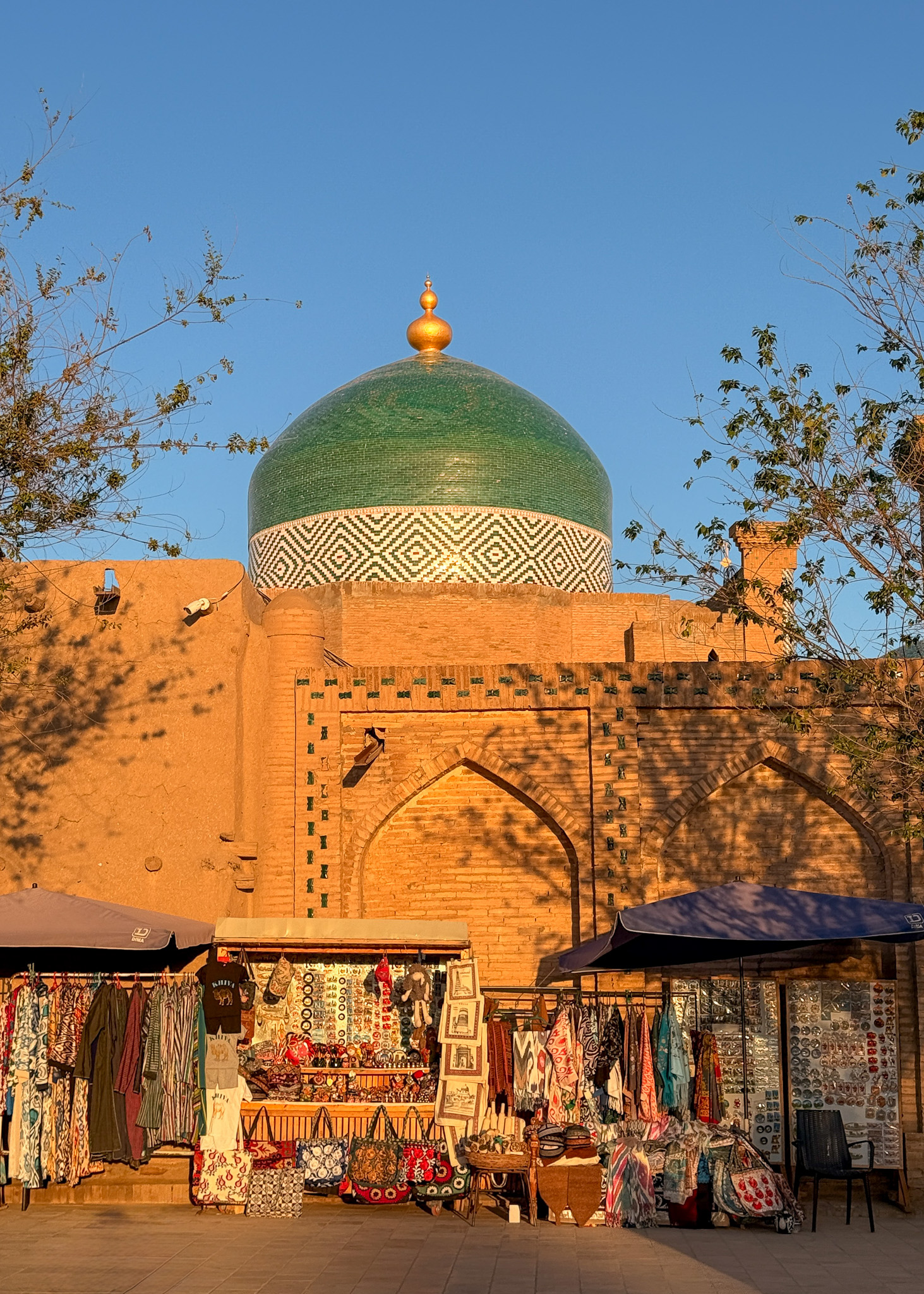
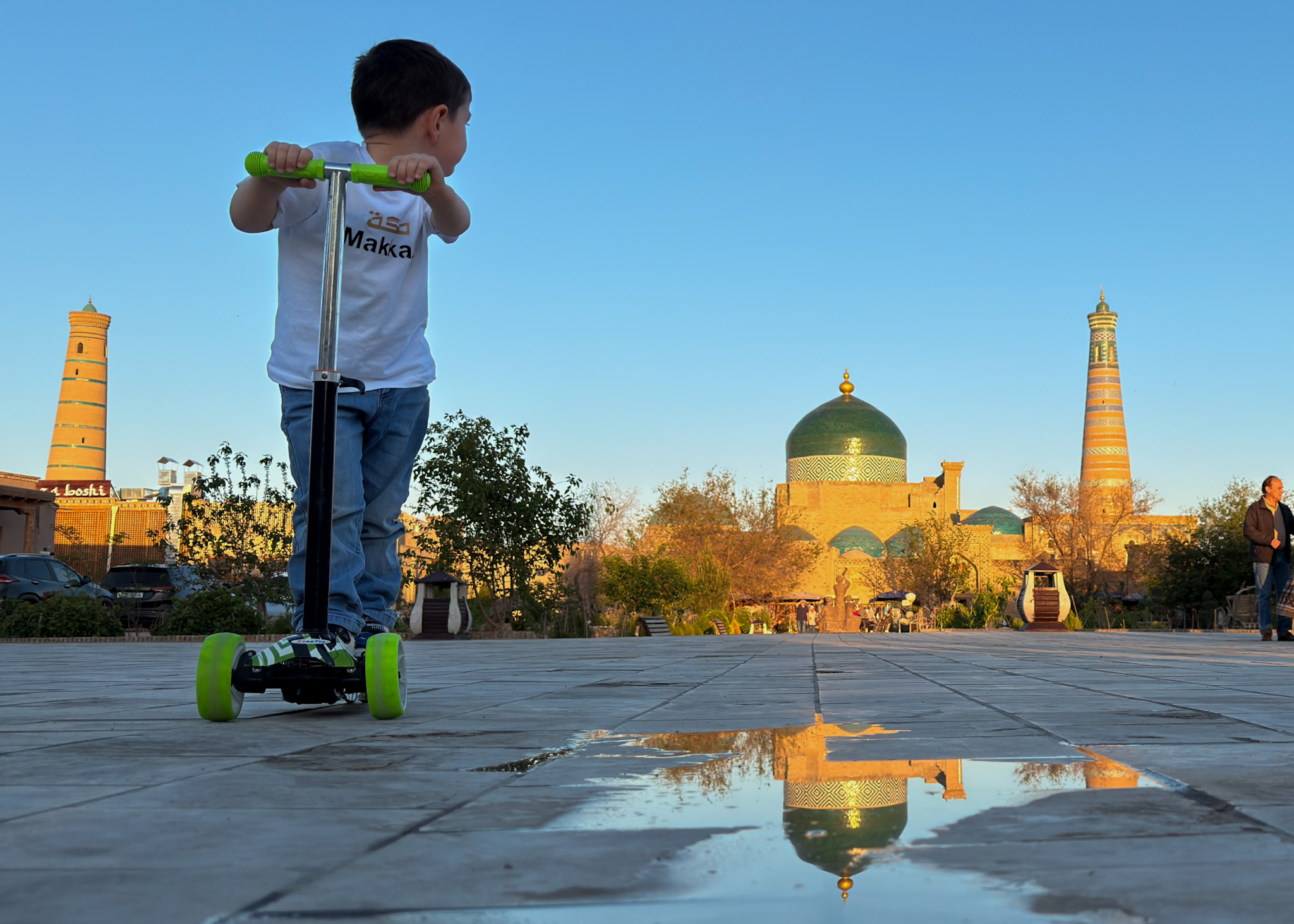
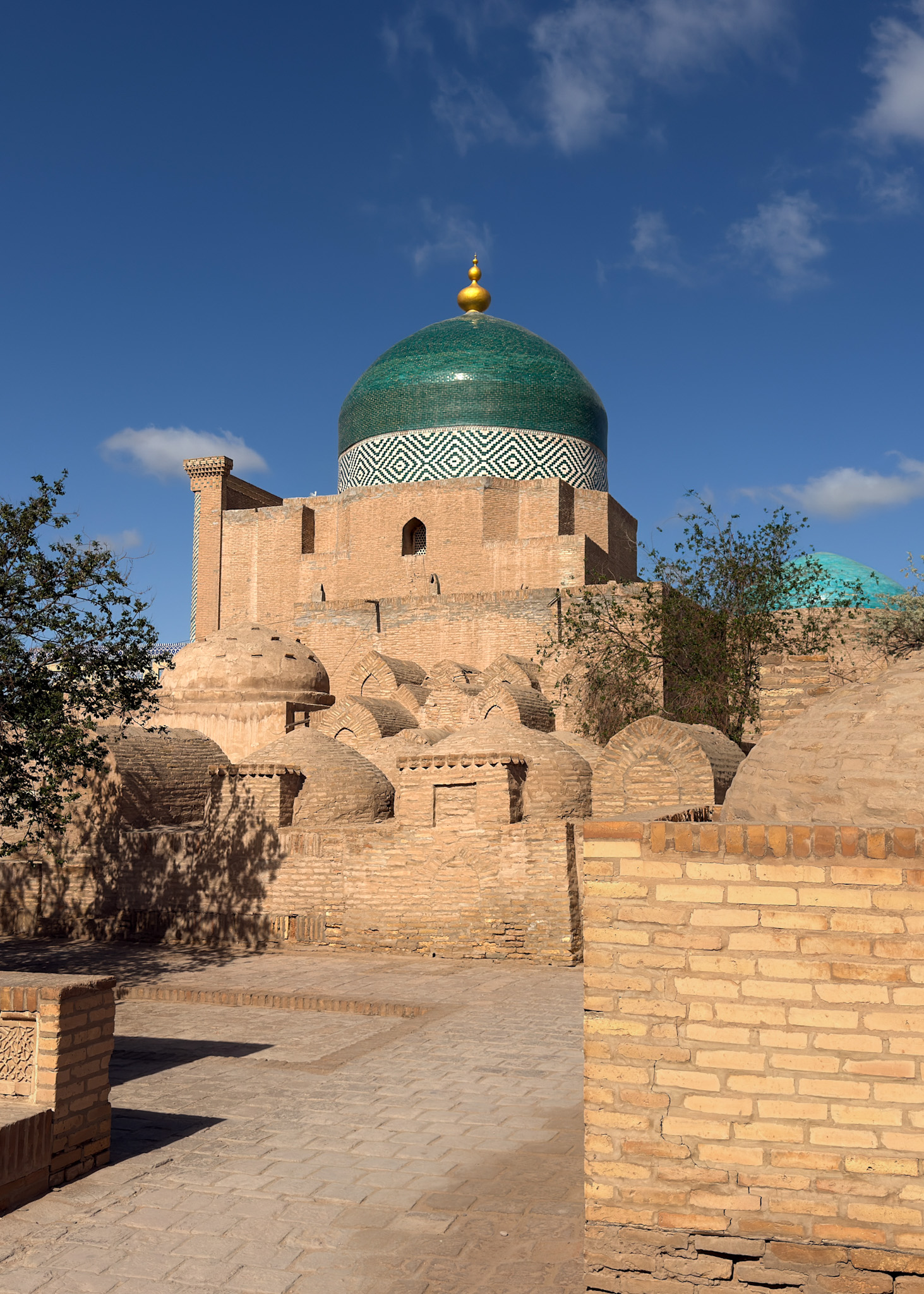
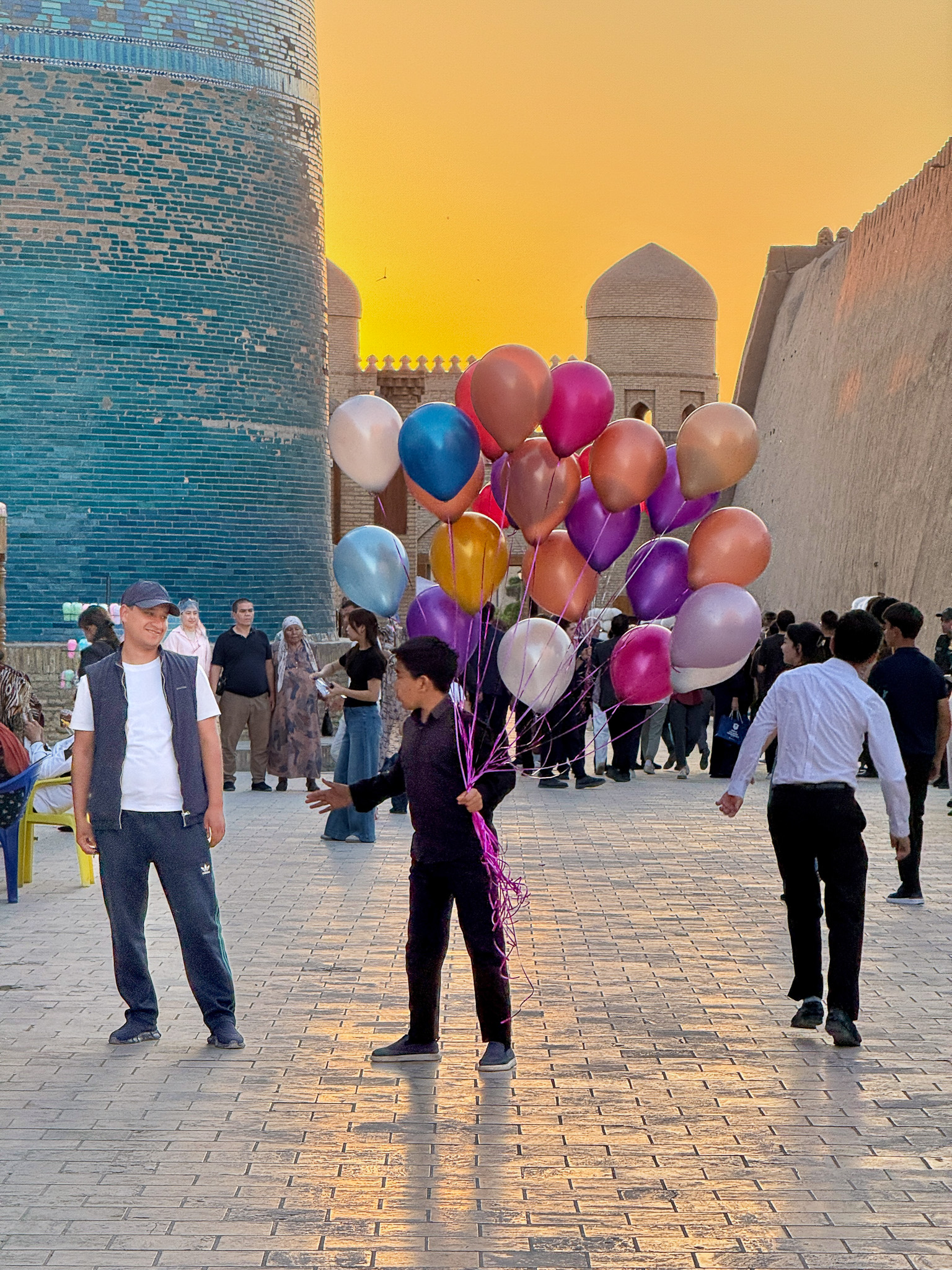
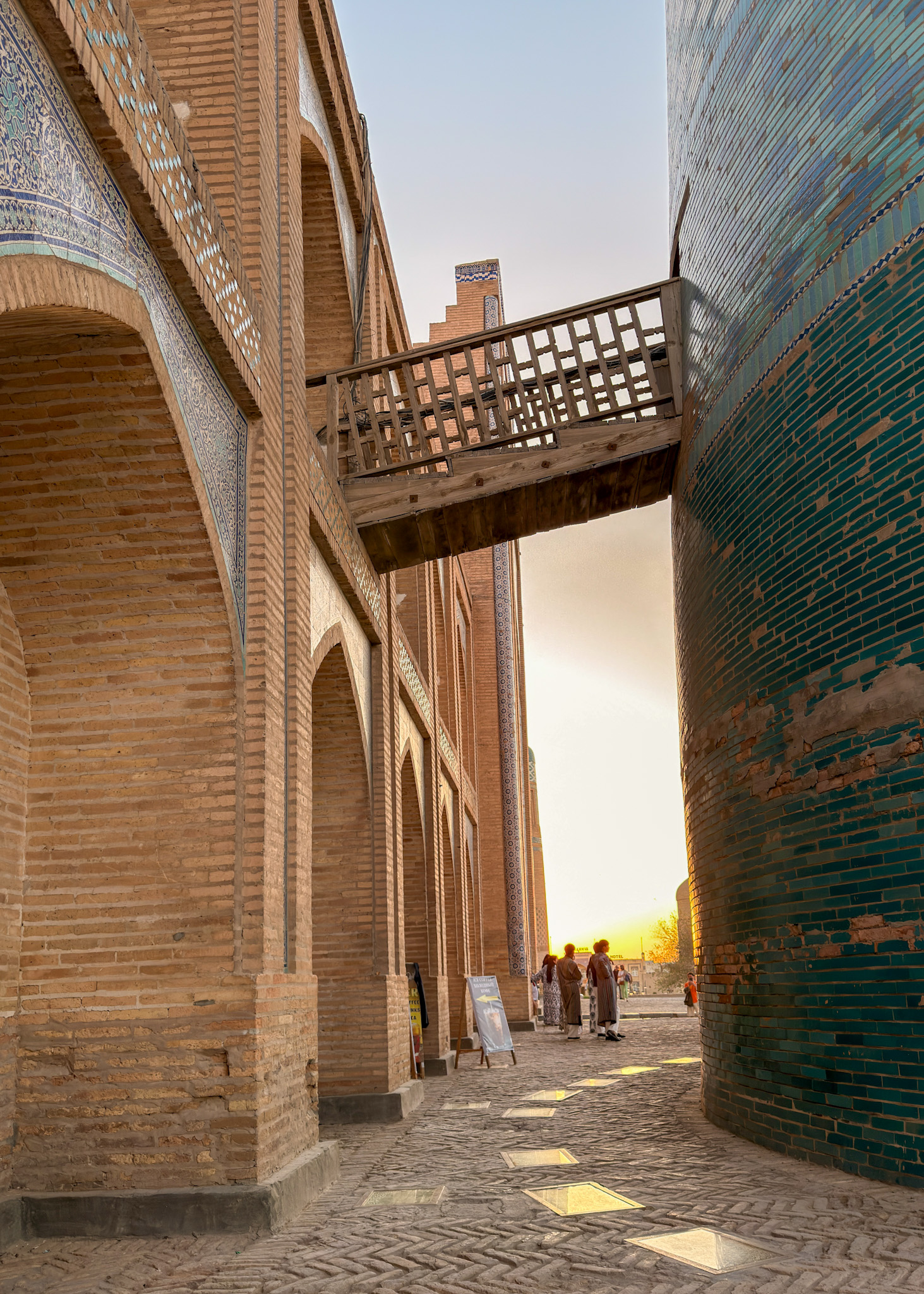
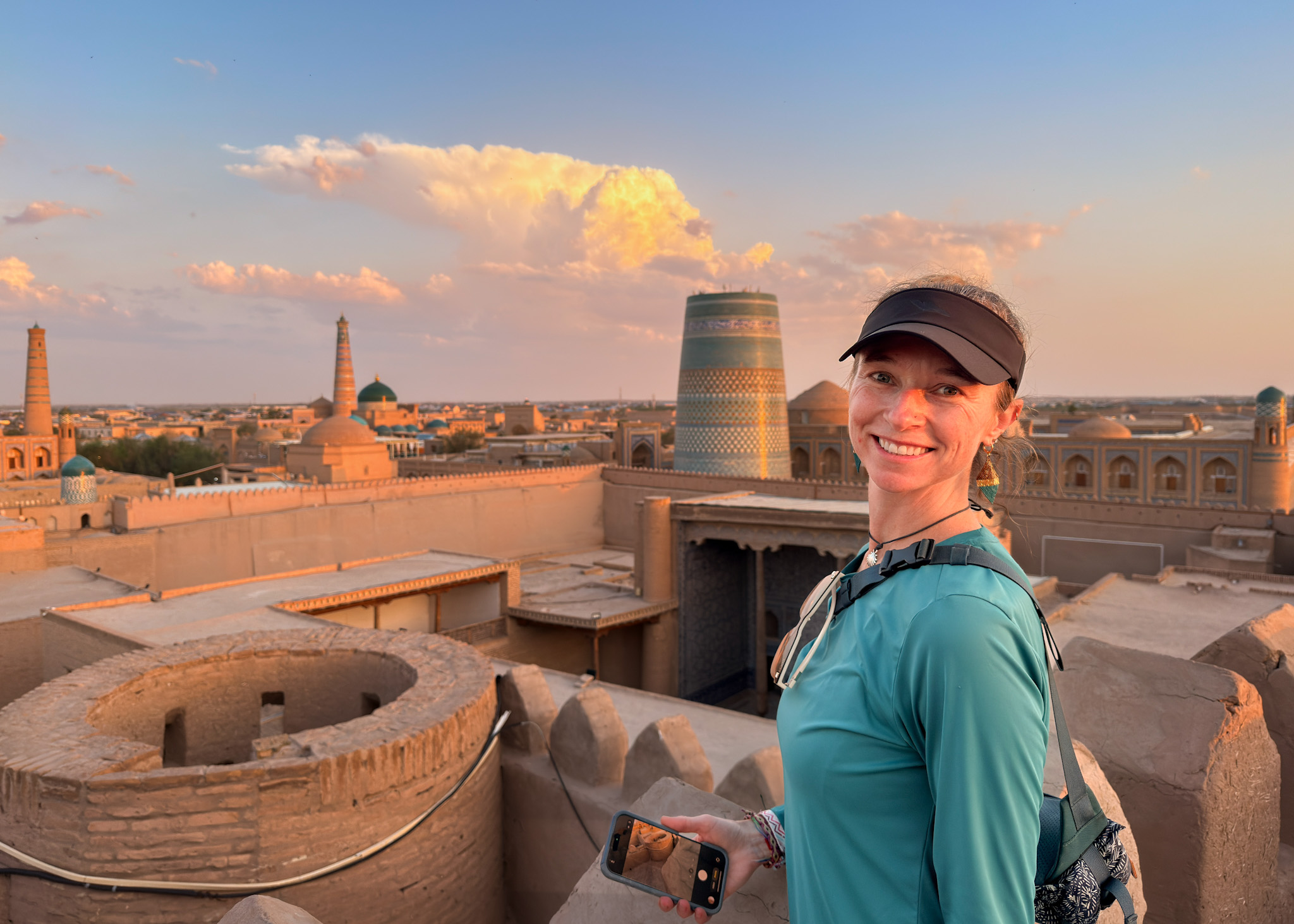
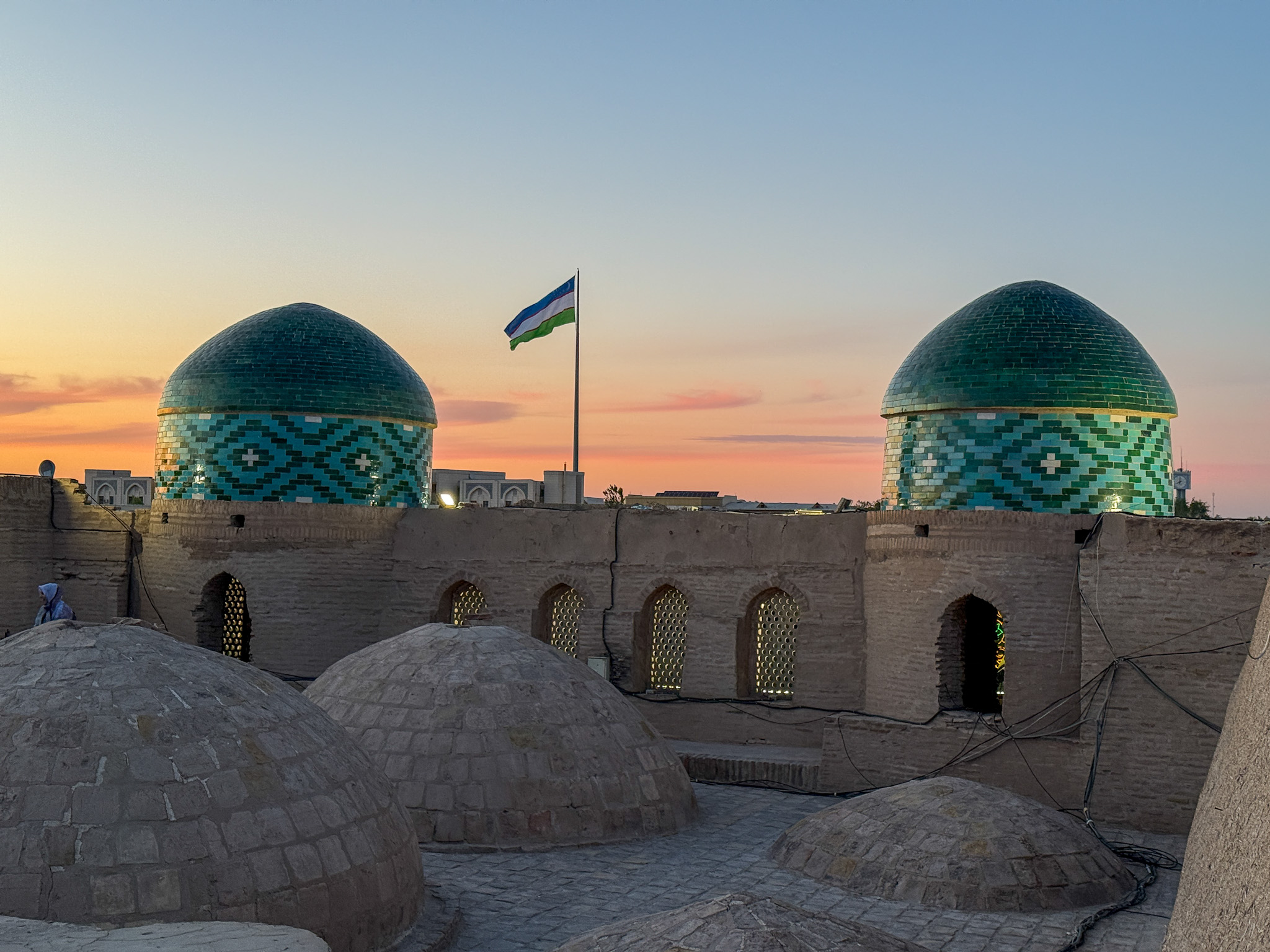
The lanes of Itchan Kala gave off a kind of low hum, something between the exotic and the ancient, and the only reasonable response to it was to put the phone away and walk toward whatever looked interesting. Then we just wandered. No agenda, no direction, just moving through the flagstone lanes and letting the city reveal itself. Golden hour in the desert does something to light that is hard to describe. The air itself seems to glow, and the blue and green tilework on the mosques and madrasas catches that light and radiates in a way that stops you mid-step.
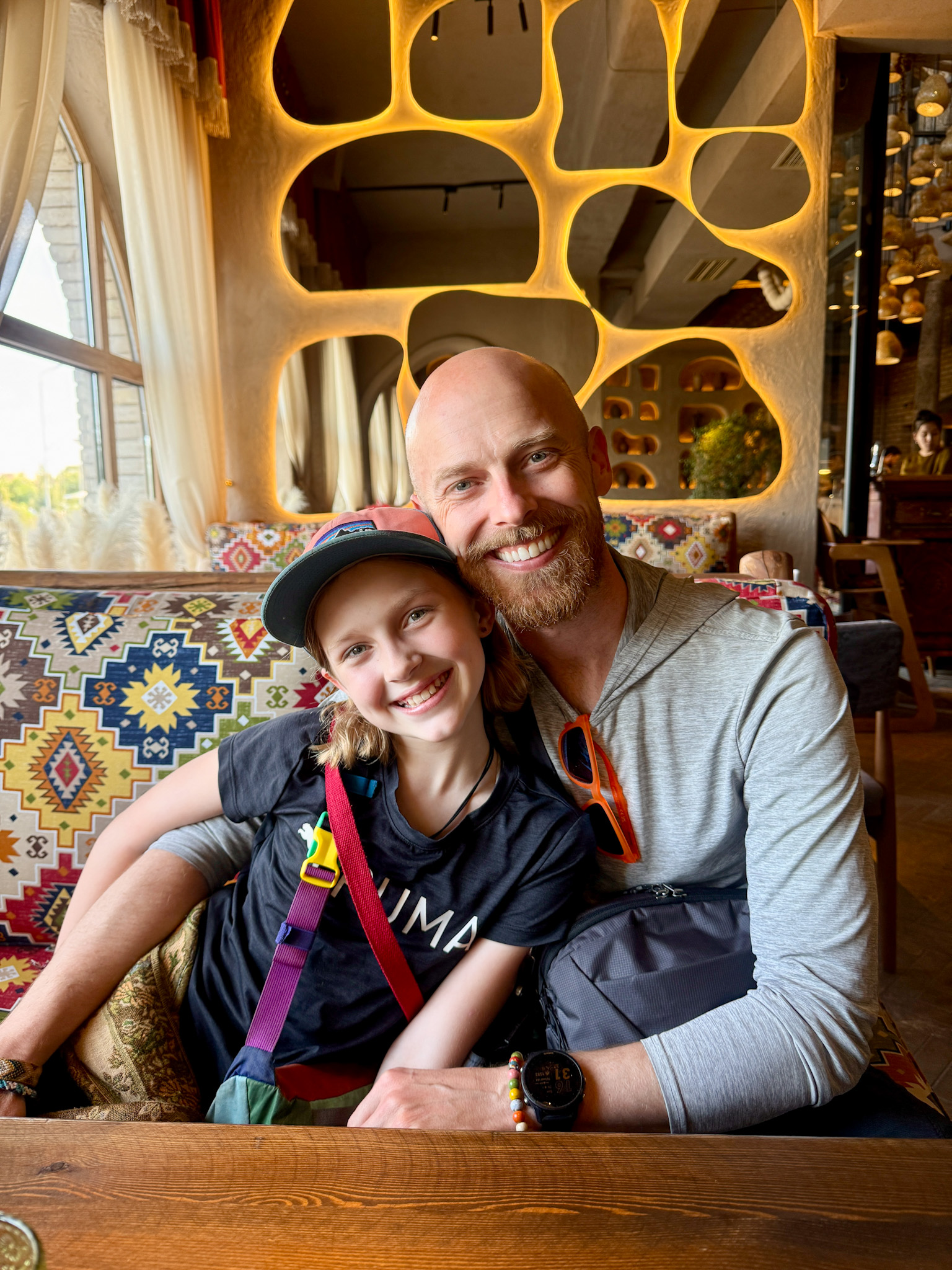
We made our way to Terrassa Cafe, consistently ranked the top restaurant in Khiva, with a shaded rooftop terrace and jaw-dropping views over the old town. We had a mezze plate, two soups, and a Khiva Bayti kebab, beef grilled on a skewer and served wrapped in thin flatbread with tomato sauce and yogurt. The kebab won the table by a clear margin. We finished the evening with more wandering as darkness settled in and the minarets began lighting up under their built-in illumination systems. Uzbekistan has been outstanding at this at every historic site we’ve visited, and Khiva is the best of all of them.
The next morning we had a driver coming to take us out into the desert for the day, with a pickup right after breakfast and the girls needing homework done before we left. Into this already moderately pressured morning, Max announced he was going for a run. He should have gotten up an hour earlier. He said he’d be back by 8:40, but this left Shaina to manage the homework situation, the packing, and the general readiness of the whole operation while he went and did laps around an ancient city. Not his finest logistical moment. She gave him the green light anyway, and he quickly slunk away without looking back.
He ran two circuits of the walled city. Each loop is 2.5 kilometers on the dot, and even at 8:00 AM, the route was already baking under a full desert sun. In his rush to get out of the house, he had forgotten sunscreen. He had forgotten his hat. He even forgot his sunglasses. At some point he removed his T-shirt and wrapped it around his head like a turban. He is not entirely sure how this was received by the residents of Khiva, but he never looked back to find out. He returned to the guesthouse just before 8:40, technically on time but feeling behind schedule all the same. He showered at light speed, dressed, sat down at the breakfast table, and immediately had to excuse himself to find a hand towel to mop the sweat off his face. The girls asked what was wrong with him. There was no good answer.
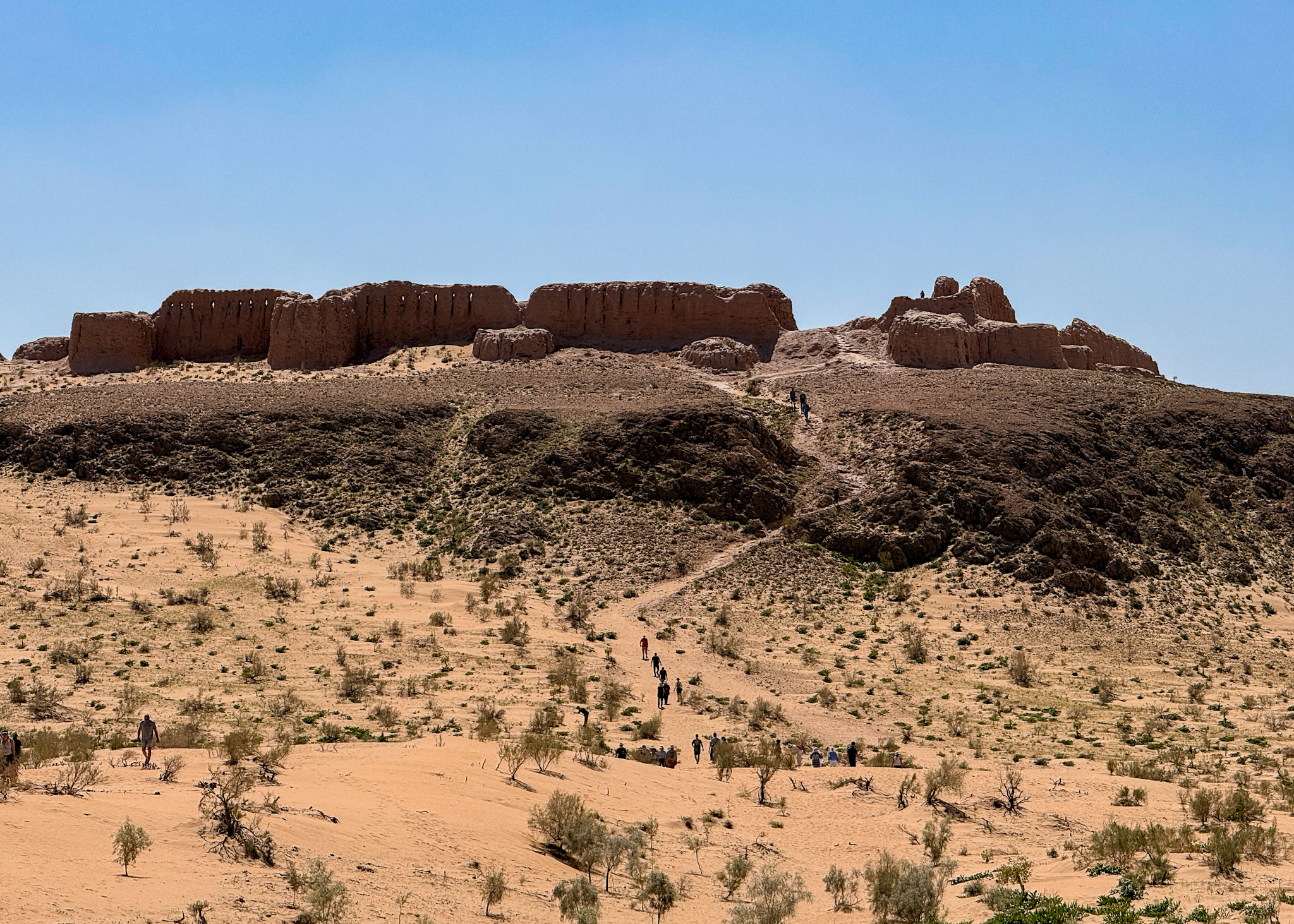
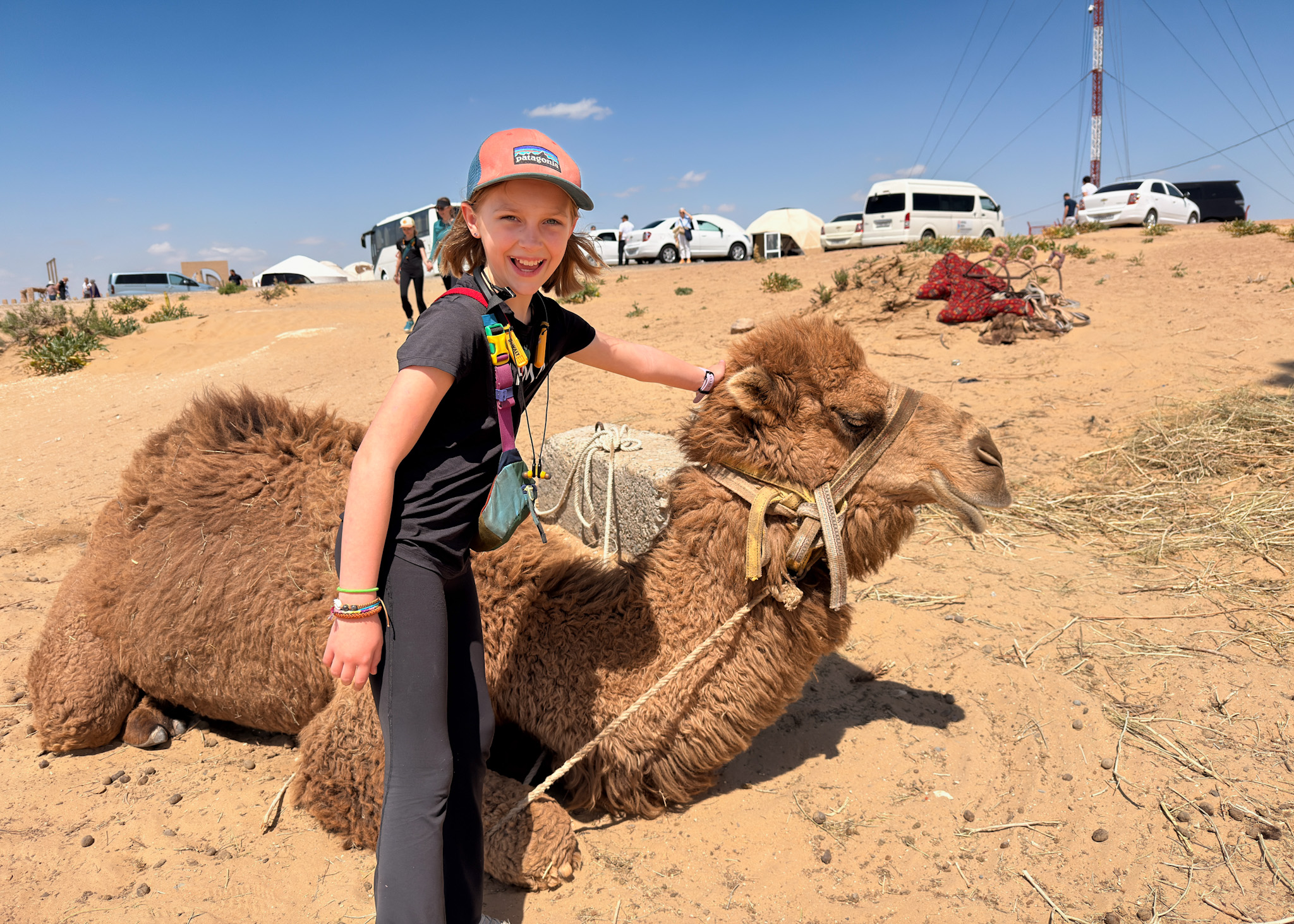
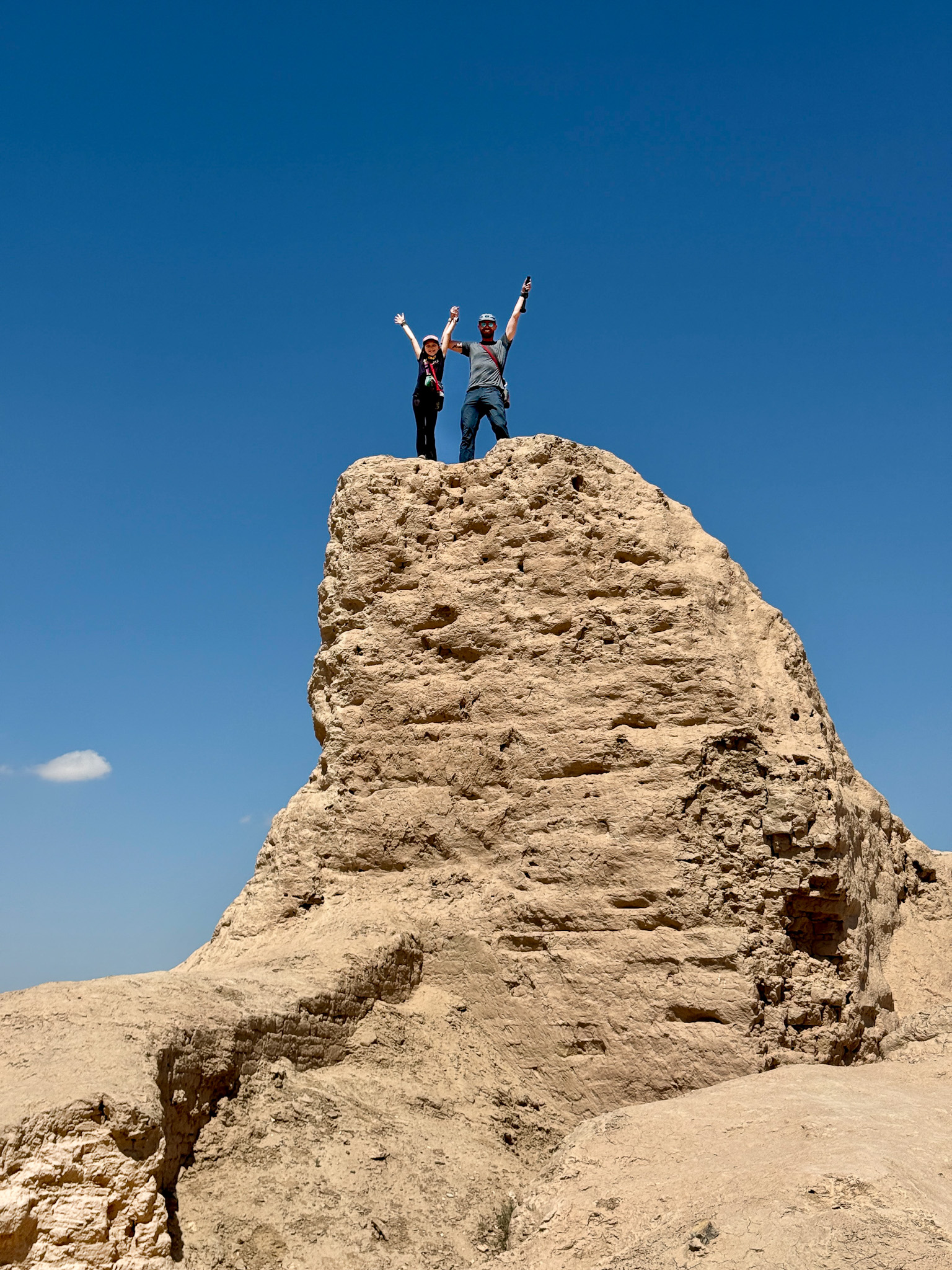
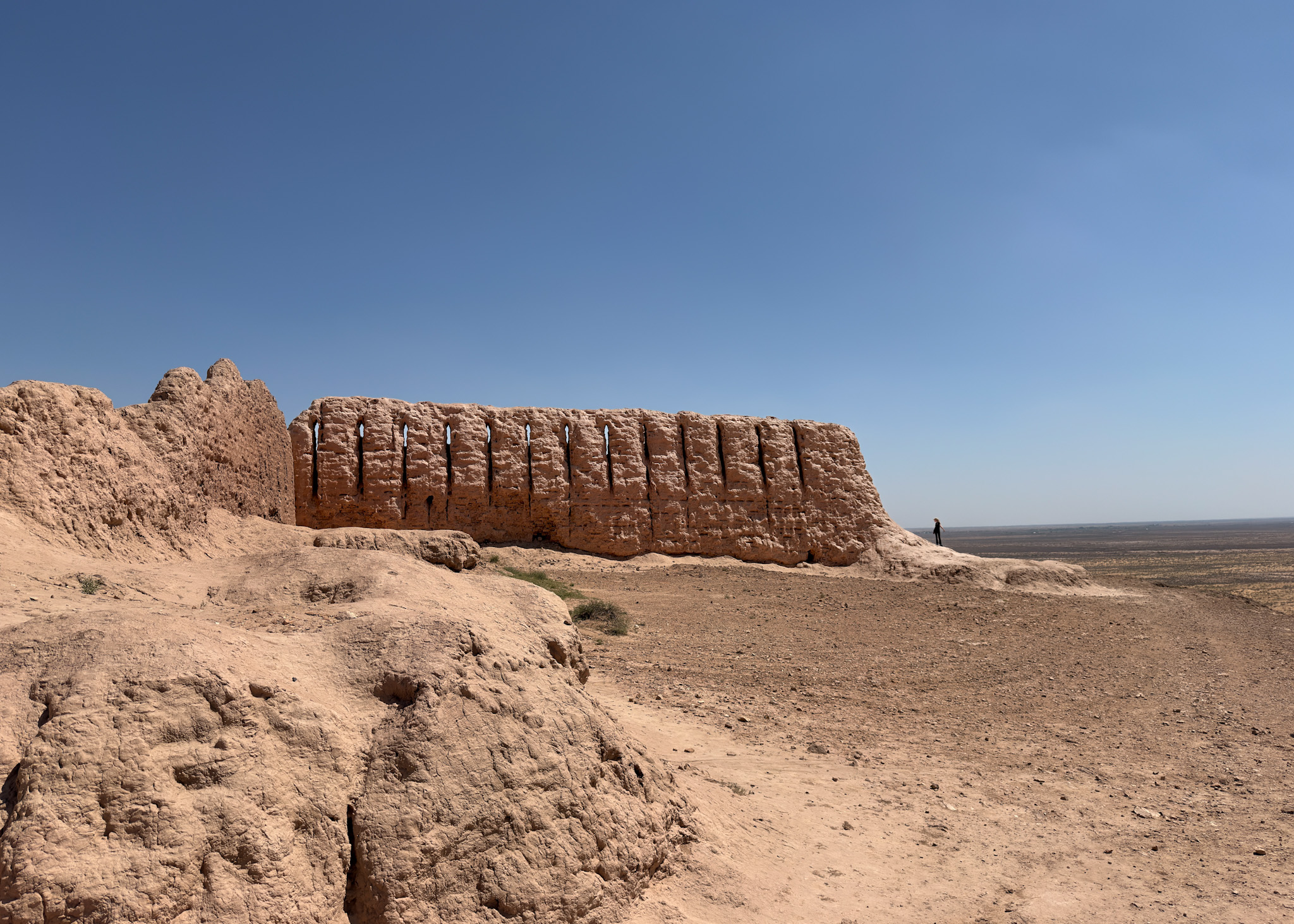
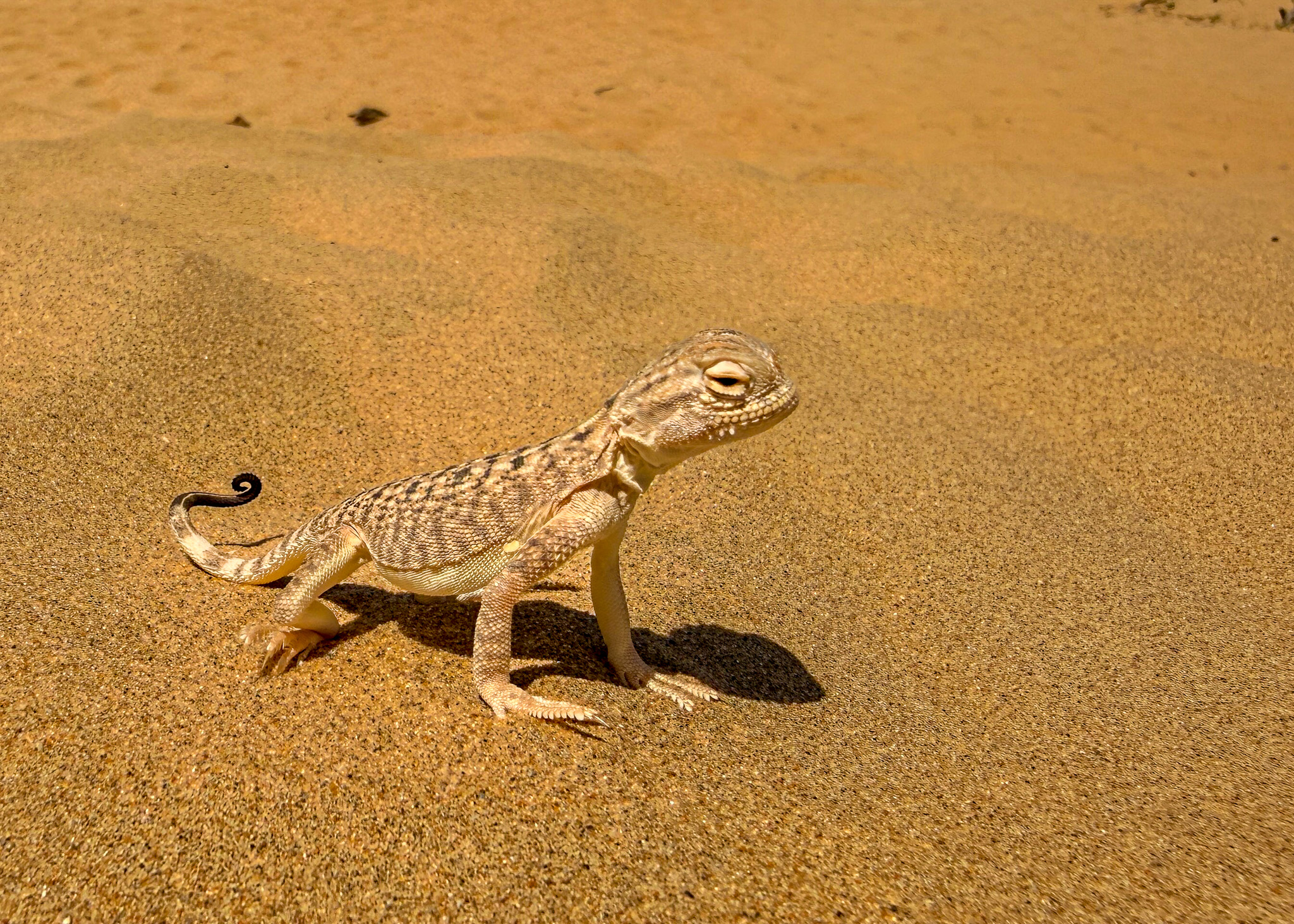
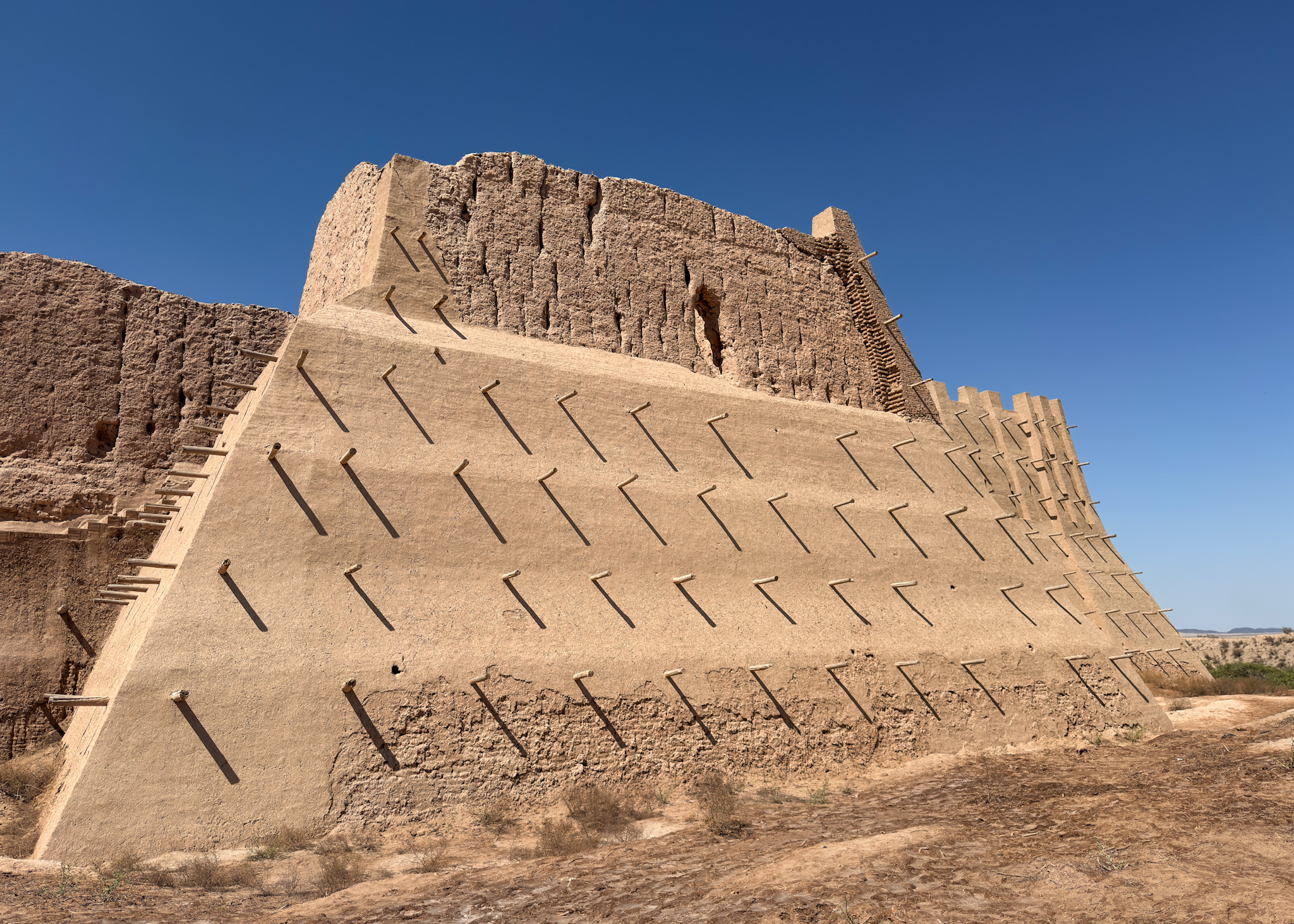
After breakfast we piled into a car for the two-hour drive out into the Kyzylkum desert to see what remains of ancient Khorezm. This was a civilization fed by the Amu Darya river that rose between two great deserts more than 2,000 years ago, almost certainly the cradle of Zoroastrianism, and passed between just about every major empire that swept through Central Asia. At its peak it had so many fortresses scattered across the desert that the region earned the nickname Elliq Qala, or “fifty fortresses.” The air conditioning in our driver’s car was not equal to the desert sun, but we made it.
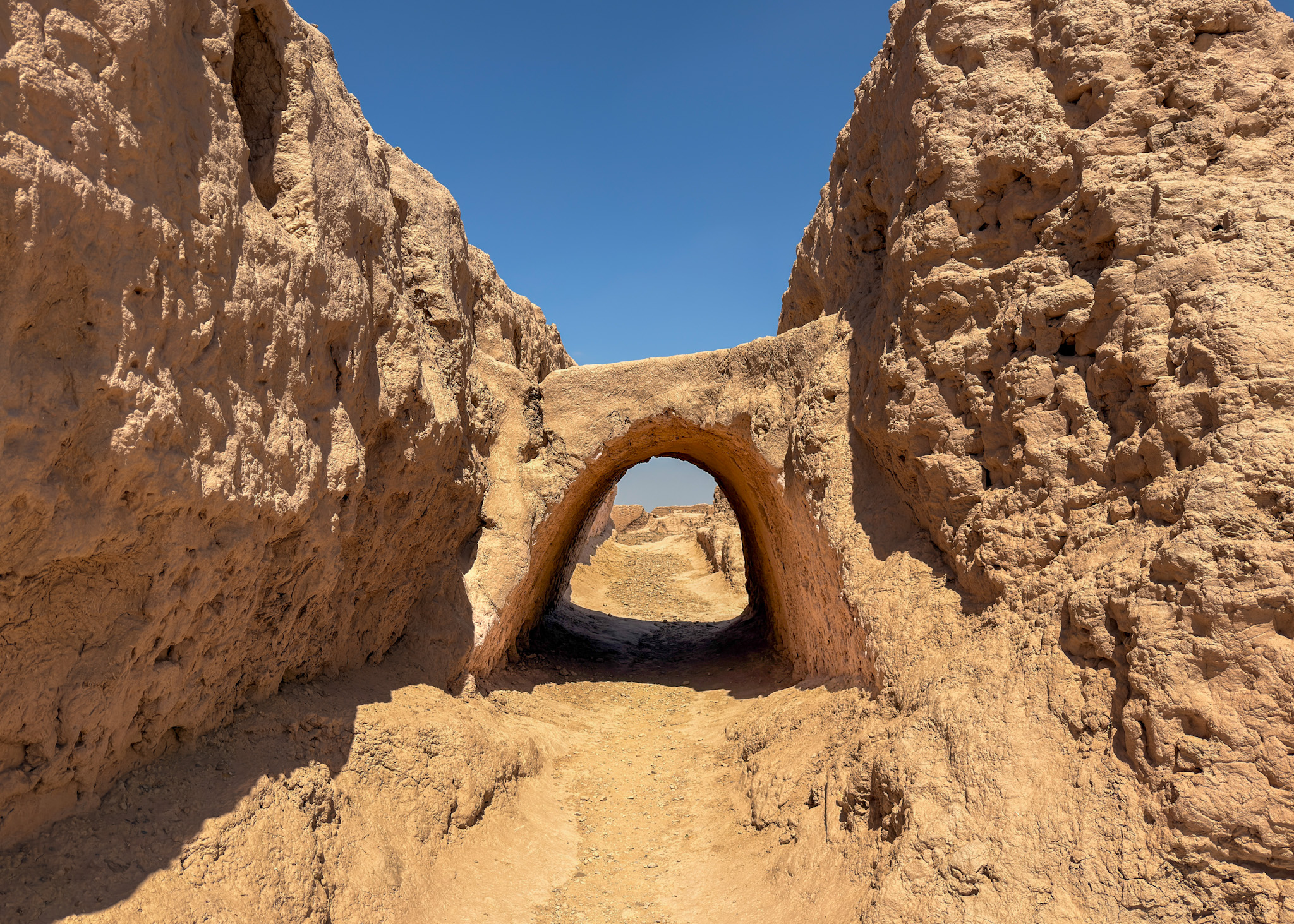
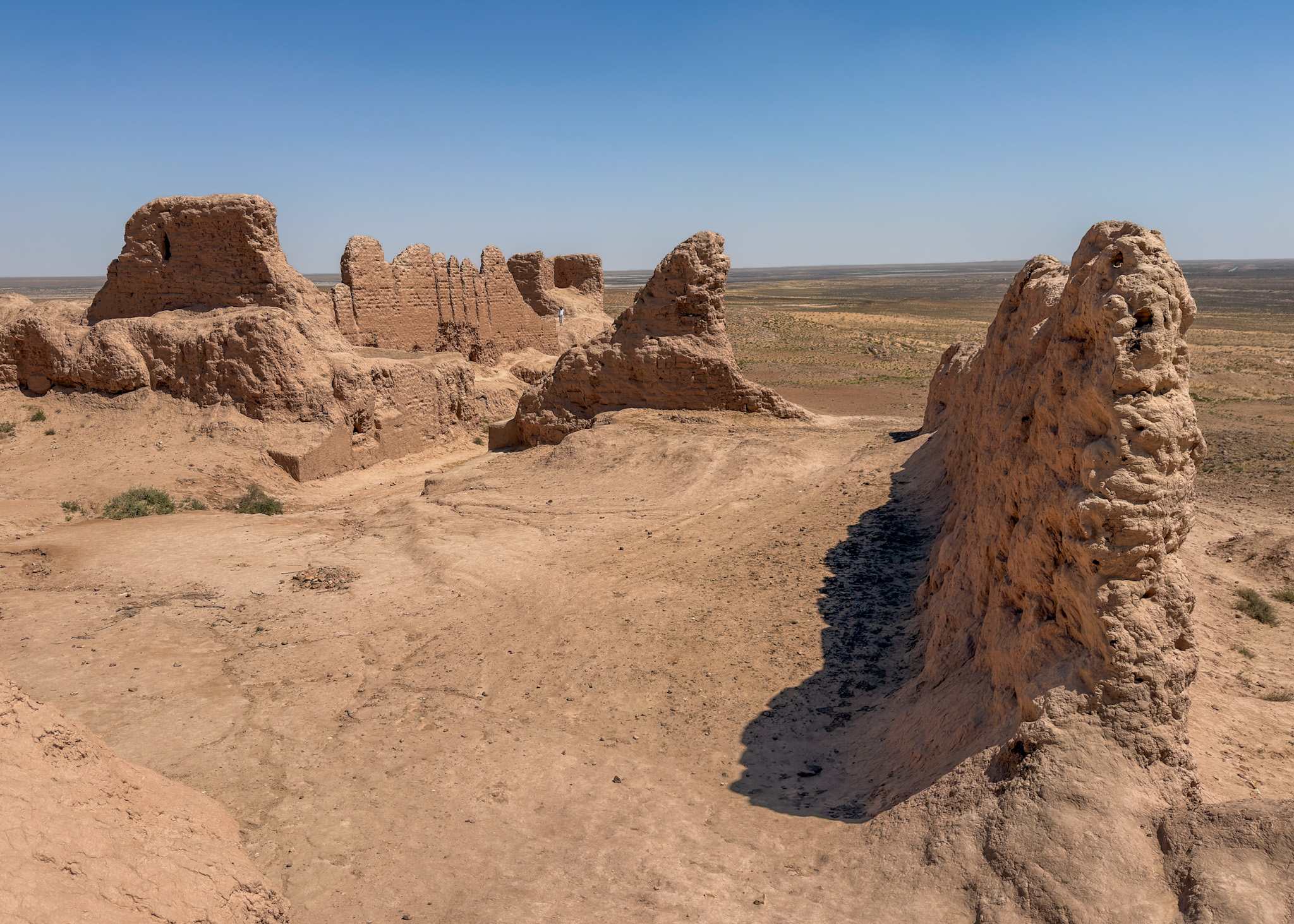
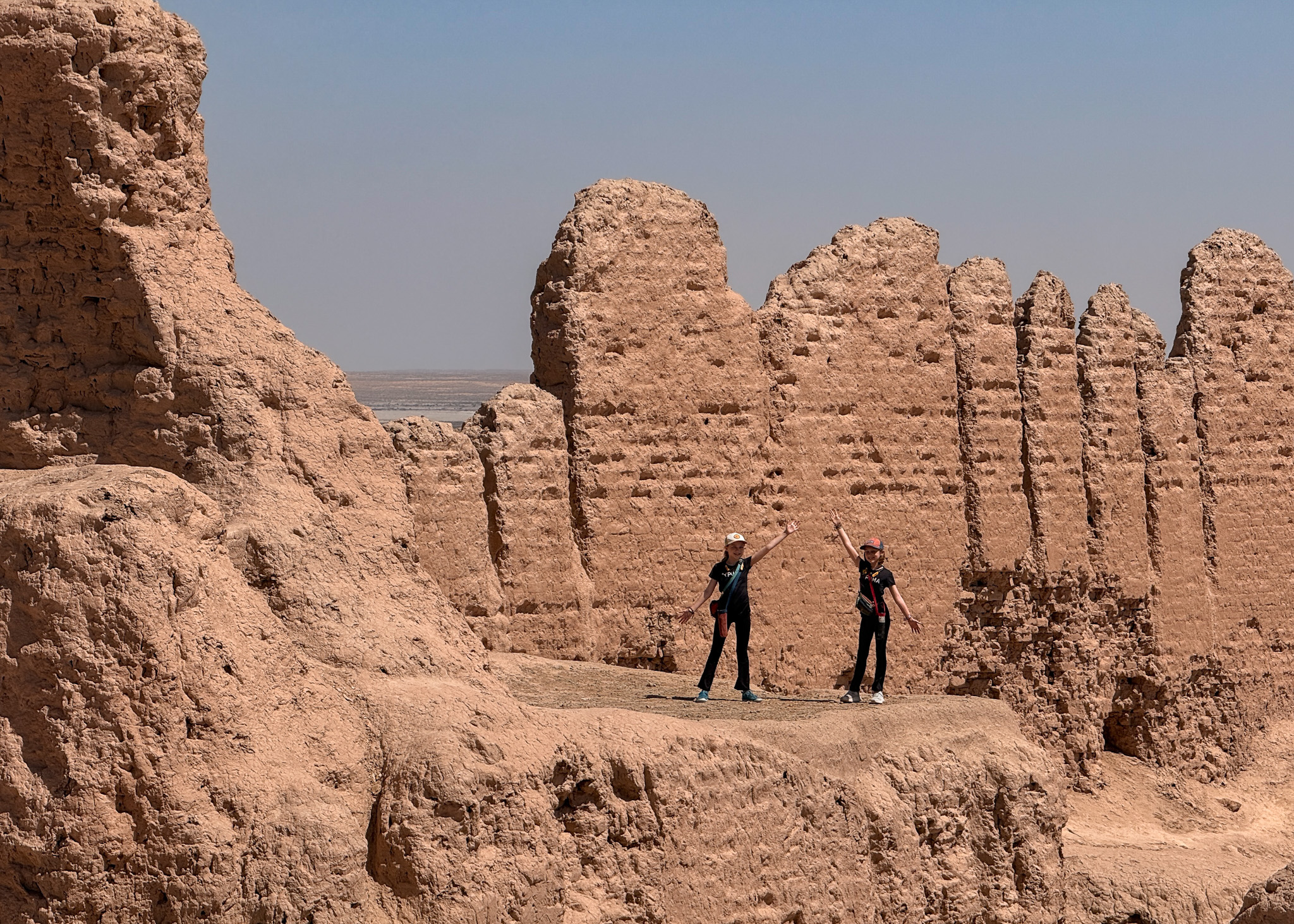
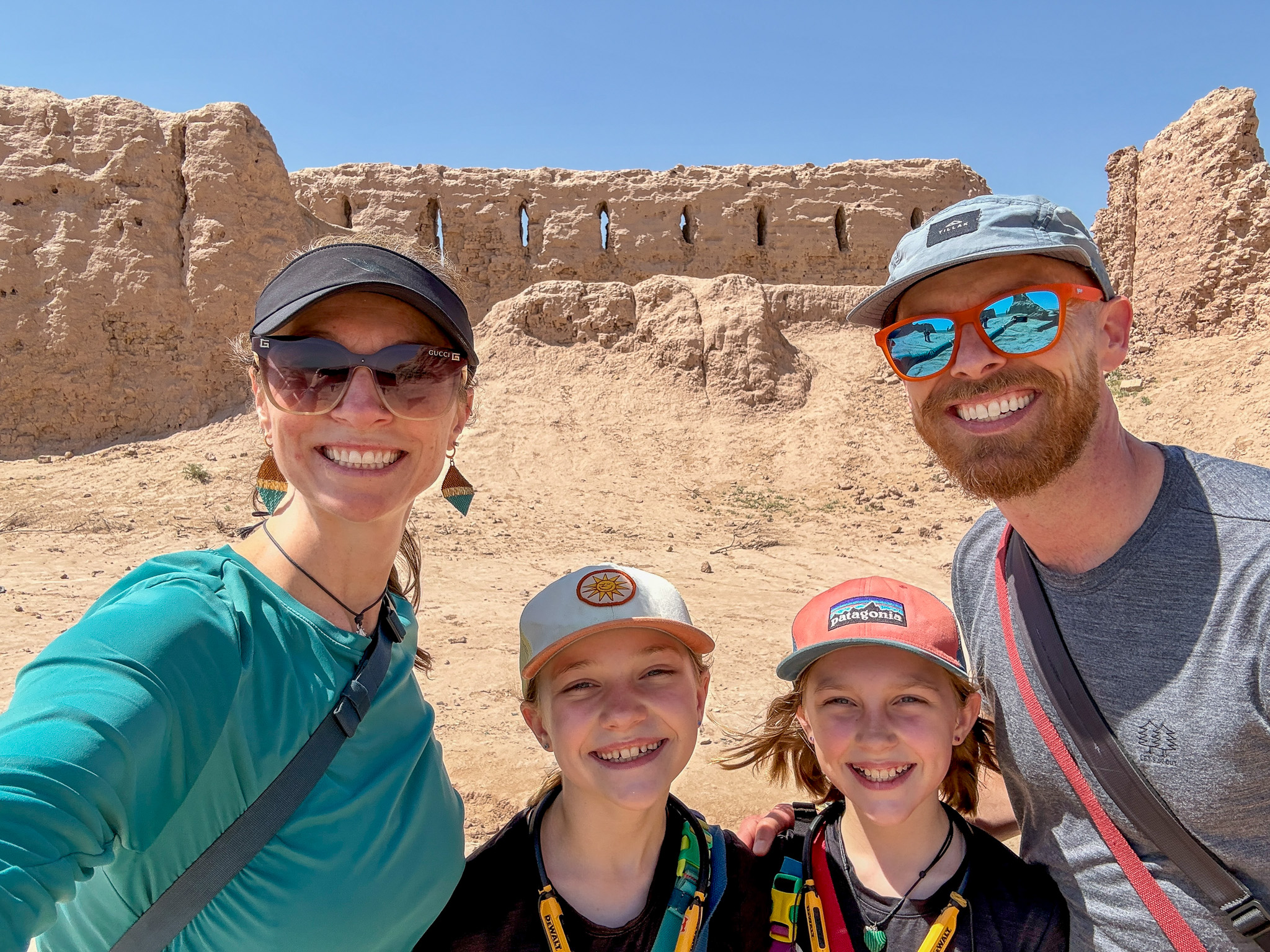
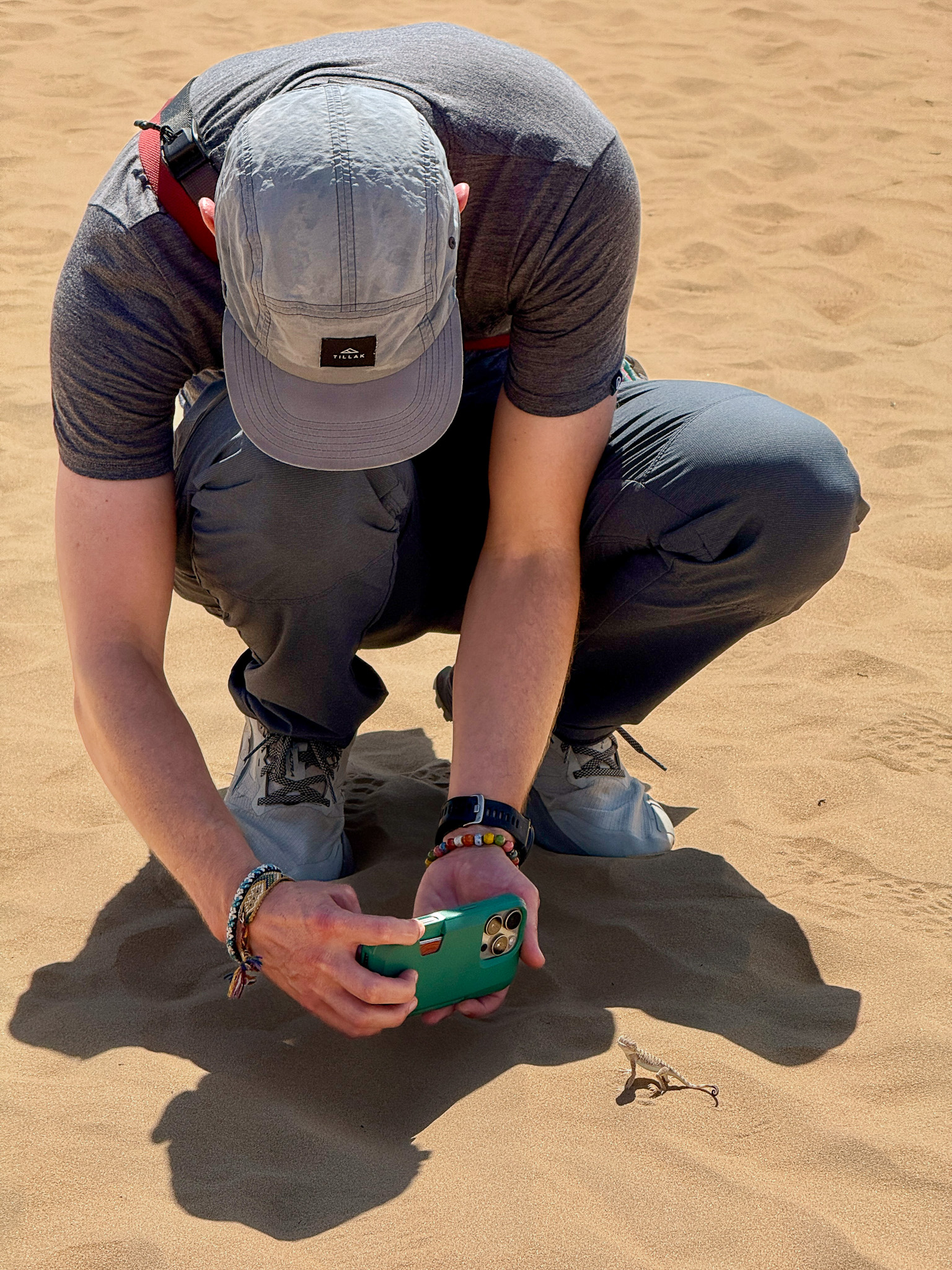
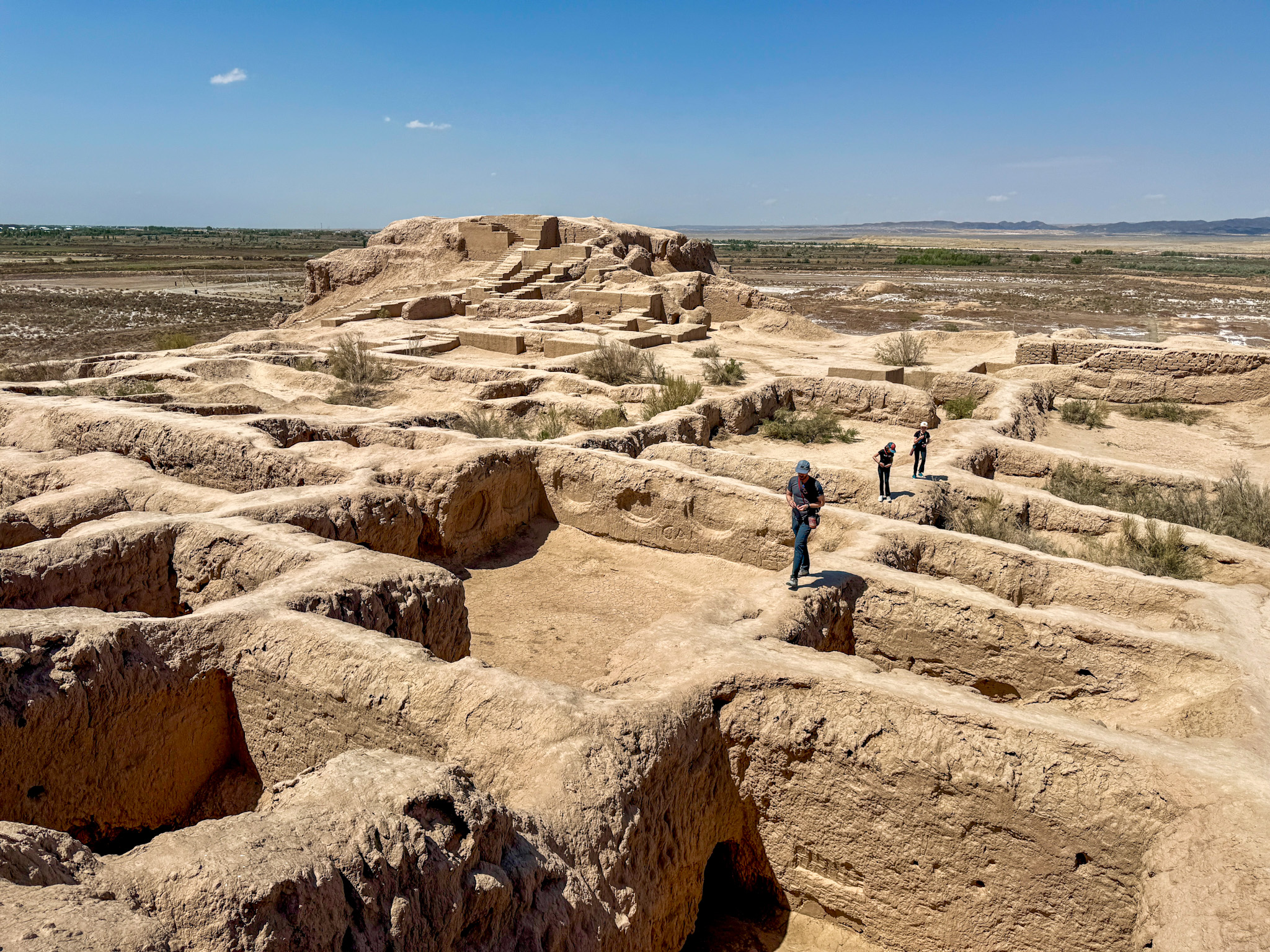
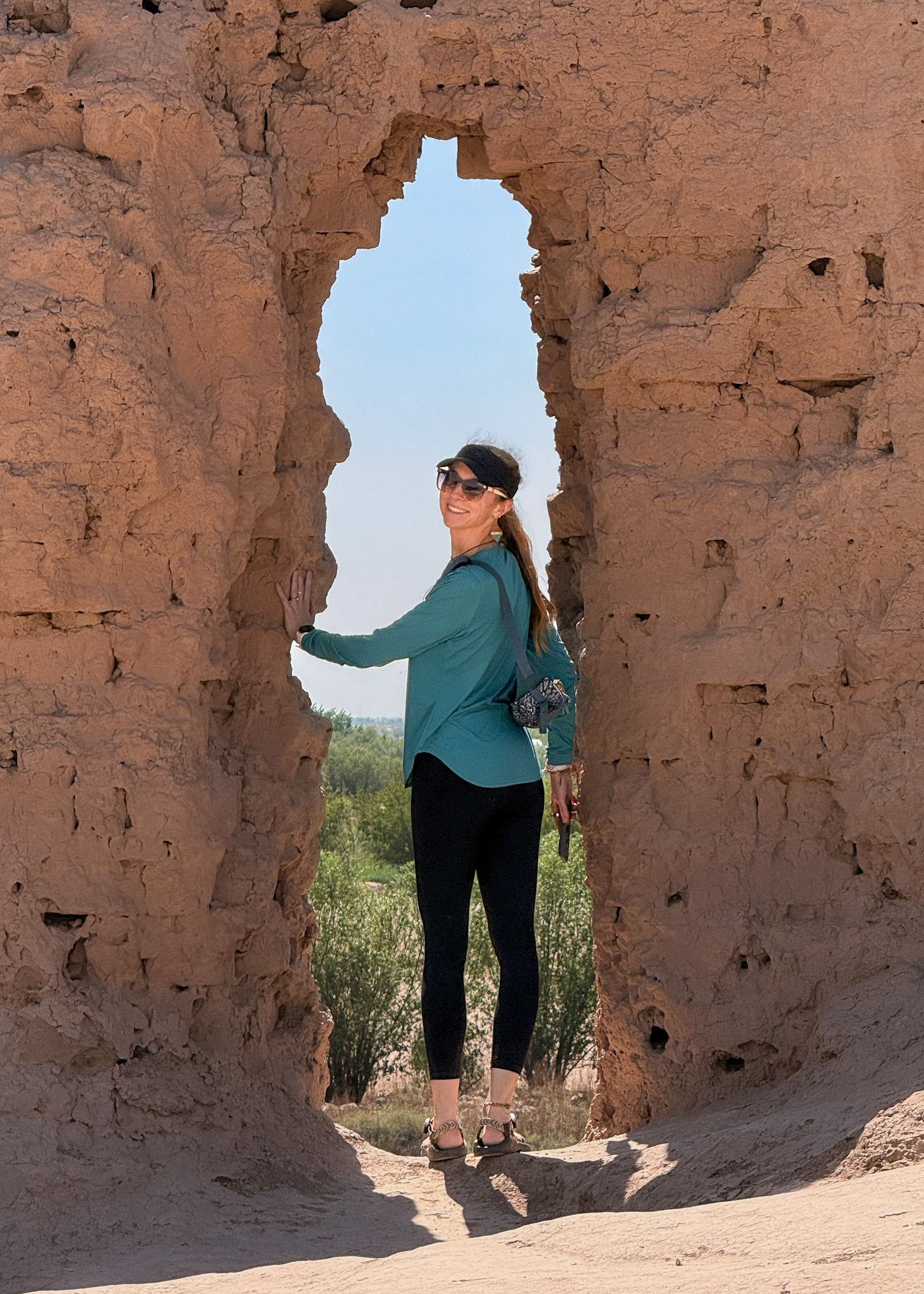
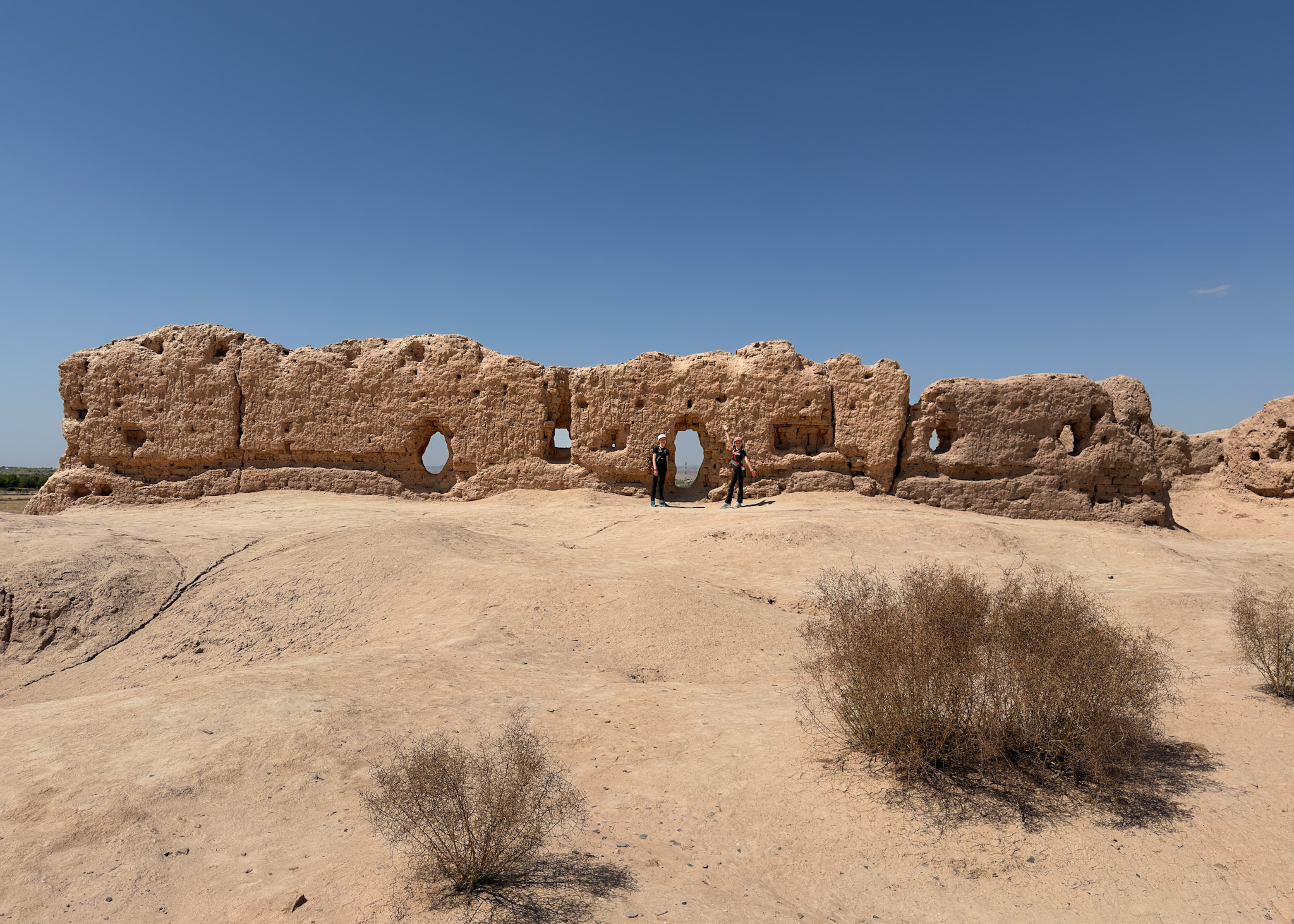
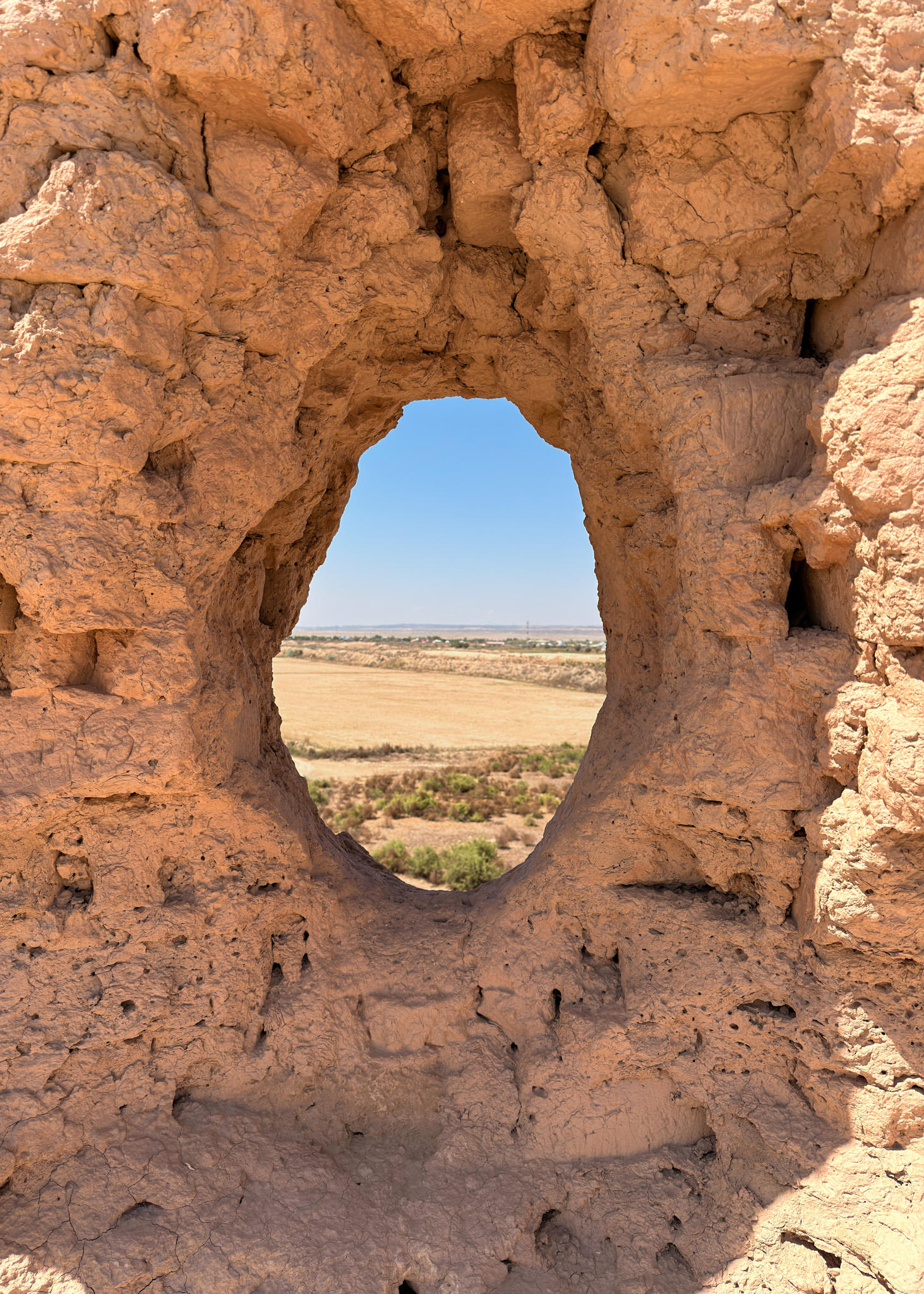
The first fortress was Ayaz Kala, actually three fortresses bundled into one site, the earliest dating to the 4th century B.C.E. and the latest to the 7th century C.E. The main structure sits perched on a steep slope with commanding views extending forty or more kilometers in every direction over the flat desert. The girls ran between the dilapidated mud-brick walls, ducked under earthen arches, and climbed over the exposed foundations with an enthusiasm that archaeologists would probably find alarming. It was exactly the right way to experience the place.
Toprak Kala was the royal palace complex and capital of the Khorezmian empire in the 2nd and 3rd centuries C.E., larger and more administratively impressive than Ayaz Kala, with ceremonial halls that archaeologists have given names like the Hall of Kings and the Hall of Dancing Monks. Unbeknownst to us back in Tashkent, we’d carefully studied these very grounds at the Center for Islamic Civilization—featured in a nicely done underfoot shadow box beneath transparent glass. Now it felt somewhat surreal to walk amongst the walls ourselves. The girls leapt from wall to wall, racing each other from one end of the complex to the other, repeatedly and with a consistency of energy the adults can only observe from a respectful distance.
Kyzyl Kala, the Red Fort, was our last stop on the ancient Khorezm “fortress circuit”. It was also the smallest and the most extensively restored, which gave it a different quality: less ruined, more legible, a clearer sense of what these places looked like when people actually lived and worked in them. We appreciated it for that, even if the restoration work may not have met the most rigorous archaeological standards set out by UNESCO.
After returning from our desert excursion to Khiva we had a late lunch at Khiva Moon: beef manti, four different meat skewers, salads, and local beer, eaten cross-legged on cushions at a low table in a shaded courtyard. The meal and ambience were top notch, that is until a group of Russians arrived midway through and chain-smoked with such dedication that we eventually moved inside to finish. Even paradise has its footnotes.
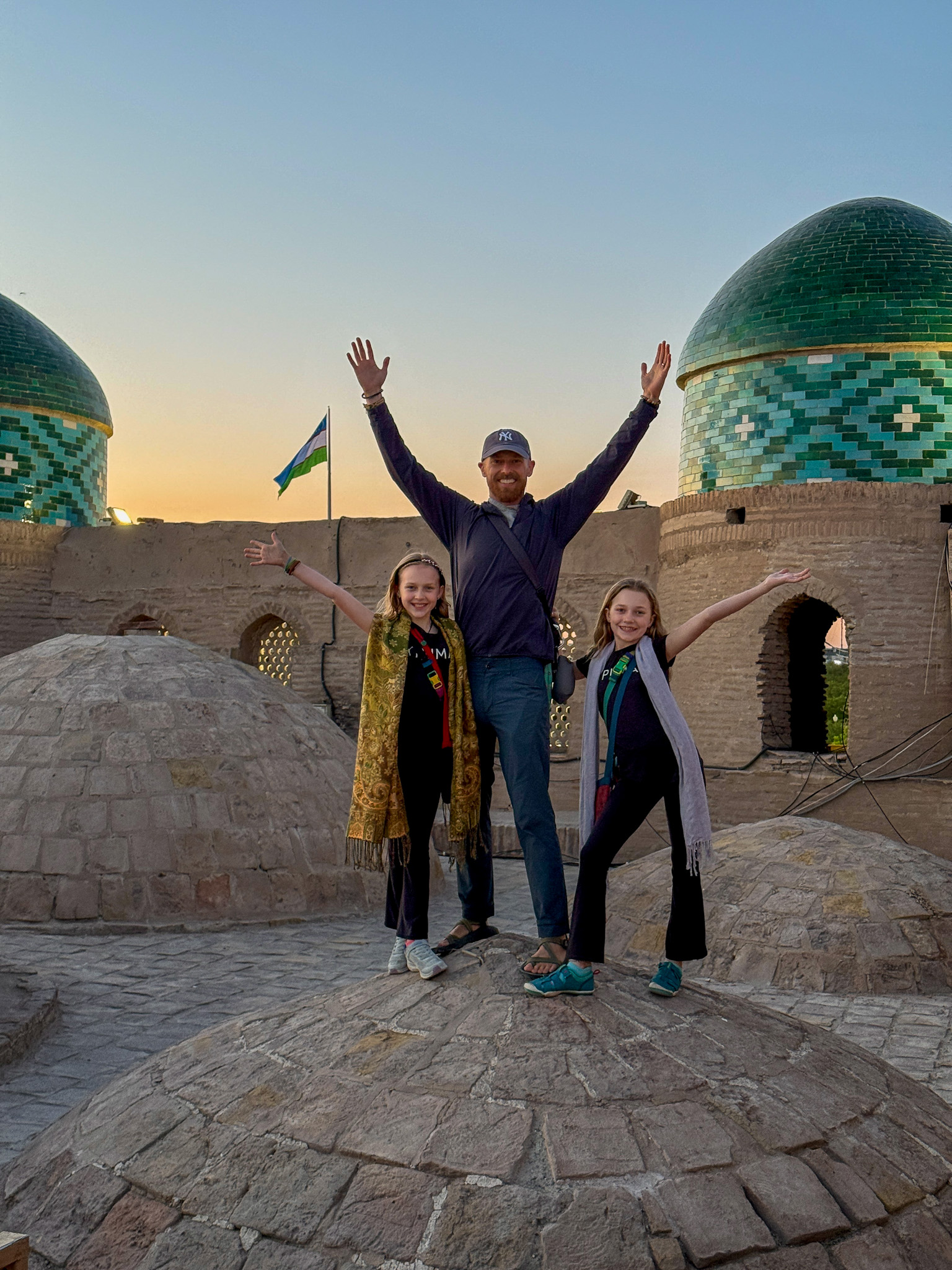
The day ended at the watchtower of the Kuhna Ark, the original citadel and residence of the Khans of Khiva, widely regarded as the best single vantage point in the city for sunset. We watched the light run through its full progression, gold to red to purple to deep blue, and then the minarets began lighting up below us and the whole city went magical. We stayed longer than we were supposed to. The attendant had to unlock the heavy wooden doors to let us out—for a moment it felt like we’d genuinely been locked into the garrison.
The following day was designated low-key, which it mostly was. We had a productive morning of homework and journaling, a leisurely lunch back at Terrassa, and then headed out in the early evening for the opening ceremony of an international dance festival our guesthouse had told us about, supposedly beginning at 18:00. The girls were giddy with excitement as they spotted the large crowd that had gathered at the East Gate. A bank of bleacher seating had been constructed. No one was being admitted. A guard suggested 19:00. We wandered the old lanes, looked at souvenirs, watched the light change on the minarets. Returned at 19:00. Still nothing. Another worker said 20:00. We bought ice cream, accepting once again that vanilla is the complete and total range of flavors available at every ice cream stand in Khiva, and kept walking. At 20:00, music and dancing were happening on stage. We asked when we could actually sit and watch. “Practice now. Watching on Monday.” The real festival actually started two days later, by which point we would be in a different country.
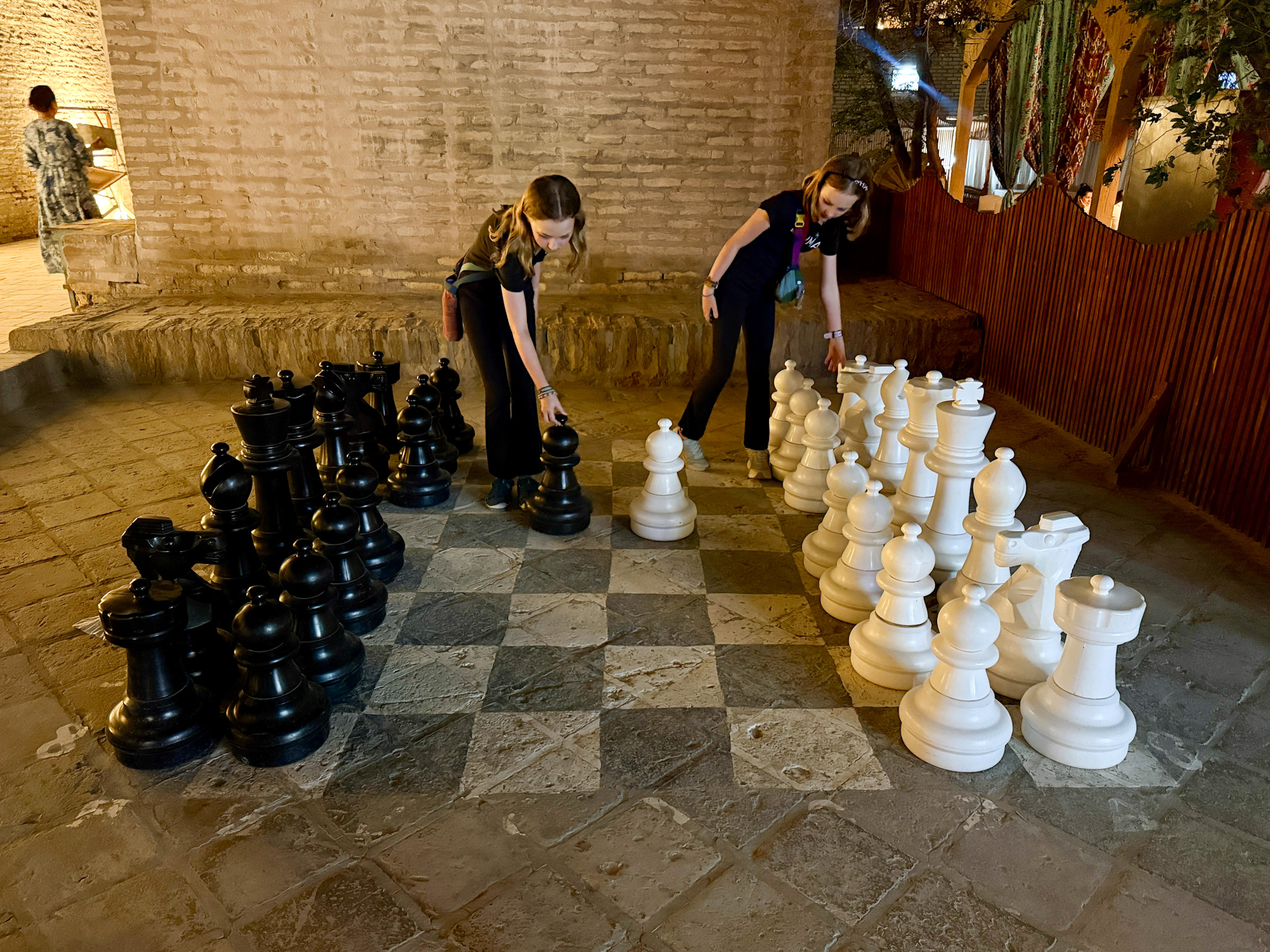
On the walk back, the girls were deflated, until we stumbled onto a giant streetside chessboard. The girls asked if they could play. What followed was a systematic dismantling of Finlee by Arya that suggested some tactical work is in order. But what actually stayed with us was the ending: they shook hands, said good job, and meant it. No drama, no tears, no gloating on either side. Then they enthusiastically reset the chess board together “so that more people can have fun later.” Tiny moments like that add up.
The final full day in Khiva was the real one, and we went in with a theme.
A quick disclaimer before we dive into the history: what follows is how Max presented the day to the girls, built around a narrative thread he’d assembled with some multiplatform AI-guided research and a fair amount of creative license. The broad historical outlines are accurate. The framing, though, was deliberately chosen to hold the attention of a nine and eleven-year-old, which requires a hook. And the hook Khiva handed him was almost too good: a parade of rulers who kept overreaching in increasingly spectacular ways, each one seemingly determined to outdo his predecessor’s particular brand of ambition, and each one paying for it in increasingly memorable fashion. Whether a historian would organize the day around the concept of hubris is debatable. Whether it worked on the girls is not.
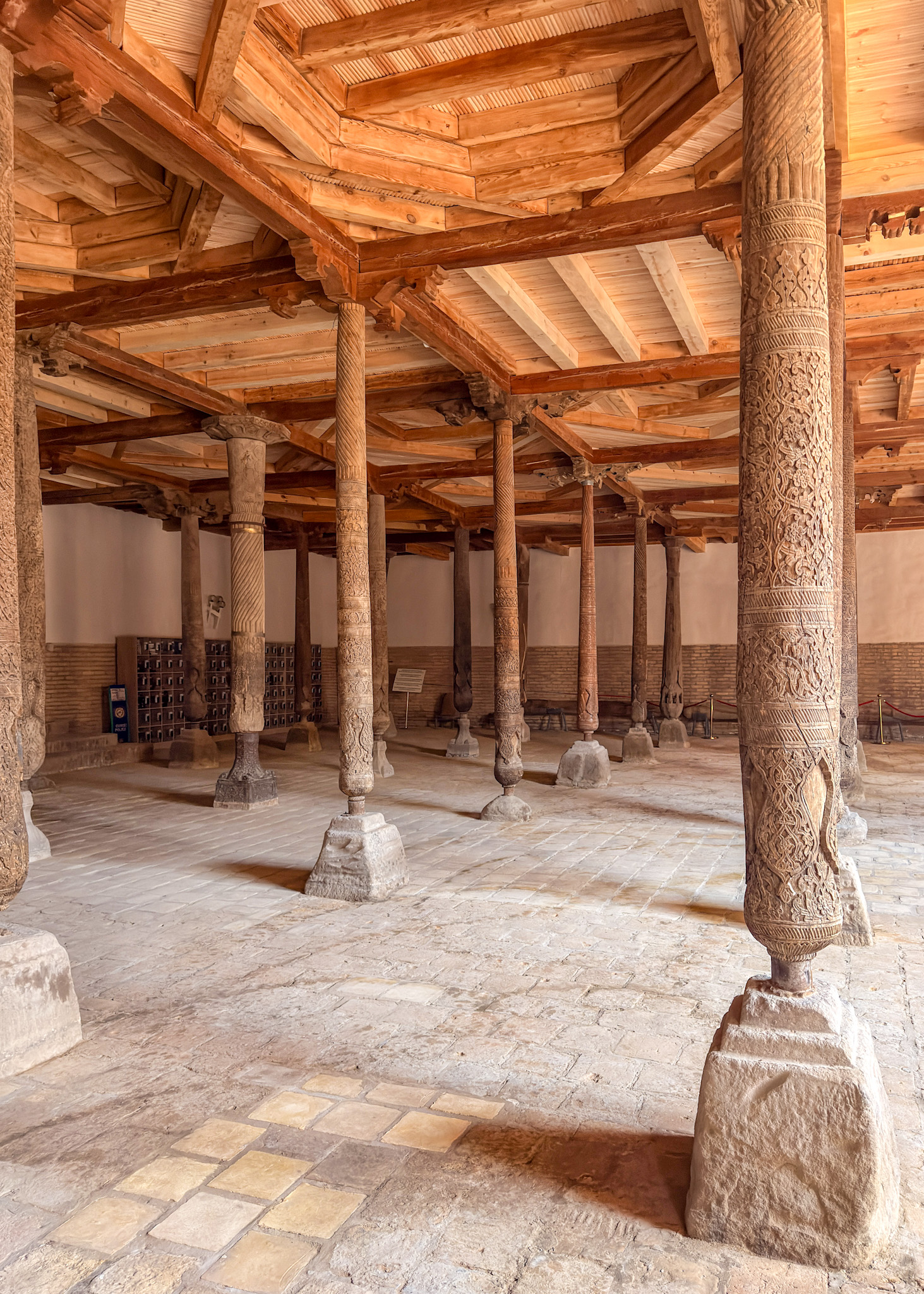
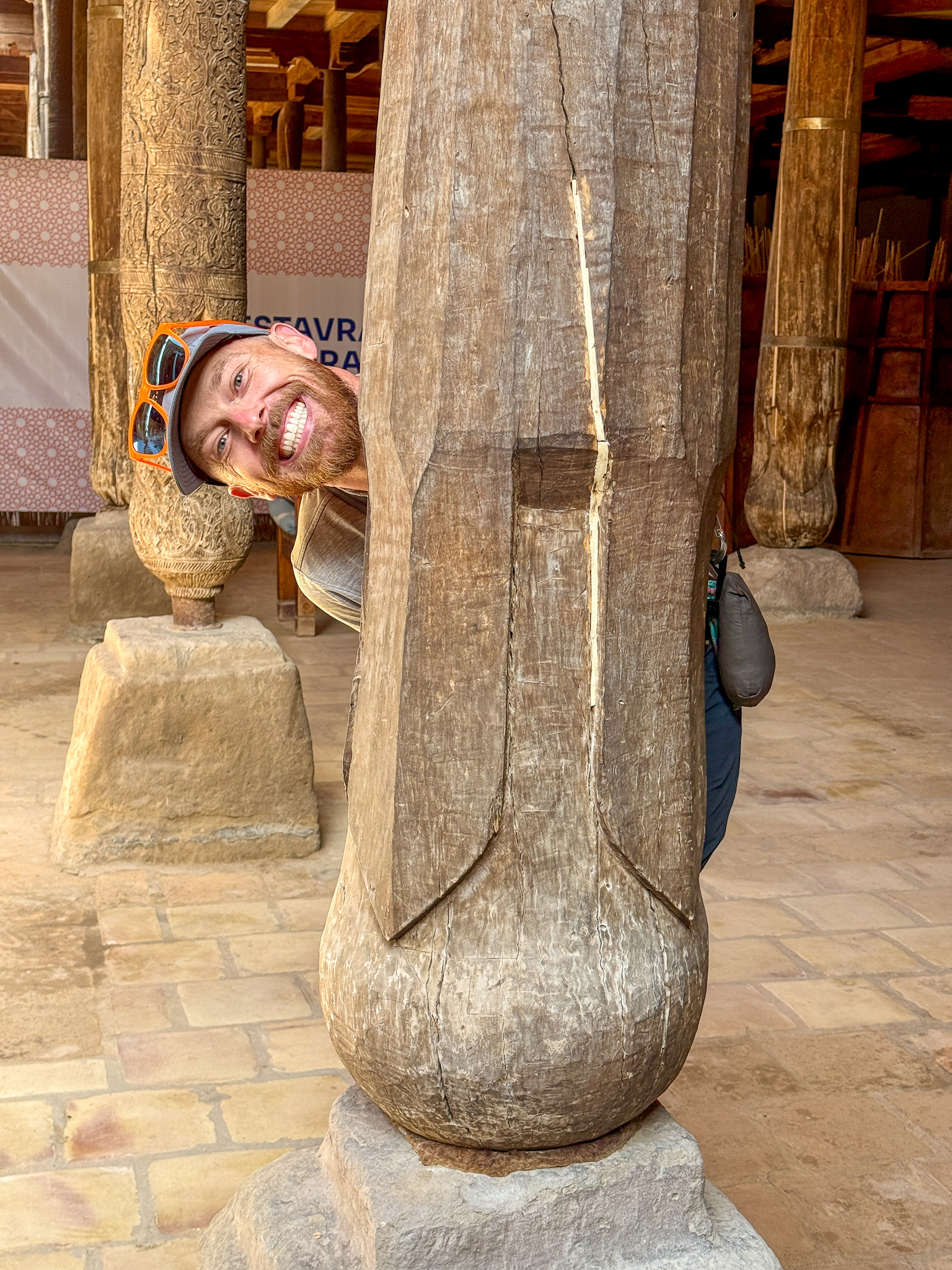
We started gently. The Juma Mosque, with its 218 intricately carved wooden columns filling the entire interior, no dome or courtyard, just a forest of wood holding up a flat roof over a dimly-lit interior. A handful of the columns date to the 10th century, brought in from older structures around the region. The girls ran a scavenger hunt for the most beautifully carved ones and then dissolved into hide-and-seek among the trunks, which is probably not the sanctioned use of the space but was genuinely hard to object to.
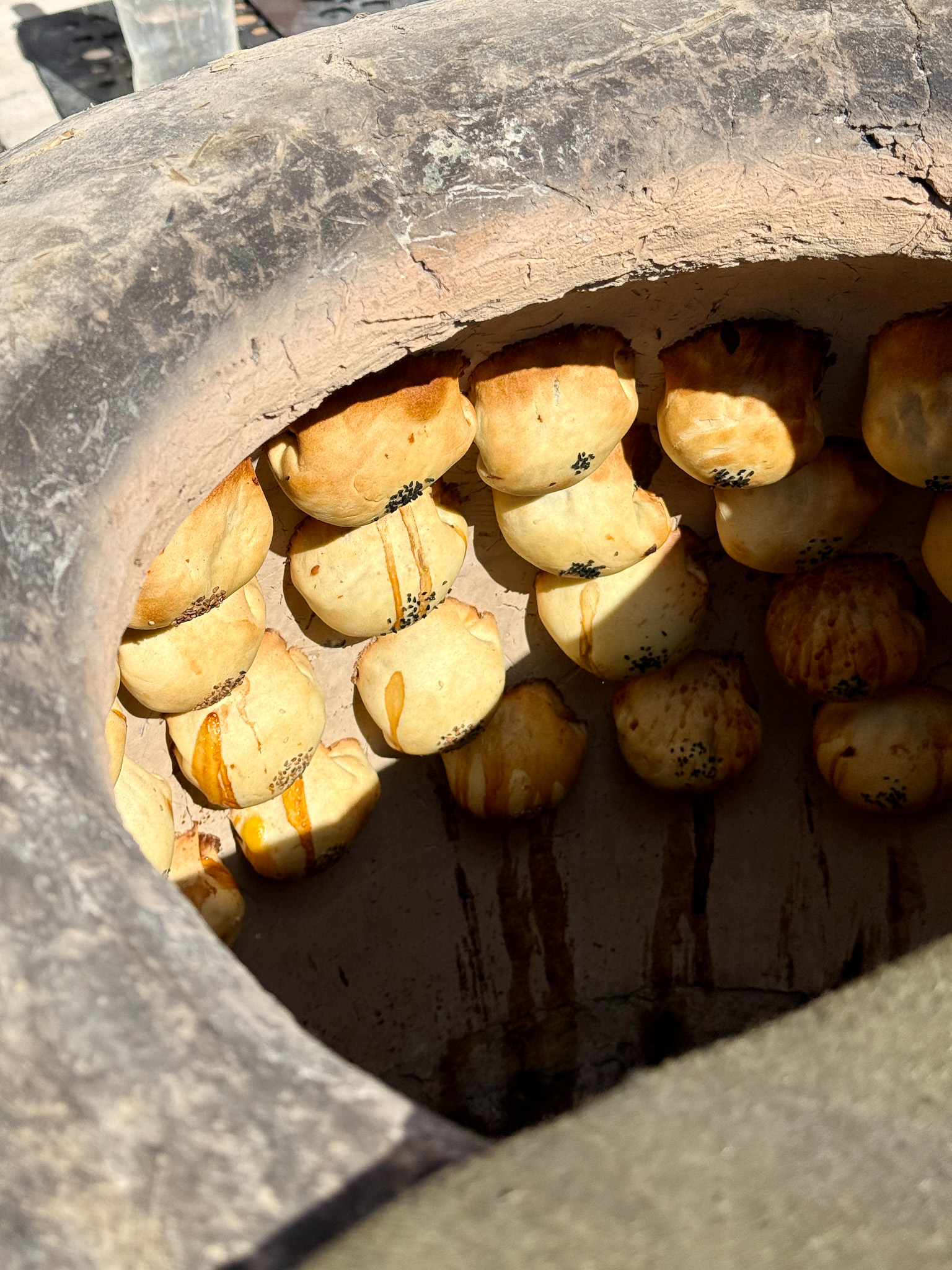
We then returned to the guesthouse for breakfast, which produced the best dish of our entire Khiva stay: tukhum barak, a Khorezm specialty of handmade ravioli filled with raw beaten egg and milk, sealed and boiled so the filling comes out silky and custardy rather than scrambled. We hadn’t seen anything like it, and everyone wanted more. Our hosts seemed genuinely pleased at our enjoyment as well, since they’re “such a pain to make.” And we were pleased that our Americanisms are making it into the vernacular of the Uzbek hospitality business.
Then the hubris parade began in earnest.
Stop one was Toshhovli Palace, commissioned by Allakuli Khan in 1830 because the existing royal residence, the Kuhna Ark, apparently wasn’t lavish enough. He wanted over 150 rooms across nine courtyards. He told his architect to finish it in two years. When the architect suggested, presumably with great care, that two years was not a realistic timeline, Allakuli had him impaled. His replacement quietly took eight years to complete the project. The girls were not impressed by the Khan’s management style. They were even less impressed by the harem wing, which was both the largest part of the palace and the part where dozens of women were essentially confined for life. Questions were asked. Answers were given as honestly as they could be. Many of our responses circled back to “The Shadow Spinner,” a piece of historical fiction that Shaina has been reading along with them, and assigning writing assignments to develop their understanding. It takes place in an Aladdin-era Harem where Shaharazad spins nightly takes to keep the Sultan entertained enough that he doesn’t end her life, but rather keeps her around for one more night each day, to hear more of her stories. The girls are equally enthralled at the suspense and appalled and the premise. History is messy, and stories such as this help us make sense of it all.
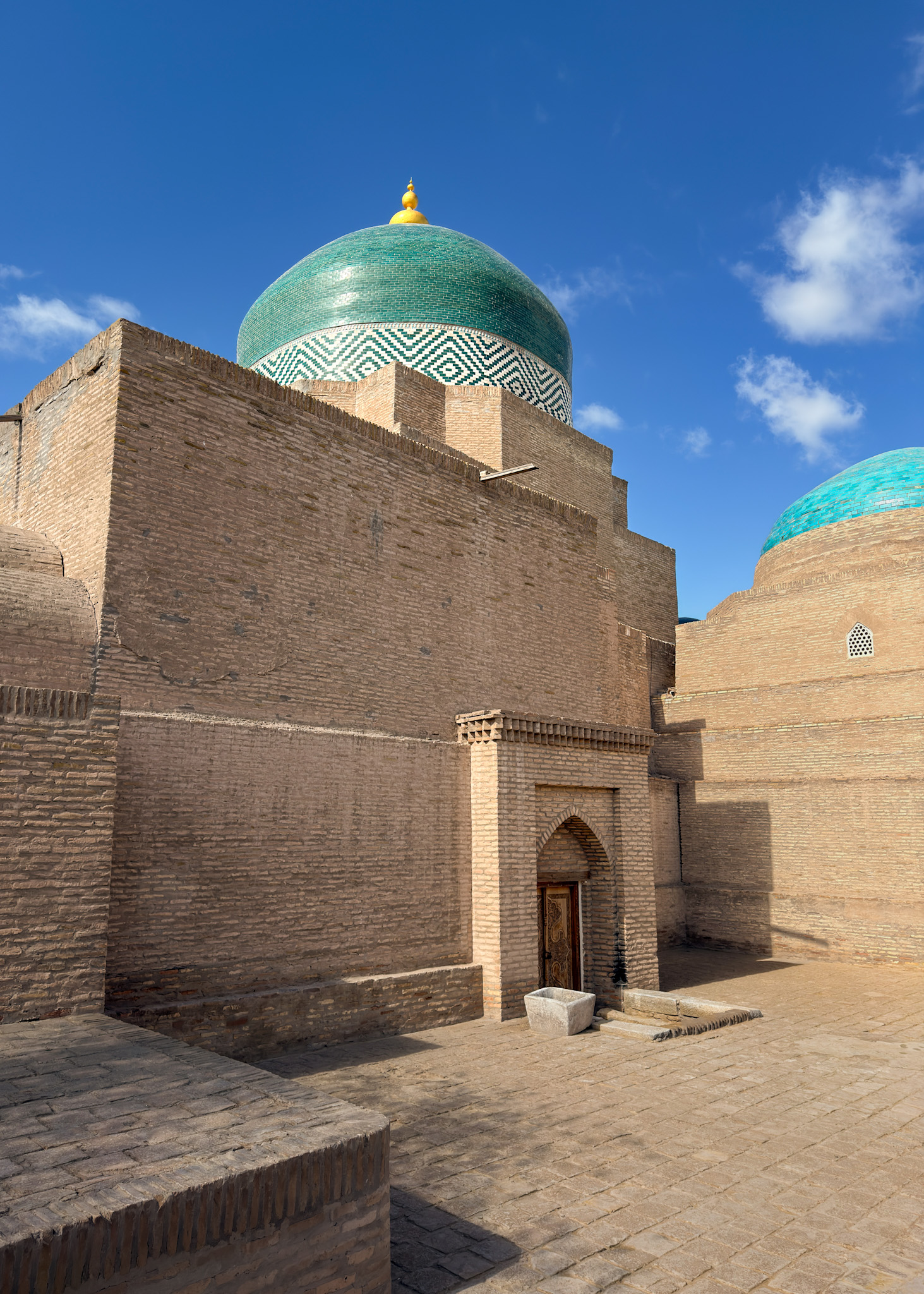
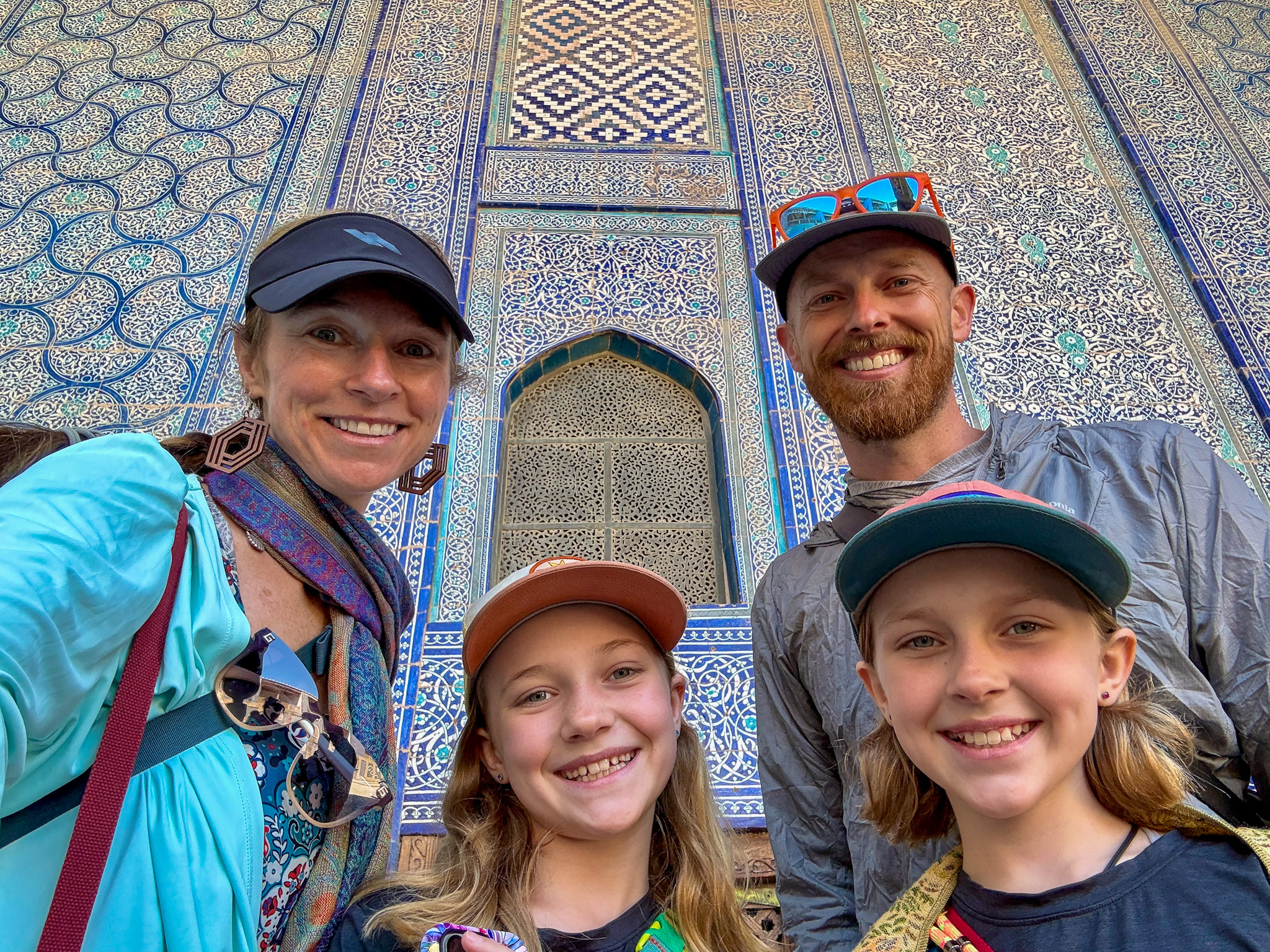
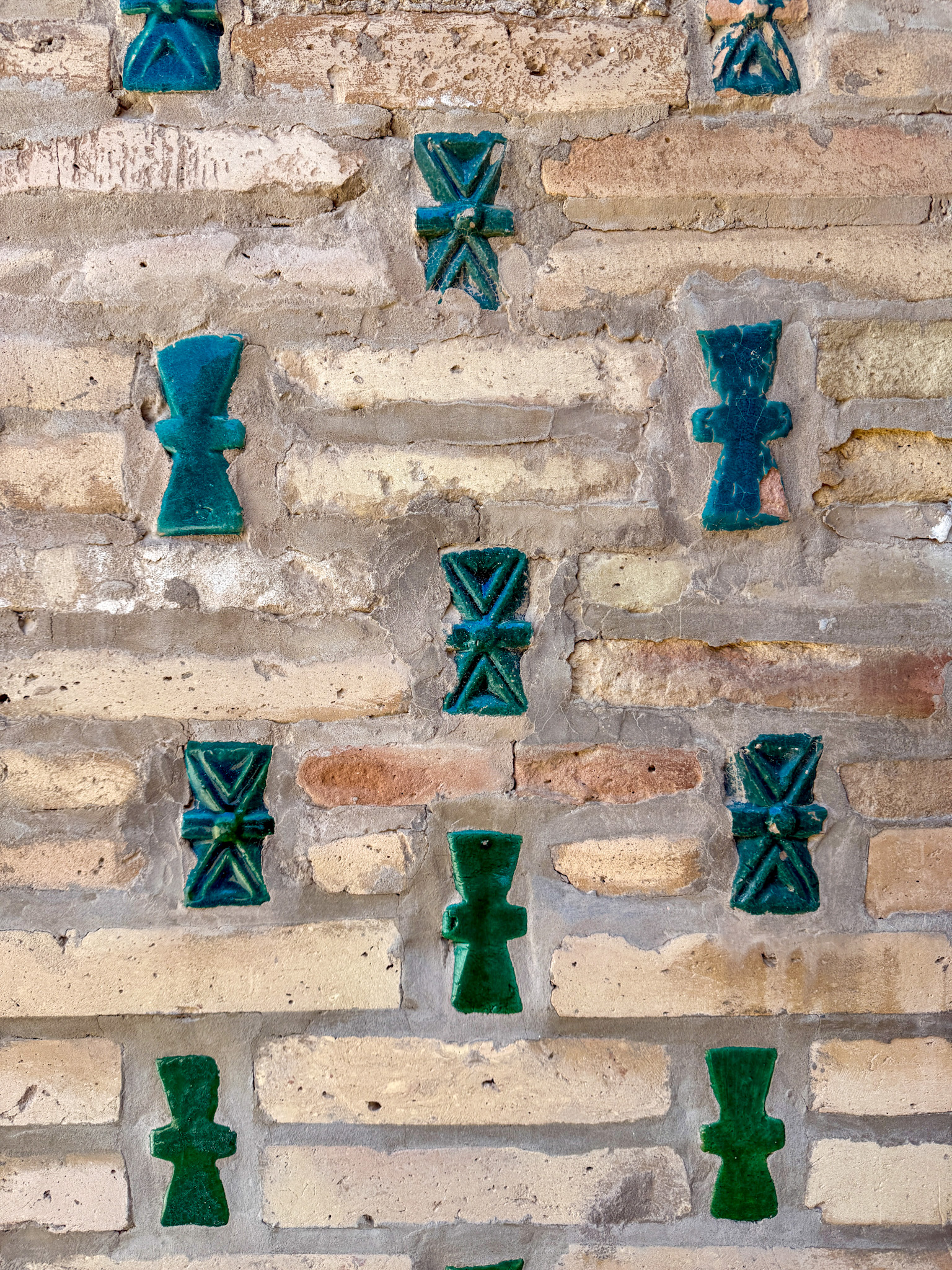
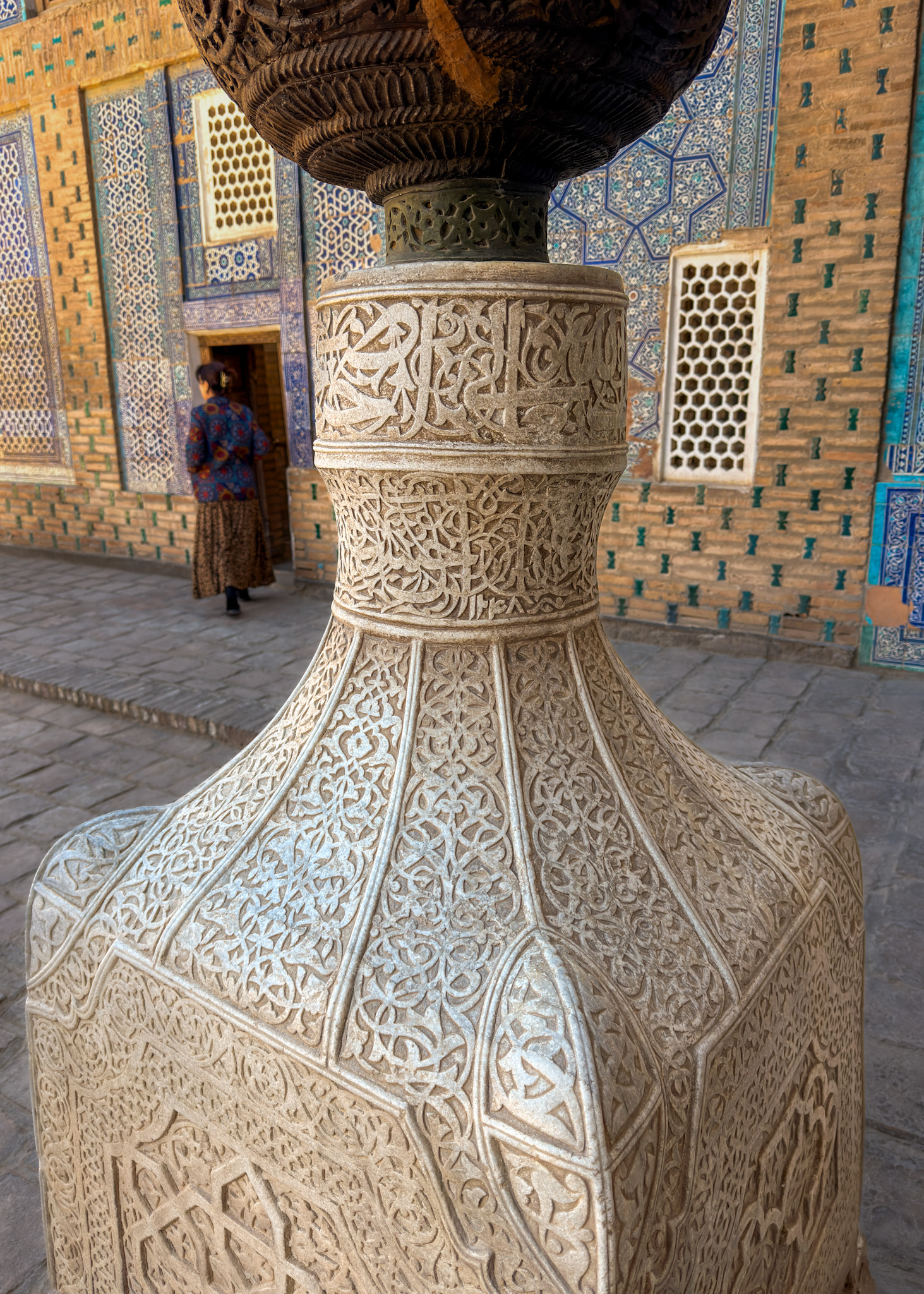
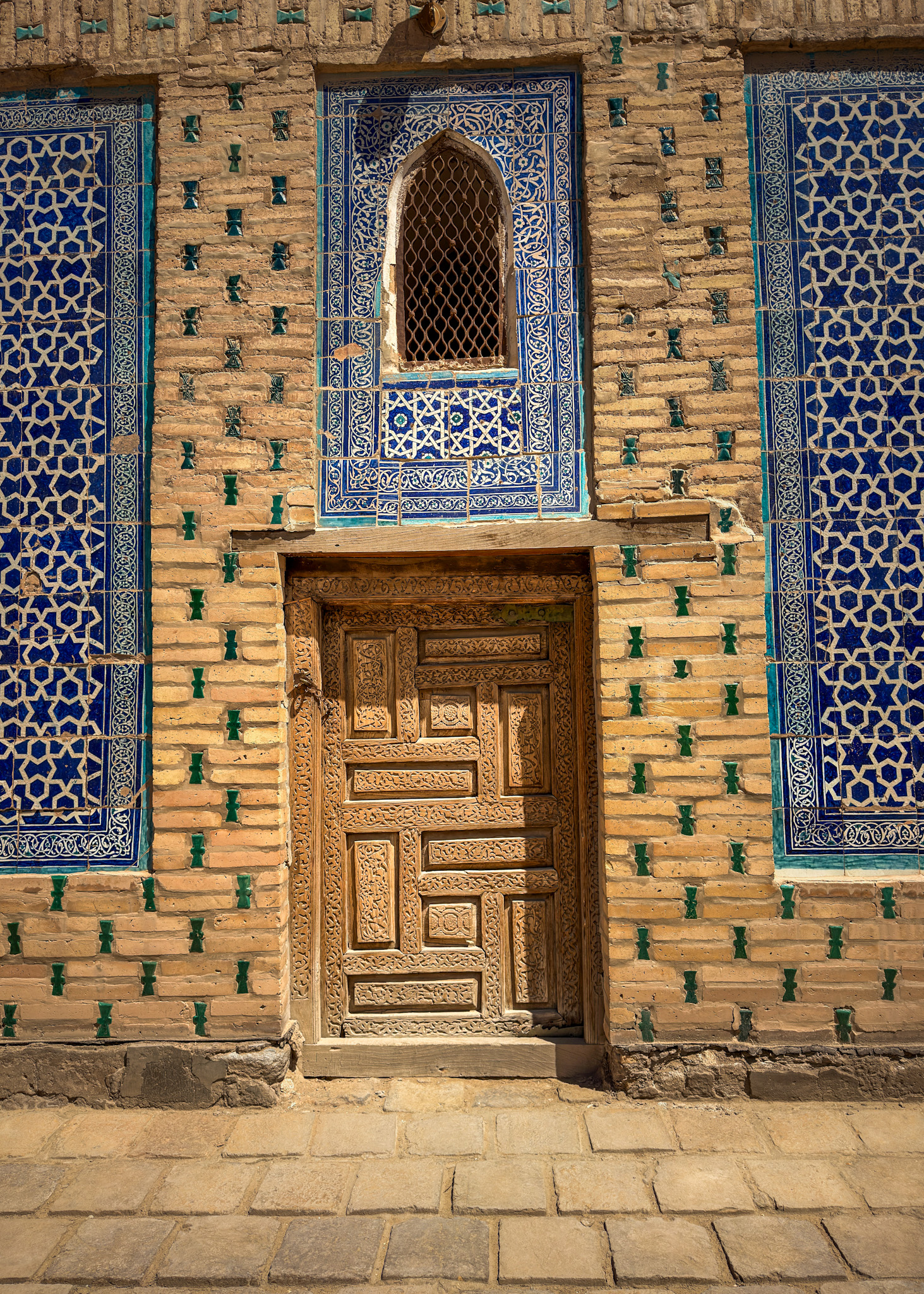
From there we walked to the Allakuli Khan Madrasa and Caravanserai, the Khan’s other major project: an enormous complex of school and trading hall built directly into the eastern wall of the city. To make space, Allakuli had a section of the protective city wall removed. When the Russians arrived in 1873, they came in through that exact gap. The girls found this deeply satisfying in a karmic sense.
Then that satisfaction came to an abrupt halt as we visited the Islam Khodja Madrasa and Minaret, which introduced the one figure in Khiva’s royal history who seemed to be genuinely trying to improve things. Islam Khodja was grand vizier under a later Khan, and he’d traveled to St. Petersburg, admired what he saw of European modernization, and used his own resources to begin bringing Khiva into the 20th century: the first secular school, the first hospital, a pharmacy, a telegraph line, a power station. In 1913, for this, he was lured out of the palace by his own Khan and assassinated on the road home by a group of conservative clergy and merchants who felt he was secularizing the country too aggressively. Arya in particular found this infuriating. She was right to.
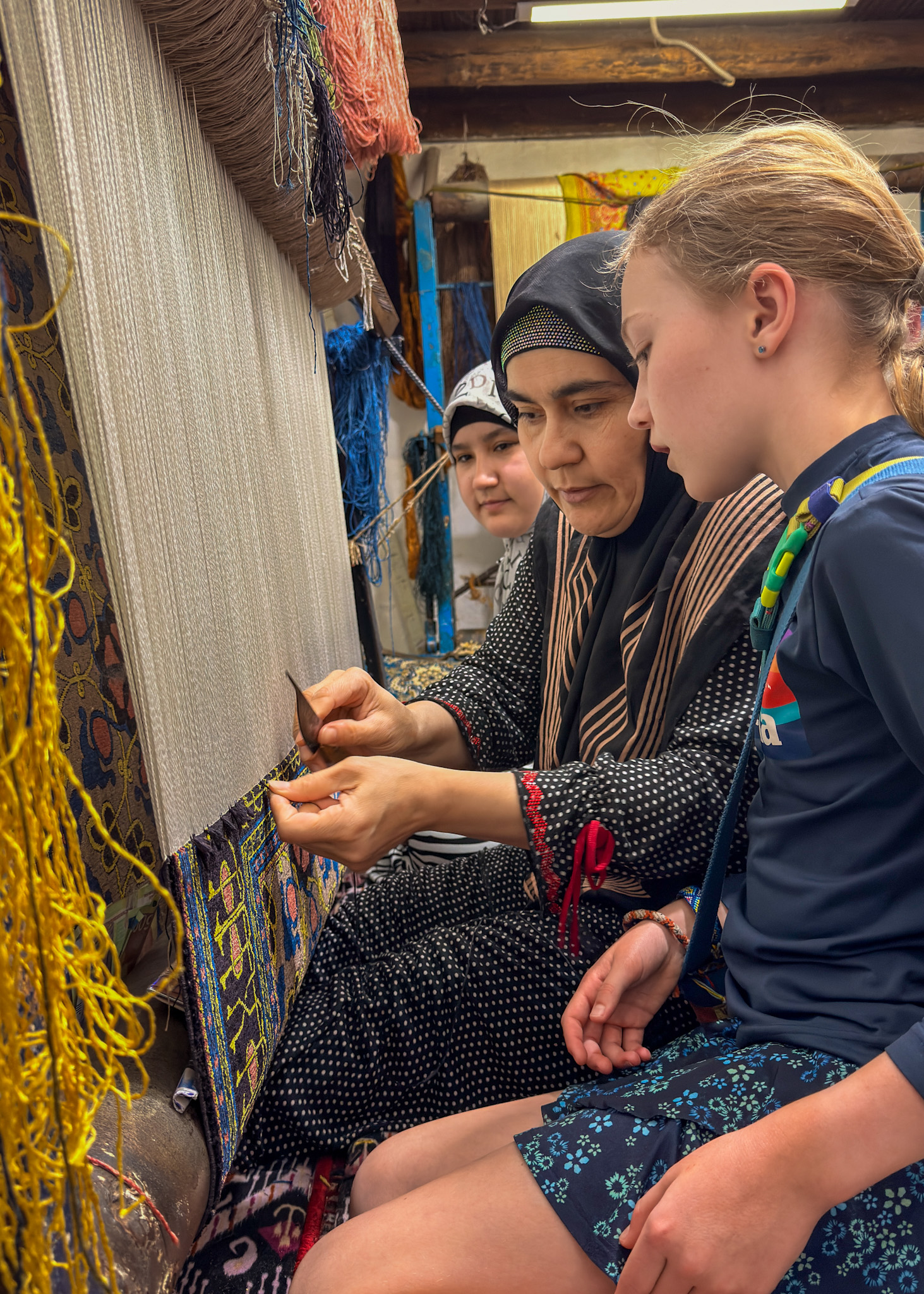
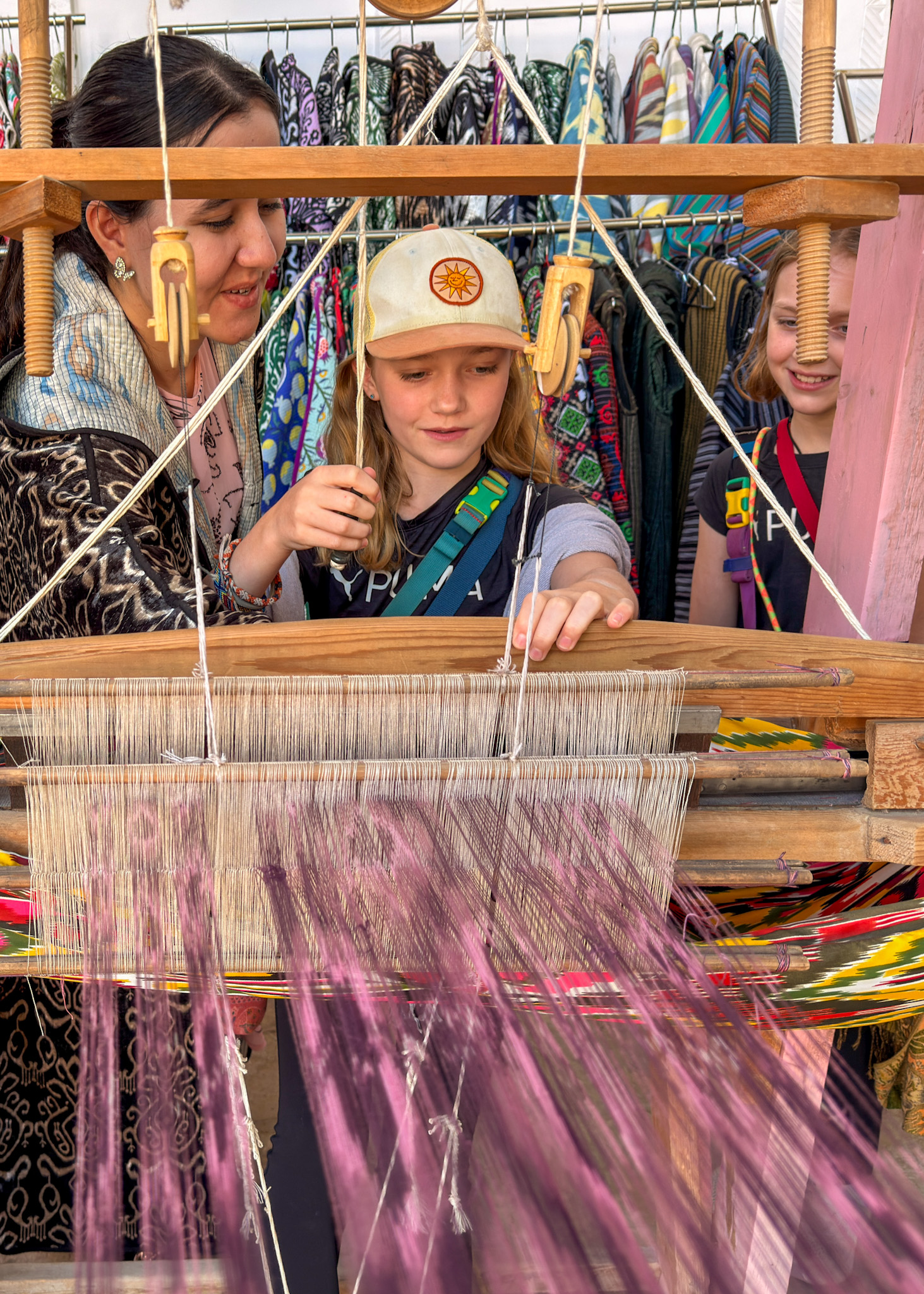
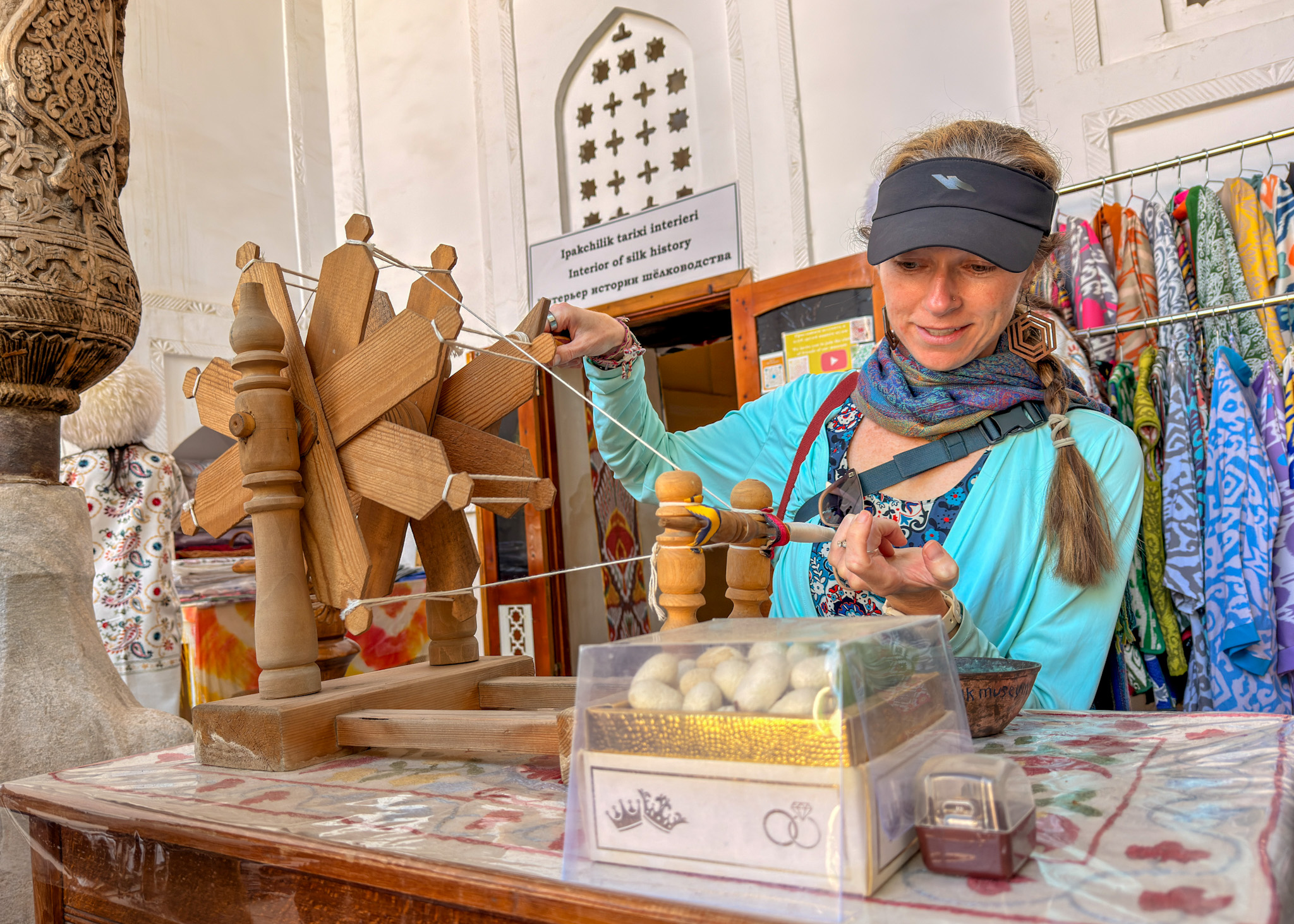
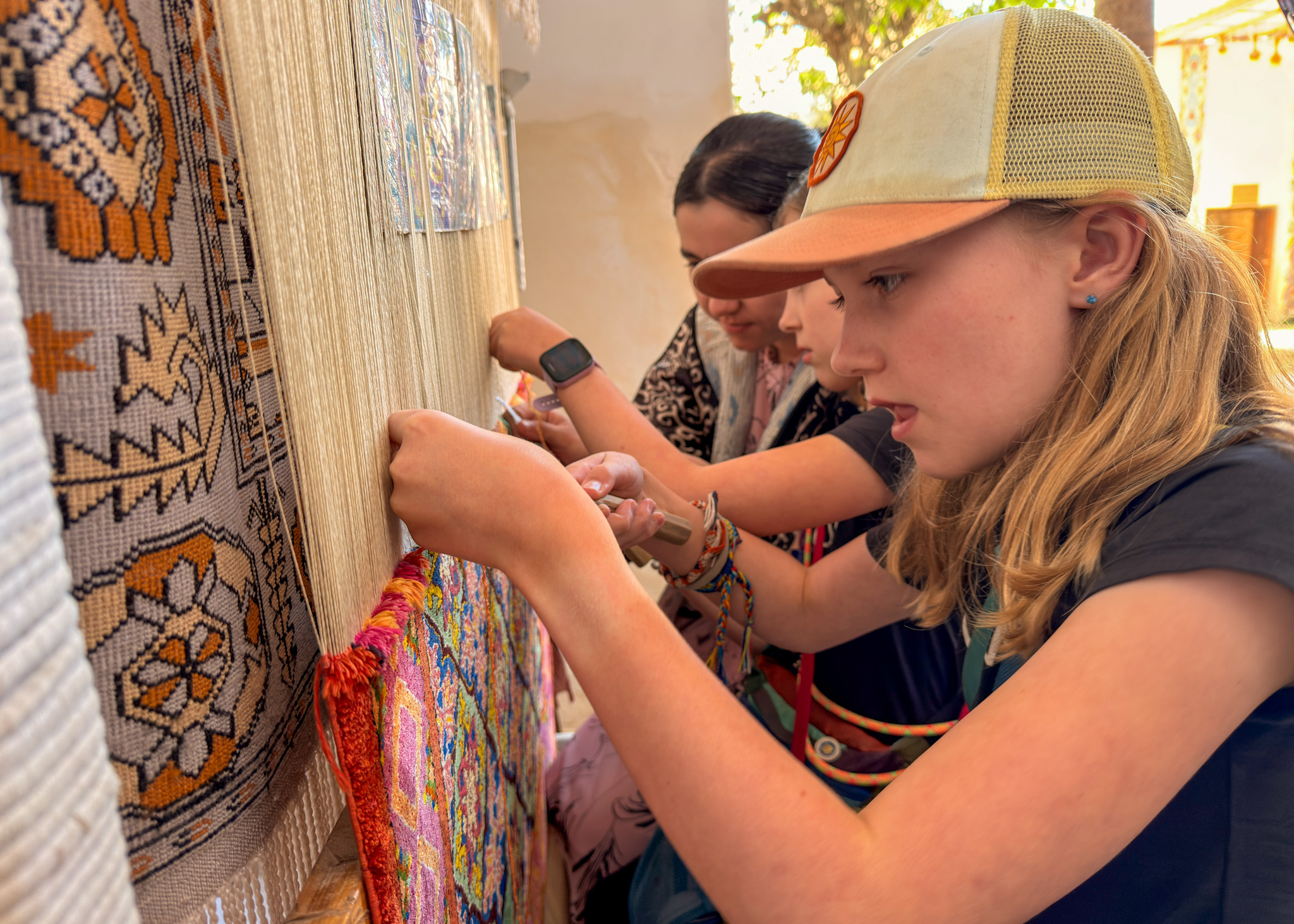
The Khorezm Silk Museum came next and served as a welcome change of emotional register. This is a hands-on space where the girls got to learn how to weave silk wall hangings, spin thread, and work a section of an actual silk carpet loom. Sitting at those stations and doing even a few rows of each made the production of these pieces of art feel suddenly and viscerally real, in a way that no amount of looking at them in a display case achieves. It takes an almost incomprehensible amount of patience and time. The girls came out of it with a different relationship to every carpet they will ever walk across for the rest of their lives.
The Kuhna Ark, the original khan citadel they’d seen from the outside at sunset two nights earlier, was next: its own mosque, mint, harem, and the watchtower they’d already stood on. The complex is massive. It is also, given that Allakuli had a second even larger palace built nearby, evidence that the concept of enough was not particularly well developed among the rulers of Khiva.
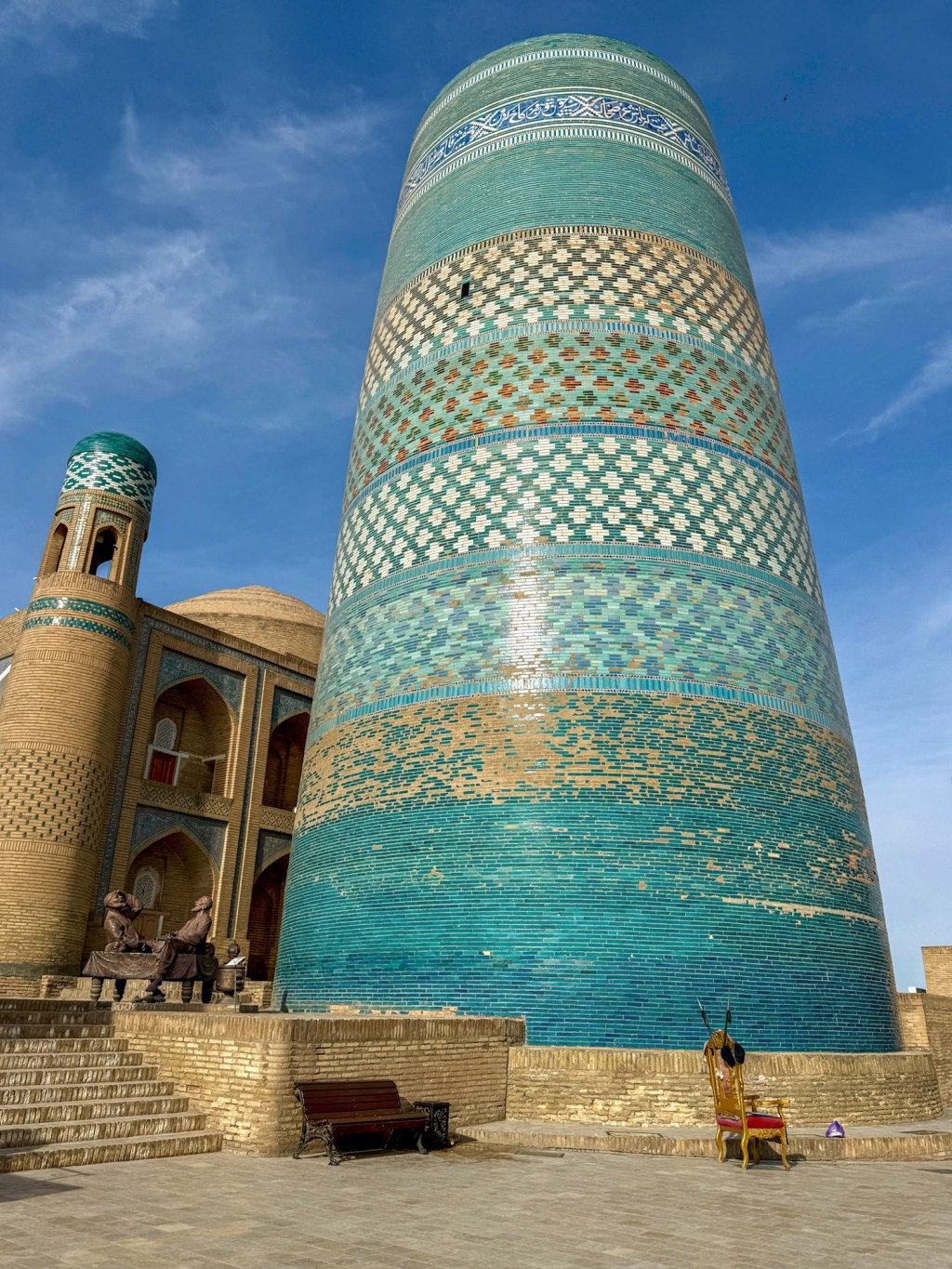
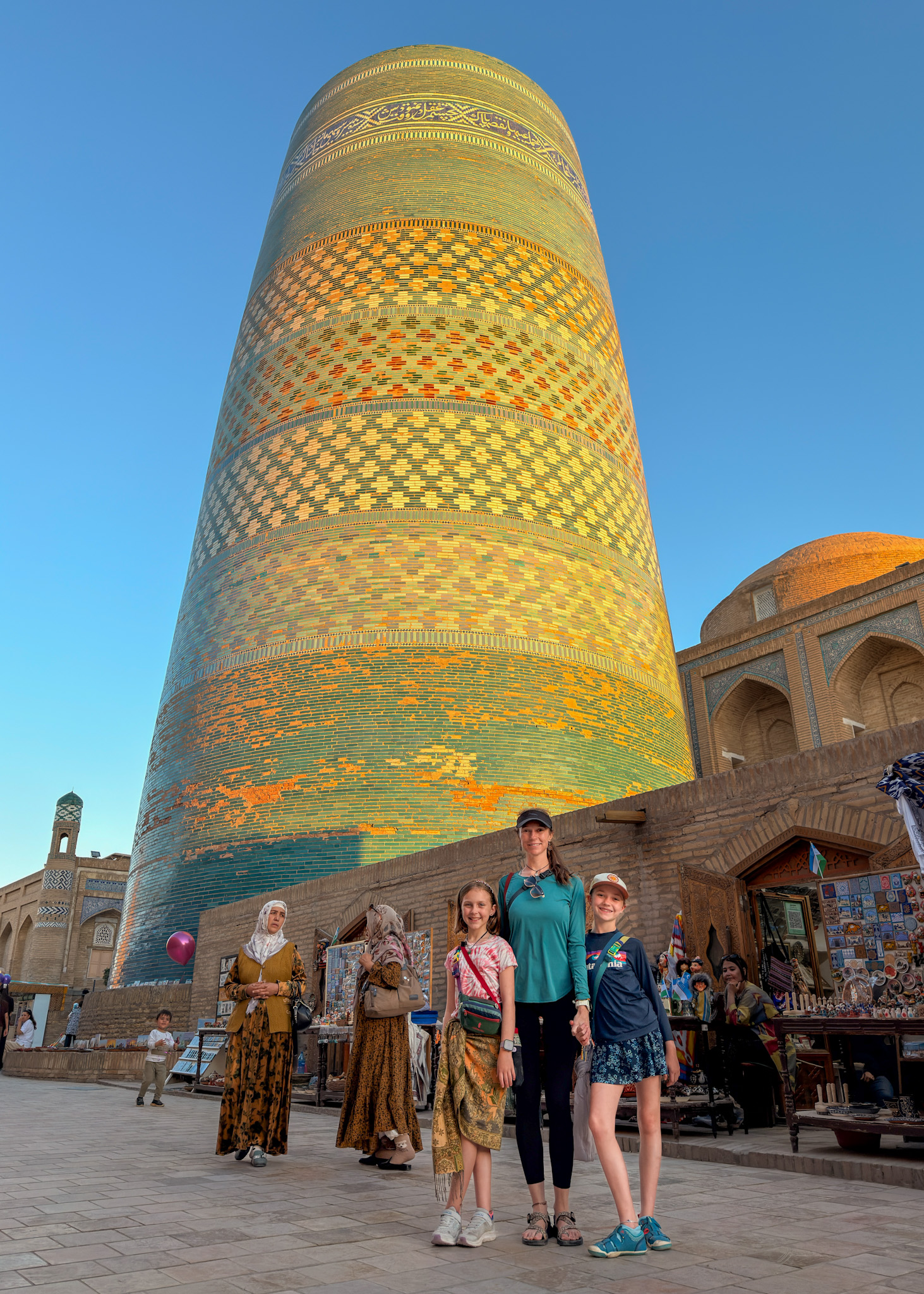
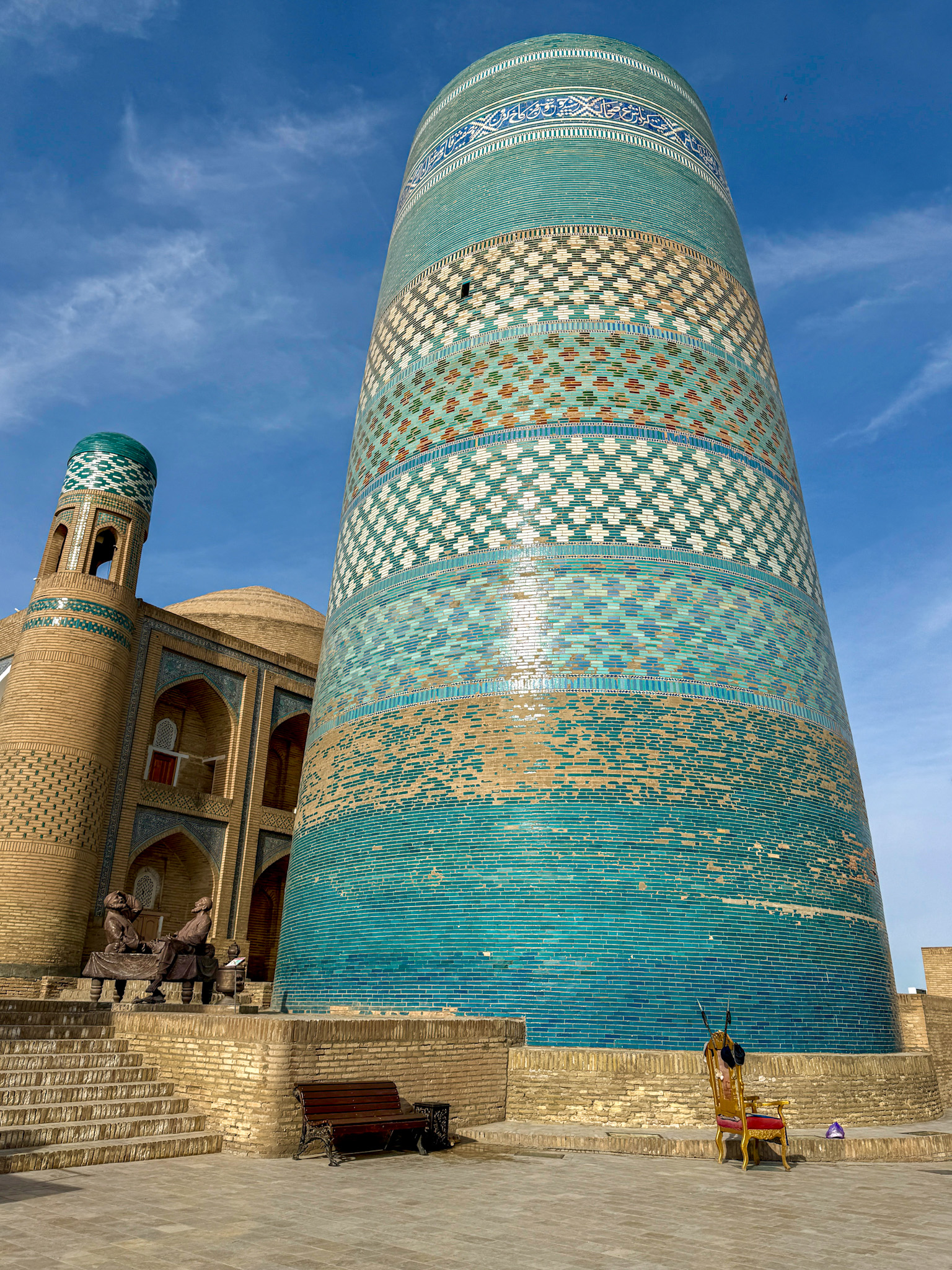
And then the grand finale of the hubris tour: the Kalta Minor, Khiva’s crown jewel and easily the most recognizable monument in this city, if not the entire country.
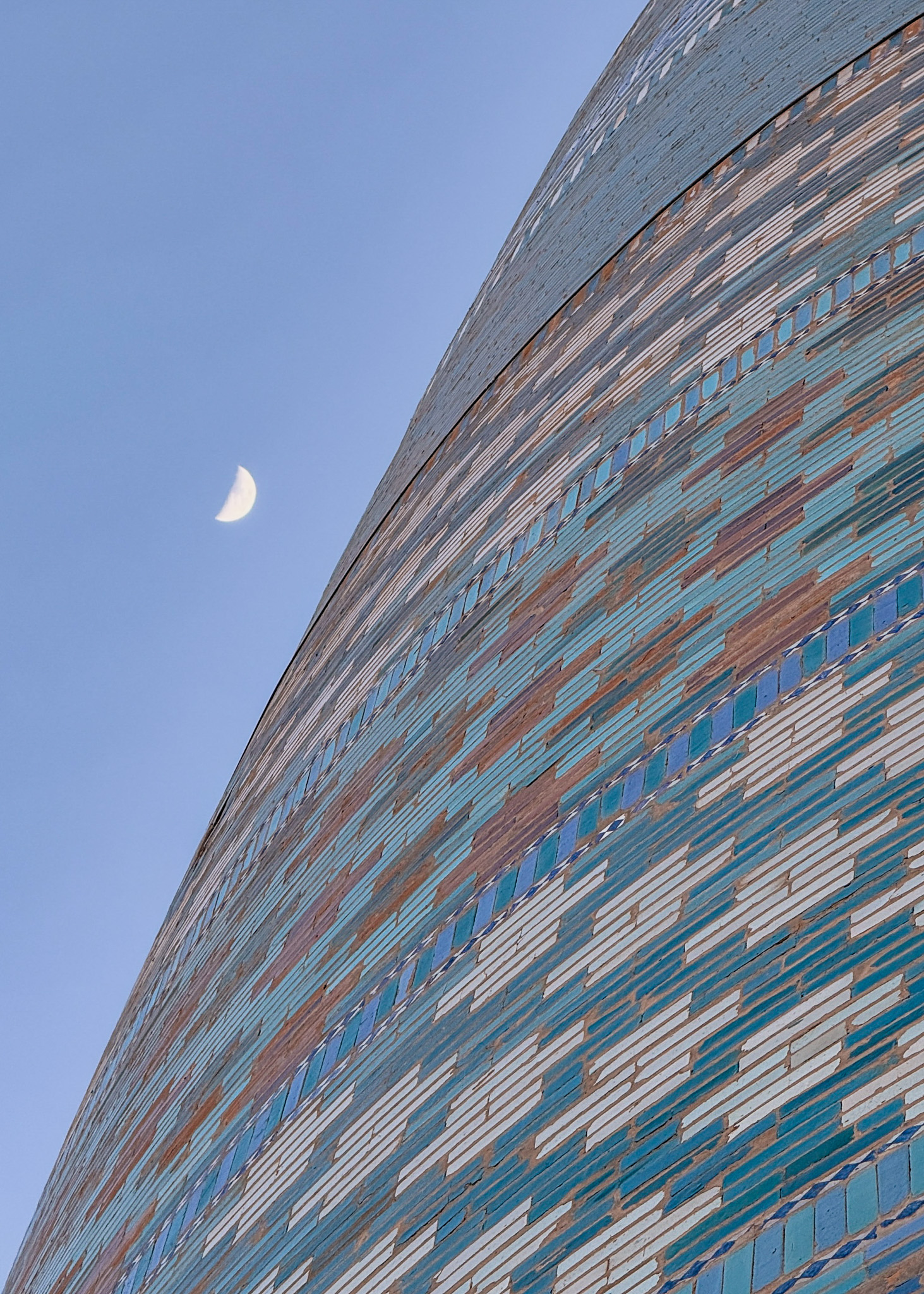
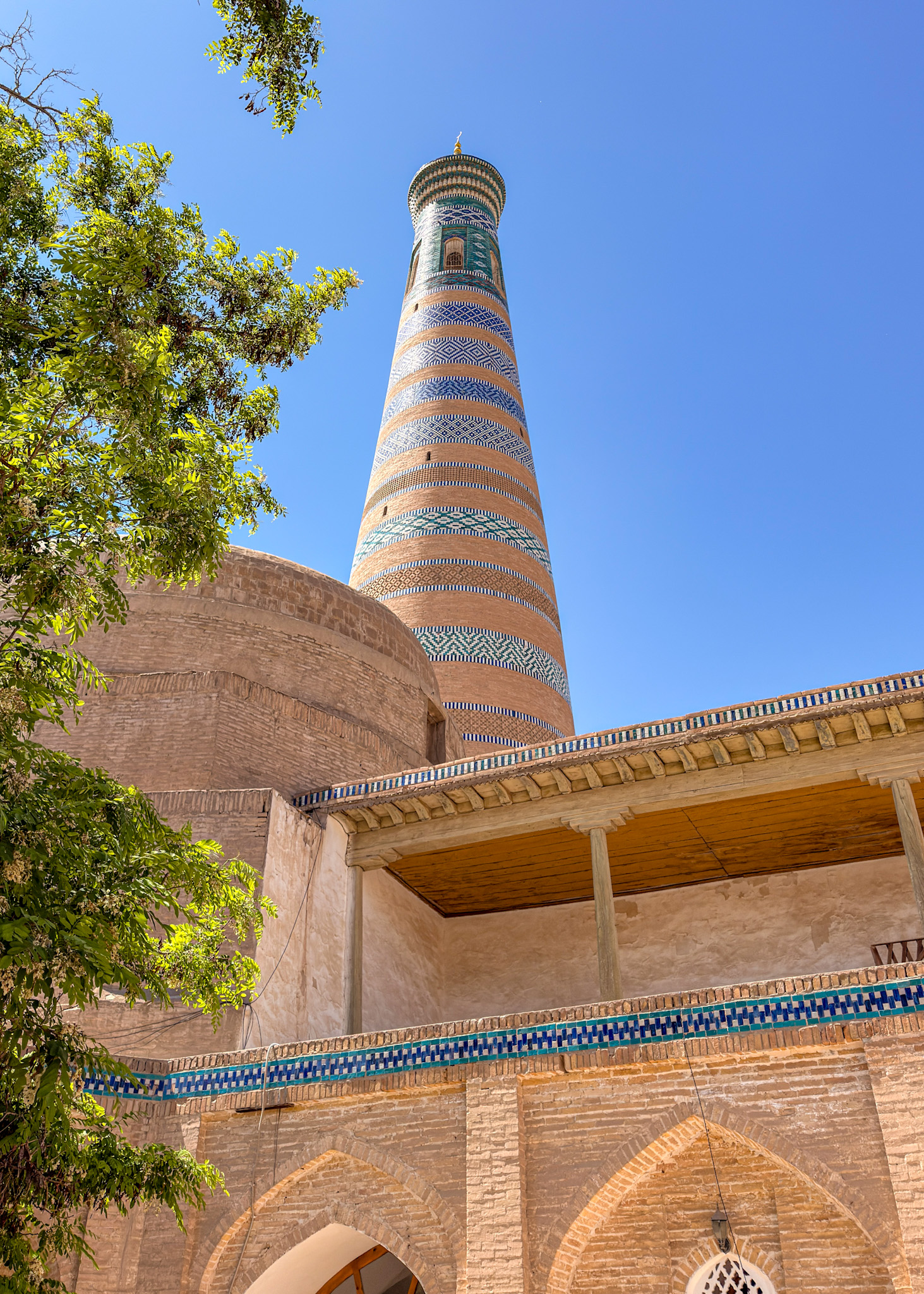
The Kalta Minor was commissioned in 1851 by Muhammad Amin Khan, who wanted to build the tallest minaret in the entire Muslim world. Plans called for a final height of somewhere between 70 and 110 meters, depending on which source you believe. Construction began in 1852. In 1855 Muhammad Amin Khan died in battle. Construction stopped immediately. The minaret was left at a height of just 29 meters, which is to say it is a stump: 14 meters wide at the base, covered in beautiful tilework, and going absolutely nowhere. The girls affectionately, if not unceremoniously, nicknamed it “Chubs.” Max tried to circle back to the big picture, using this as a teaching moment about the importance of finishing things you care about before you run out of time. The girls rolled their eyes at him. He reflected on this for a moment and concluded that they were right—if you are going to leave behind an unfinished minaret, leave one behind that the entire world now recognizes specifically because it is a stump. The Kalta Minor is famous. Muhammad Amin Khan’s completed projects are not.
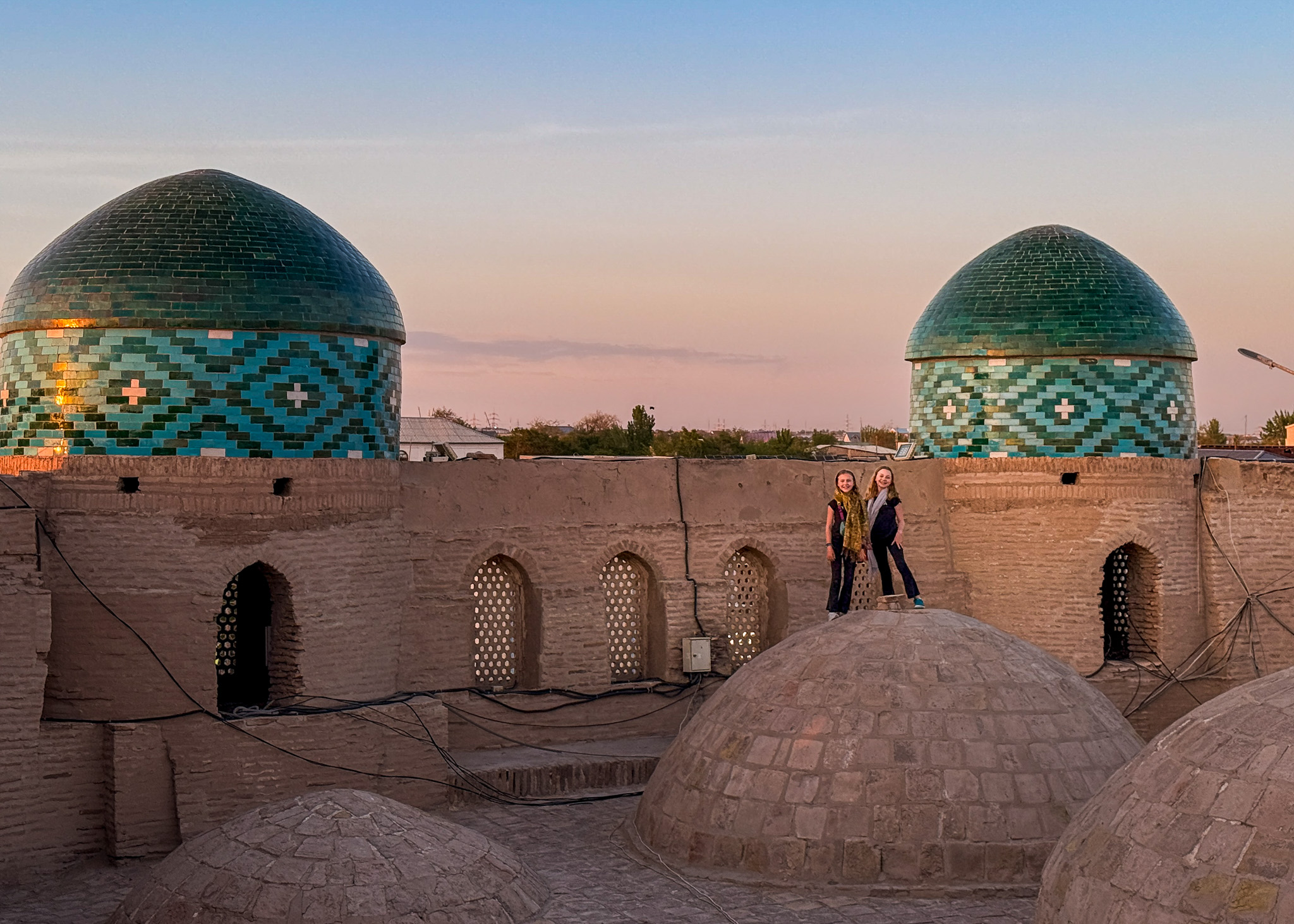
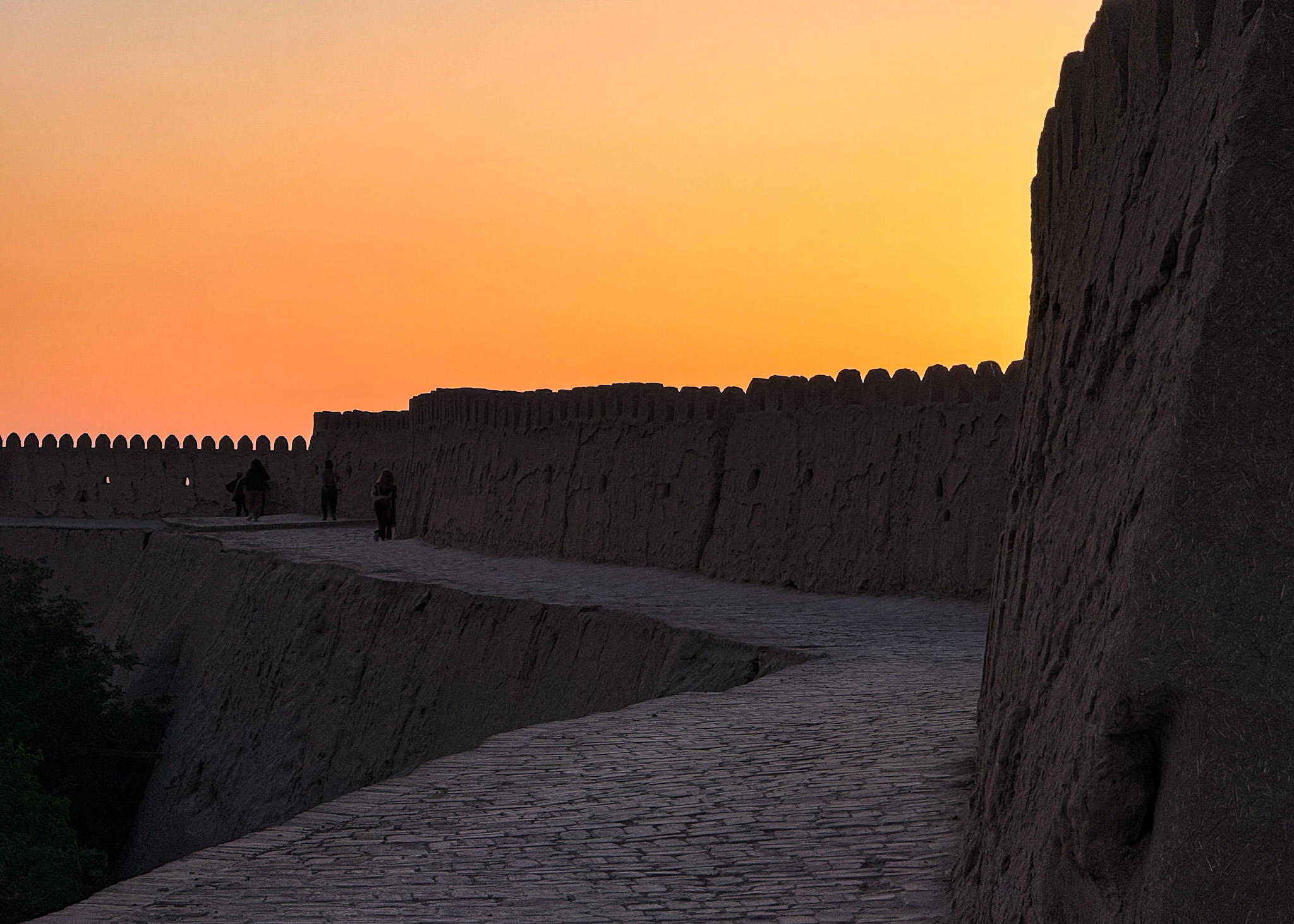
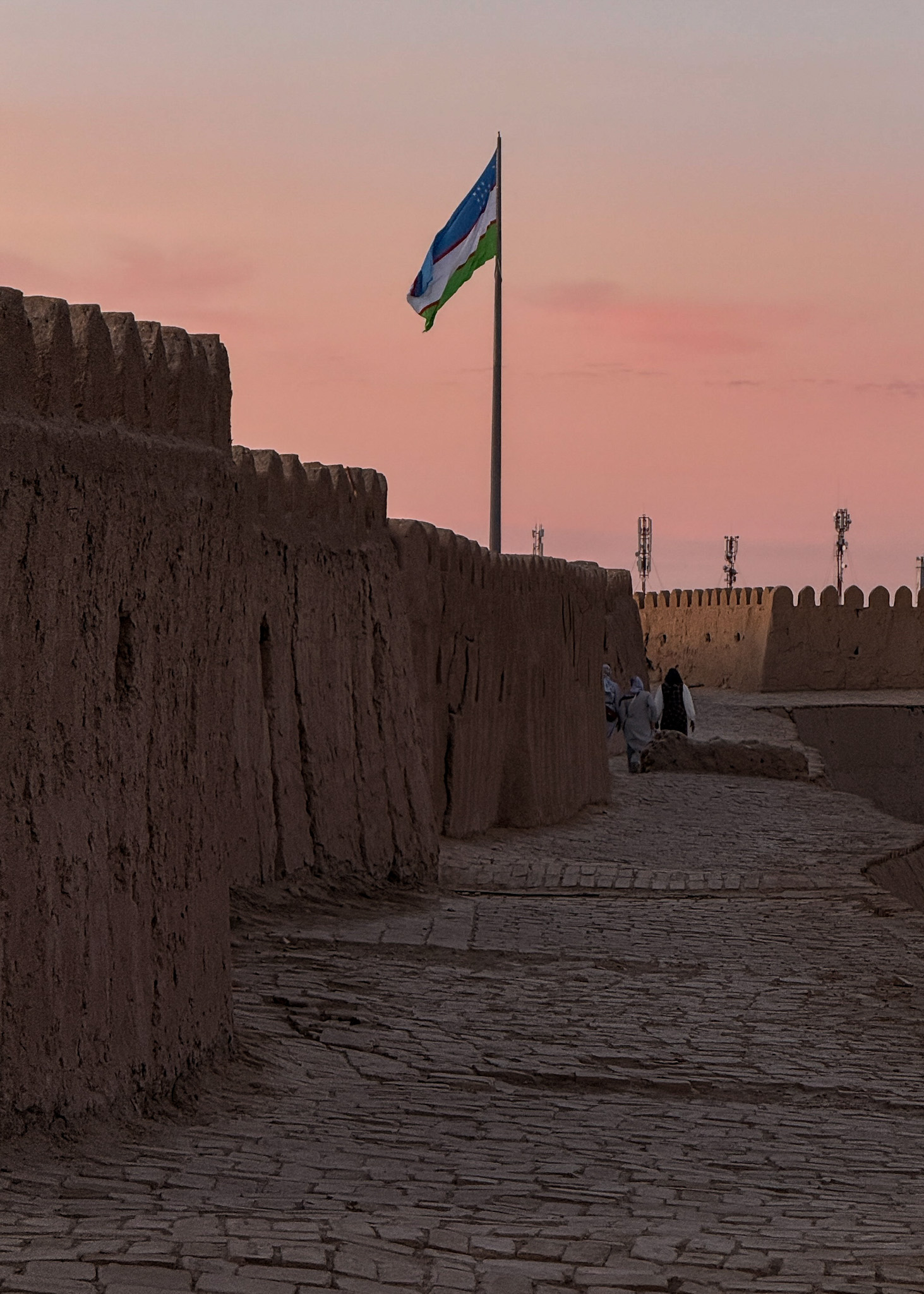
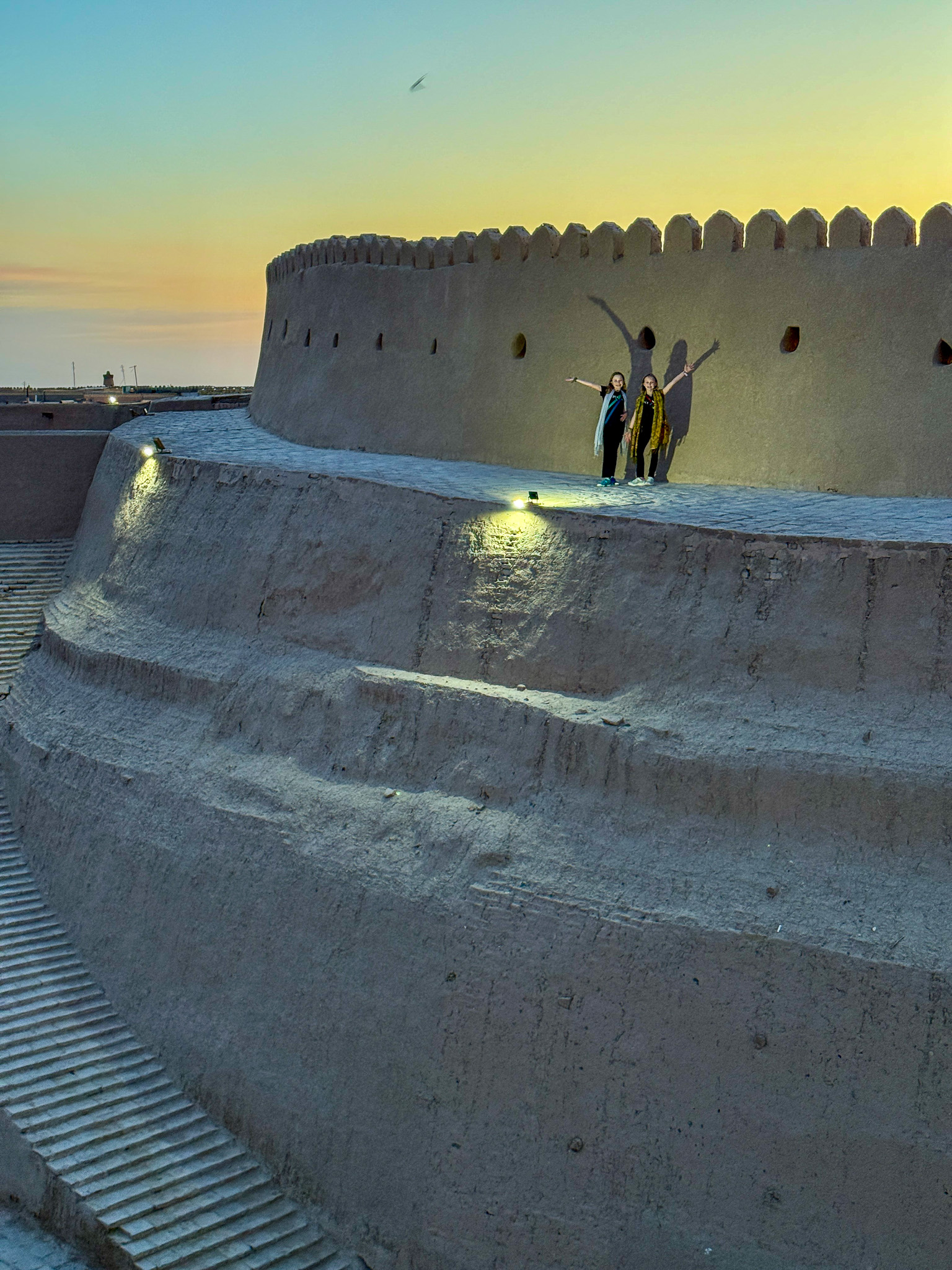
We finished the day on the city walls. From the North Gate you can climb up onto the ramparts and walk a long stretch of the original fortifications, cautiously looking down into the city from above, as Western safety standards such as railings are not ubiquitous here yet. The temperature had cooled, the sunset was starting, and the serpentine path of the walls around Itchan Kala gave us changing views of the minarets and madrasa domes at every turn. Mud swallows were zipping through the air below us catching the evening insects. Arya and Finlee were deep in some private conversation and declined to share what about—“girl talk”, they said—and that was that. So we grownups took the opportunity for a lovely stroll at sunset, hand in hand, just like we did 20+ years ago when we met—crazy how far we’ve come since then.
After the sun went down we made our way to Cafe Zarafshon, an open-air courtyard restaurant near the Islam Khodja minaret. We weren’t especially hungry but a warm something on a cool evening was the right call. We ordered manpar, a Uyghur and Central Asian classic of small pinched square noodles in a spiced tomato-and-pepper broth with beef, and a clear dumpling soup that was completely different and equally good. Both worked.
While we were eating, a large group of Spaniards arrived and made themselves entirely at home. They appeared to be in their 60s and 70s, the wine was flowing freely, and they had hired musicians to play while they ate. Once the music got going they got up and danced like no one was watching, which given that we were very much watching, showed admirable commitment.
As we were getting up to leave, Finlee decided she wanted to say something. She turned to one of the women at the nearest table and introduced herself in Spanish and asked where they were from. Then what began as a quick exchange, lasted about fifteen minutes. Arya joined in. Between them they held a real conversation with a group of strangers in a second language, on the other side of the world, in a restaurant in an ancient Uzbek city at ten o’clock at night. We have been lucky, over the course of this trip, to cross paths with Spanish speakers at enough unexpected moments that the girls have had real practice beyond the classroom. It shows. Finlee’s willingness to simply begin the conversation, without prompting and without hesitation, shows something too. Our littlest girl is coming into her own.
The musicians played on as we said our goodbyes and walked back through the glowing old town toward the guesthouse, parents and girls both bursting with pride.
Khiva. The city of miscalculated ambitions and unfinished projects, few of which are still standing strong.
Except “Chubs the Stump”—it’s still standing proud.
 Pause and Wander
Leave a comment