
Dates: March 18th-22nd, 2026
Place: Bukhara, Uzbekistan
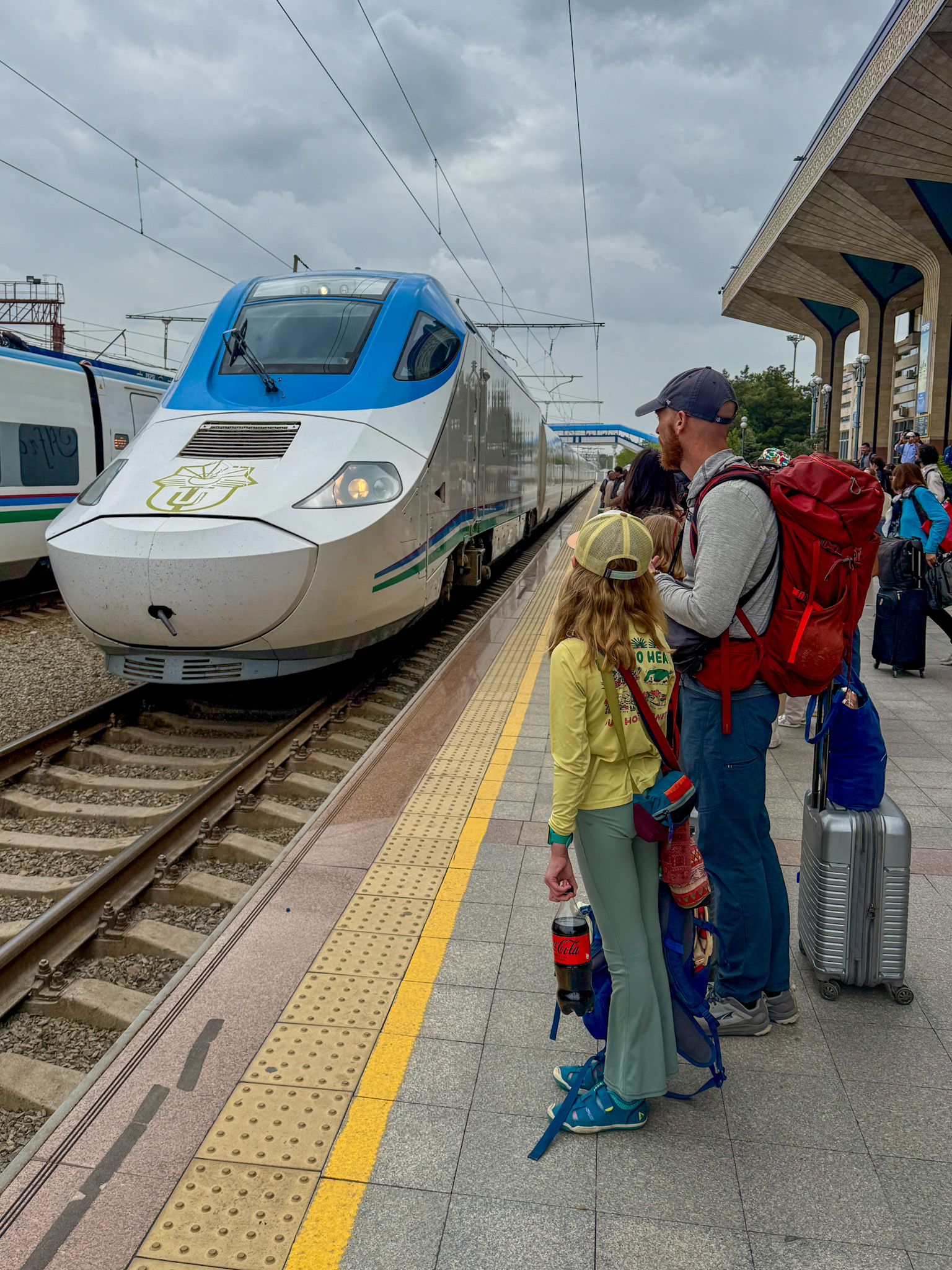
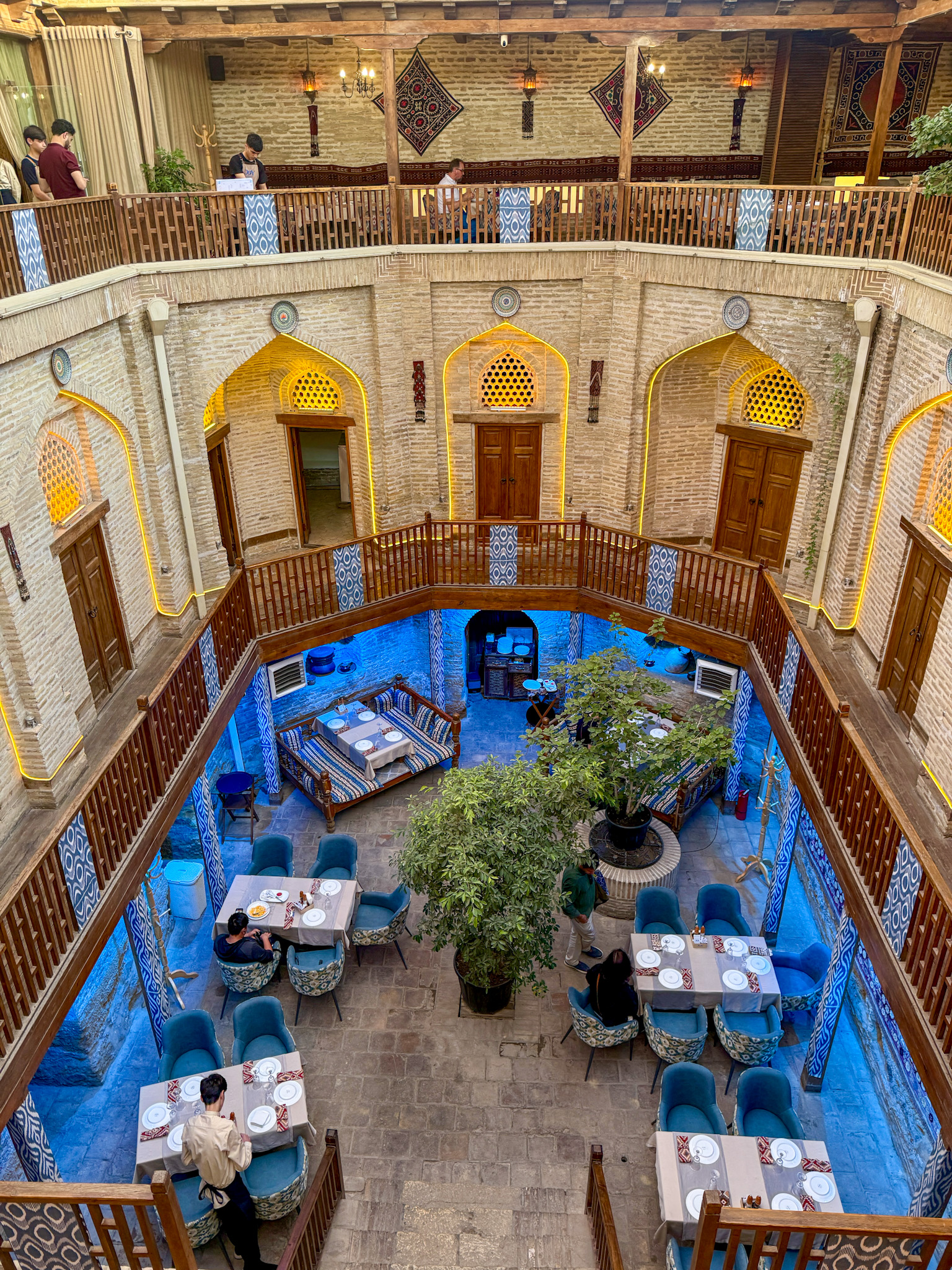
We arrived via an impressively modern high speed train in the early afternoon, checked into our riad-style boutique hotel nestled in the narrow streets of Old Town, already amazed by the juxtaposition of the old and new in this city. Noticing our hungry children, the friendly hotel attendant pointed us toward JOY Chaikhana Lounge, a few minutes away through maze-like narrow streets, set inside a beautifully preserved caravanserai on Sarafon Street. We had one of our family favorite dishes laghman, Uyghur-style hand-pulled noodles in broth with beef and vegetables, a dish that spread across Central Asia along the Silk Road from what is now western China, and beef manti, baseball-sized steamed dumplings topped with yogurt, a Central Asian staple that appears in some form from Turkey all the way to Mongolia. Local beers for Shaina and Max. A pitcher of mojito-style lemonade for the girls. Forty-two dollars total, which for the quality felt almost unreasonably good.
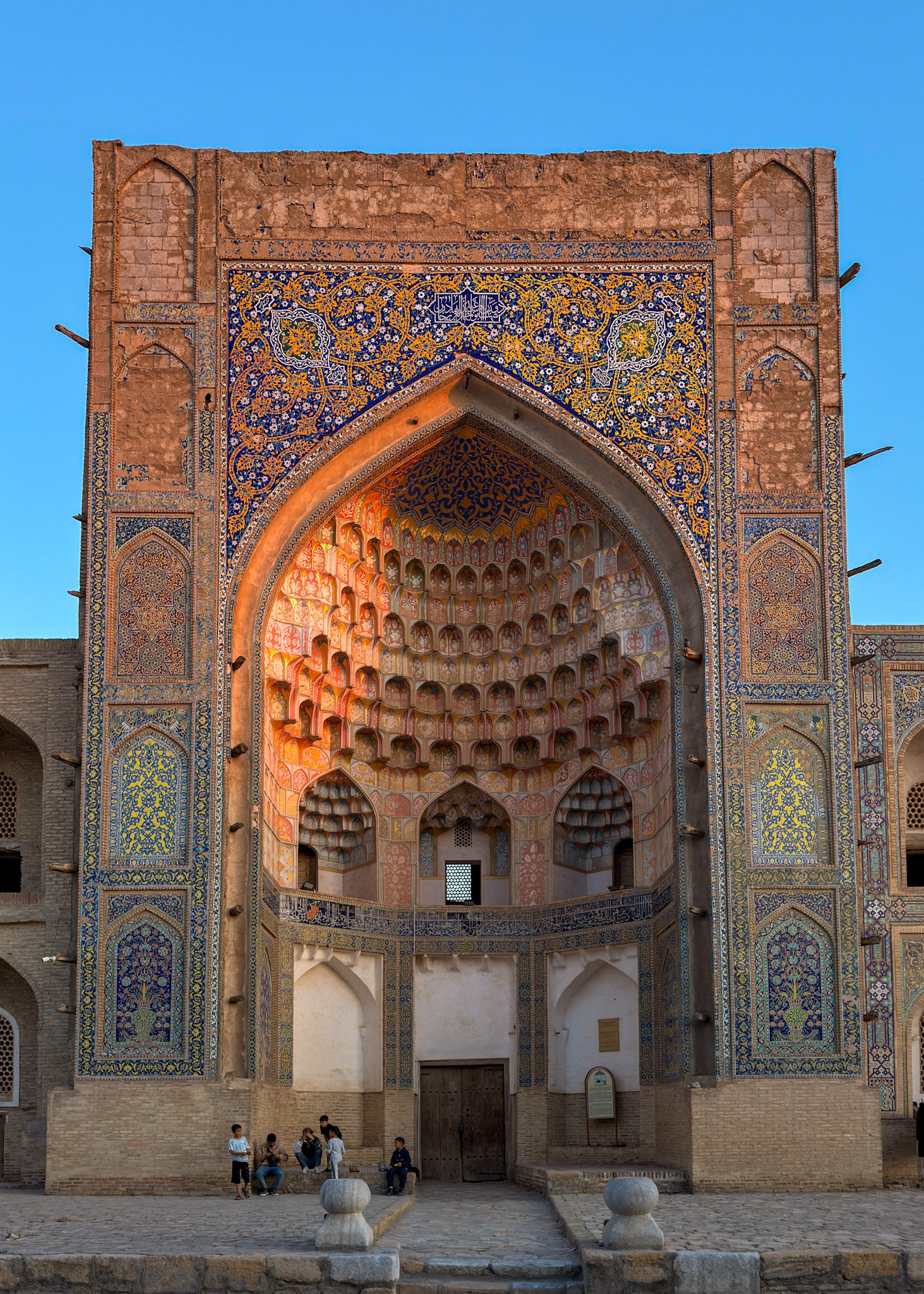
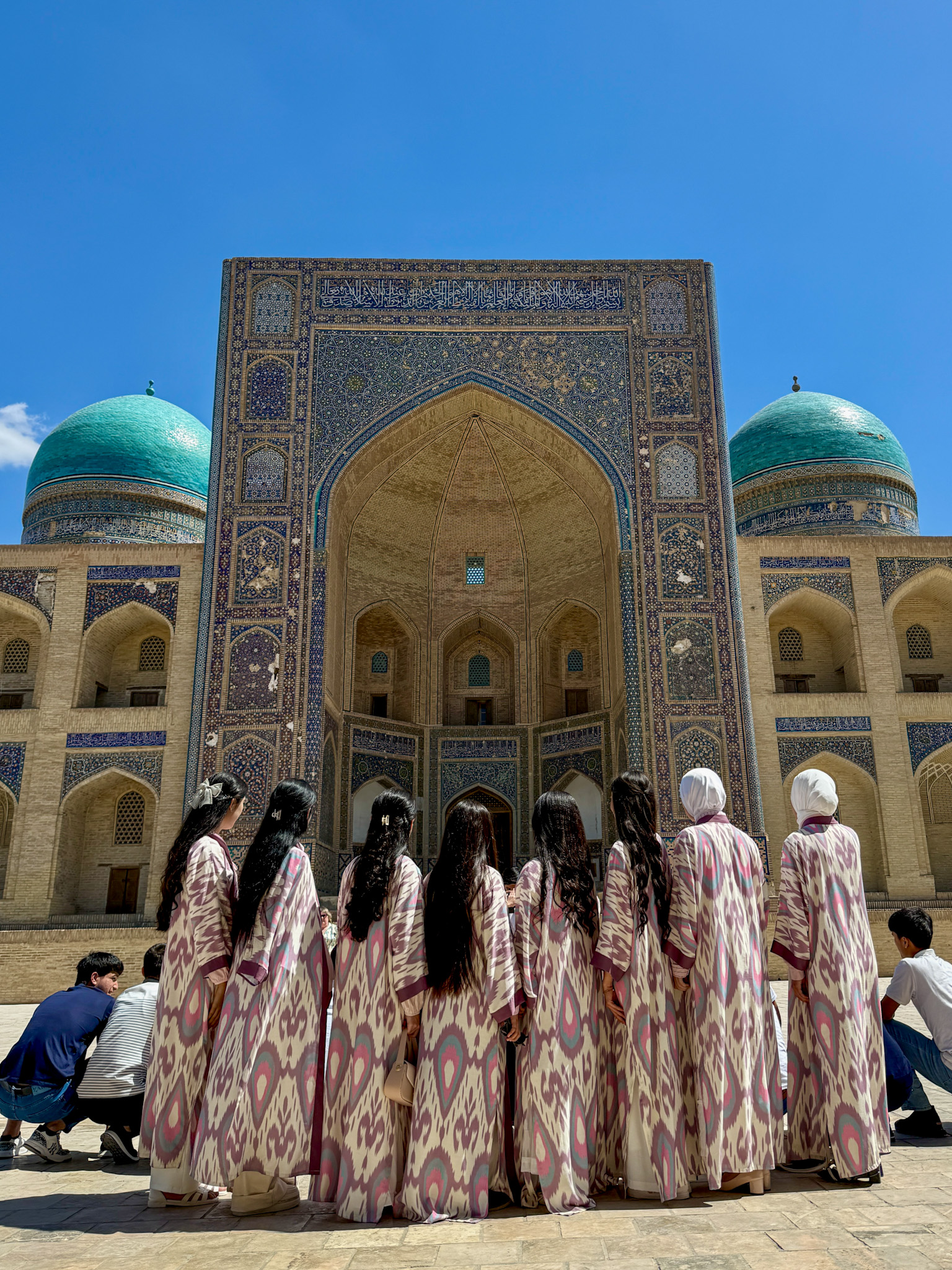
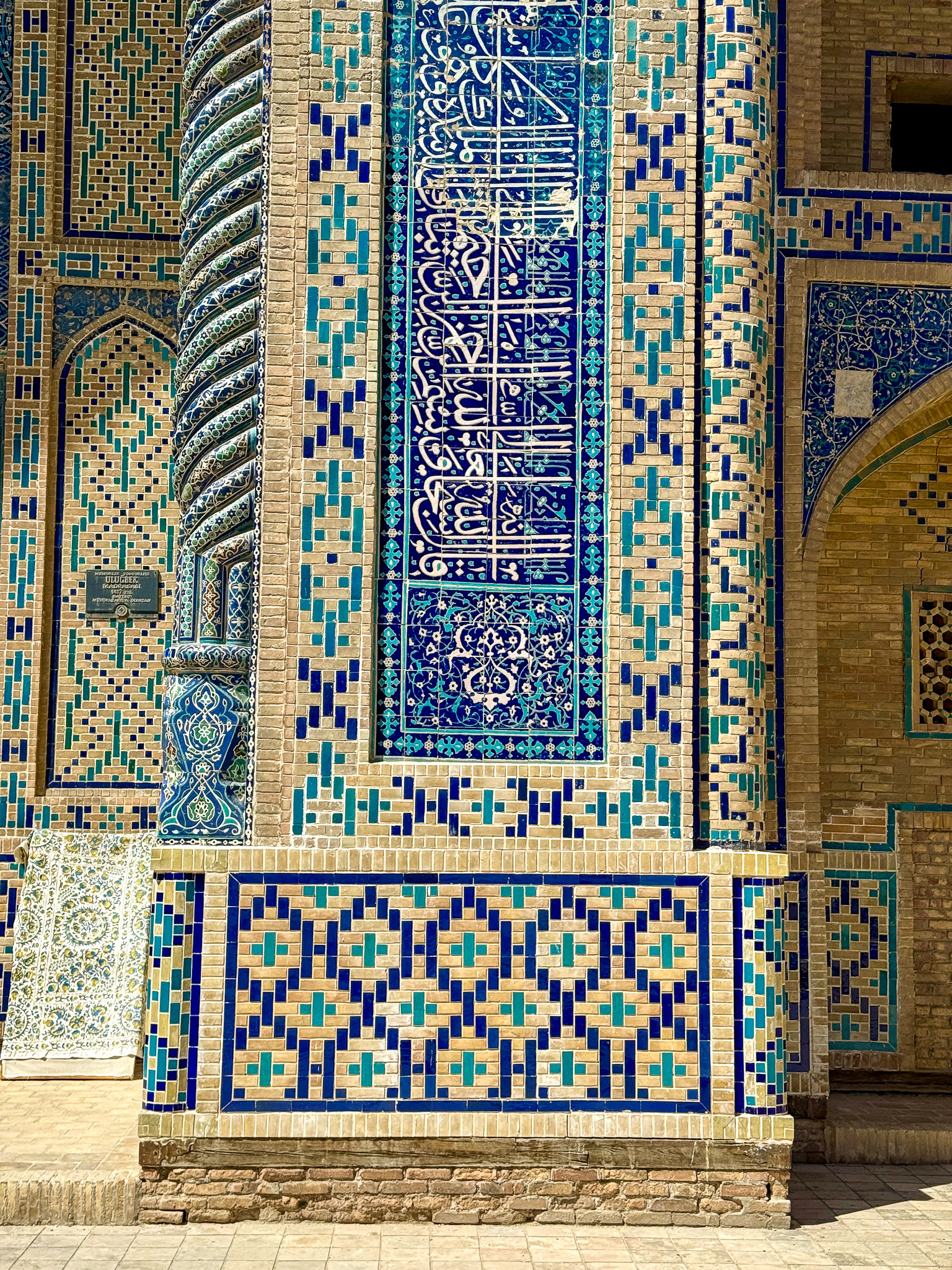
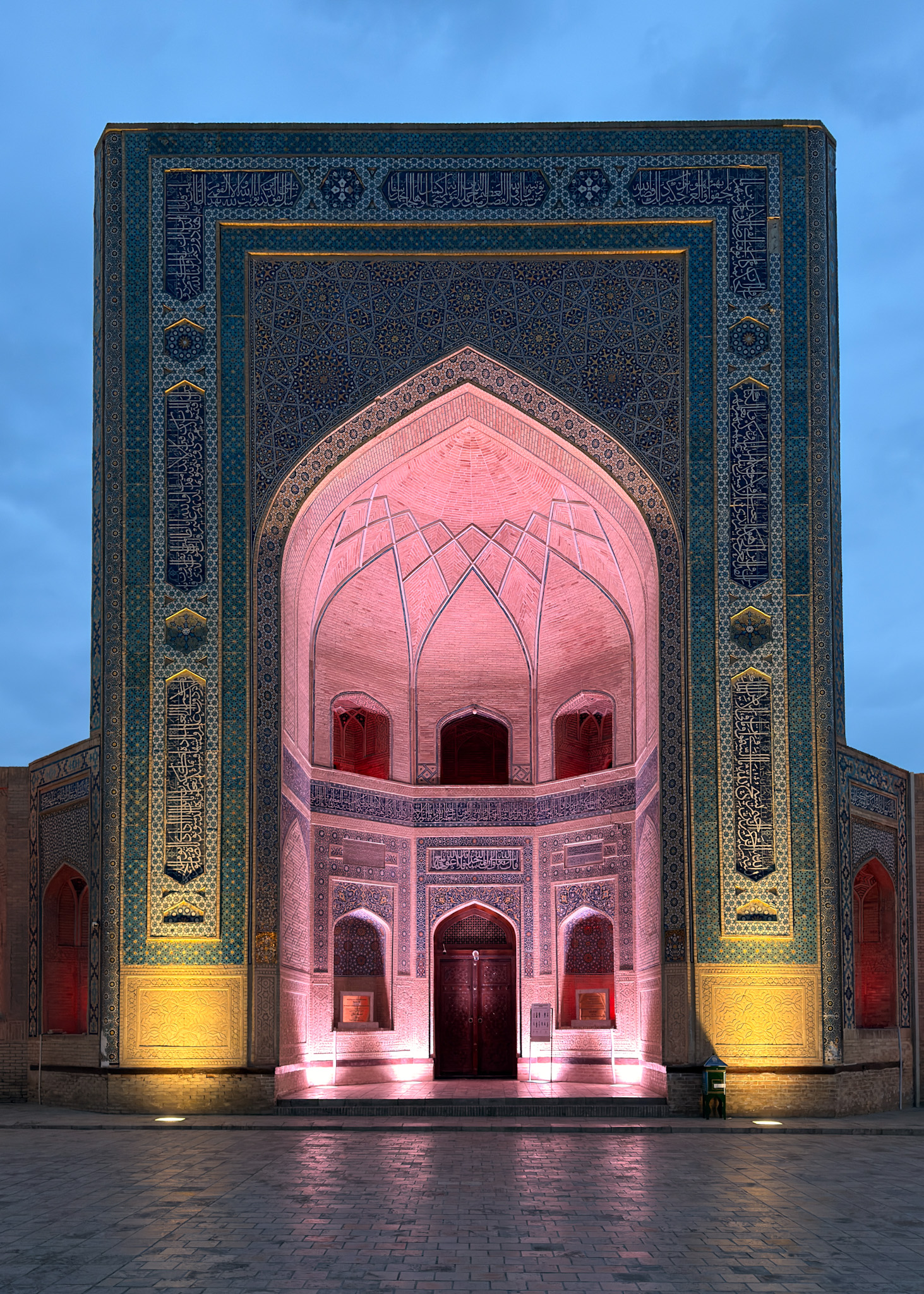
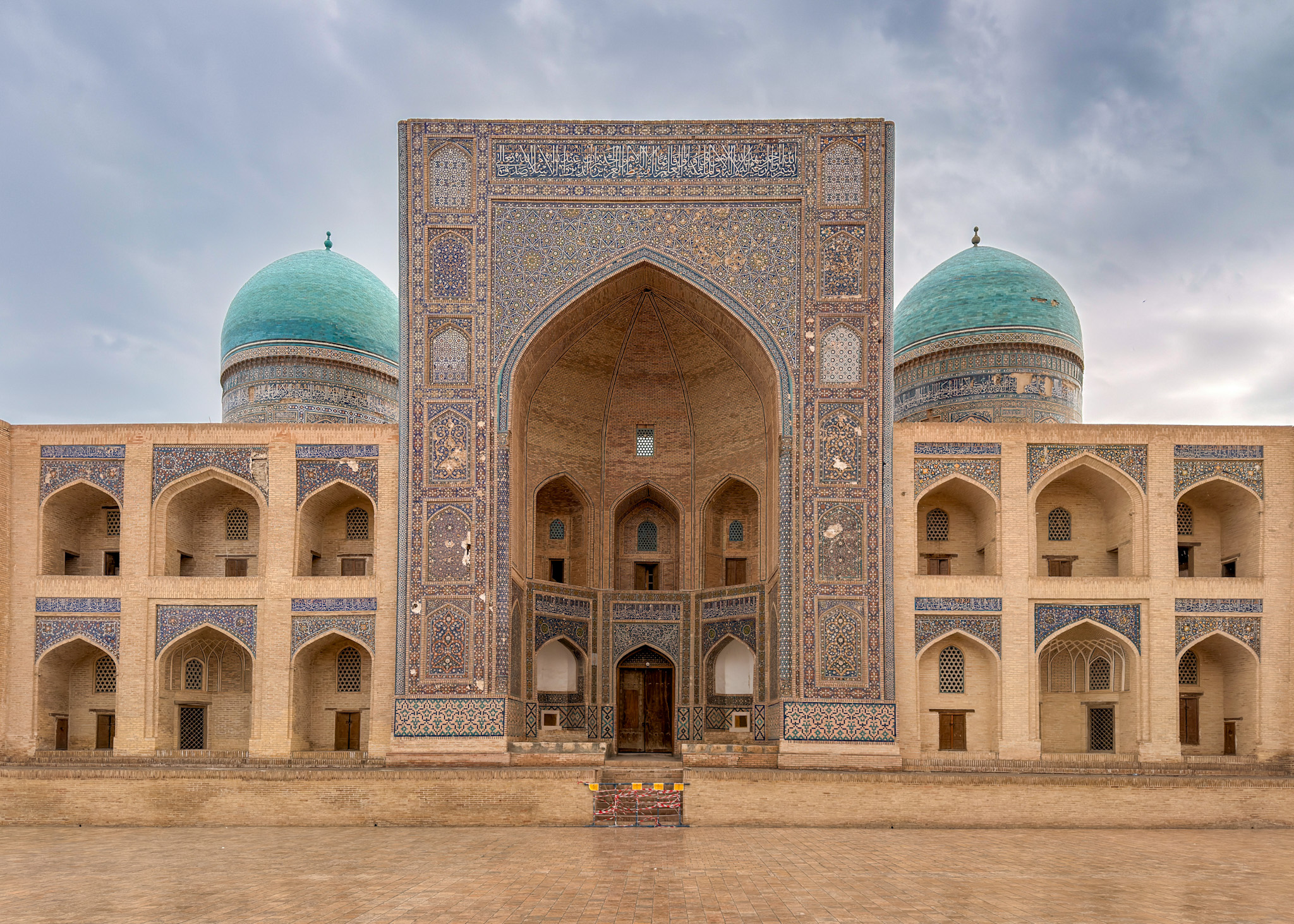
After dinner we walked. Bukhara is over 2,000 years old and is widely considered the most complete surviving example of a medieval Central Asian city, more than 140 architectural monuments packed into a relatively small area, a UNESCO World Heritage Site, historically important enough to be known throughout the Islamic world simply as Noble Bukhara. We wandered without a route as the sun went down, just letting the place reveal itself. At the end of the evening we found ourselves in front of the Ulugbek Madrasa, built in 1417, the oldest surviving madrasa in Central Asia. Above its entrance, an Arabic inscription translates roughly as: “Education is obligatory for every Muslim man and woman.”
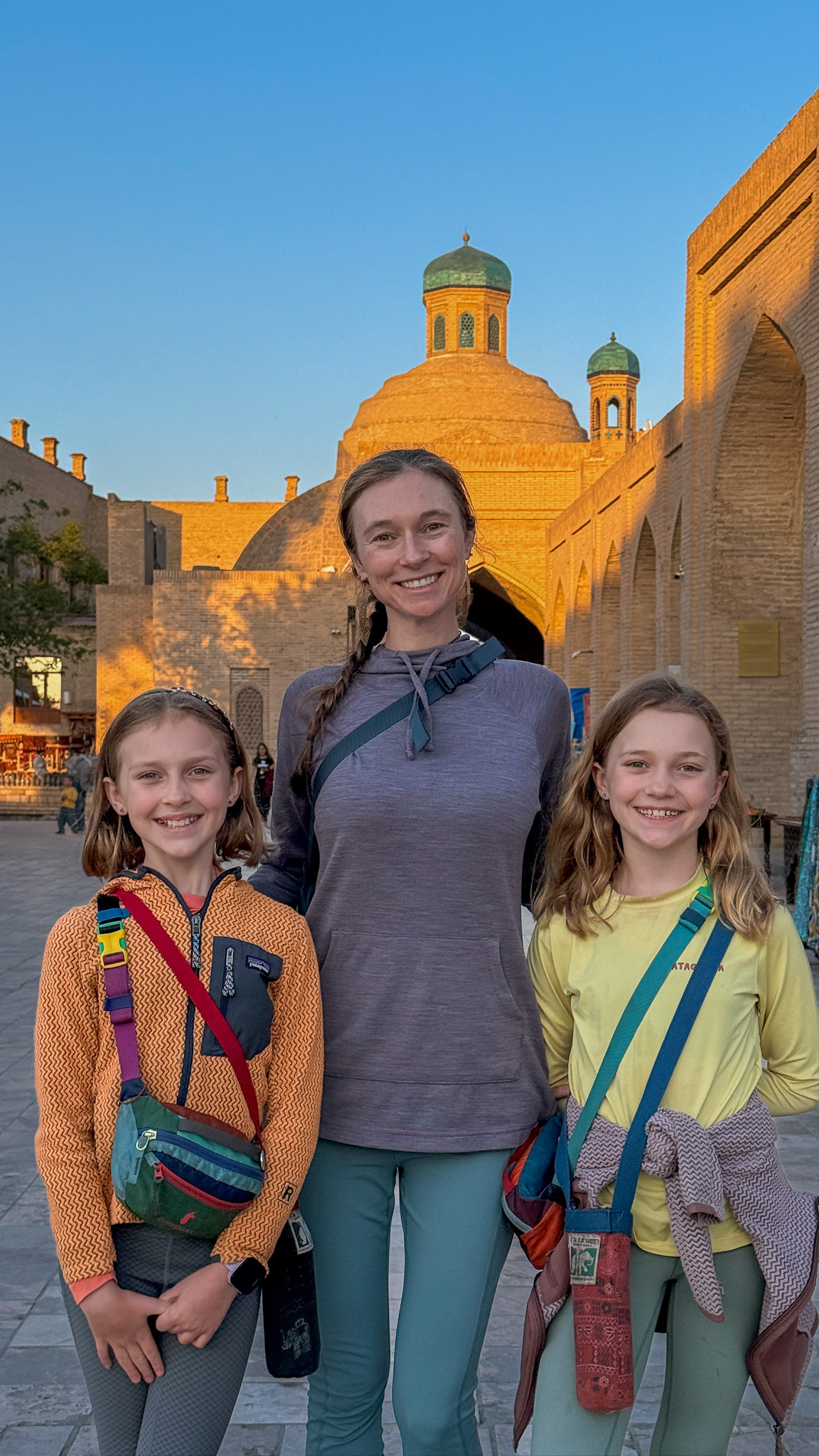
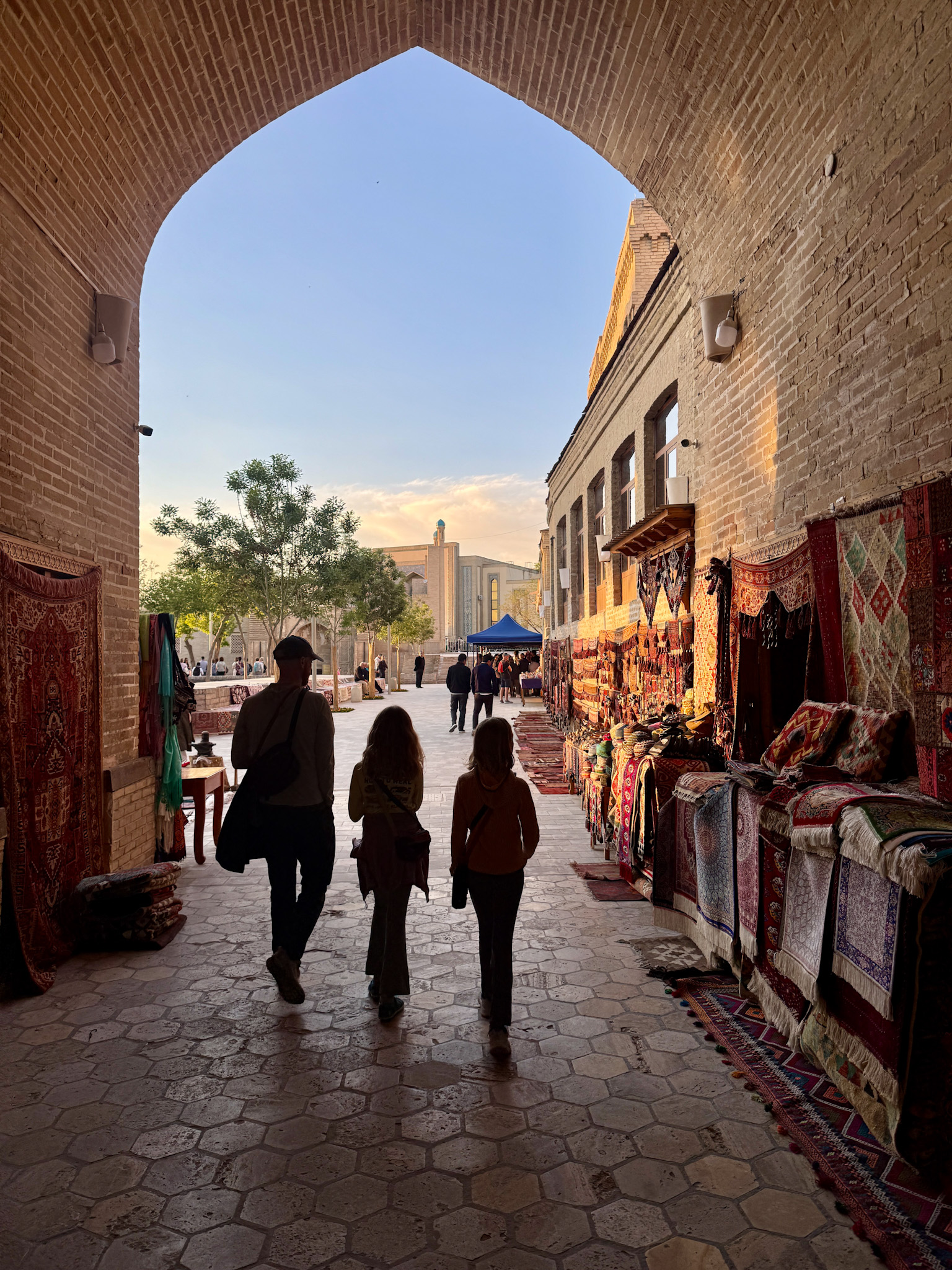
We all had a similar feeling about this city almost immediately, something hard to fully articulate. Not the reconstructed-for-tourists quality some old towns have, where everything has been too carefully curated and the life drained out in the name of preservation. Something that felt genuinely “lived in.” Ancient bones with continuous life running through them. We’d see it more clearly over the next few days, though it was Arya who finally put it into those words.
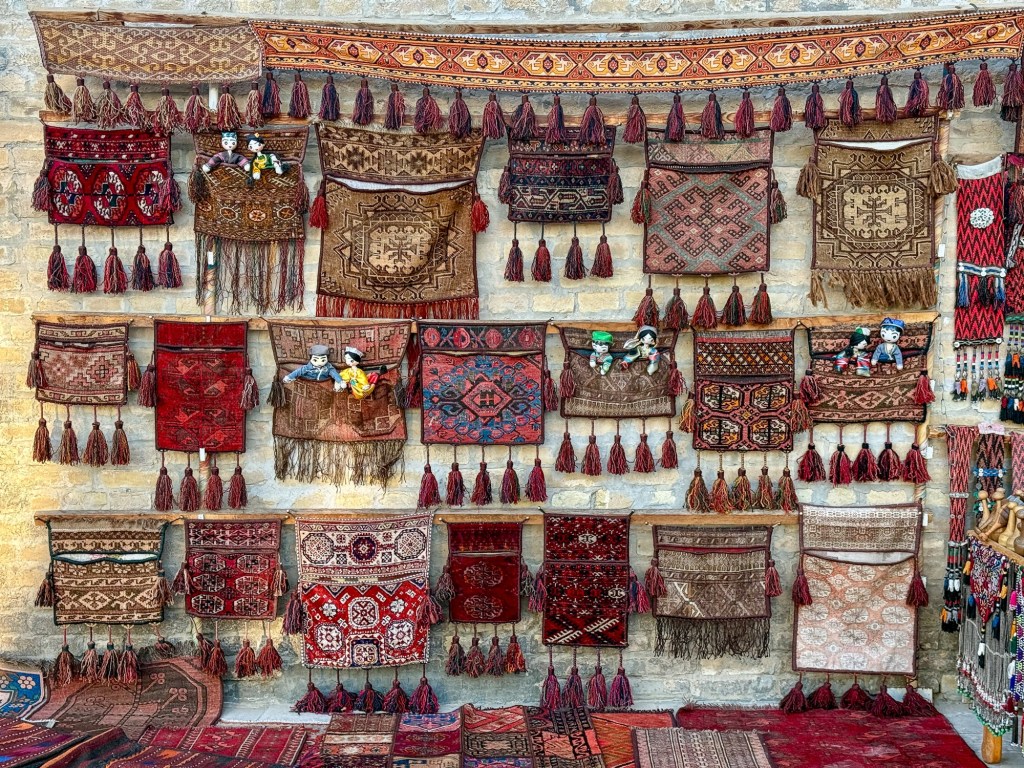
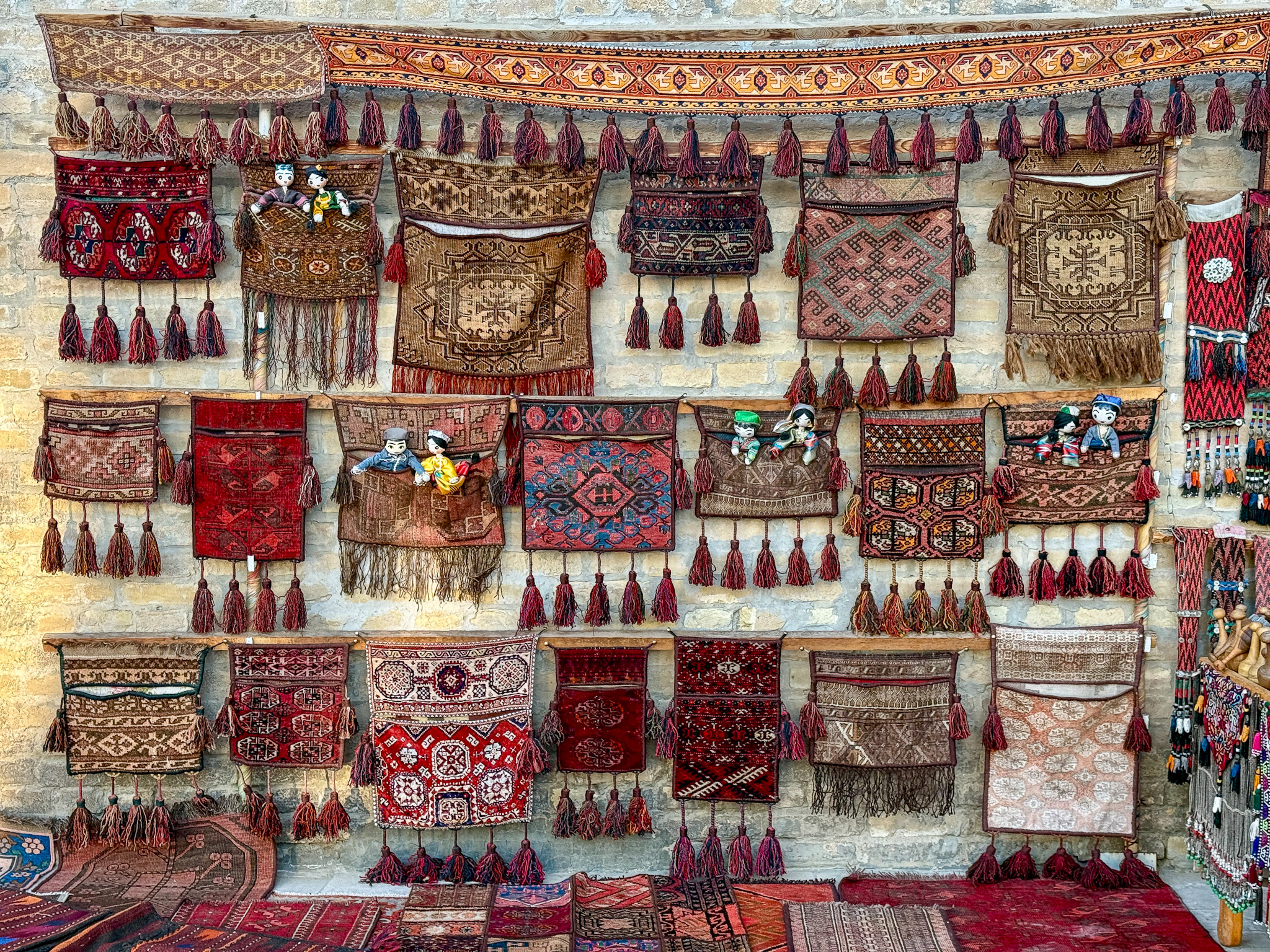
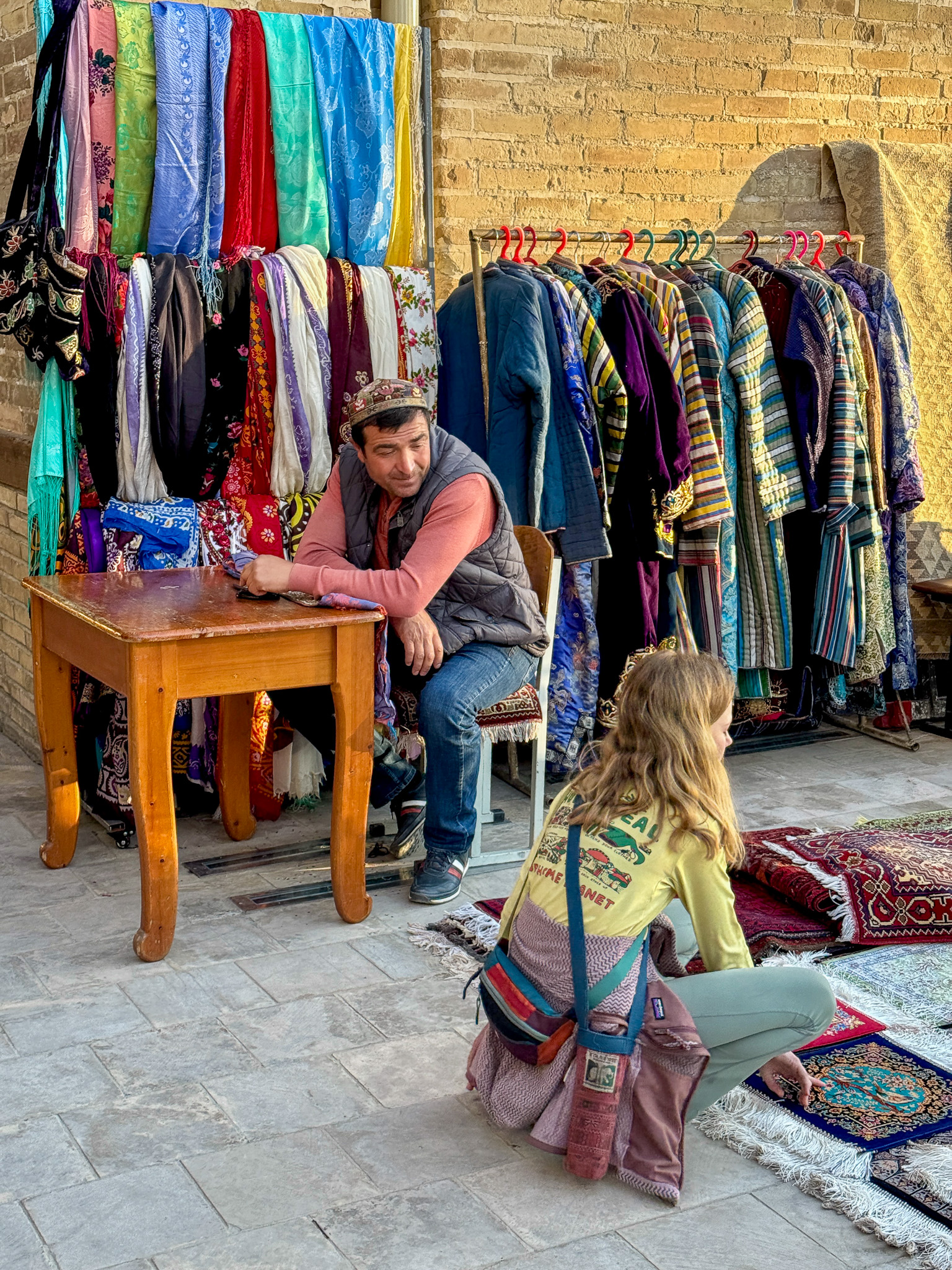
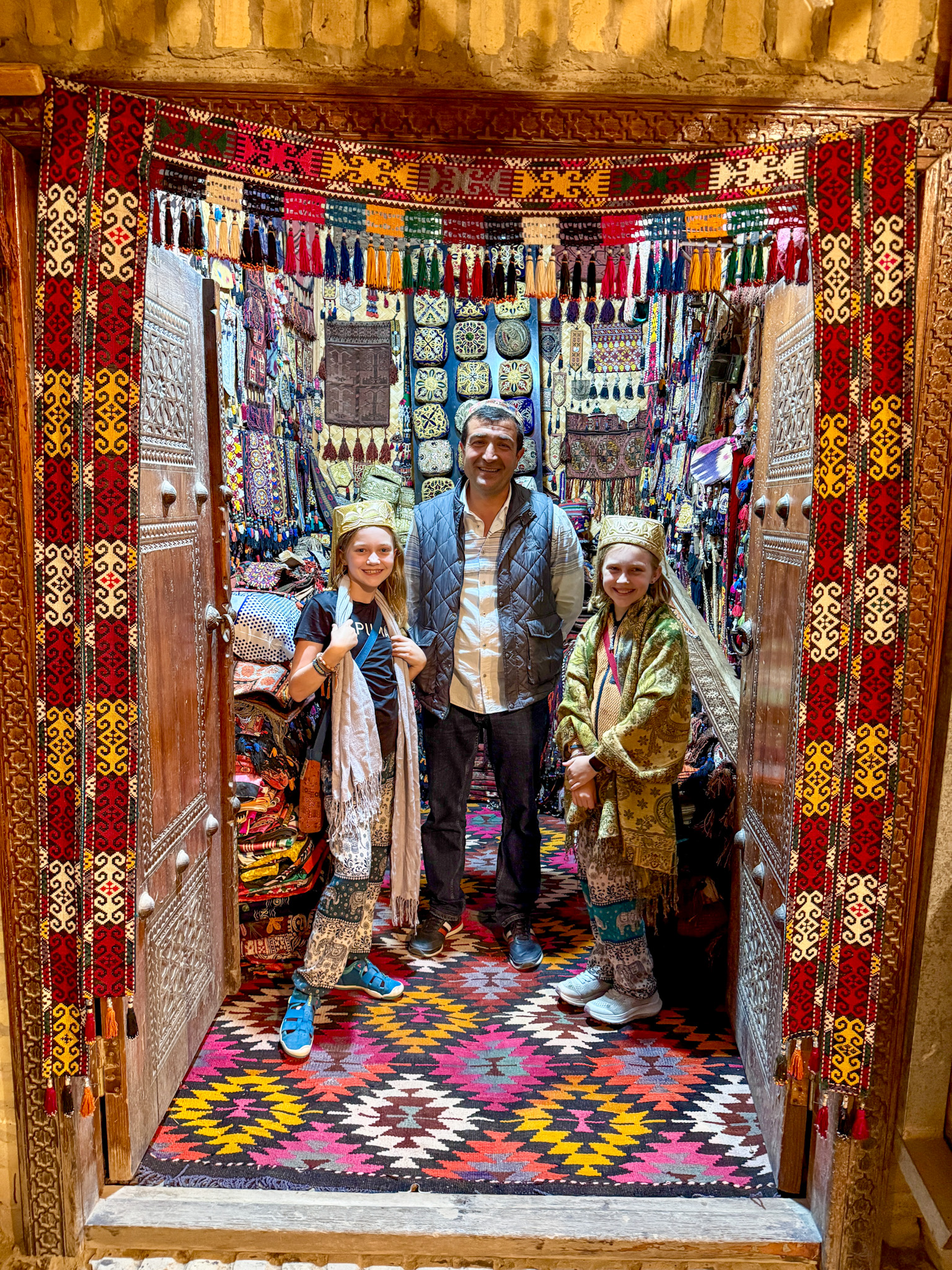
Each day we saw everyday-life peppered amongst the grand monuments, and the best example came when we met Djamal, who hilariously introduced himself as “Djamal Millionaire” at our first encounter. “Not a millionaire from money, but from friends.” His genuine smile and disarming vibe made us linger at his stall longer than most, inspecting his wide array of repurposed rugs and wall-hangings that he made from recycling old carpets and fabrics and creating new art—quite unlike the standard tourist traps that littered the main drag of Bukhara’s old town. We passed his stall several times a day, each time stopping for a quick chat, hearing about his family, his craft, and his life in Bukhara—he became a staple of our daily routine.
Max put together a self-guided walking tour one morning that he’d structured as a loop through the highlights of the old town. What we didn’t realize going in was that we were about to spend four hours walking through a city that has been conquered, destroyed, and rebuilt more times than almost anywhere on earth, and that each stop was going to be another chapter of the same story.
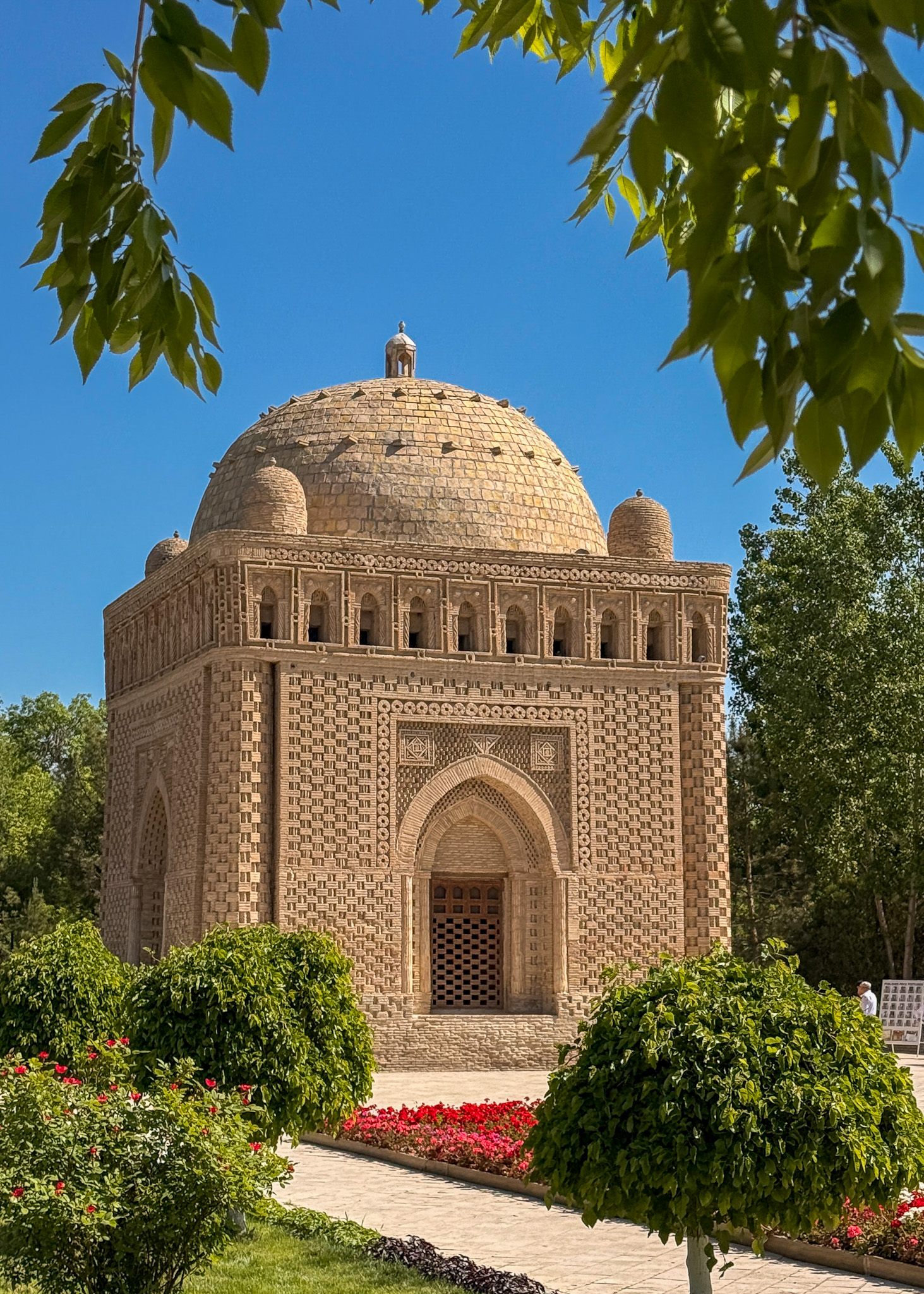
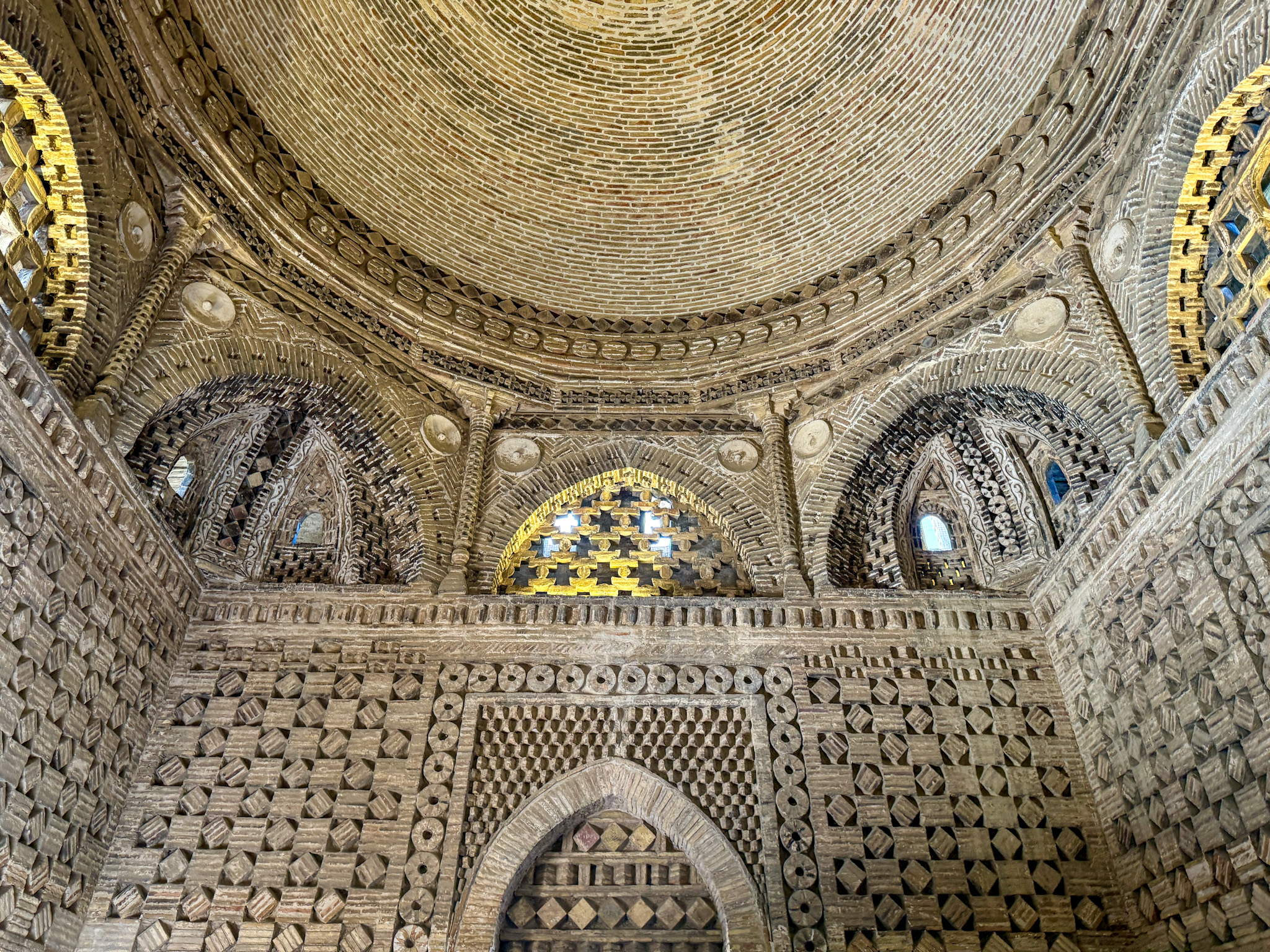
The first stop set the tone. The Ismail Samani Mausoleum, completed around 905 CE, is the oldest surviving Muslim monument in Bukhara, and one of the oldest well-preserved Muslim monuments in the whole world. It is a perfect cube of baked brick topped by a hemispherical dome, no glazed tiles, no later ornamentation, just the brickwork itself laid in patterns so intricate the building seems to shift in character as the light moves across it. It should not exist. When Genghis Khan sacked Bukhara in 1220 he intentionally left most of it in rubble. The Ismail Samani Mausoleum survived only because flood silt had buried it a century before the Mongols arrived. They walked straight past it without knowing it was there. It sat forgotten under meters of sand until Soviet archaeologists found it in the 1920s. The oldest thing in Bukhara survived the worst thing that ever happened to Bukhara because the earth hid it.
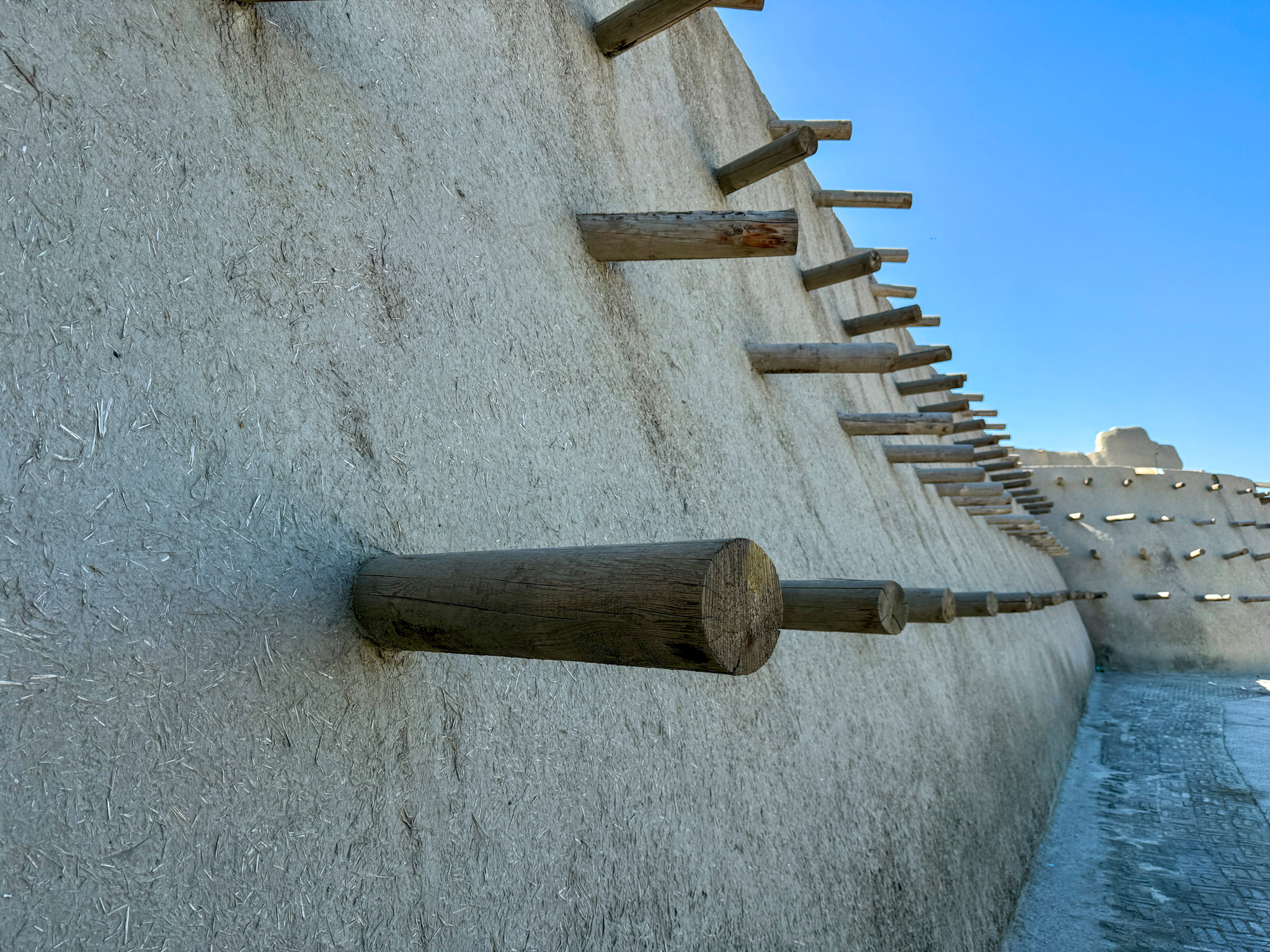
From there we walked to the Ark, the royal citadel at the center of the city, a town-within-a-town built up over centuries on a massive earthen mound. The Ark was occupied continuously from the 5th century all the way through to 1920, when the Bolsheviks bombed it and ended the Bukharan Emirate for good. Fifteen centuries of continuous occupation, ended in an afternoon. We didn’t go inside, but the gate and the long ramp rising to the entrance and the massive tapered walls looming above said everything that needed to be said. Some structures communicate the weight of power even in ruins.
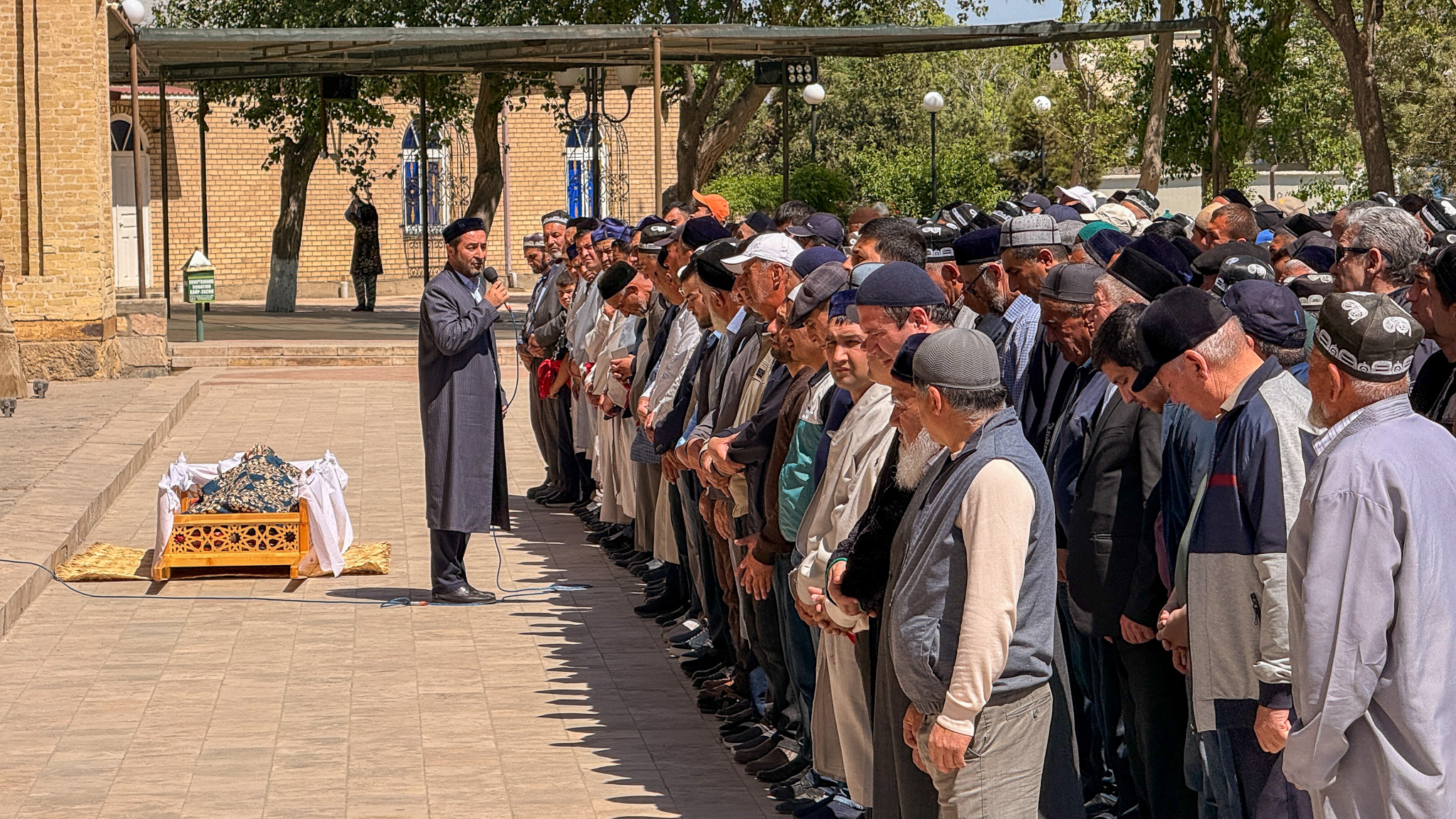
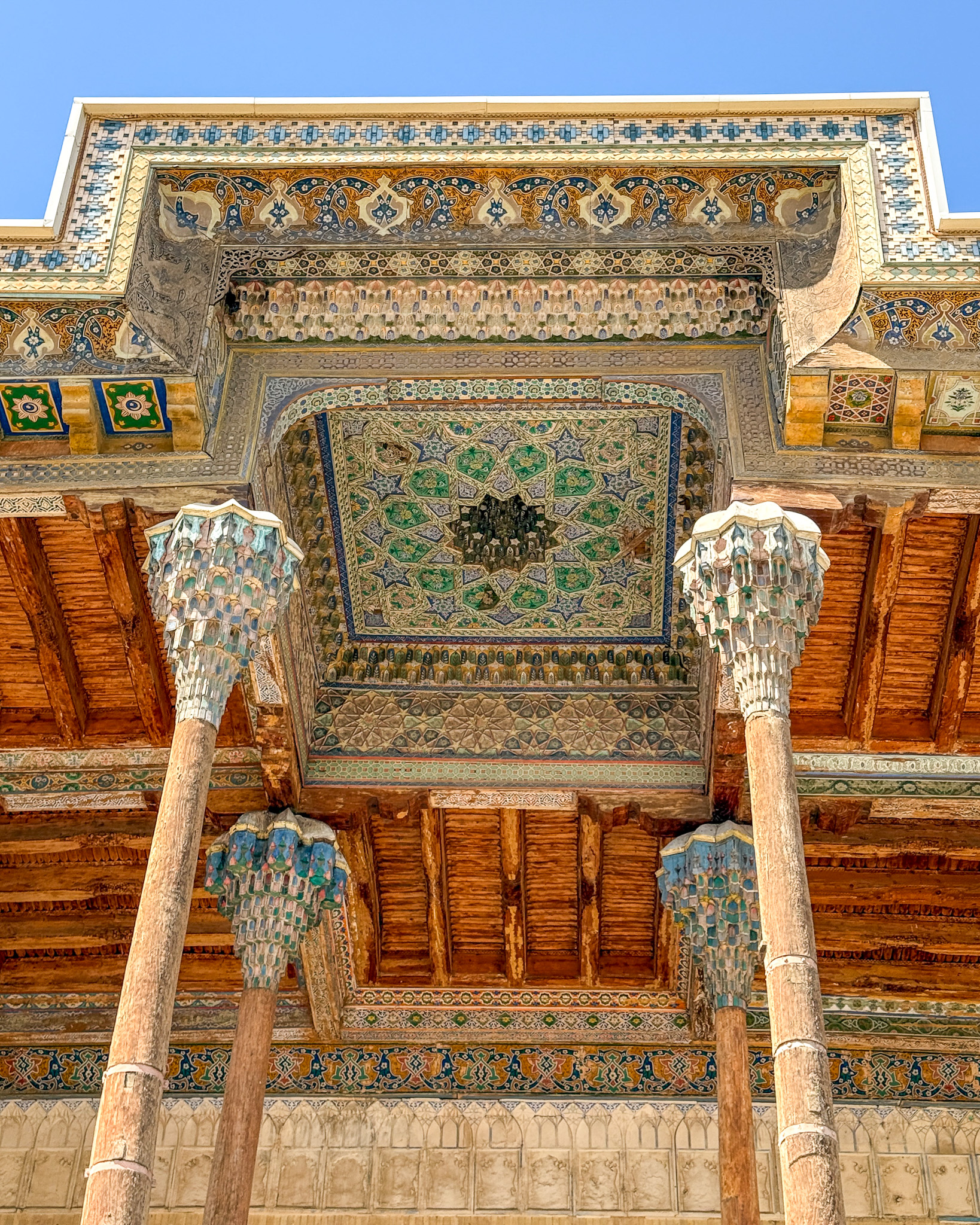
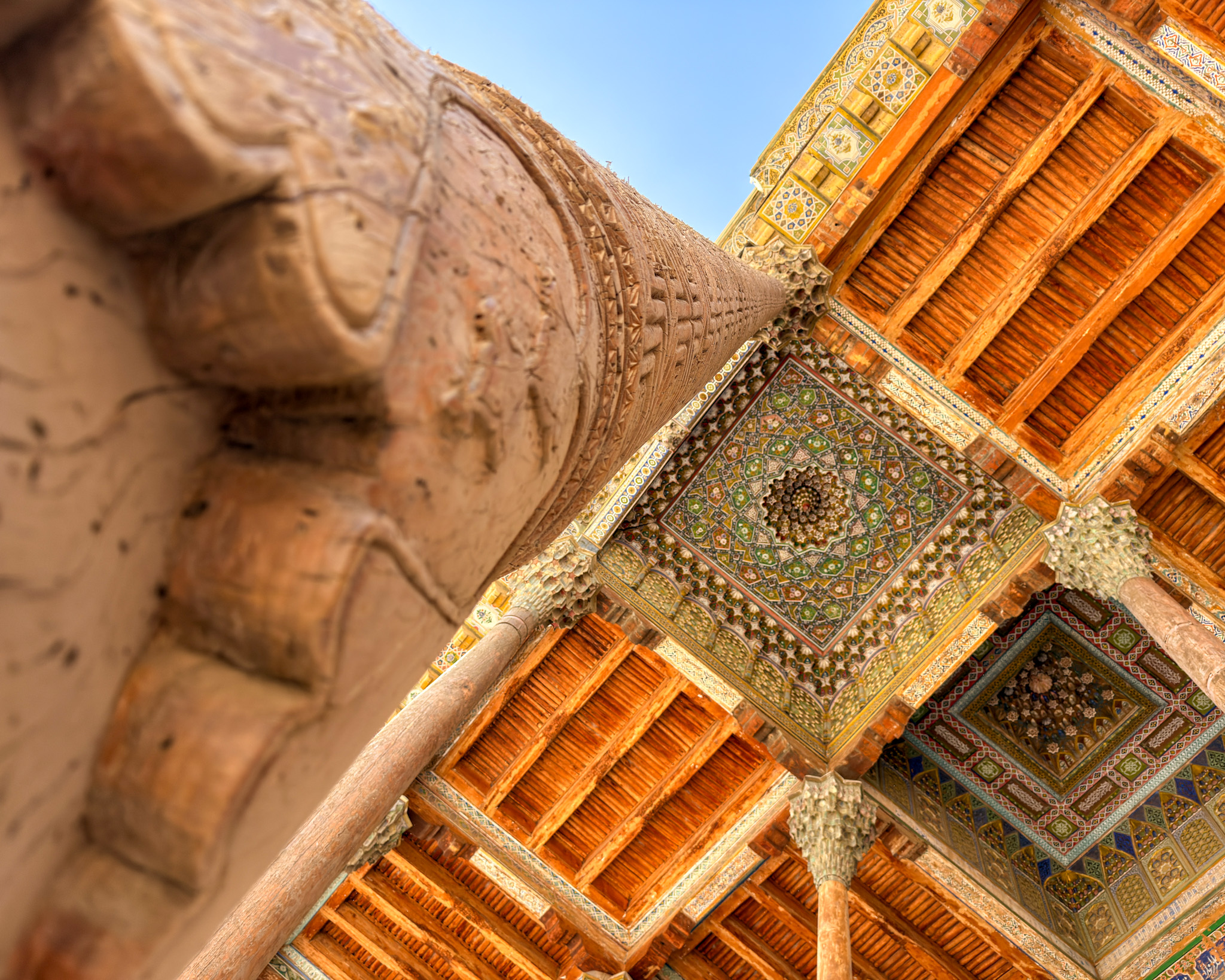
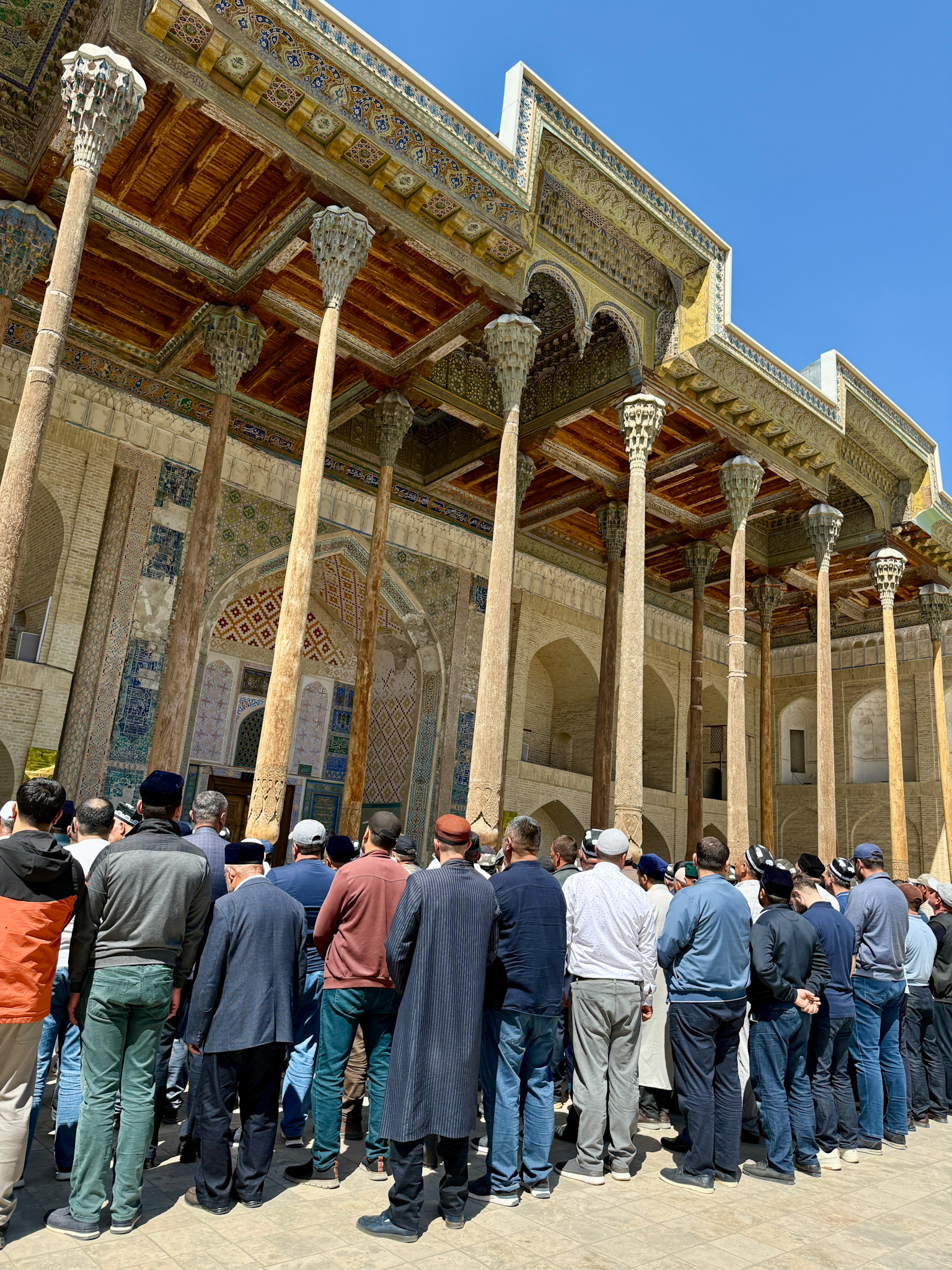
Right across from the Ark is the Bolo Hauz Mosque, built in 1712 as the emir’s official Friday mosque. Its rows of 20 tall carved wooden columns reflects in the pond out front, appearing to double, which is why locals call it the “Mosque of Forty Columns.” By pure chance, we arrived just as a funeral was beginning.
We hung back, sitting respectfully on a bench facing the facade, taking in the whole thing. The men had lined up in front of the mosque, having carried the body on a simple wooden platform at the front of the congregation. The imam began the service, and more and more men continued to flood into the area, almost running to be able to line up and take part. We all were mesmerized by the expanding rows of robed men in traditional Uzbek flat caps. The girls said the quiet part out loud: “wow, this guy must’ve had a lot of friends when he was alive.” But it felt too random, too scattered. Naturally we did some research on the spot: it’s a big deal to attend a funeral in Islamic culture—a collective obligation that both fosters community and gains the participants a hefty dose of Merit on their own spiritual scorecard.
Afterward we did more research to really understand what we’d witnessed. Tradition and Islamic law dictate that funerals are open to all. Strangers are not just permitted to join the prayer but actively encouraged to. The body is wrapped in simple white cloth. The prayer is brief, communal, and unhurried. Burial is meant to happen quickly, often the same day. The girls have never attended any funeral of any kind. Watching people grieve in a completely unfamiliar cultural context, different language, different rituals, a different relationship to death and ceremony, was one of those moments travel occasionally grants you that you can’t plan for and can’t manufacture. It was also something else: a reminder that through everything that had swept over this city, every army that had come through, every empire that had claimed it, people had been standing in front of mosques grieving their dead in more or less this same way for over a thousand years.
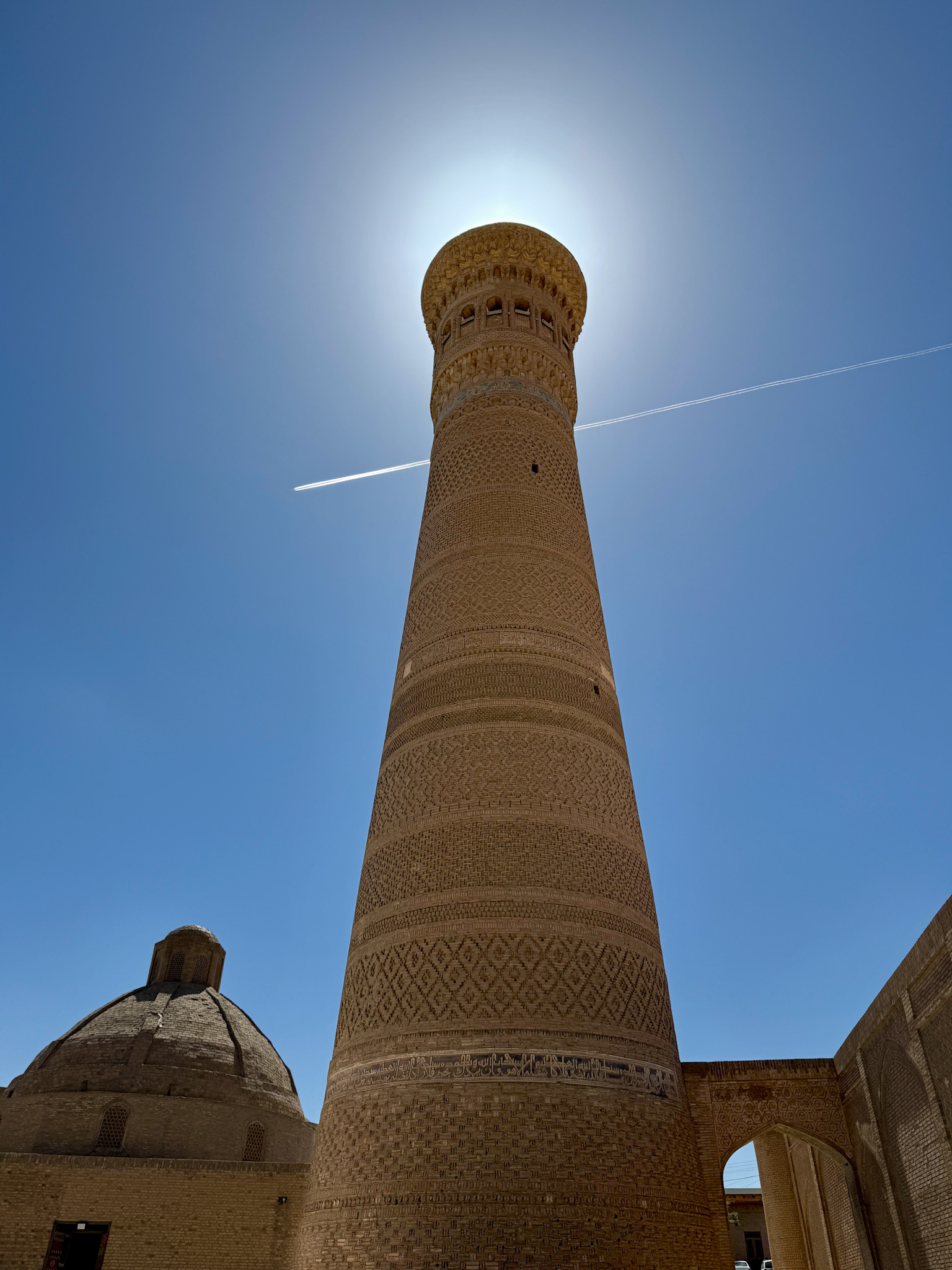
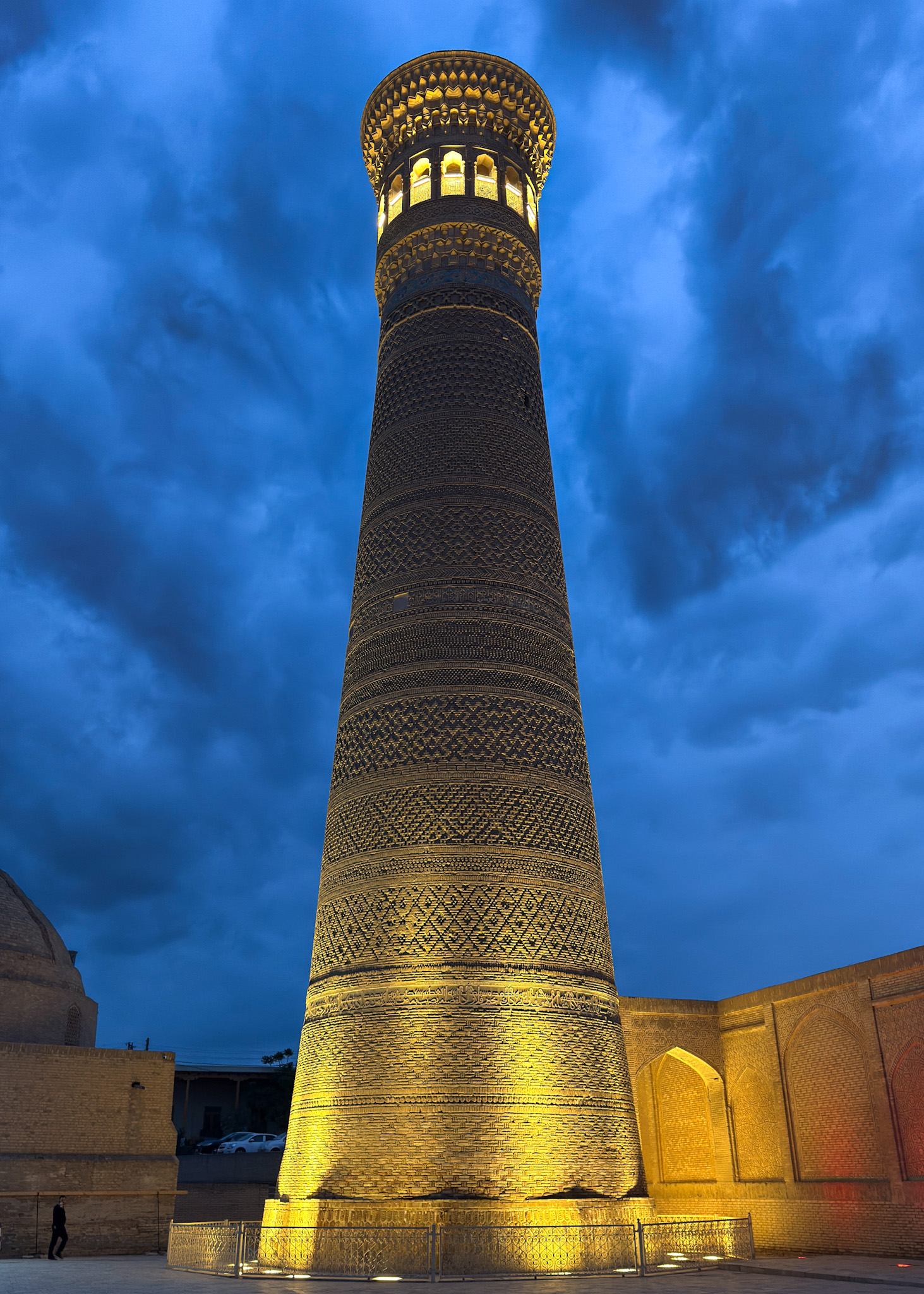
From Bolo Hauz we walked into Po-i-Kalyan square, the visual and spiritual heart of Bukhara. The Kalyan Minaret, built in 1127, stands about 48 meters tall, and it is famous mostly for one thing: it survived Genghis Khan. Legend holds that when he reached Bukhara in 1220 he stood at the base, tipped his head back to take in the full height, and was so impressed he ordered it spared while his army razed the rest of the city. Whether that story is precisely true or has been improved in the telling, the minaret is the only significant pre-Mongol structure in Bukhara still standing in its original form. A conqueror who destroyed almost everything chose to keep this one thing. Standing in that square, looking up at the same brickwork Genghis Khan once looked up at from the same spot, is one of those moments where history stops being a list of dates.
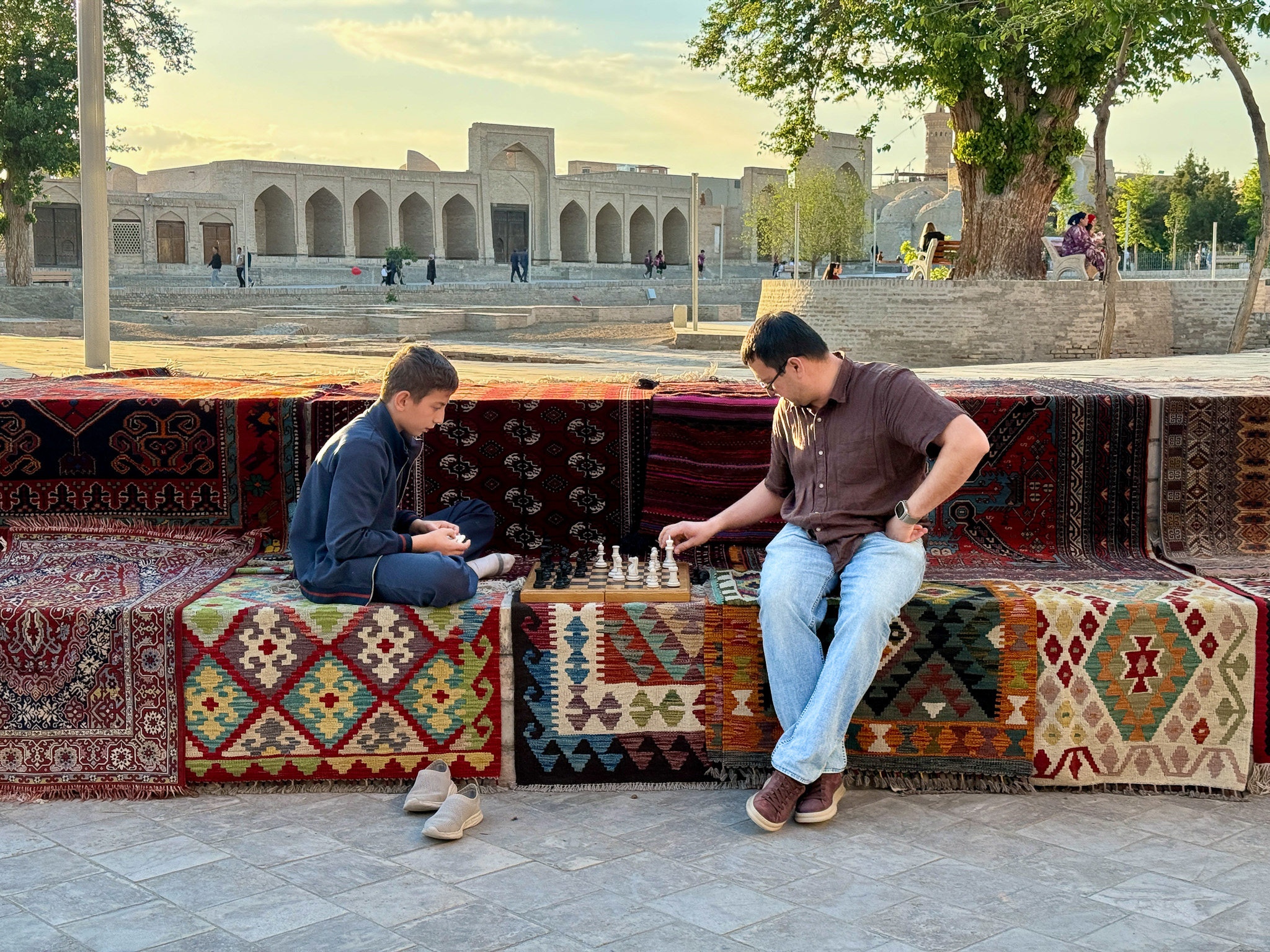
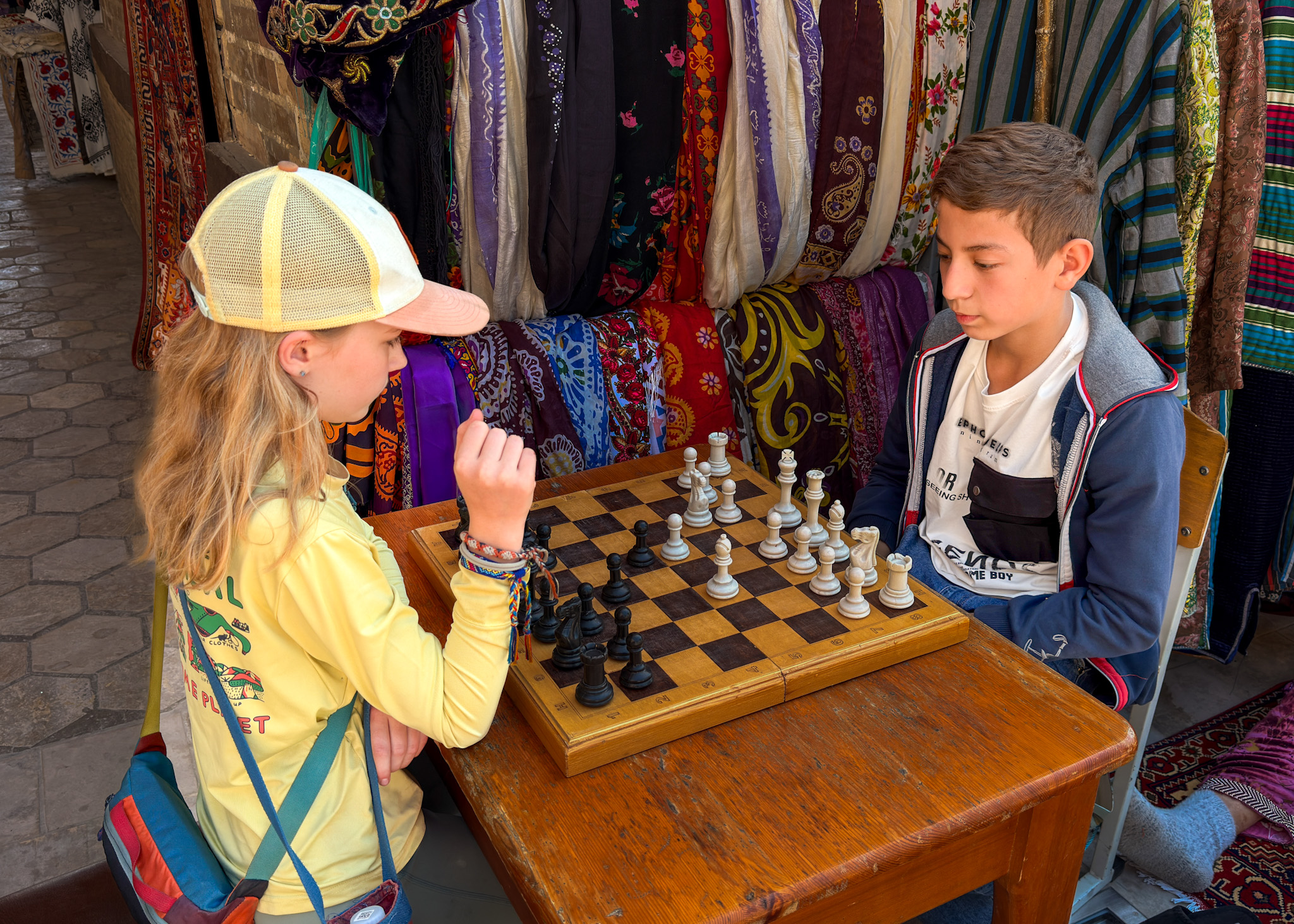
Heading back towards the center of the old city, we ran into Djamal again, just finishing up a game of chess with his 12-year-old son, Kamal. We nudged Arya to take a seat and play a match. Initially she blushed and balked at the idea, but when offered her an ice cream if she won, she took enthusiastically a seat. Djamal said with a laugh “Ice creams for all of you if she wins, and you get ice creams for all of us if he does!” We chuckled and silently nodded in agreement. Arya hadn’t played chess in months, and got throughly thumped. But she shook Kamal’s hand afterwards in congratulations. Proud parents at the show of sportsmanship, we bade them farewell to finish our walking tour.
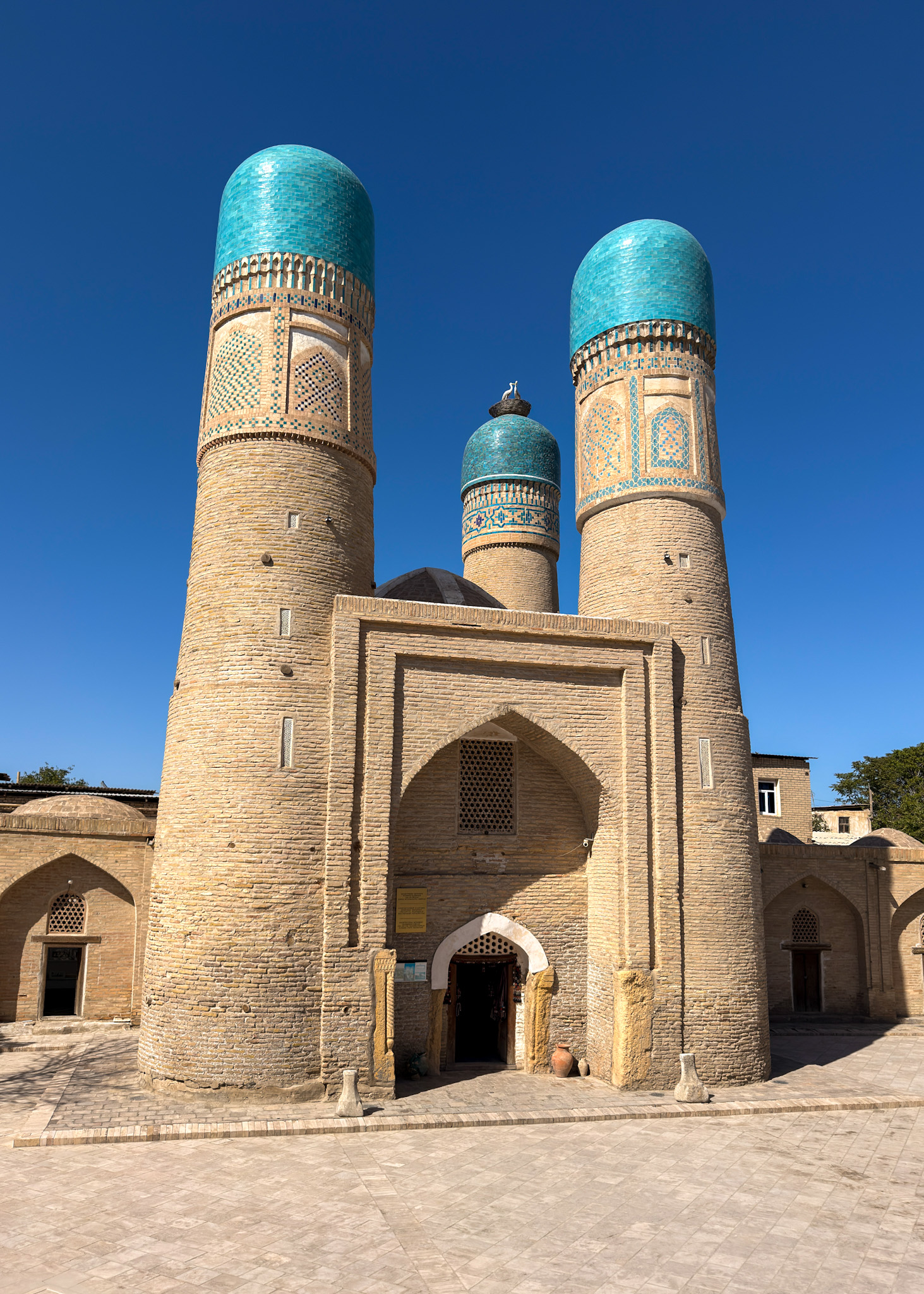
Our last stop was Chor Minor, which Finlee took one look at and declared resembled an upside-down cow udder. She is not wrong. Chor Minor means “four minarets” in Persian, a small square gatehouse with four stubby blue-domed towers at the corners, built in 1807 as the entrance to a madrasa that no longer exists. What’s remarkable about it is that each tower is decorated differently than the rest of the monuments in town—the decorations are traditionally understood to represent the four religions present in Central Asia at the time: Islam, Christianity, Buddhism, and Zoroastrianism. You can pick out what look like crosses, a Christian fish symbol, a Buddhist prayer wheel. Someone in 1807, under a conservative Islamic dynasty, built a religious school gate that acknowledged and perhaps even celebrated other religious traditions. A small act of openness, fixed in brick and tile, now outlasting the school it was built to serve. We talked with the girls about what it means that this exists, that a conquered and reconquered people, living under a dynasty that had its own strong claims on absolute truth, still managed to build something that said: other ways of understanding the world are worth remembering.
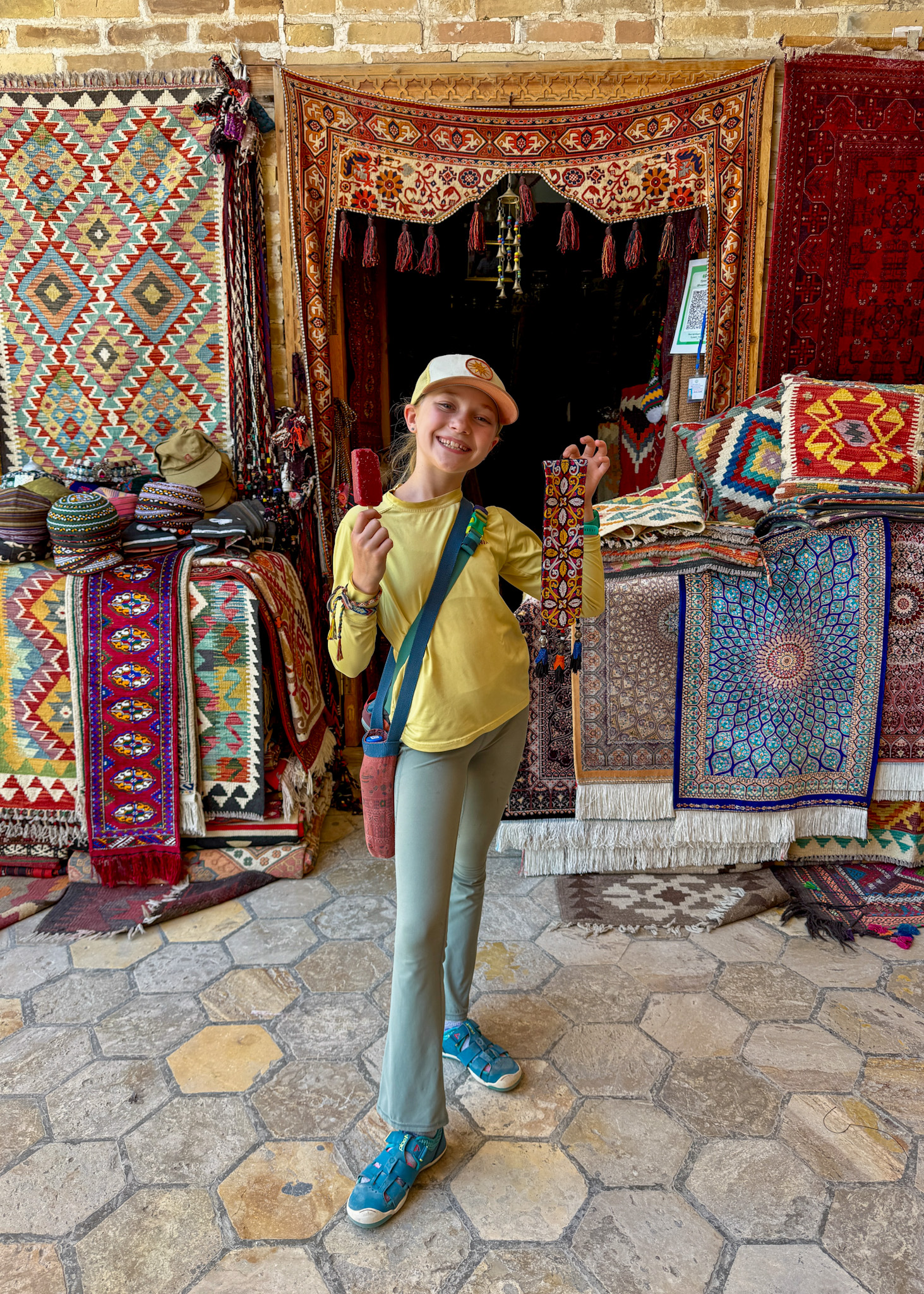
Walking tour done, we all felt we’d earned that ice cream now and we found a shop with tasty-looking fresh pomegranate popsicles. So we bought 8 of them, hurried back to Djamal’s shop and handed them out to Kamal and his dad, as well as his grandma and friend who’d watched the whole thing. They seemed utterly flabbergasted that we’d followed through on the “wager”, and Djamal immediately ran into his shop. He came out with one of his personal creations—a wall hanging made of a repurposed strip of rug with dangling tassels of woven wool and beads. He handed it to Arya, who beamed with pride. When we left them, she wisely summarized the whole affair: “fortune favors the bold.”
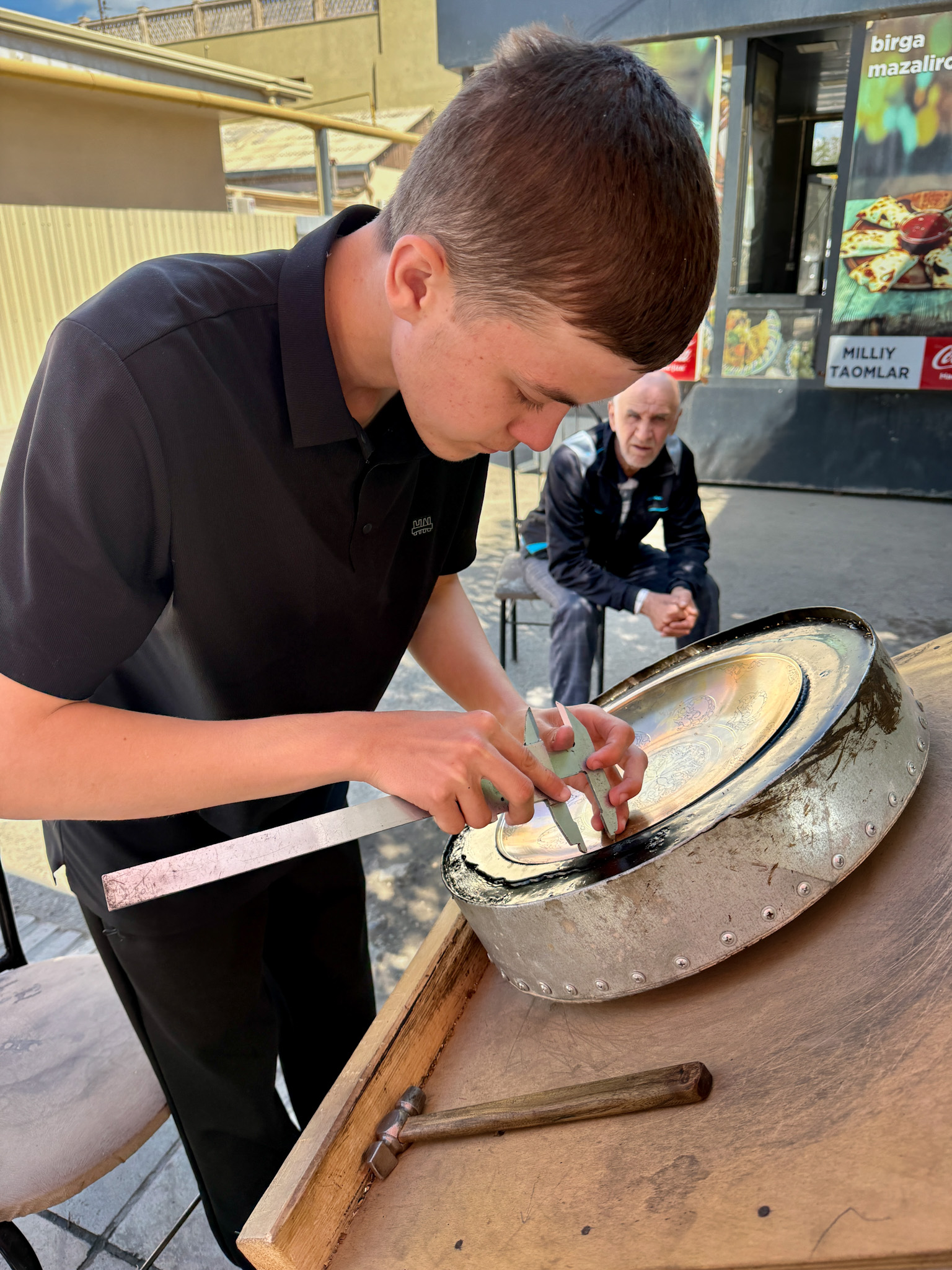
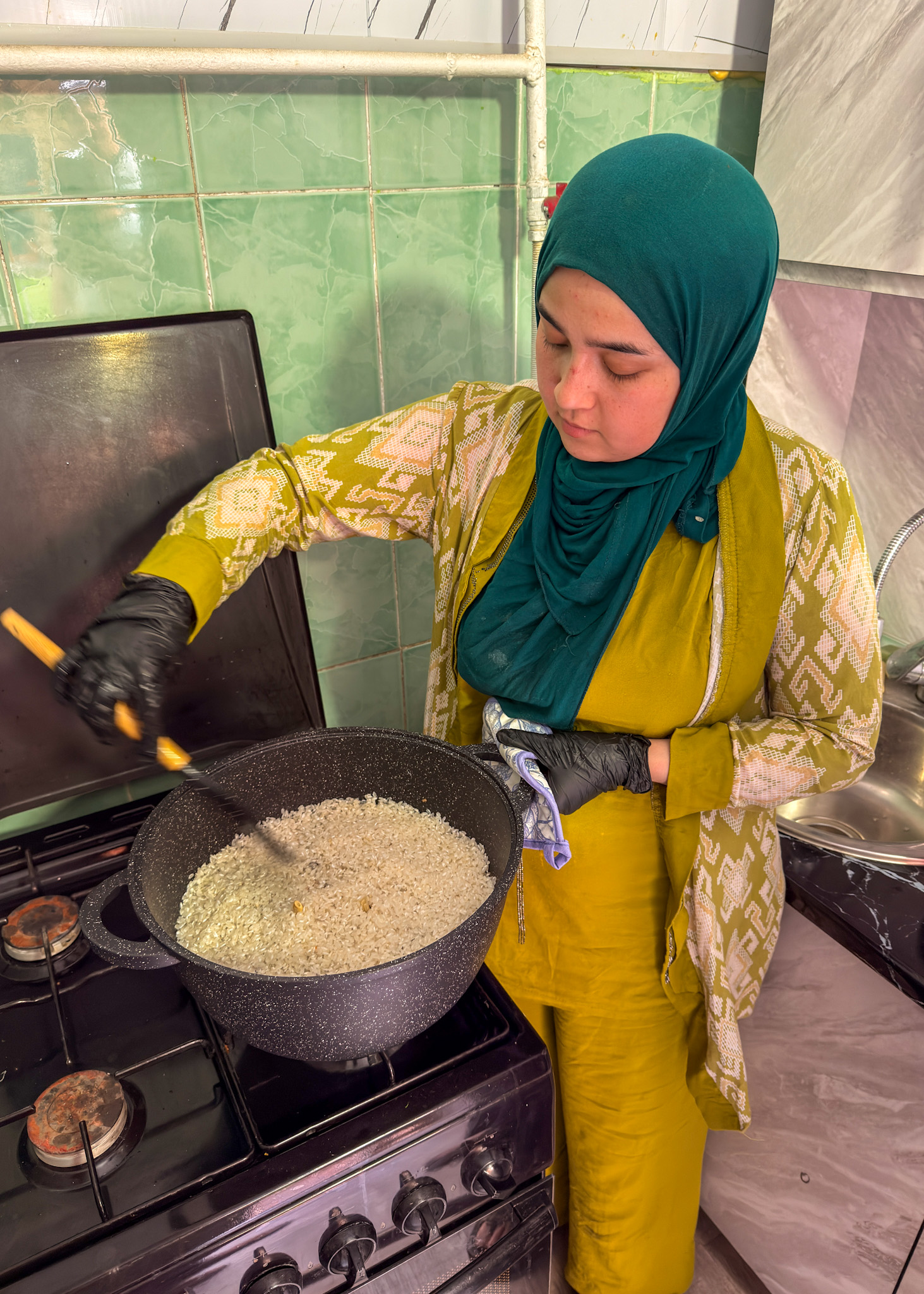
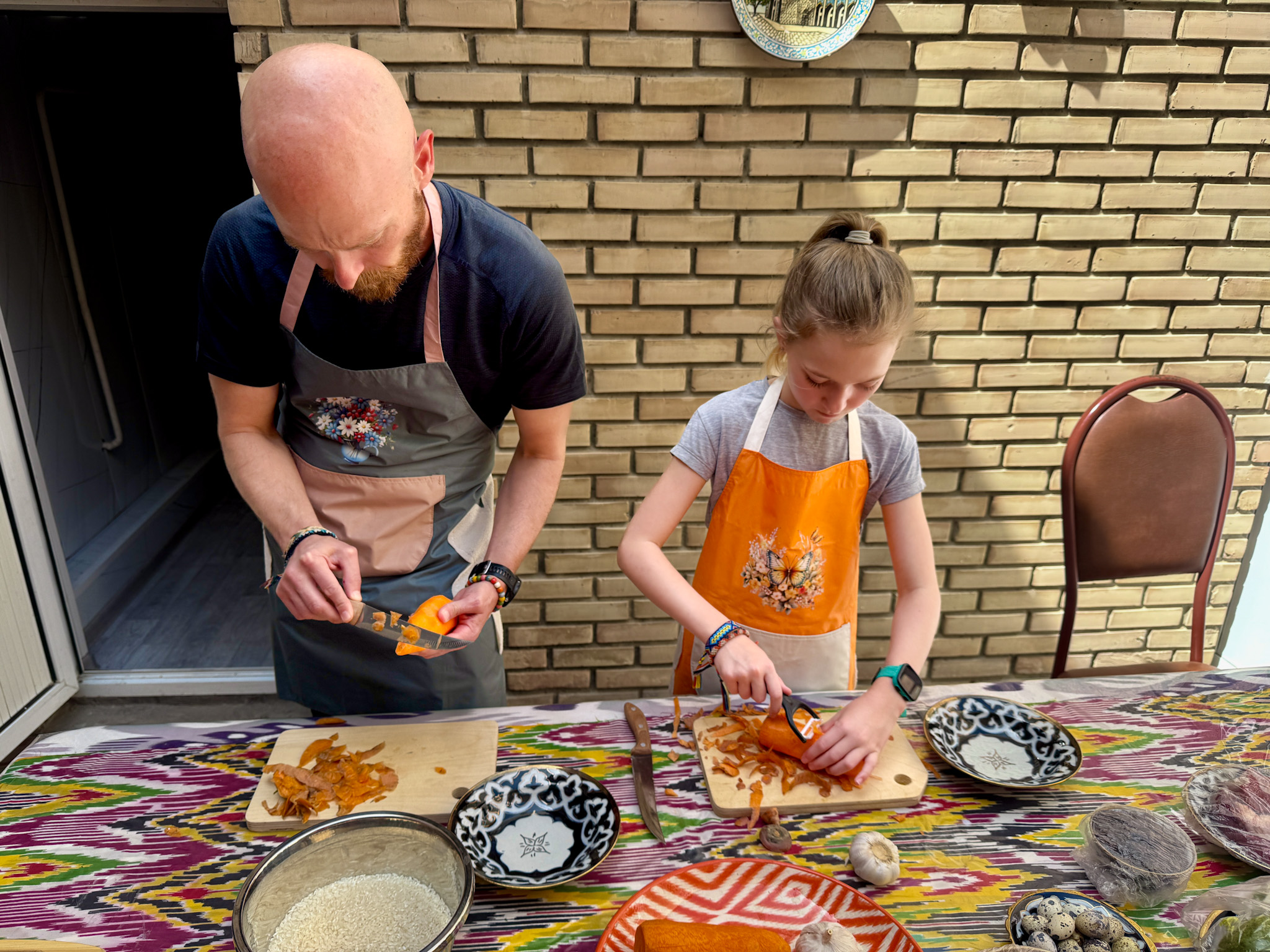
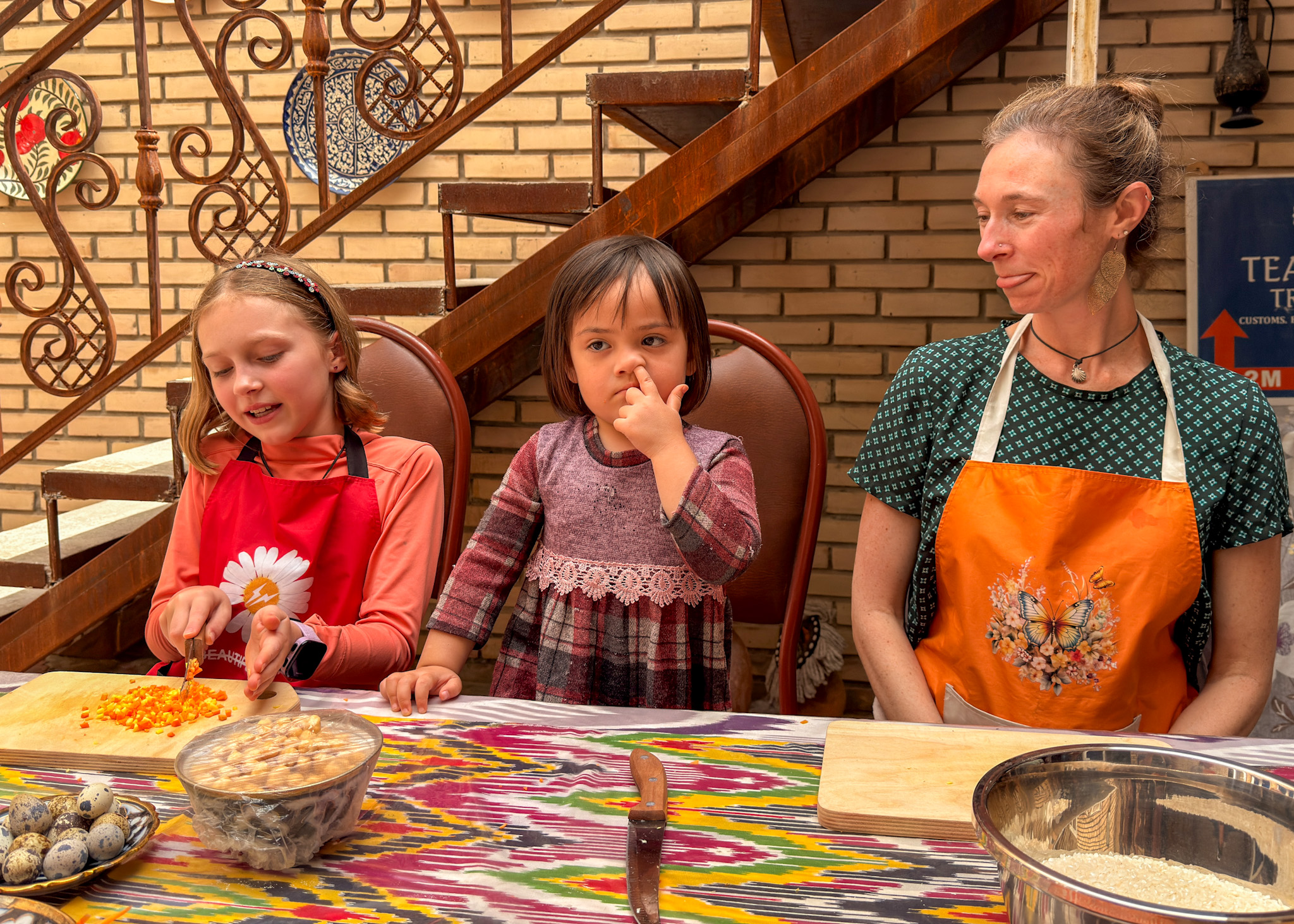
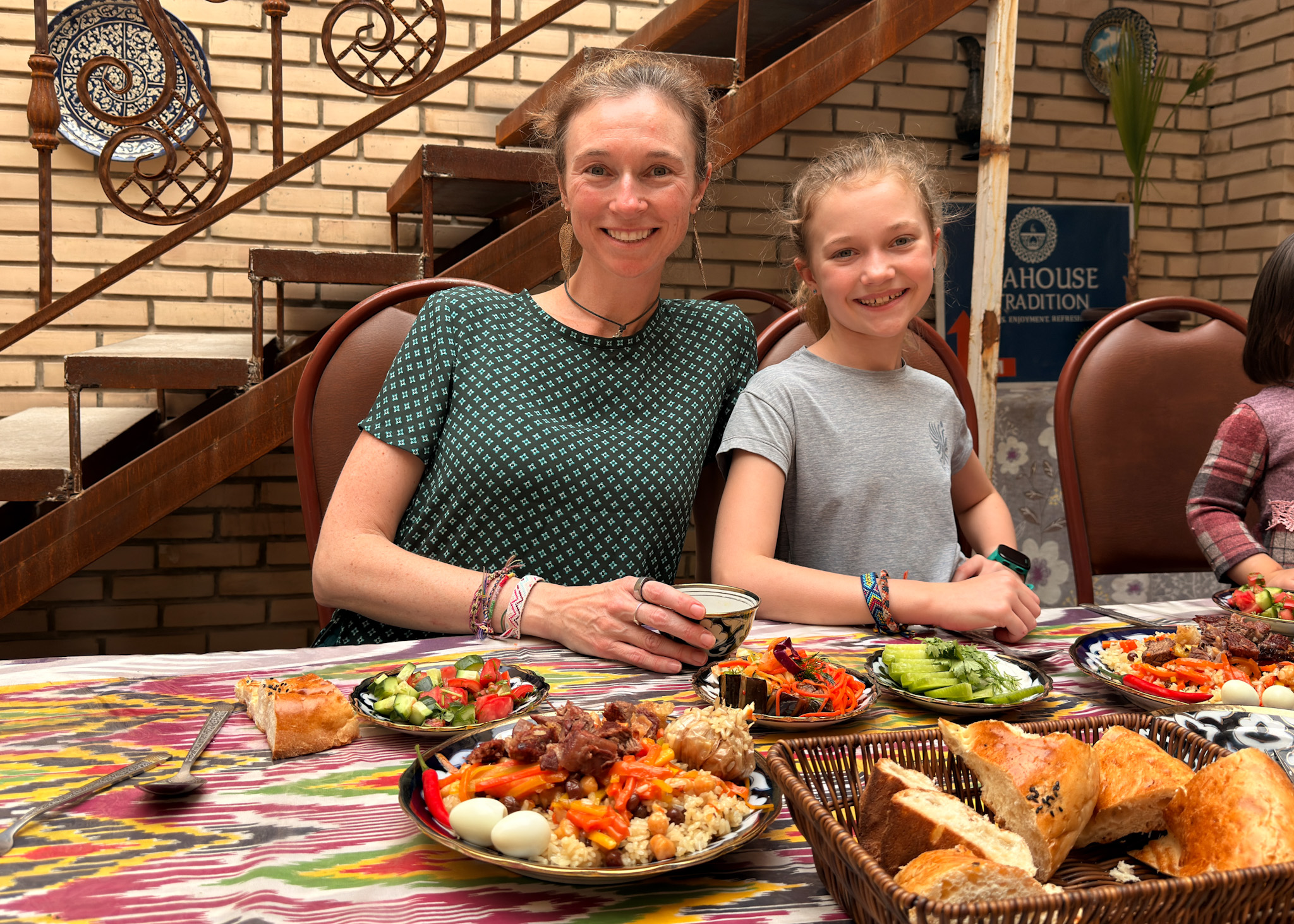
The next morning we made our way to a family home on the north side of the old city to take part in a plov cooking class, hilariously titled “Cook Plov with My Wife” online. Our host was a man named Iha who runs the inherited house as a small guesthouse. He lives there with his young wife Guli, their daughter Amina, their younger son, watched by grandma while we cooked. Guli did all the actual cooking while Iha narrated in English, explaining what she was doing and why as she worked. What we saw was a woman whose hands clearly knew exactly what they were doing, and a meal that proved it. The several-hour affair was intermixed with insightful conversation—our family’s circuitous path to their table and their culturally distinct path of essentially an arranged marriage between a city man and a cotton-farm girl 20 years his junior. Our girls listened intently, and later on would have lots of questions about how exactly arranged marriages worked, and why anyone would ever agree to that. No surprise, they prefer how things are done back home, but they also now appreciate how fortunate we are to be able to make our own decisions in life and love.
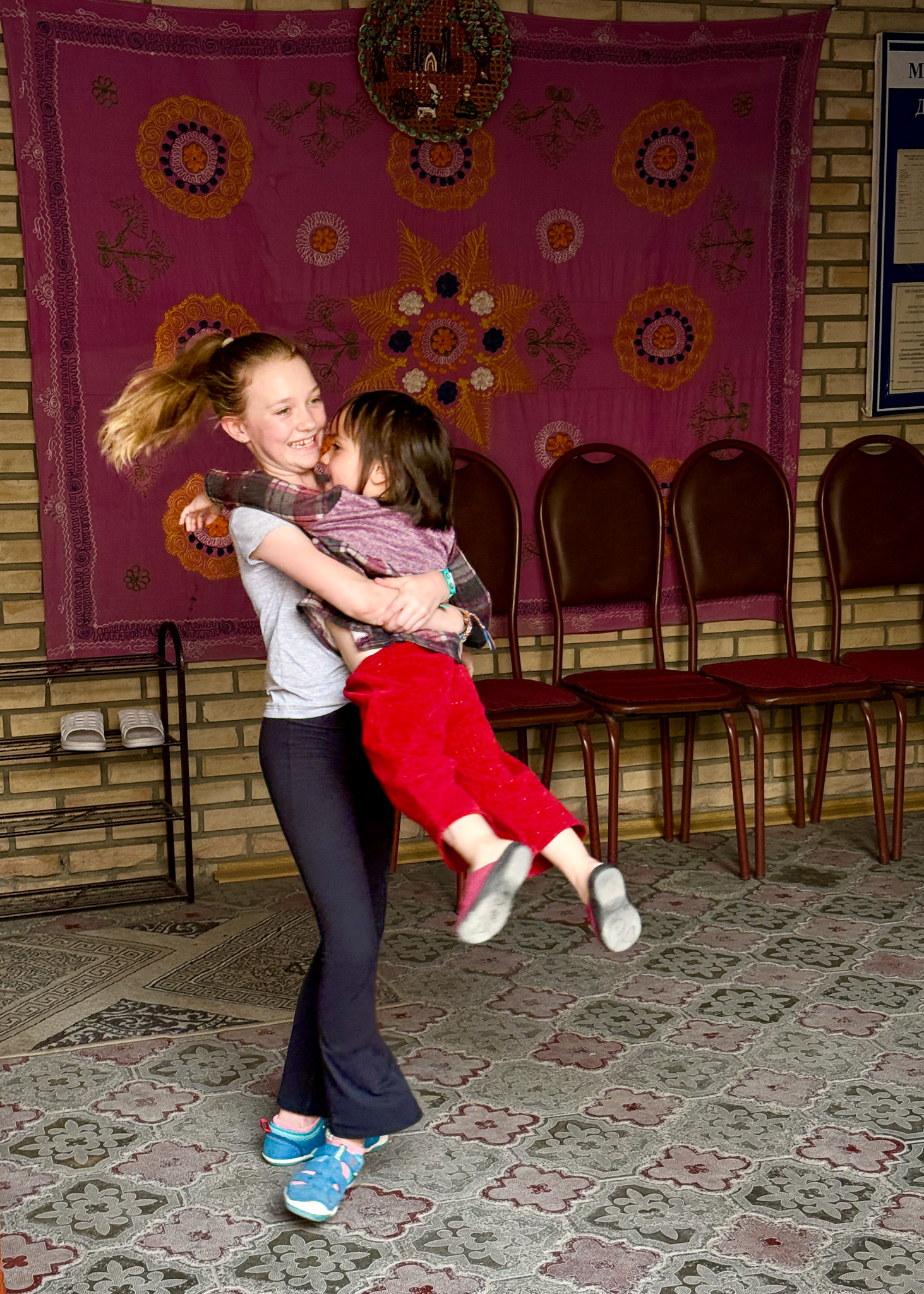
Most of the time spent at their house, in between prepping food and various stages of cooking, our girls were ignoring us and playing with Amina, their 3-year-old daughter. Amina wanted absolutely nothing to do with Shaina or Max, holding our eyes with scrunched-face suspicion every time we looked in her direction, but with Arya and Finlee she was a completely different child. She leaped into their arms, ran circuits around the courtyard, and attached herself to them for the entire morning.
The plov itself was excellent. It is the national dish of Uzbekistan, a one-pot rice dish built up in layers of lamb, onions, carrots, and spices, finished under a lid so the rice steams into the broth below. UNESCO added it to its Intangible Cultural Heritage list in 2016. It is less a recipe and more a ritual, with regional variations fiercely defended across Central Asia. The seasoning was strikingly minimal—cumin, salt, and pepper, nothing else—and the restraint resolved into something beautifully balanced. The standout was the garlic, two entire bulbs buried whole in the pot, left to steam until you could squeeze a full clove’s worth of paste from the root end in one motion. Mixed into the rice with the chickpeas and carrots, it was revelatory. This dish, in more or less this form, has been made in this part of the world through every conquest, every dynasty change, every empire that rolled through and declared itself in charge. Some things are simply too good to interrupt.
We spent the following days wandering without a fixed agenda, which is how Bukhara rewards you. We found the beloved statue of Khodja Nasreddin, the folk trickster who has been a hero of Central Asian and Middle Eastern storytelling for around 800 years, a clever absurdist character whose stories have outlasted every ruler who tried to suppress them. With major Don Quixote vibes, Nasreddin sits on a comically undersized donkey with one hand raised in greeting, and locals say that placing a child on the donkey fills their life with joy. We of course placed both girls on the donkey.
We later found Donuts and Coffee, a small shop that makes donuts fresh to order and produces a white-chocolate-and-pistachio donut that is genuinely one of the best things Max has eaten on this entire trip. He is not a donut person. He is reconsidering.
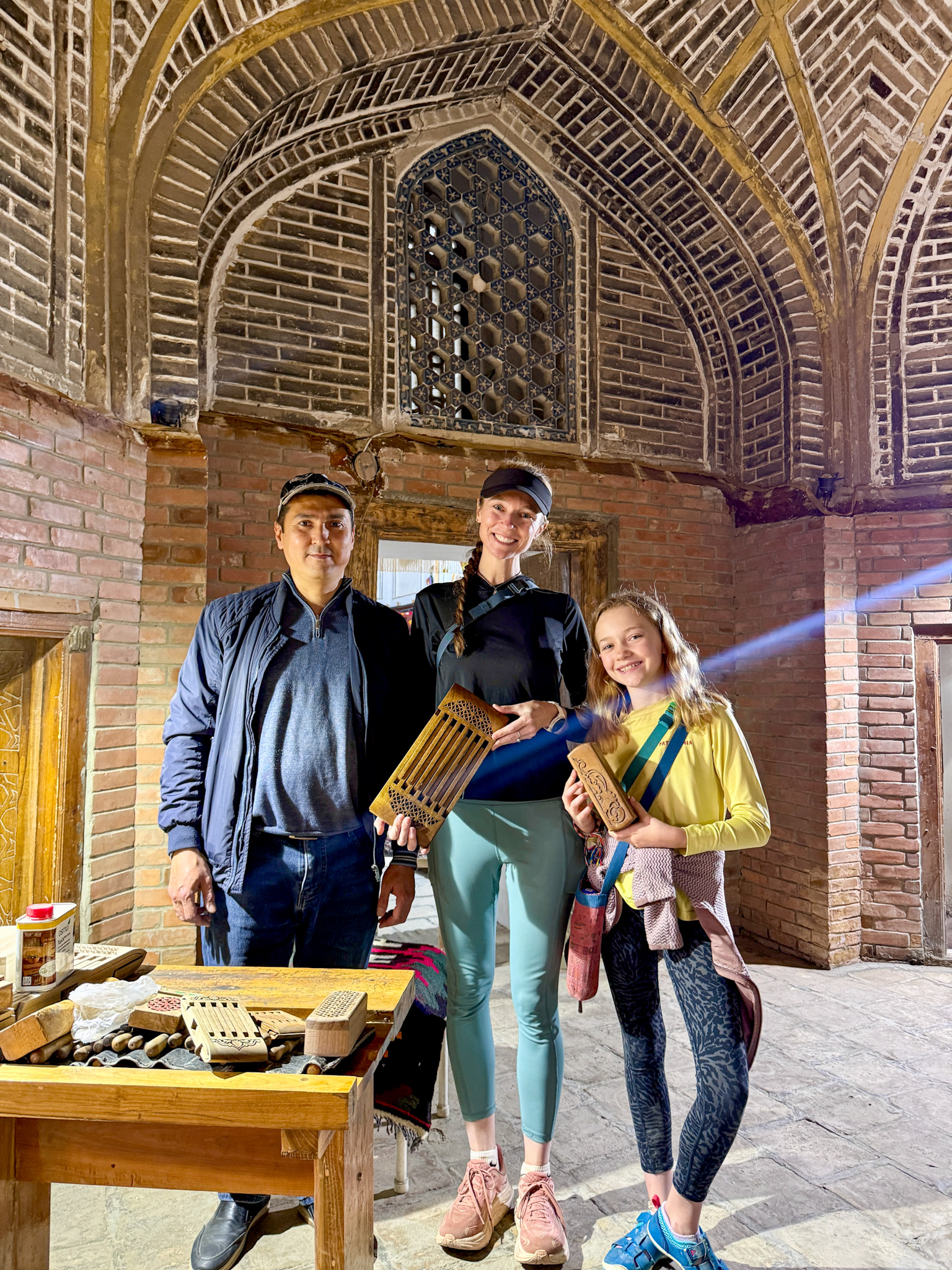
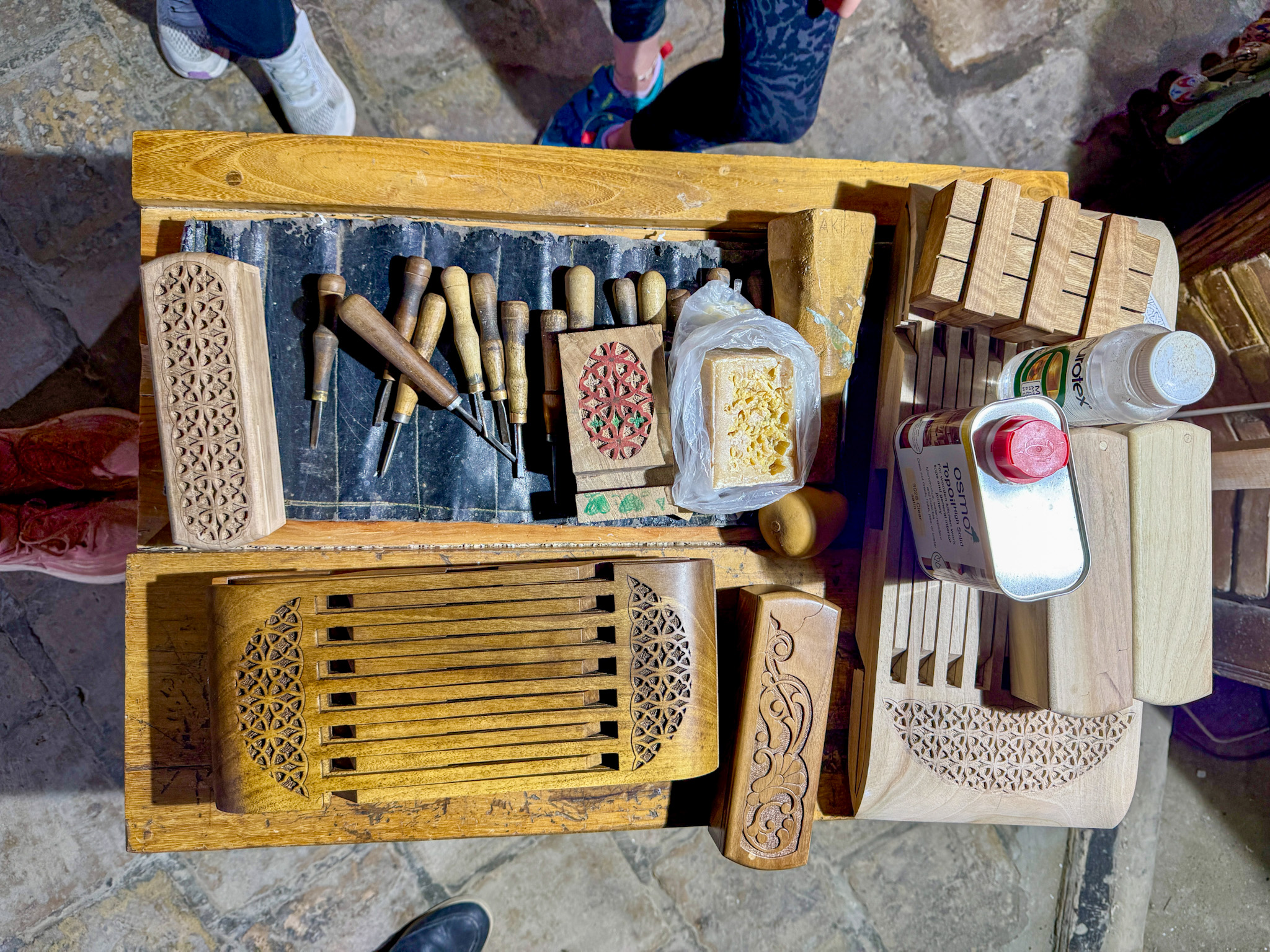
We also explored the countless monuments interspersed around town, and deep inside one madrasa, tucked into a narrow stone passageway, we found Erkin, an artisan woodworker. We found him at his workbench, carving away at his latest rehal, the traditional folding wooden stand used across the Islamic world to hold the Quran at a reading angle, masterfully carved from a single piece of wood. He also had several qalamdans, long narrow boxes made for a calligrapher’s pens and tools, decorated because the tools of writing were considered nearly as important as the writing itself. Amazed by the craftsmanship, we bought one of each.
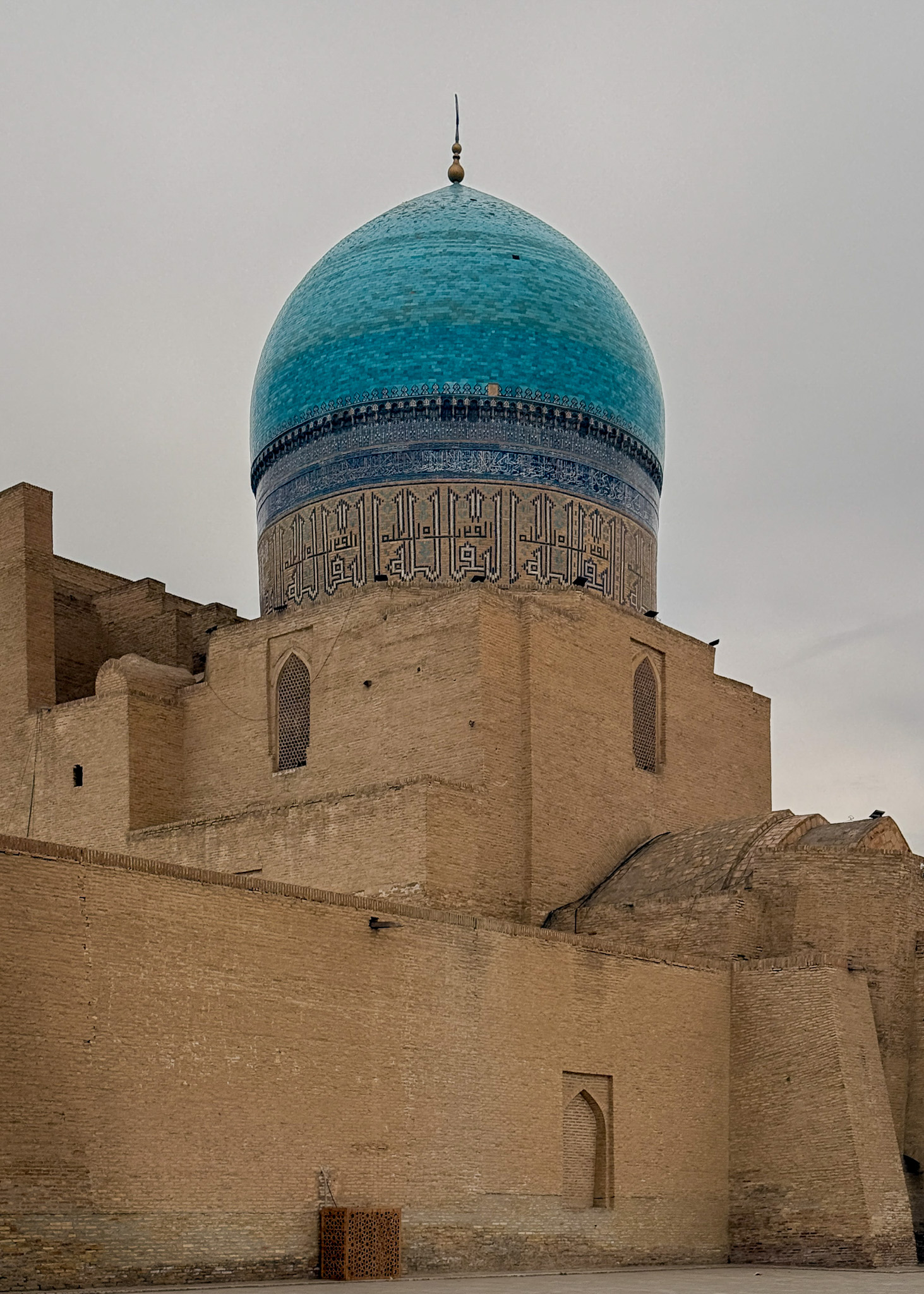
In the evenings the city kept producing conversations. We tend to present religion to the girls as a cultural phenomenon rather than a faith—stories and frameworks people have developed to make sense of the world, worth understanding on their own terms. We present the stories, the traditions, the history, and let them sit with the questions. Bukhara gave us a lot of material to work with. Chor Minor had opened a thread about religious tolerance. The Bolo Hauz funeral had opened another about grief and ritual. Both threads converged at Magoki Attori Mosque, a building that has been a holy site through three religions in sequence—initially a Zoroastrian temple, then possibly Buddhist monastery, and now a mosque, each layer built directly on top of the last. Again, protected for a millennium due to having been buried by the blowing sands of the steppe, (this apparently is a theme in Bukhara!), it’s remarkably well-preserved and you can still see the older foundations. The girls stood in front of it and were quiet for a moment in the way that sometimes means something is landing.
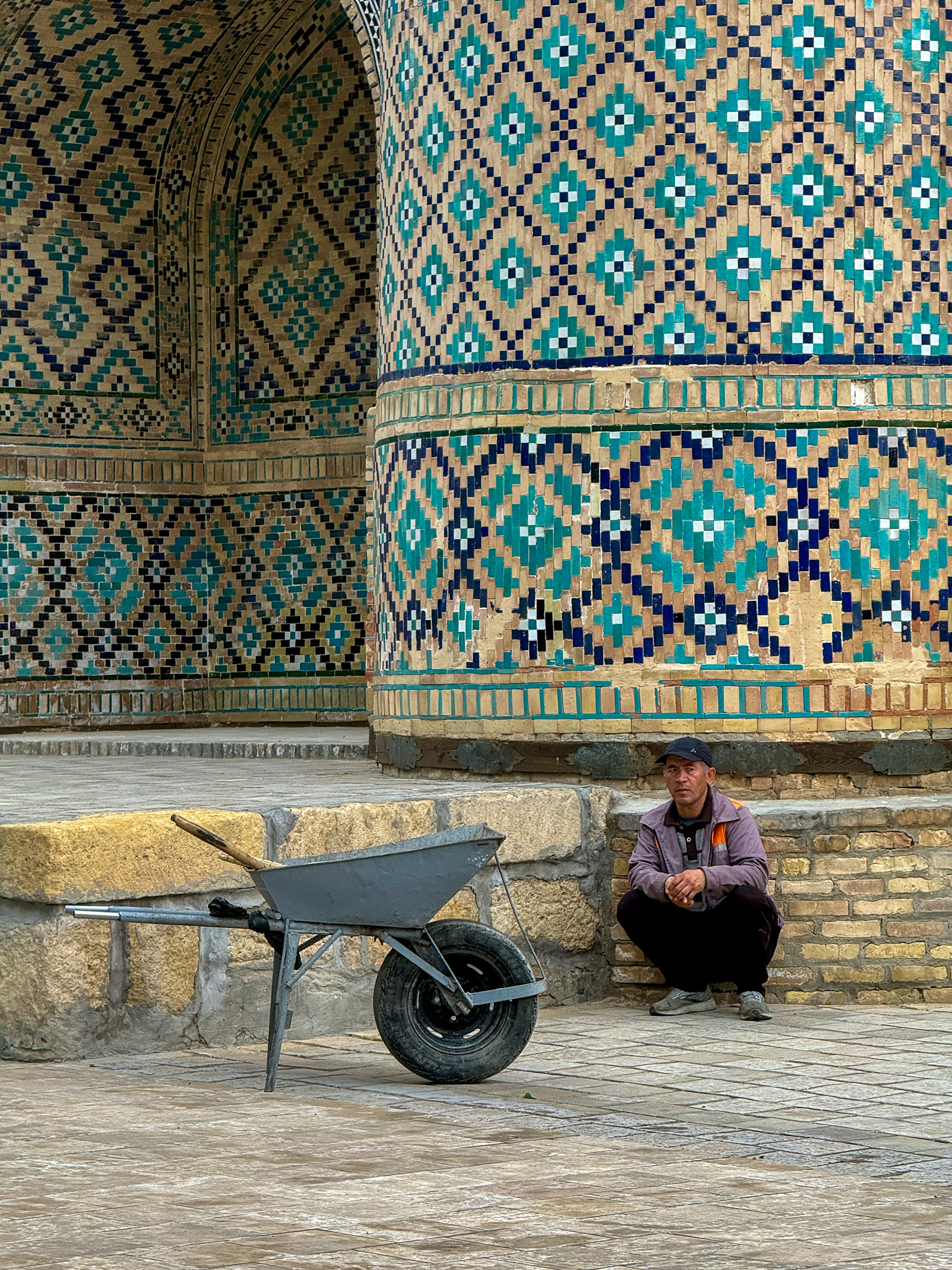
On our last full evening we were walking back through the old town as light rain started to fall, quizzing the girls on the timeline of Uzbekistan—who came when, who conquered what, who built what next. We’d been doing versions of this quiz all week, adding entries each day as we moved through the city. Finlee said it must be exhausting to keep having your home taken away from you, to keep rebuilding something only to have someone new arrive and decide it was theirs now. And then Arya, without pausing: “Everyone conquered Uzbekistan. First the Persians, then Alexander the Great, then the Persians again, then Genghis Khan and the Mongols, then Timur, and finally the Russians and the USSR. They must be doing something here that’s really cool if everyone wants to take them over.” The list of conquerors recalled in order, correctly, on a rainy Tuesday evening, was impressive enough. But the second part, the insight about what it means when that many empires want the same stretch of land, about what conquest implies about the value of the place being conquered, was not something either of us had been expecting. Finlee’s instinct had been toward the human cost. Arya’s had been toward the geopolitical logic. Between them they’d landed somewhere close to the whole truth.
We looked at each other over their heads and smiled, the quiet, slightly stunned smile of two parents who had just watched their kids become something—budding historians. Sharp ones.
The rain picked up. We began our hurried walk back to our hotel and of course passed Djamal again, who was just about finished packing up his stall for the day. We’d been looking at several of his pieces every time we’d walked by over the past several days, debating if we should get any, or maybe several, of his creations. We were on a tight budget, and we still had three months left in our trip—a long time to carry around bulky souvenirs. Tomorrow was our last day in town—we’d have to decide soon. But in passing mentioned that with rain in the forecast, he wasn’t going to open the following day, and instead planned a long overdue day to spend with his family. With sudden urgency, and the prospect of not being able to buy tomorrow, we immediately knew we actually wanted something. So we sifted through the pieces we’d liked the most and bought them all.
We had been in Bukhara for four days and had walked through fifteen centuries of people wanting what this city had and taking it and losing it and being taken in turn. The ancient mausoleum and mosque that both survived by hiding underground. The 5th century citadel that stood until 1920. The blue tiled minaret that a conqueror chose not to destroy. The gatehouse that honored four religions at once. The dish that outlasted every dynasty. And two girls who had absorbed all of it without being told to, and arrived, in the rain, at their own conclusions.
Noble Bukhara.
We think we understand the name now.


Leave a Reply