
Dates: 03/11–03/13/26
Place: The Gibbon Experience, Bokeo Nature Reserve, Laos
This is it. The Gibbon Experience.
We weren’t planning on doing this. When we started mapping out the sabbatical, the Gibbon Experience wasn’t on the list at all.
Then, sitting in a café somewhere in Vietnam in early December, we hit a crossroads. Where next? We decided Laos would be great for the girls. And if we were going to Laos… well, the Gibbon Experience is in Laos.
We pulled up their website. Completely booked until mid-March.
Could we stay in Southeast Asia from December through March just to do this?
The answer was a very certain and enthusiastic yes.
Shaina and Max did the Gibbon Experience fourteen years ago—zip-lining through the canopy, sleeping in treehouses fifty meters off the ground, listening for gibbons in the mist. We have shared pictures and stories with Arya and Finlee for years, never imagining that someday we’d get to experience it again with them.
Today, standing outside the office in Houayxay, that’s exactly what we were about to do.
When we first came here there was essentially one option: a three-day, two-night experience. You showed up, they pointed you at the jungle, and after a brief explanation of how not to die on the zip lines, off you went. The project has since expanded considerably — the original experience is known as the Classic, but there’s now an Express option for those who want maximum zip lines in minimum time, a Giant route that trades gibbon encounters for deeper trekking, and a Honeymoon option that gives couples a private treehouse while keeping them in the same network as the Classic groups during the day. We booked the Classic. The right call for a family, and statistically the best shot at actually seeing gibbons.
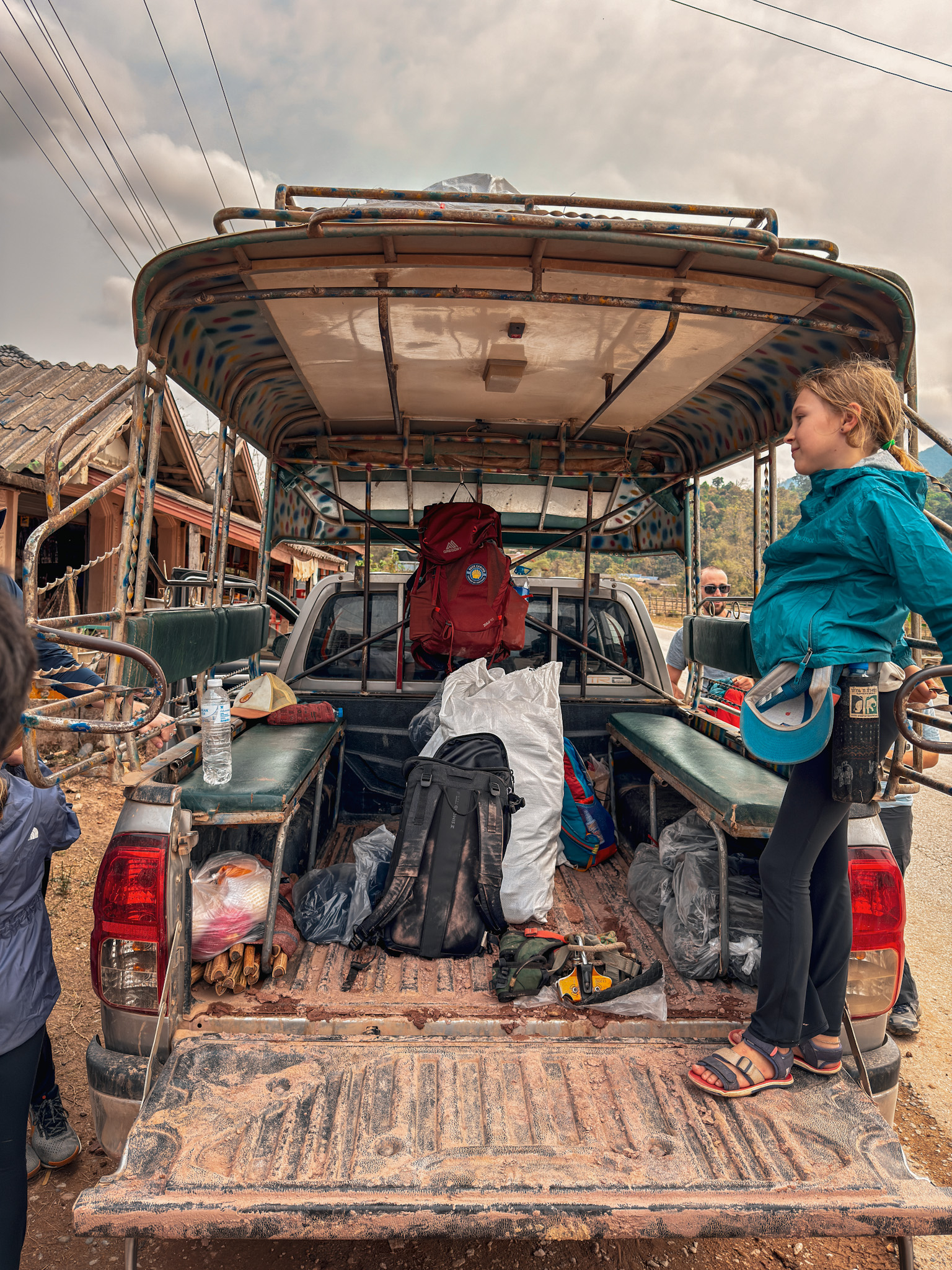
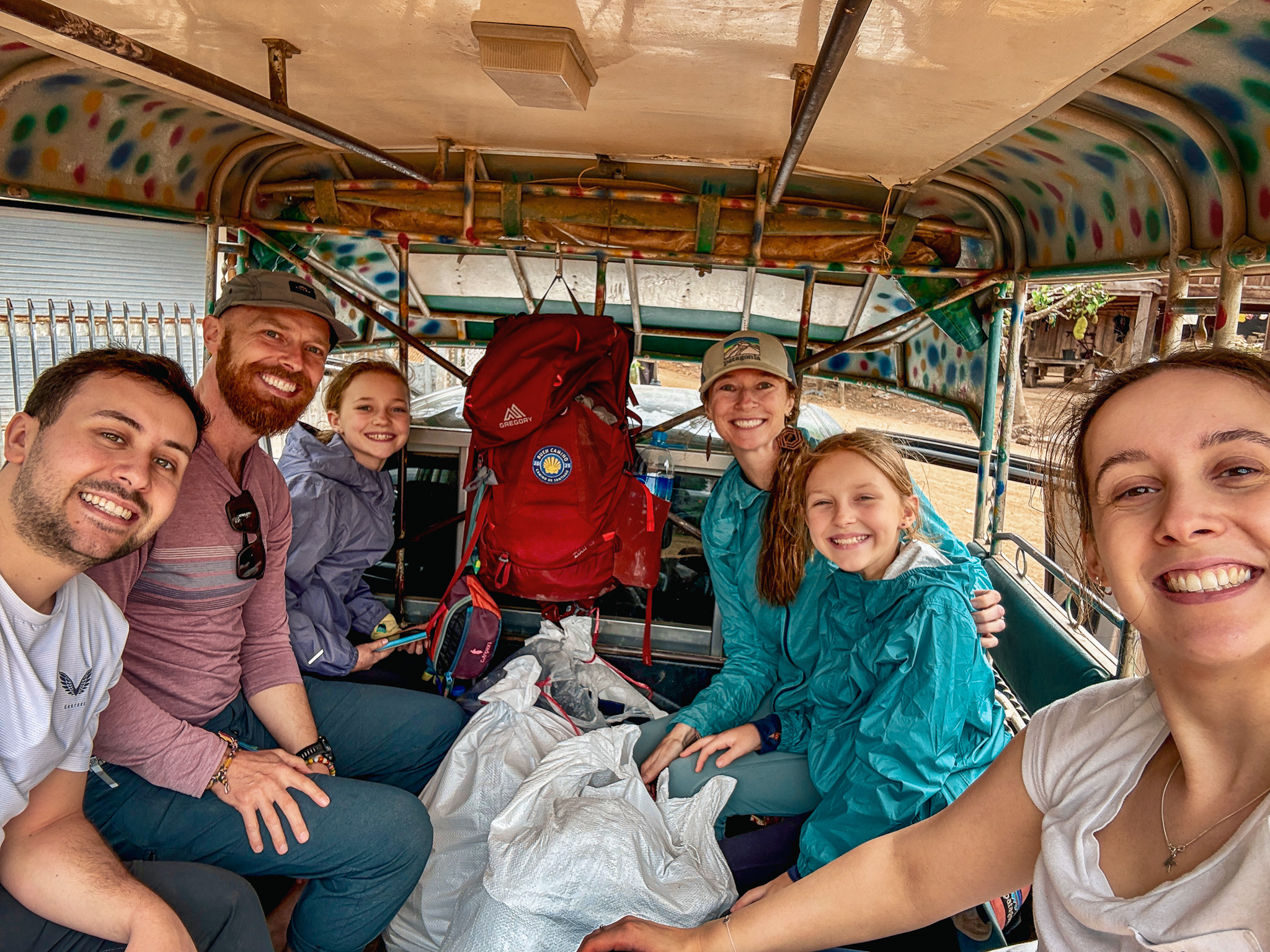
The journey in began with two and a half hour “taxi ride”, sitting in the bed of a retrofitted truck — minimally padded bench seats bolted to the floor, a sheet metal roof overhead — which sounds like it should be miserable and was, in fact, only moderately miserable. The saving grace was our company, a pair of newly engaged Brits—Declan, 26, a project manager for an oil and gas company currently on a four-month sabbatical, and Katie, 27, recently quit her job and taking stock of what comes next. They had booked the Honeymoon experience, which meant private treehouse at night but shared everything else with our Classic group during the day. We liked them immediately, which made the potholes considerably more tolerable.
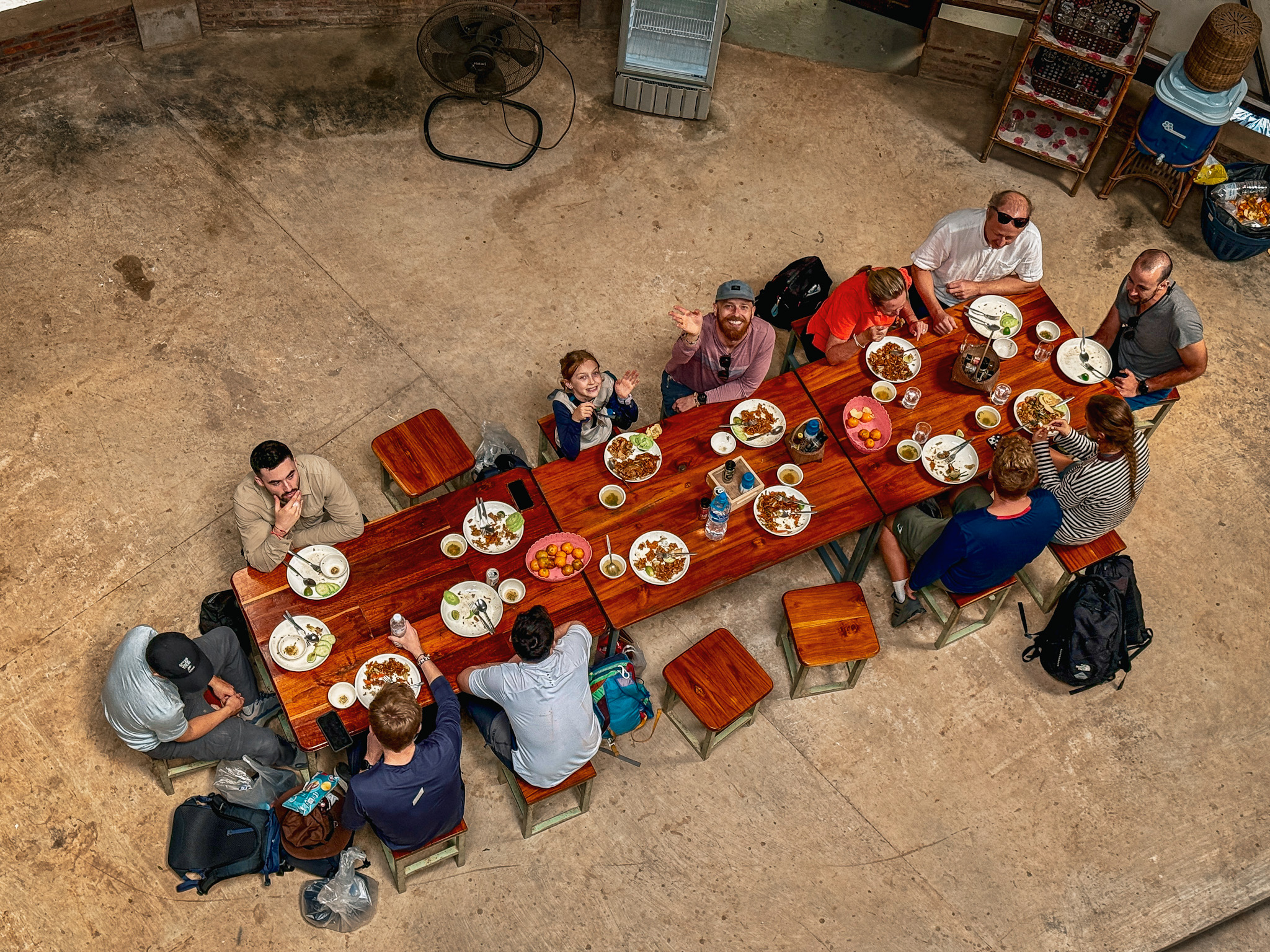
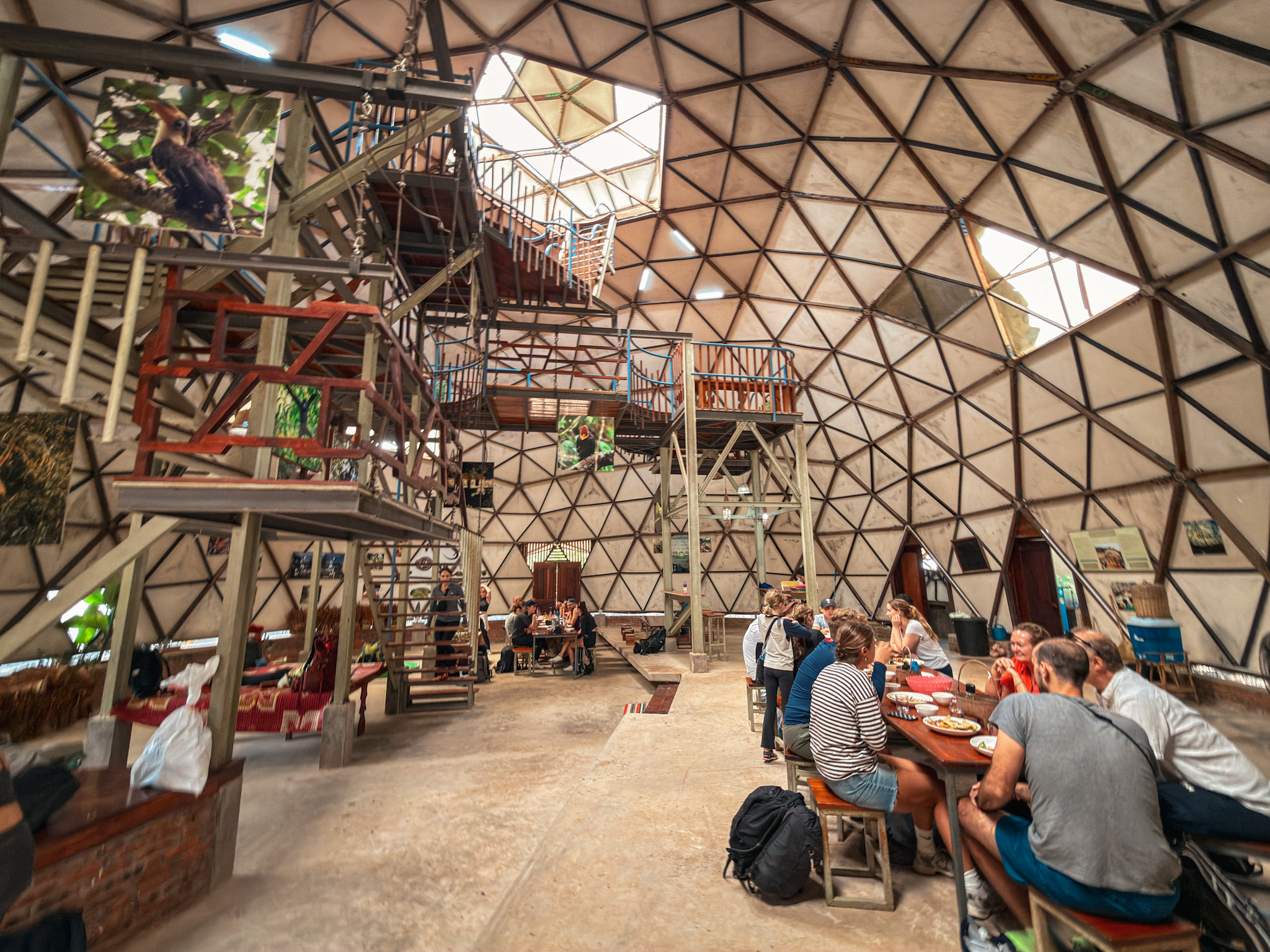
Lunch was at Ban Toup village, the staging point for every group going into the jungle and the last stop for every group coming out. Authentic Lao meals are cooked in the village and delivered to the treehouses by staff via zipline, and this is where the whole operation is organized. The lunch area is a large geodesic dome housing two long communal tables — one for groups finishing their experience, one for groups about to begin. In the center, completely independent of the dome structure, a sculpture of I-beams fills the vertical space and creates elevated platforms three stories up. The girls spotted this immediately and climbed to the top to spy on everyone below, which is exactly what we would have done at their age.
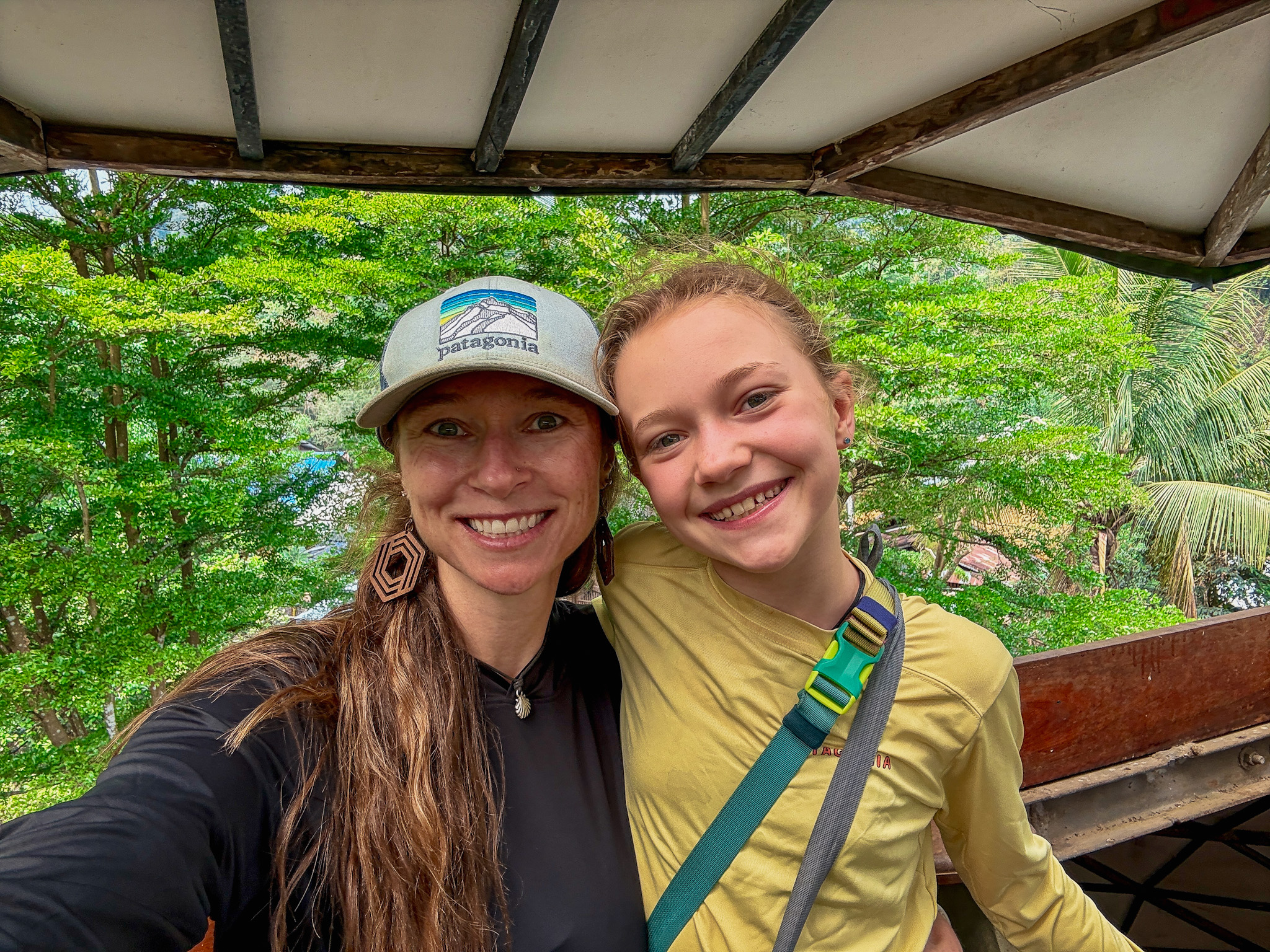
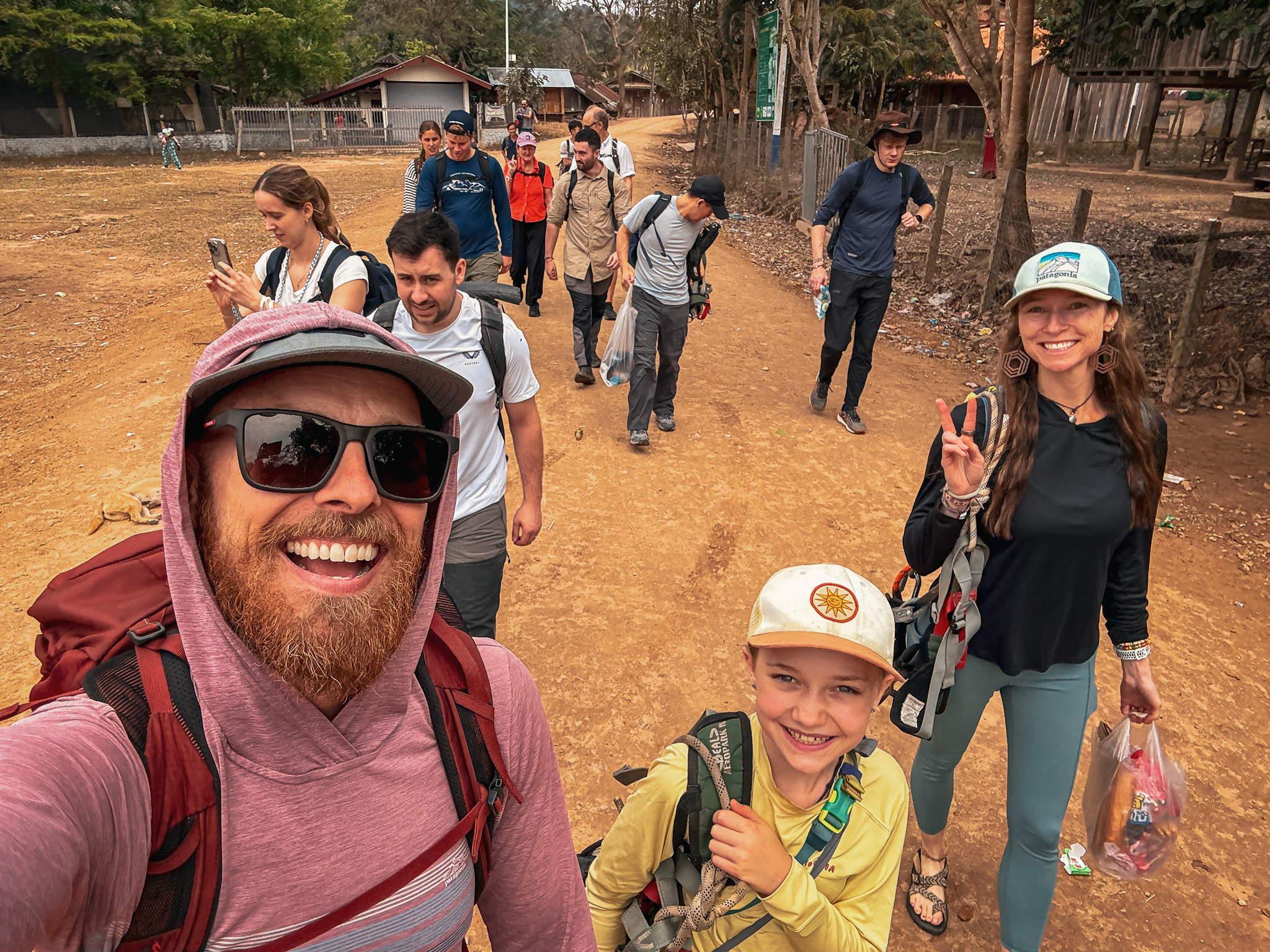
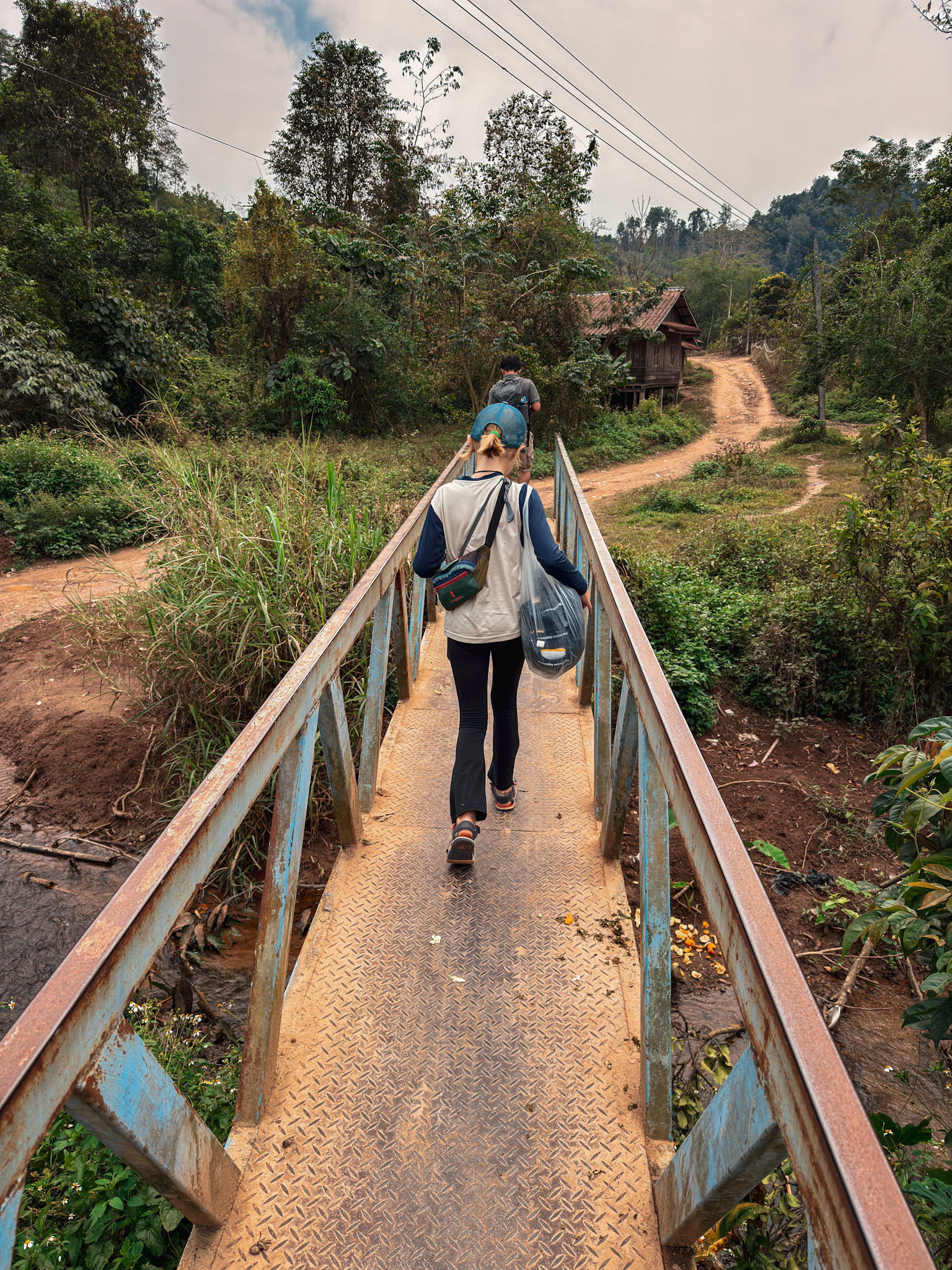
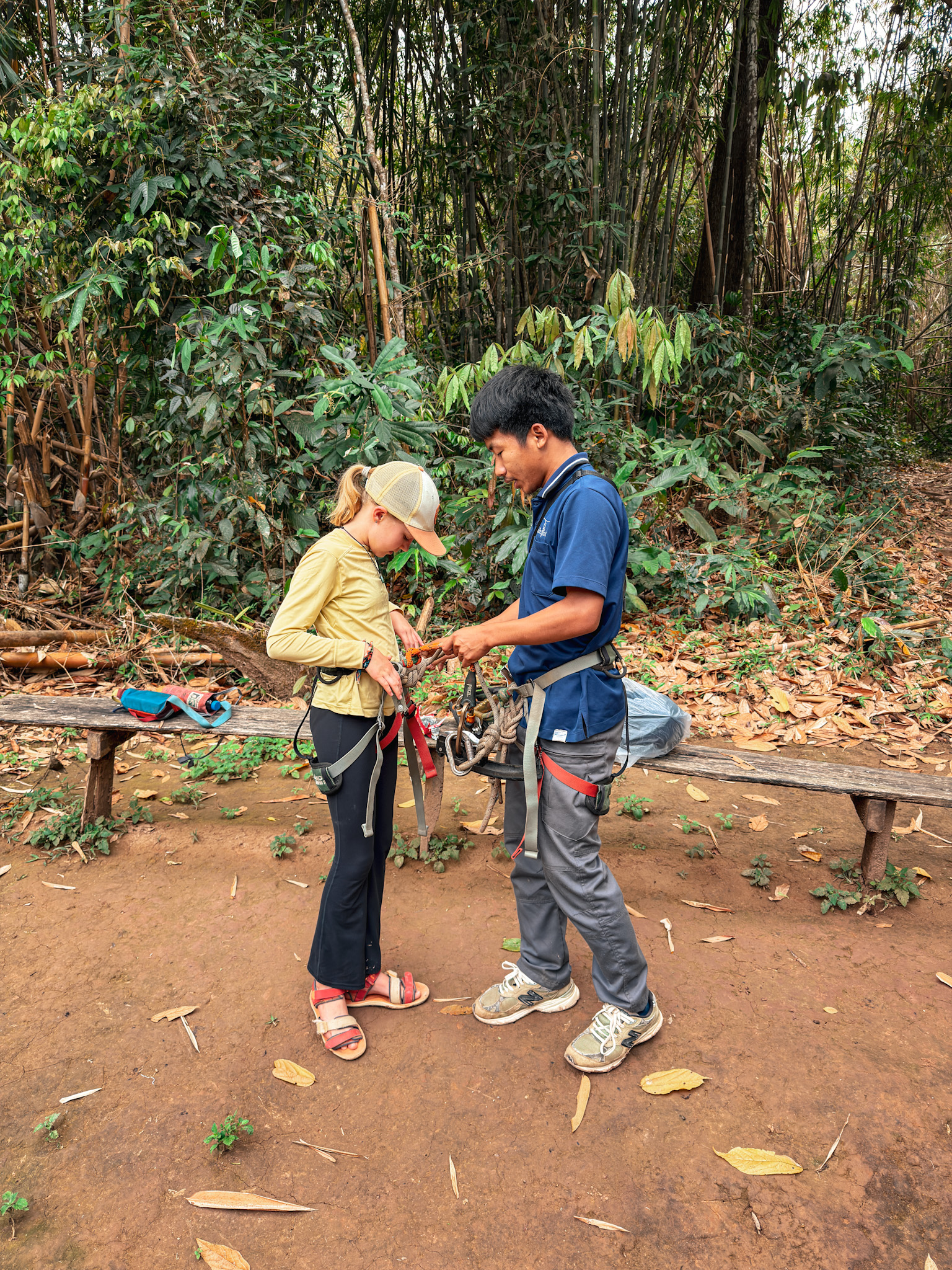
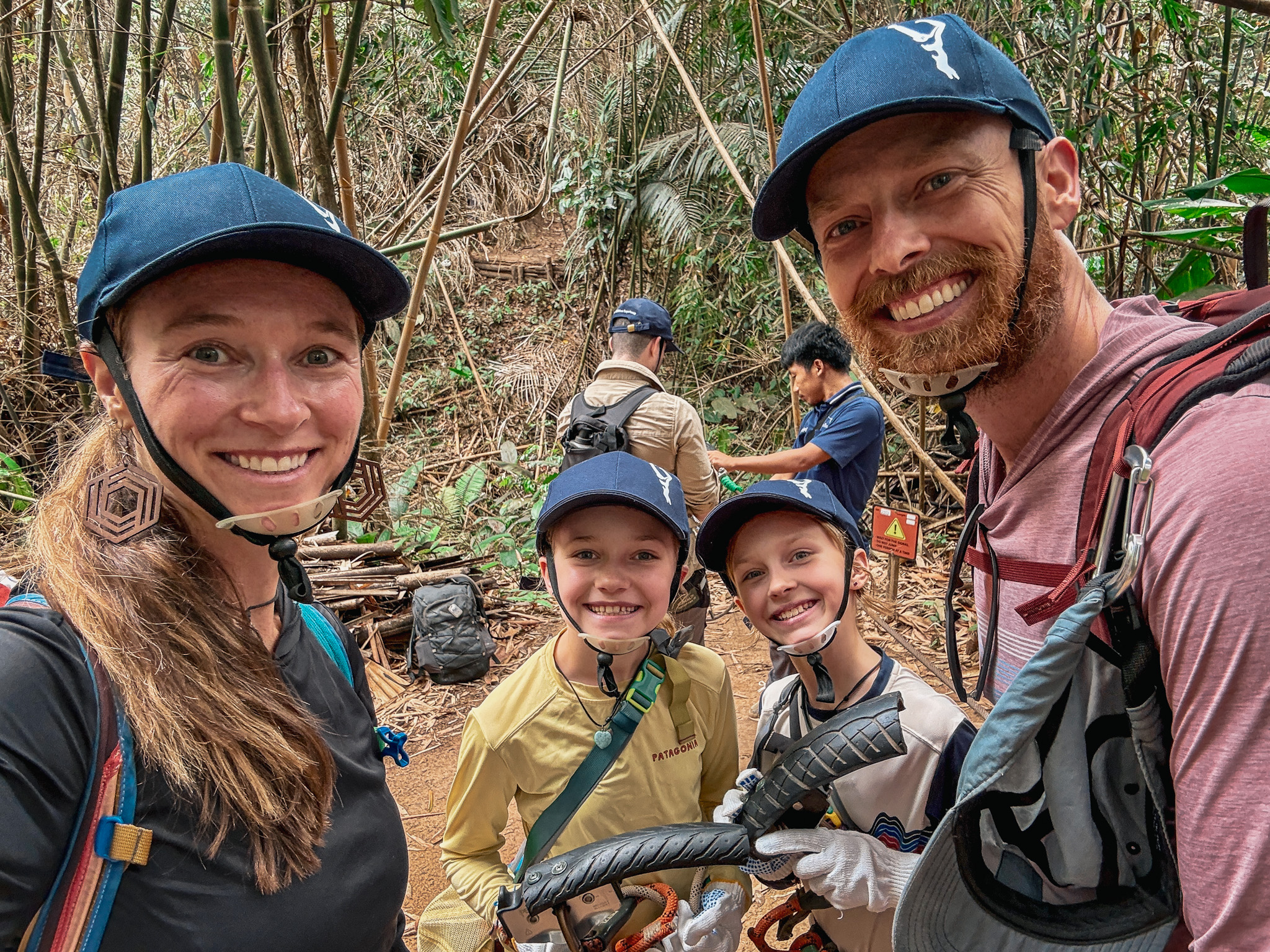
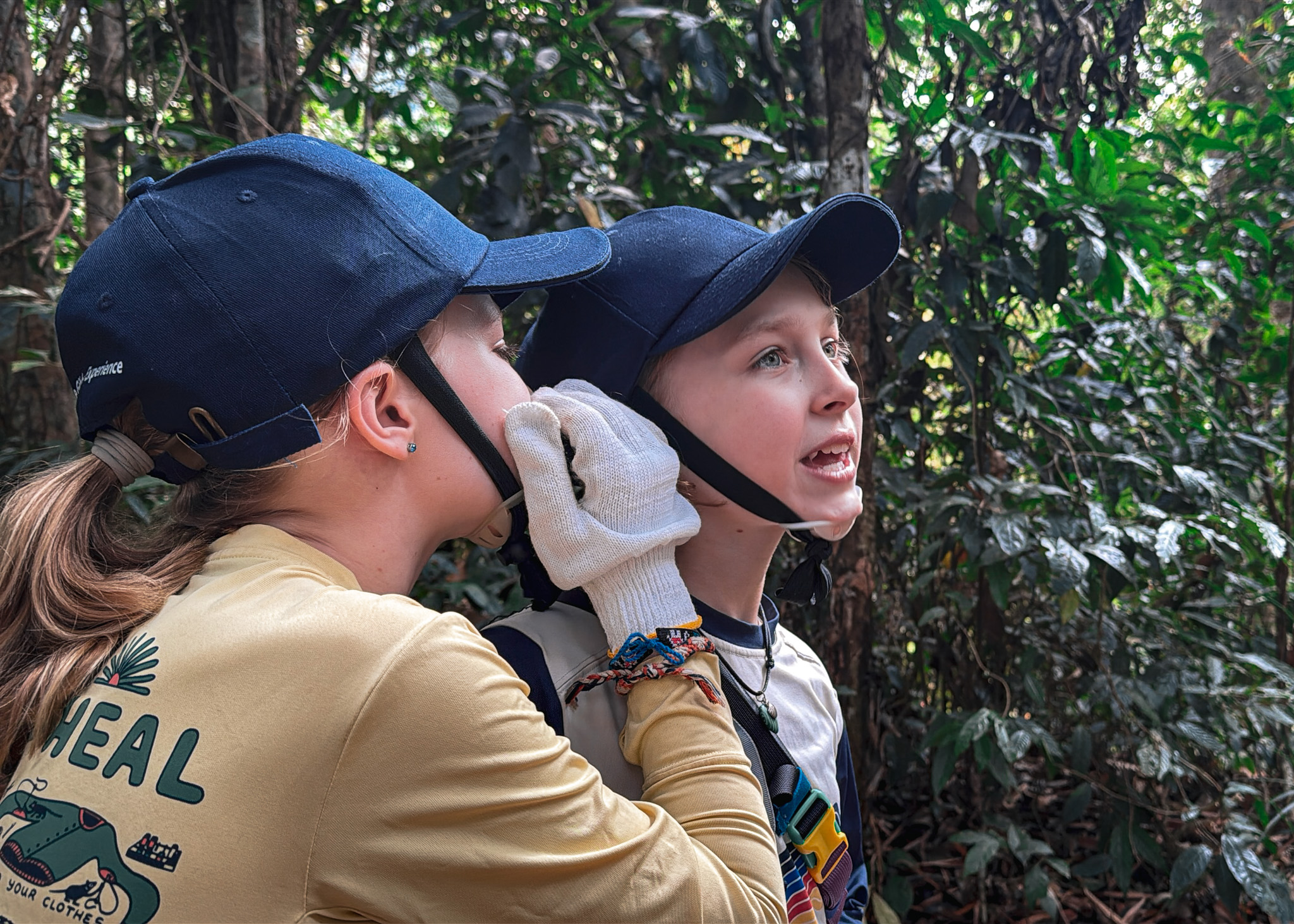
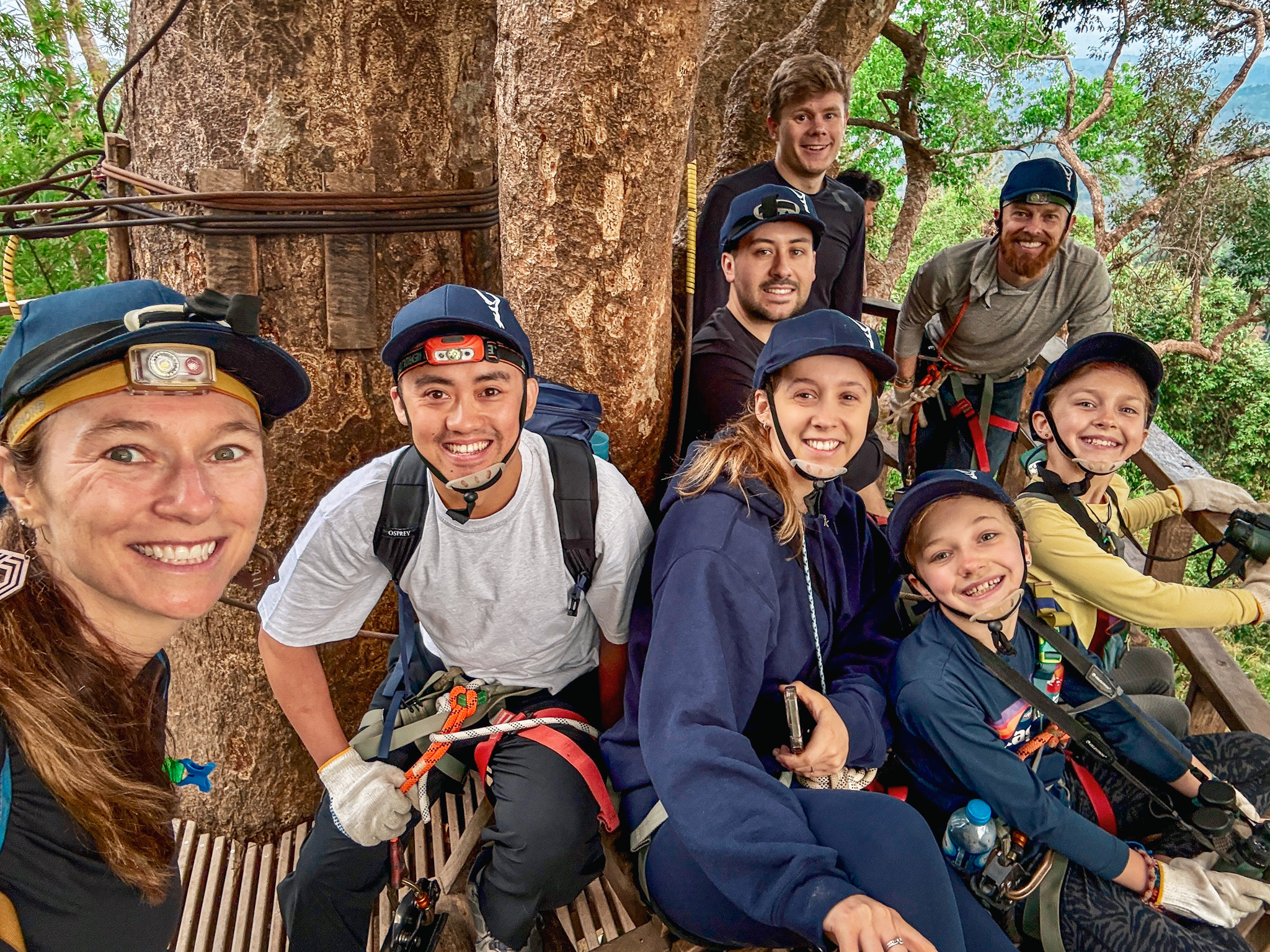
After lunch, an hour’s trek into the jungle. Our guides were Touy and Singlao, and our full group now included two more treehouse mates: Dom, a 26-year-old British accountant who works in mergers and acquisitions, and Mark, a 27-year-old Dutch economist in the pharmaceutical industry. Both were solo travelers, both immediately good company. The hike in was mostly flat with some moderate ups and downs, the canopy thick enough overhead to hold the worst of the heat at bay.
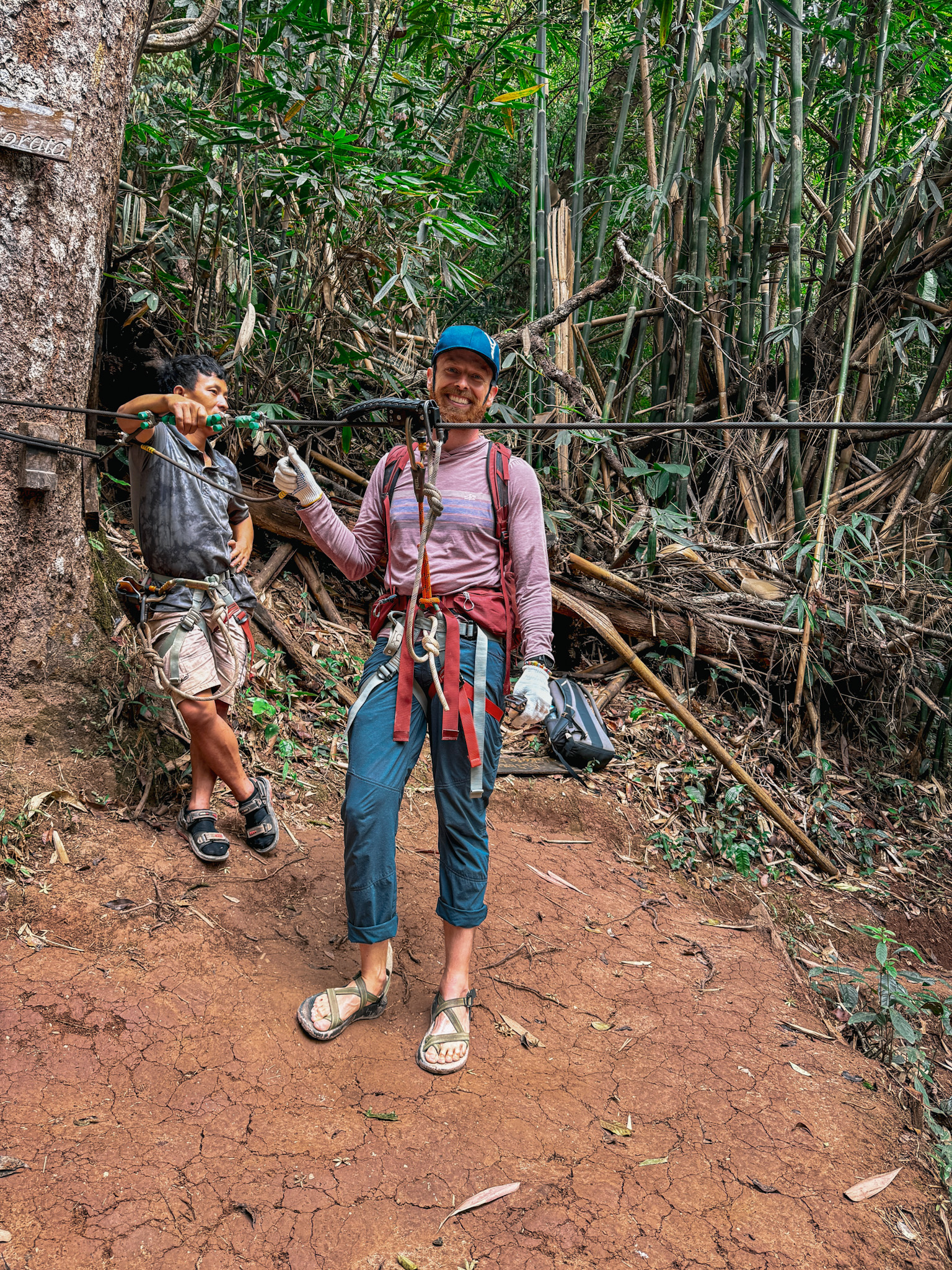
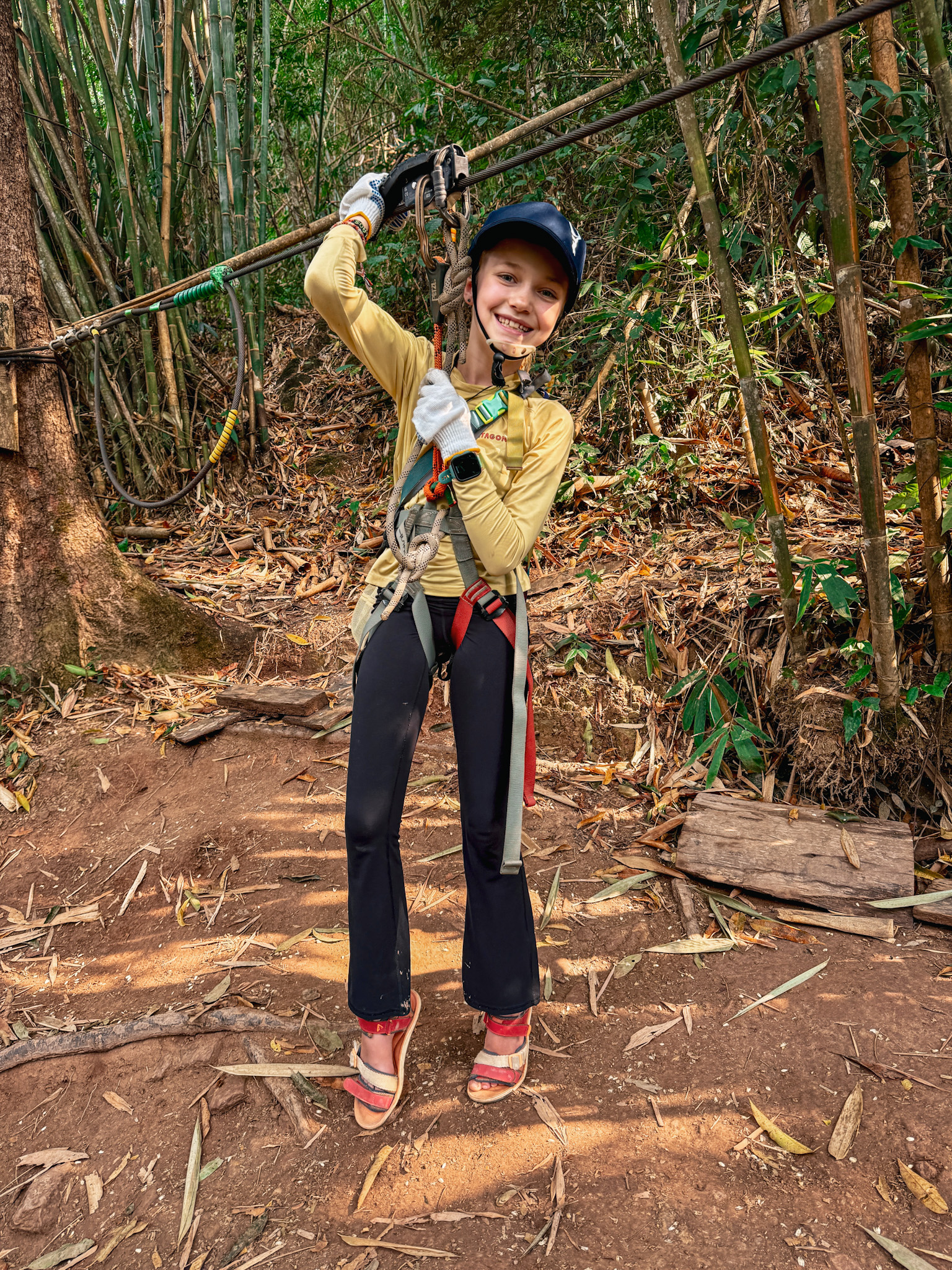
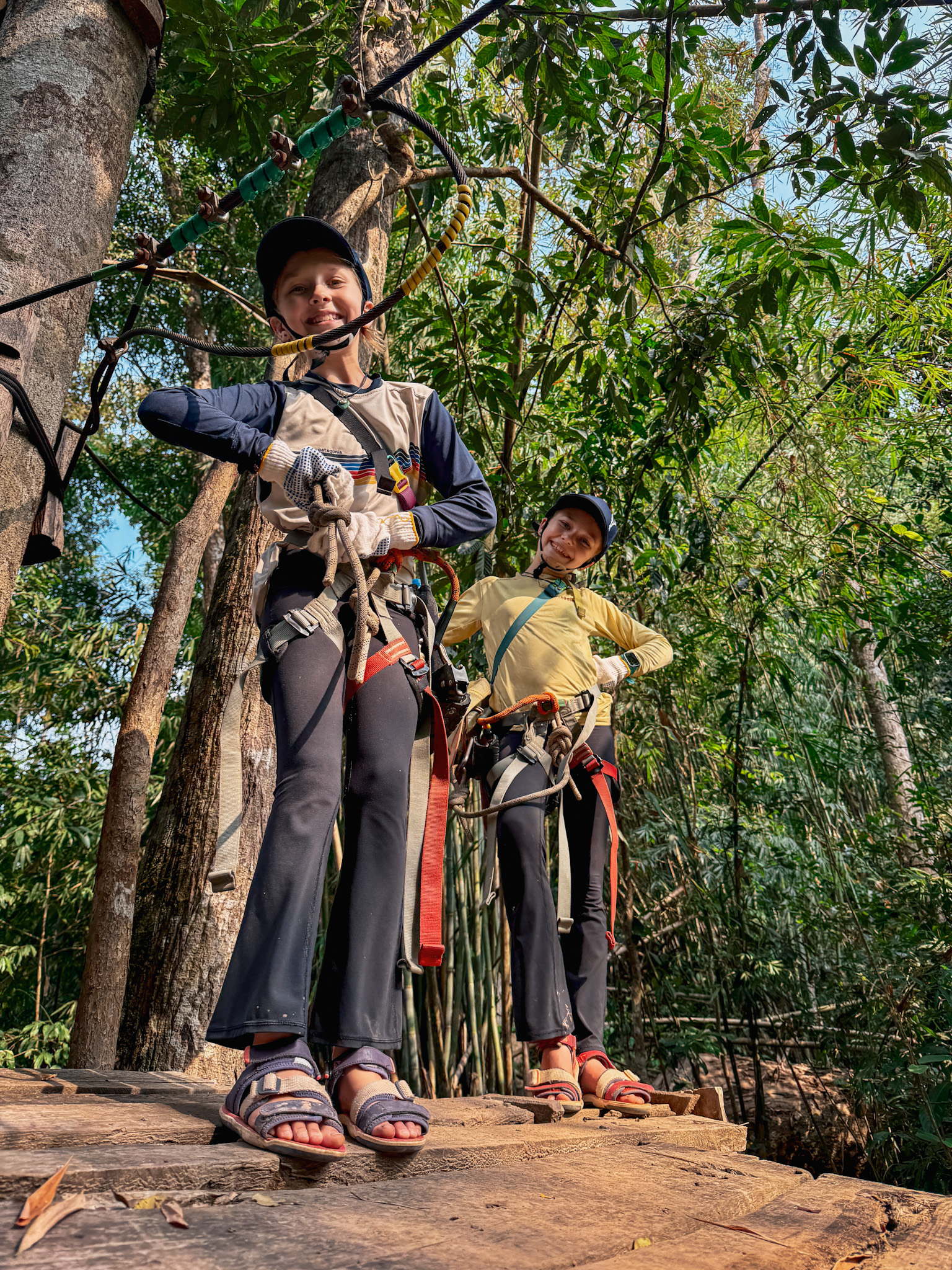
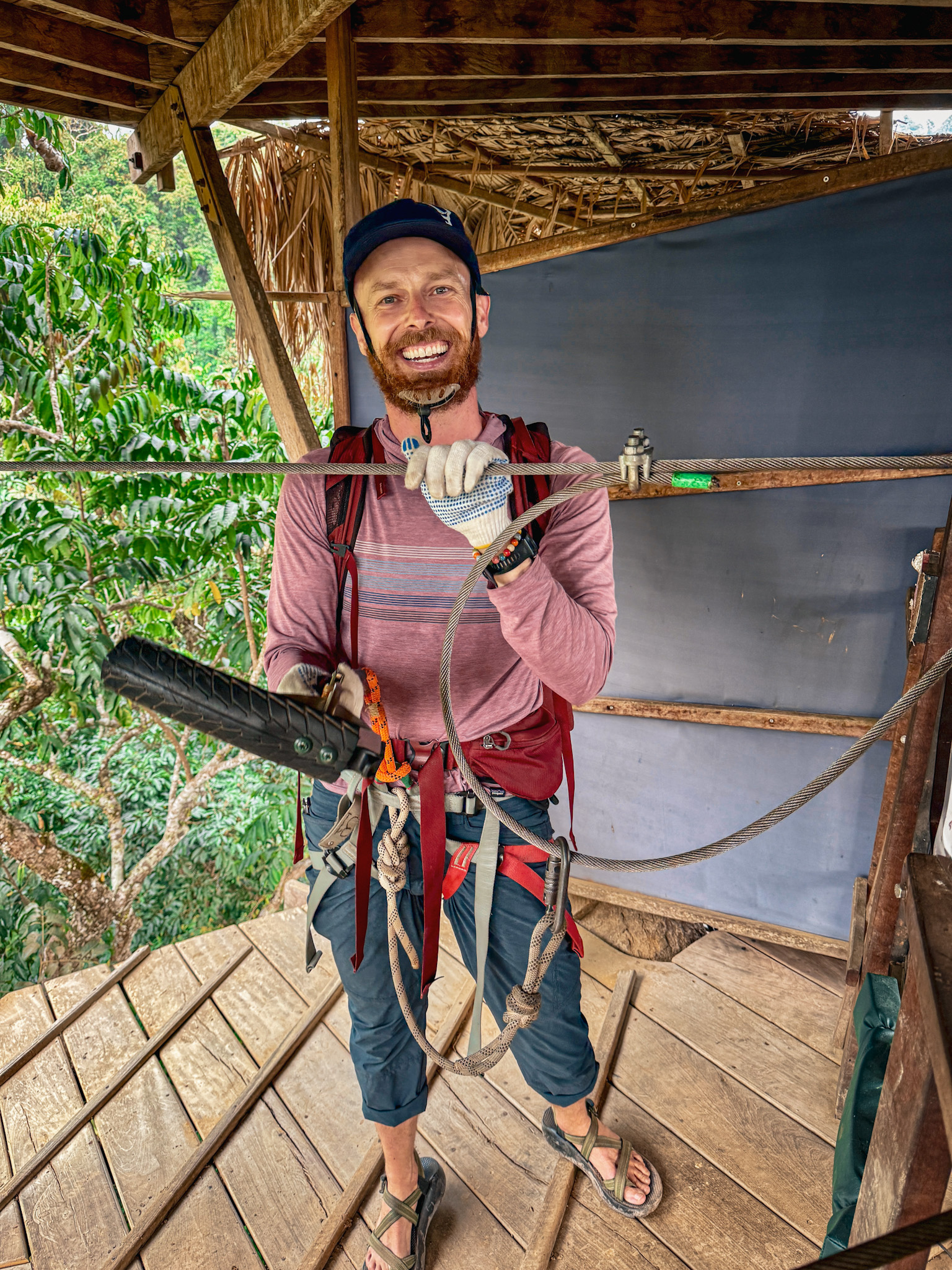
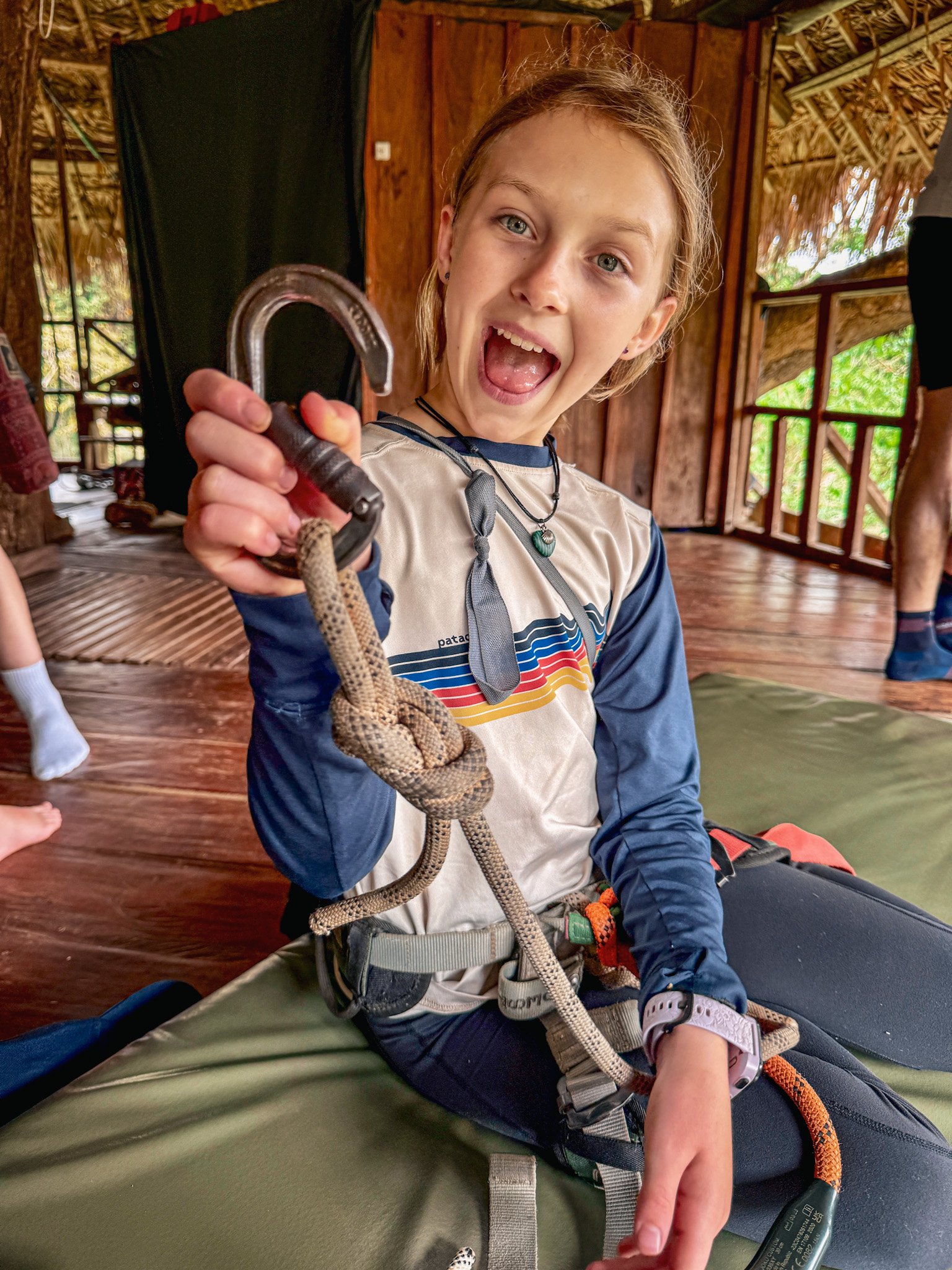
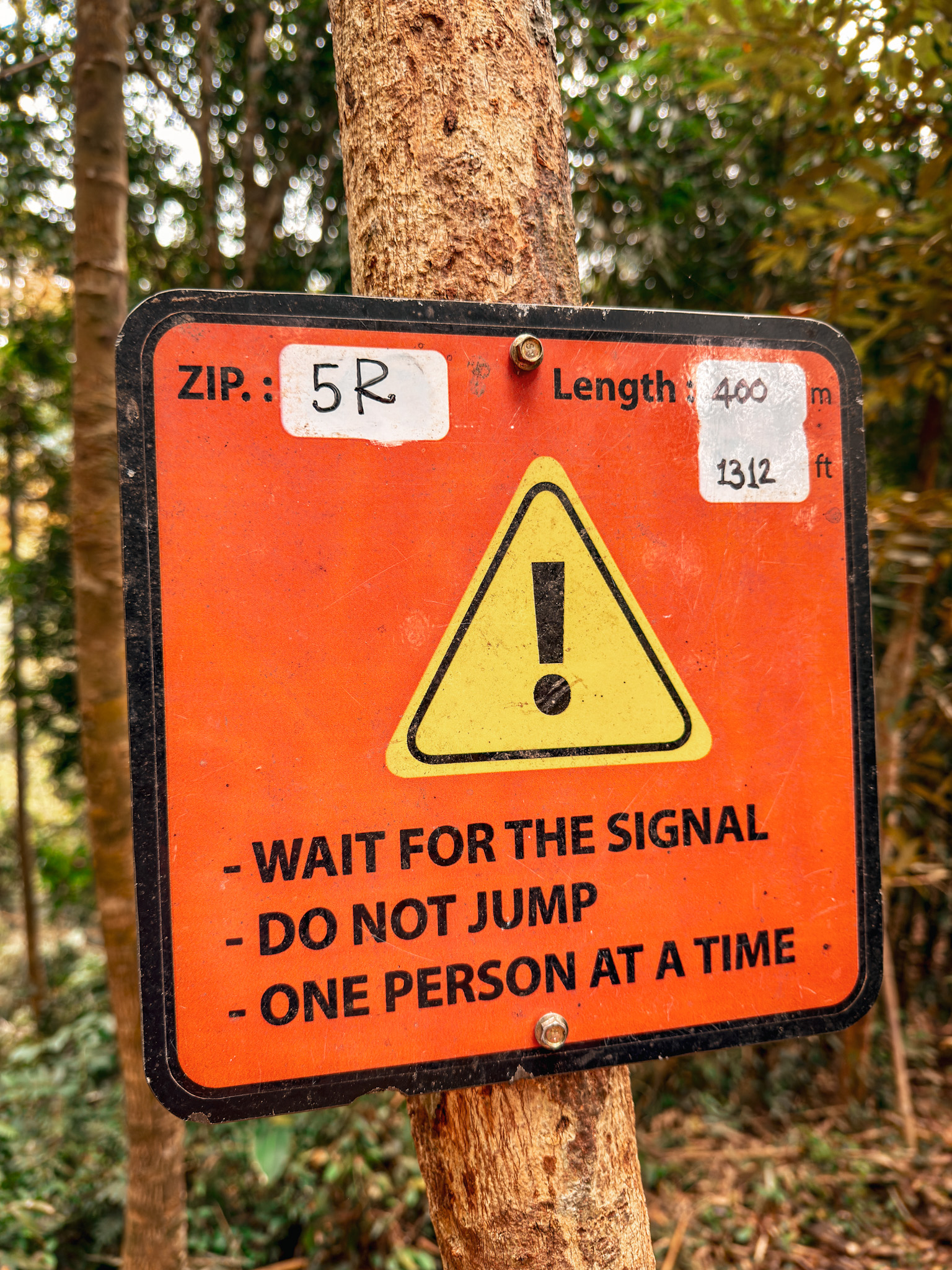
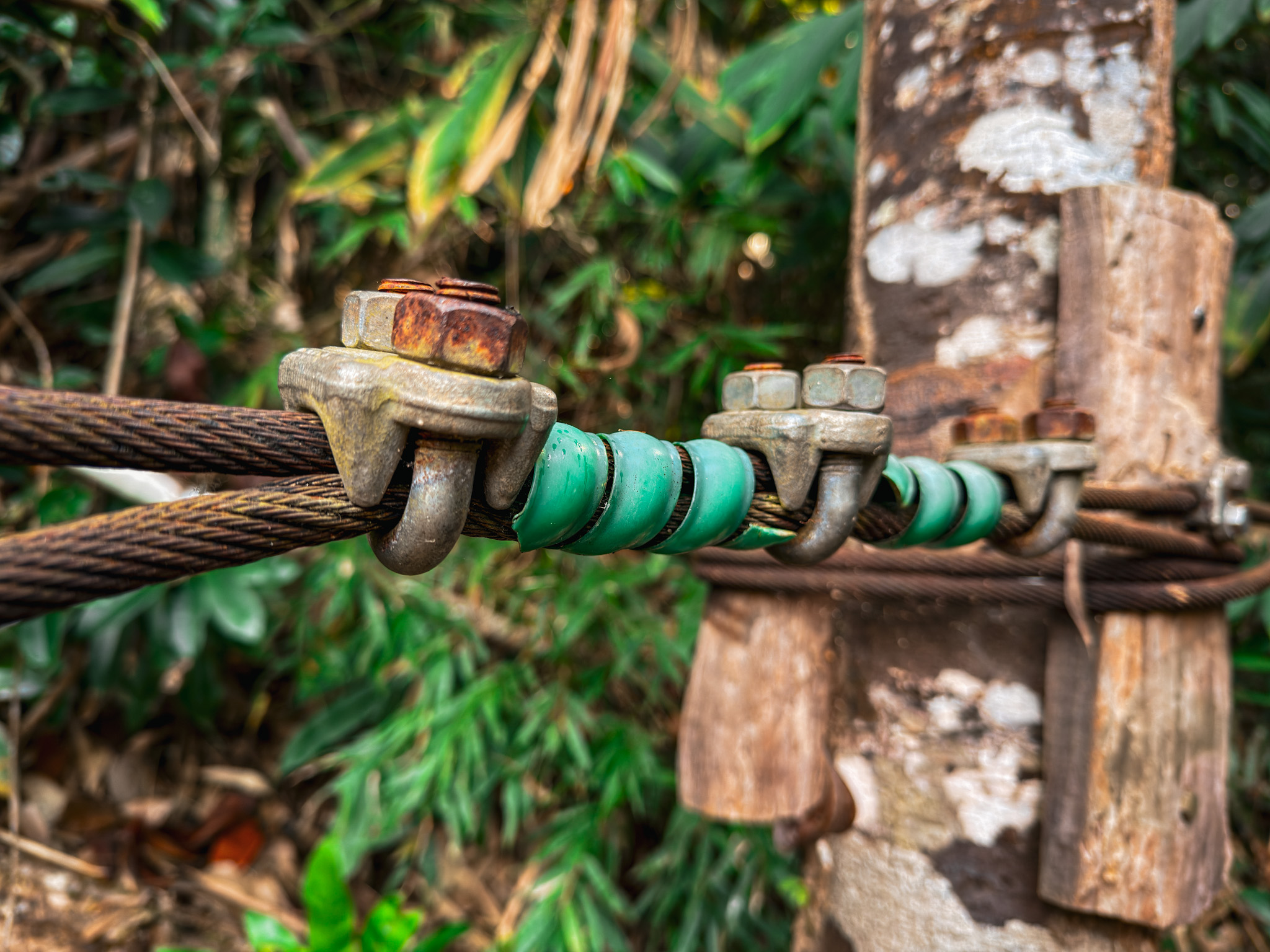
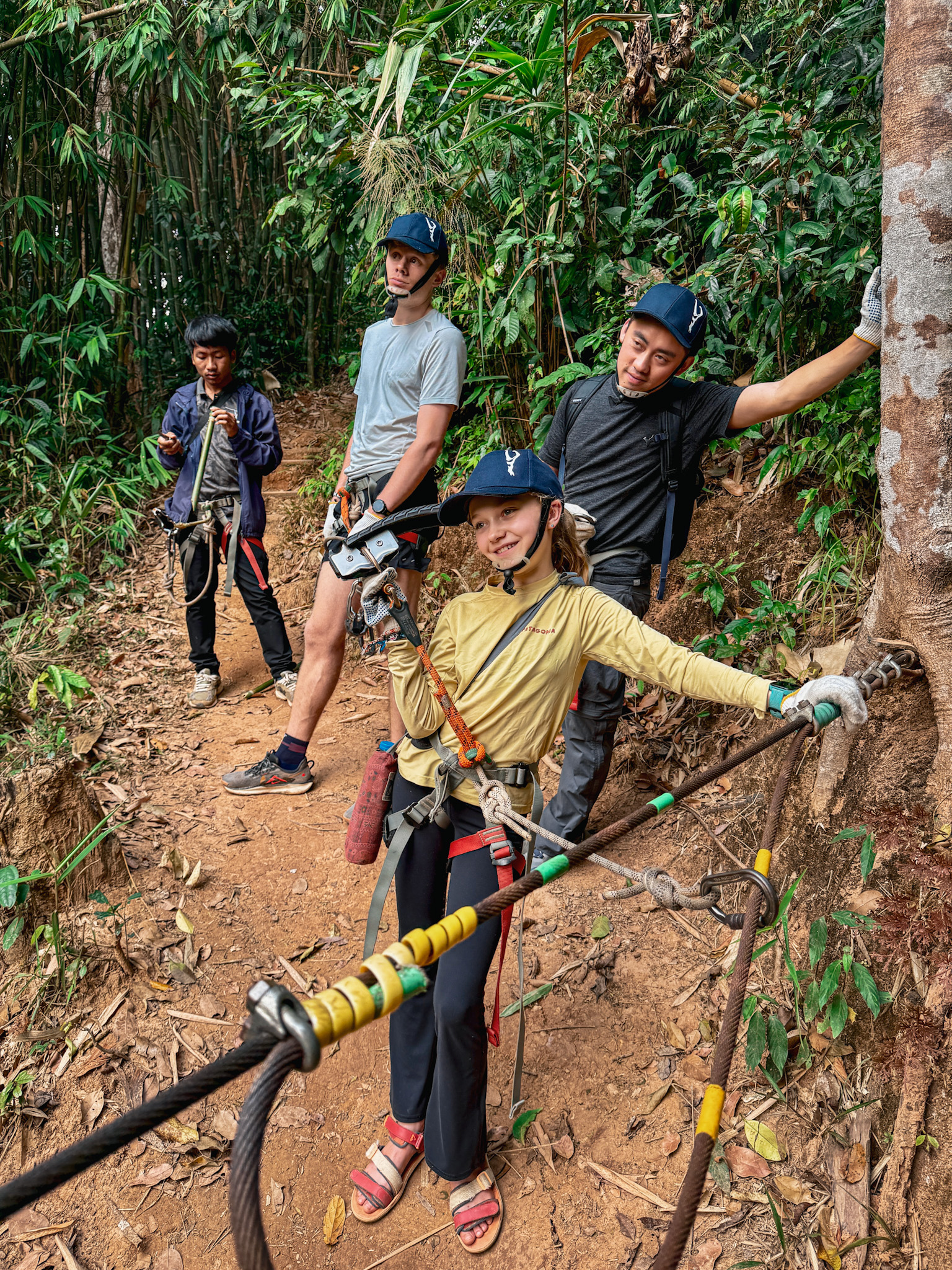
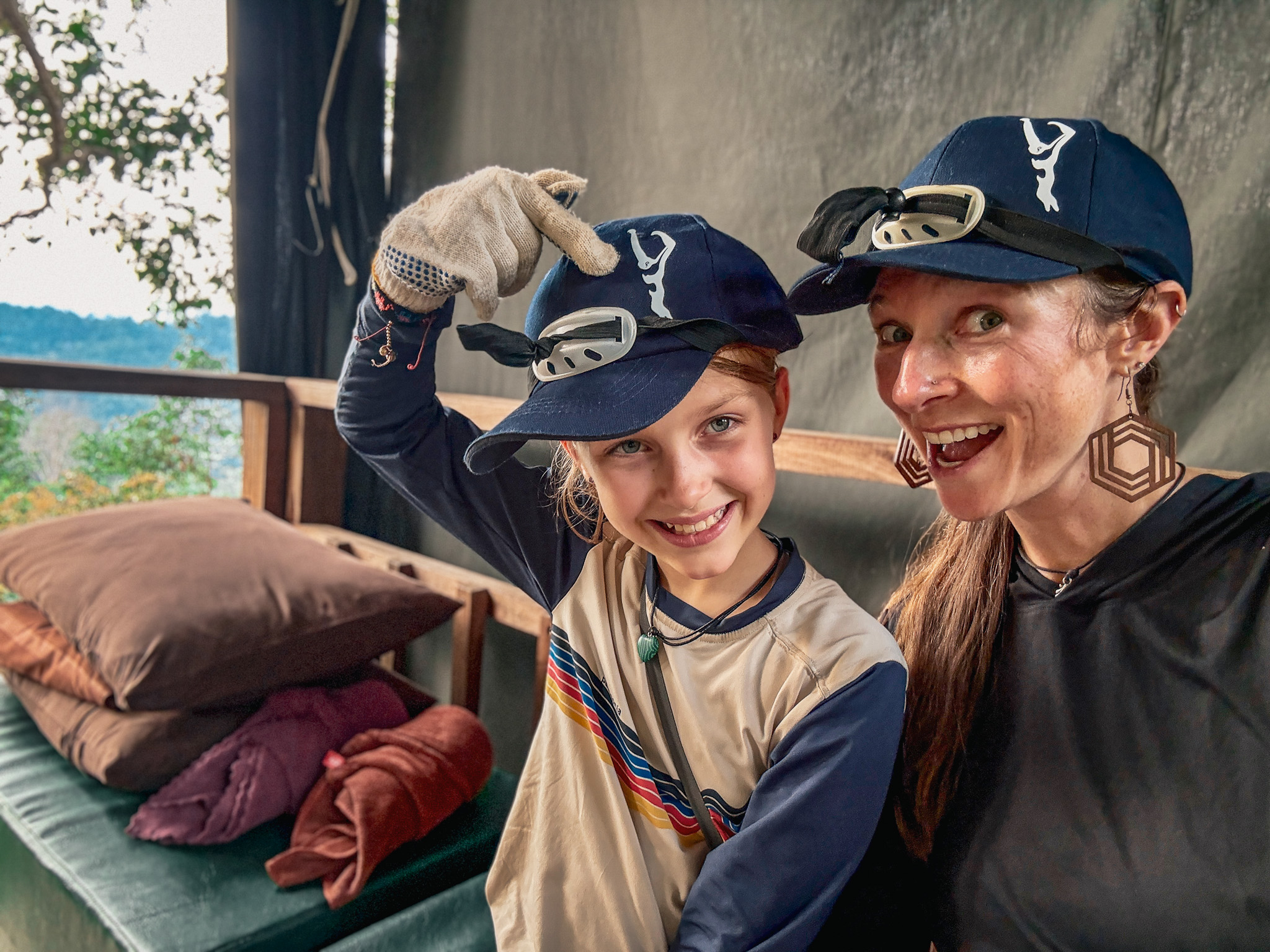
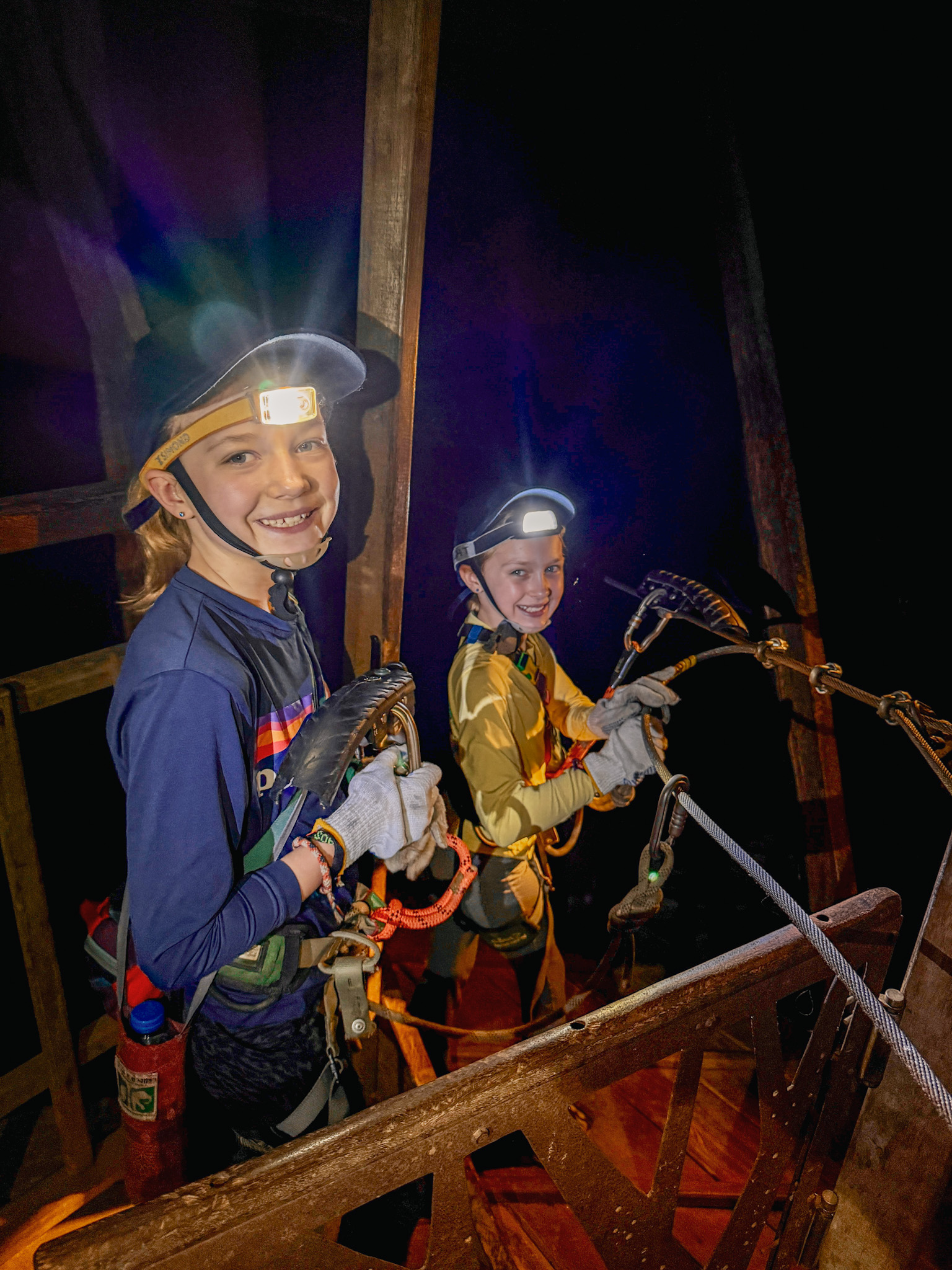
Then harnesses, gloves, and a bolted-on slice of a bike tire that serves as the braking mechanism — an innovation that tells you everything you need to know about the engineering philosophy here, which is: it works, don’t overthink it. We practiced at a training area first, learning to clip in, confirm nothing was twisted, attach the safety line, and position the body for speed. Then deeper into the jungle to the first real zip line.
Two hundred meters long. The midpoint somewhere well above the canopy.
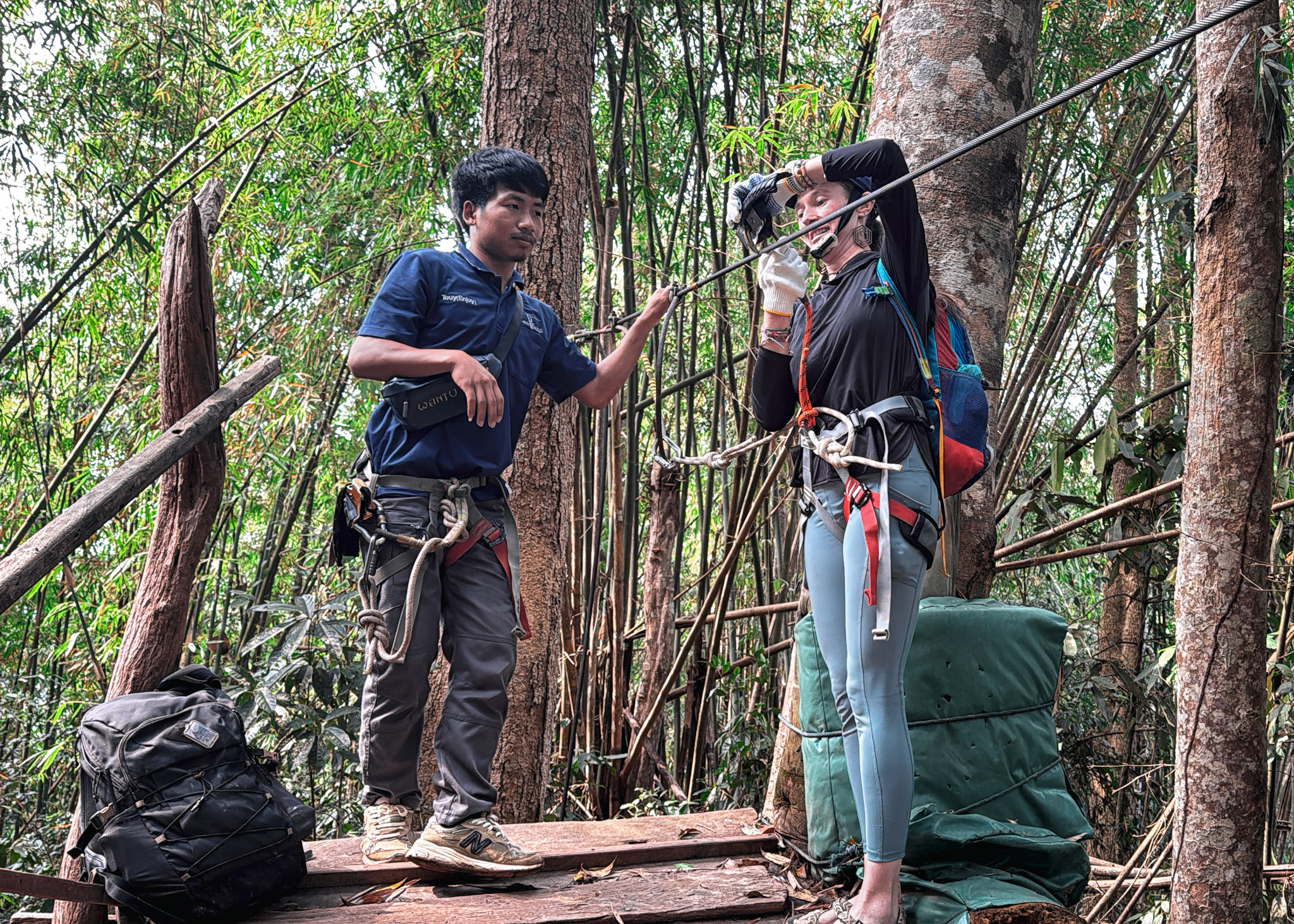
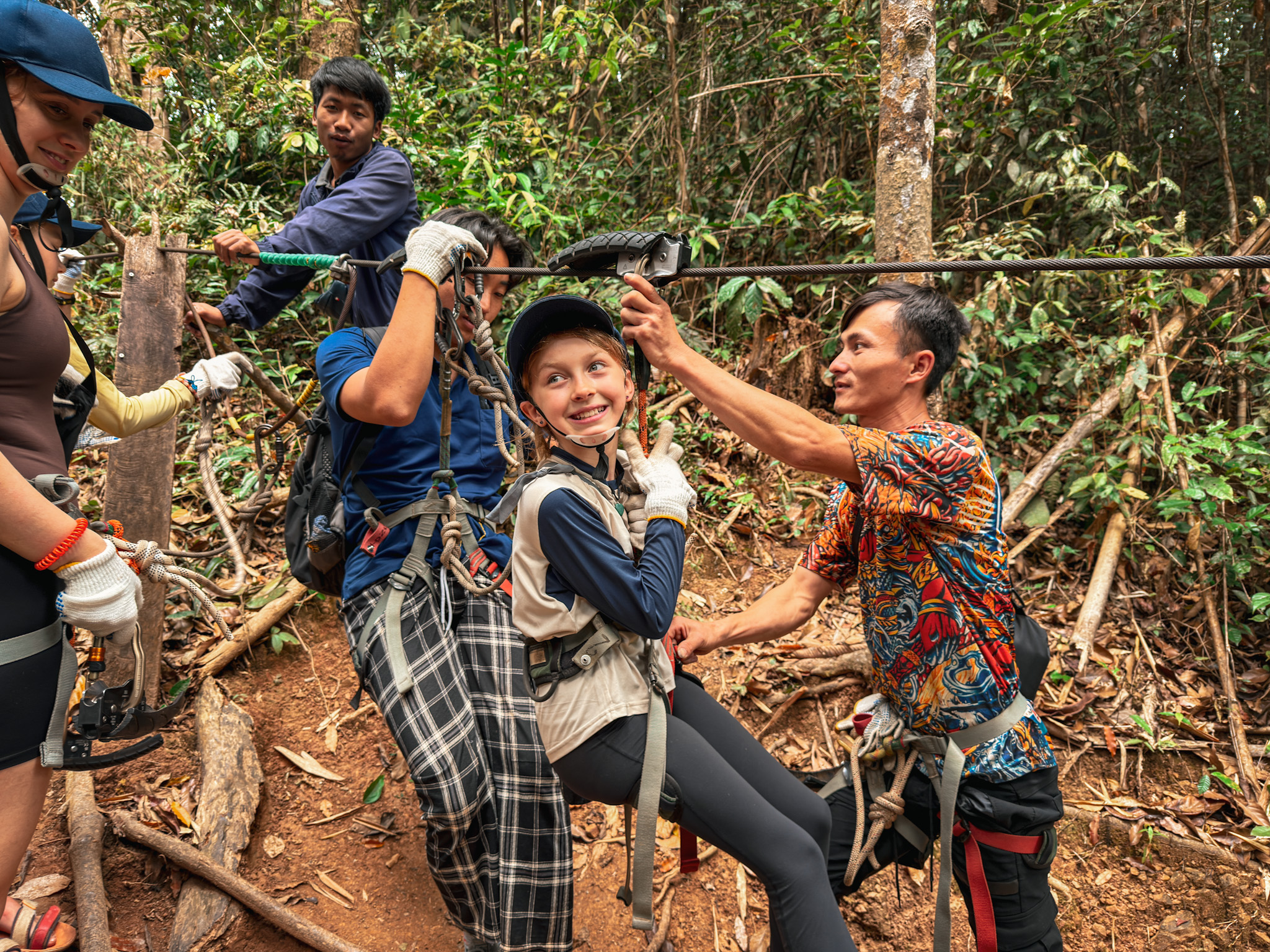
Singlao took Finlee across first, tandem. There was a moment of held breath — she was nervous, visibly, at the edge of the platform — and then they went, and then somewhere in the middle of that cable we heard a whoop of pure joy echo back through the trees. Arya went next, solo, with the confidence of someone who has never in her life doubted that zip lining would suit her, punctuated by a cry of “yippy-kai-yay!” that probably disturbed the wildlife for a hundred meters in every direction.
Max went after.
There is a specific sequence of sensations on a long jungle zip line that no amount of description fully prepares you for. The launch — a running step off the platform into empty air — followed immediately by the gathering of speed, the ball bearings in the trolley spinning up from a whisper to something resembling an angry swarm of bees, the wind hitting your face and filling your ears, the landing platform that was invisible at the start slowly resolving out of the green haze ahead. Then you remember the scooter rubber. You grab it. You grab it too enthusiastically. The platform that a moment ago seemed to be approaching too fast is now, suddenly, too far, and you coast to an undignified halt twenty meters out, hanging in midair, and must then grab the cable hand over hand with your gloves and haul yourself the remaining distance in an awkward half-upside-down backwards scramble until the guide reaches out and hauls you ignominiously onto the platform.
Shaina, on the other hand, was one of the only members of the whole group to make it to the landing platform on the first try—taking to the zip line like it was an extension of herself. Or maybe, she’s just a really good listener, following the directions of the guides to a tee. By the third zip, Max had the body position sorted — weight back, legs tucked, no swaying — and braking was something he applied subtly and rarely. The guides mentioned, with some amusement, that sometime after 2012 they added slack to the lines because too many people were slamming into the landing platforms. No serious injuries, but enough smashed fingers and bruised egos that the adjustment became necessary. This also explains the other major change from our first visit: in 2012 the guides accompanied you for the first few zips and then essentially said “be back before dark and wait for the all-clear signal” and disappeared. Today there is almost always a guide at both the launch and landing of every line. As twenty-something adrenaline seekers we might have found this mildly annoying. As 42-year-old parents watching our daughters dangle from cables above a Lao jungle, we were entirely at peace with the supervision.
Not that the girls needed much. By the end of day one, both Arya and Finlee were operating with the casual efficiency of people who have been doing this for years. Wait for the triple tap on the cable that signals all clear. Clip safety line. Clip trolley. Running leap into the green abyss. Finlee occasionally went tandem on lines where the slack was too significant for her weight to carry her all the way across, but the rest of the time she went alone, her small form sailing through the canopy with complete composure. Watching your kids manage real risk with genuine competence is a specific parenting feeling that sits somewhere between pride and disbelief.
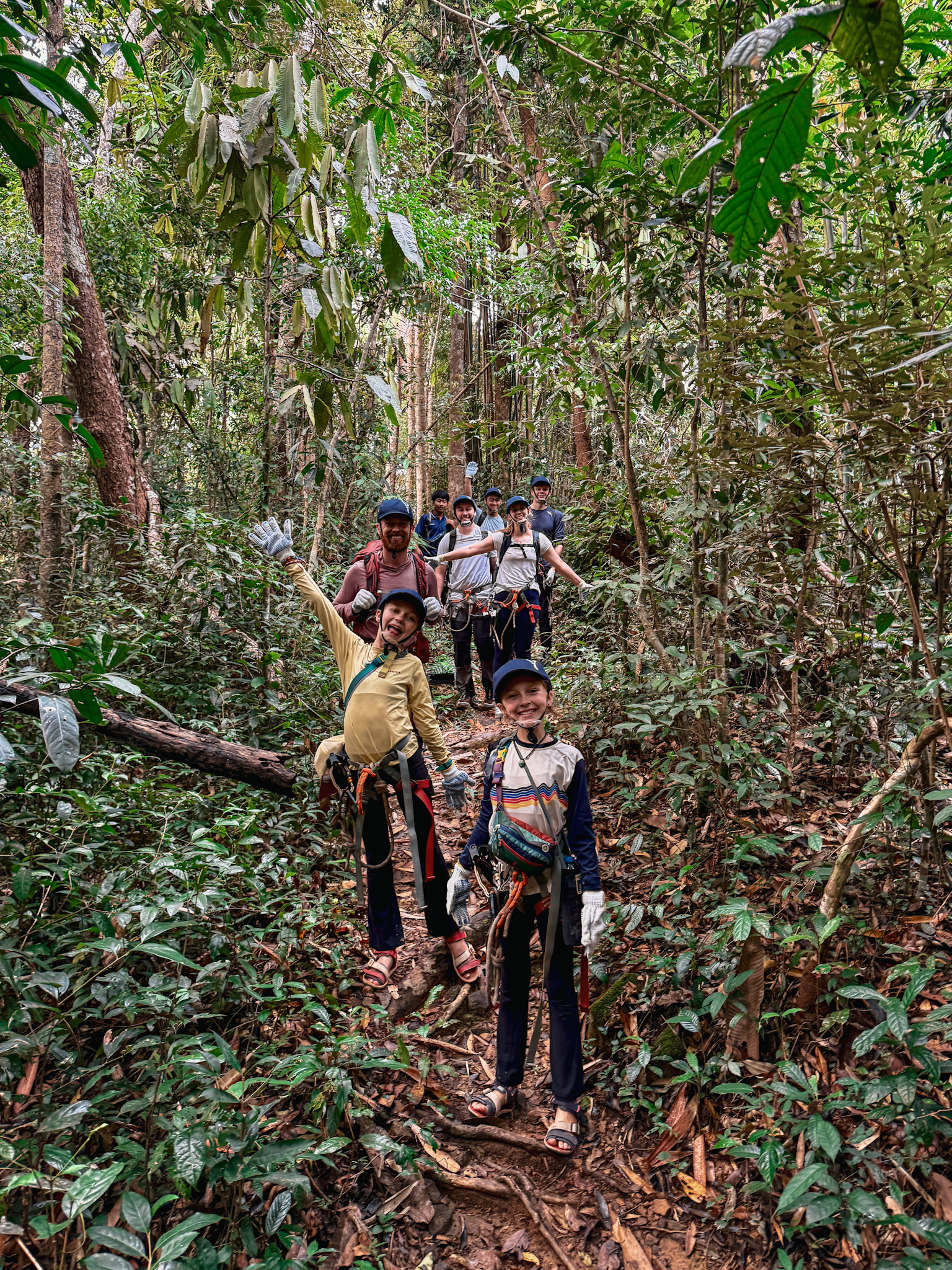
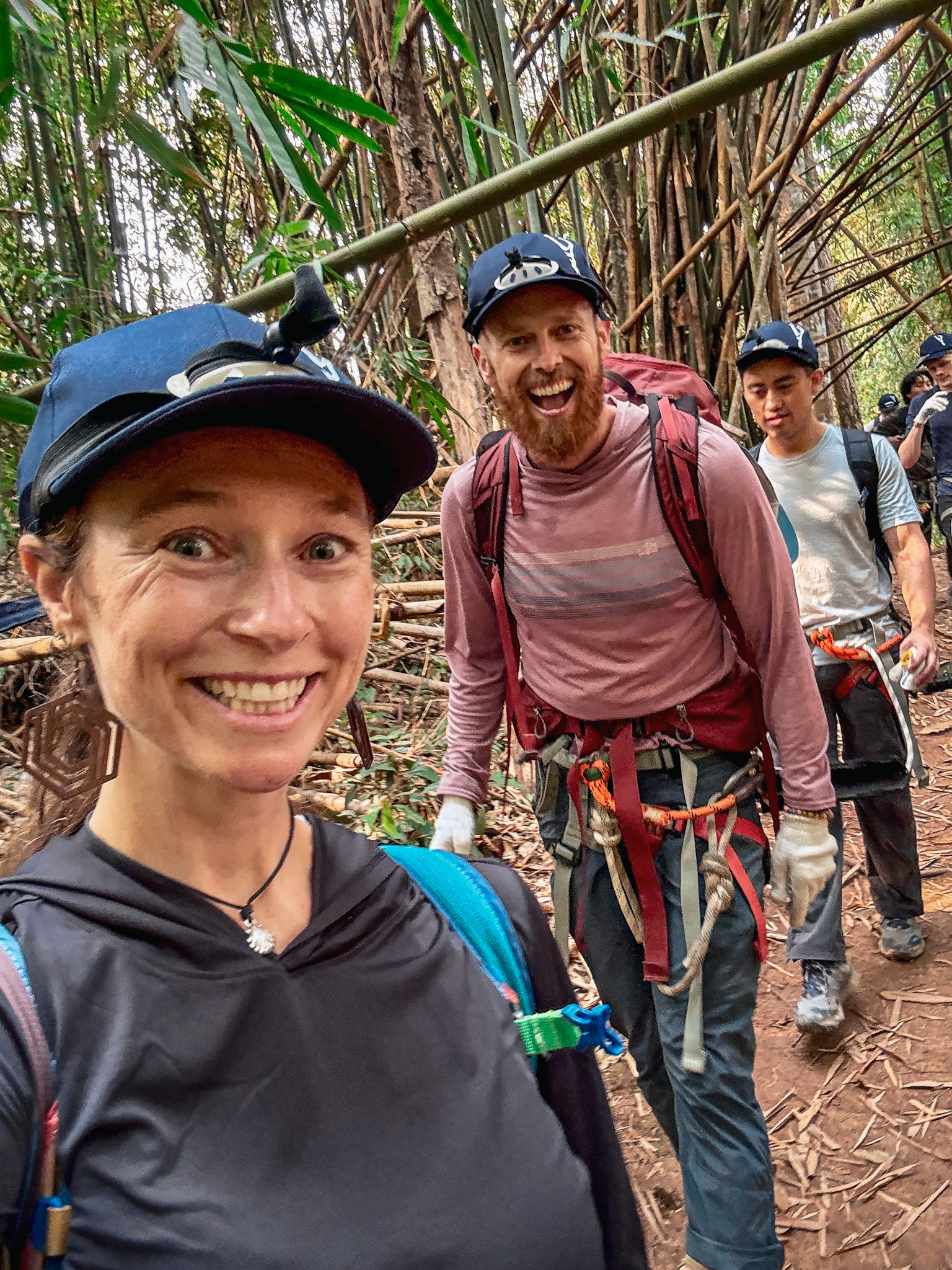
We had to part with Declan and Katie at this point, which nobody was particularly happy about. A tuk-tuk ride and half a day of zip lining had produced the kind of easy camaraderie that only travel generates, and the guides confirmed that the distance between the Honeymoon treehouse and ours made a shared dinner impractical. We said our see-you-tomorrows and hiked on with Dom and Mark toward treehouse number four, locally known as the Khisi Tree house.
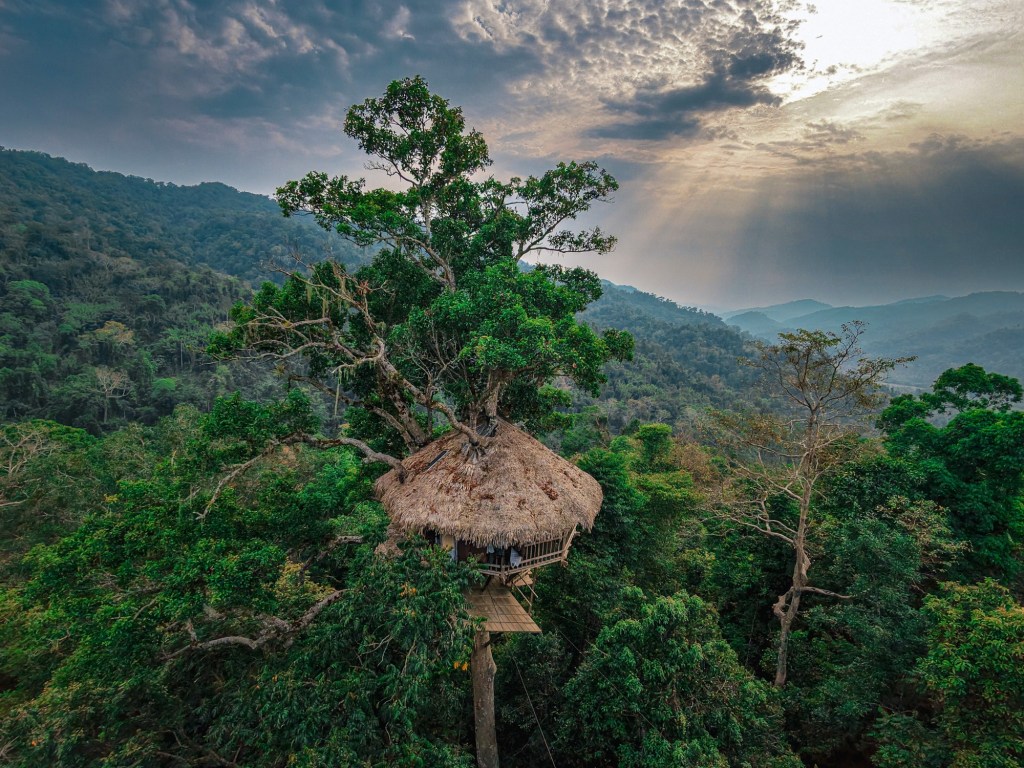
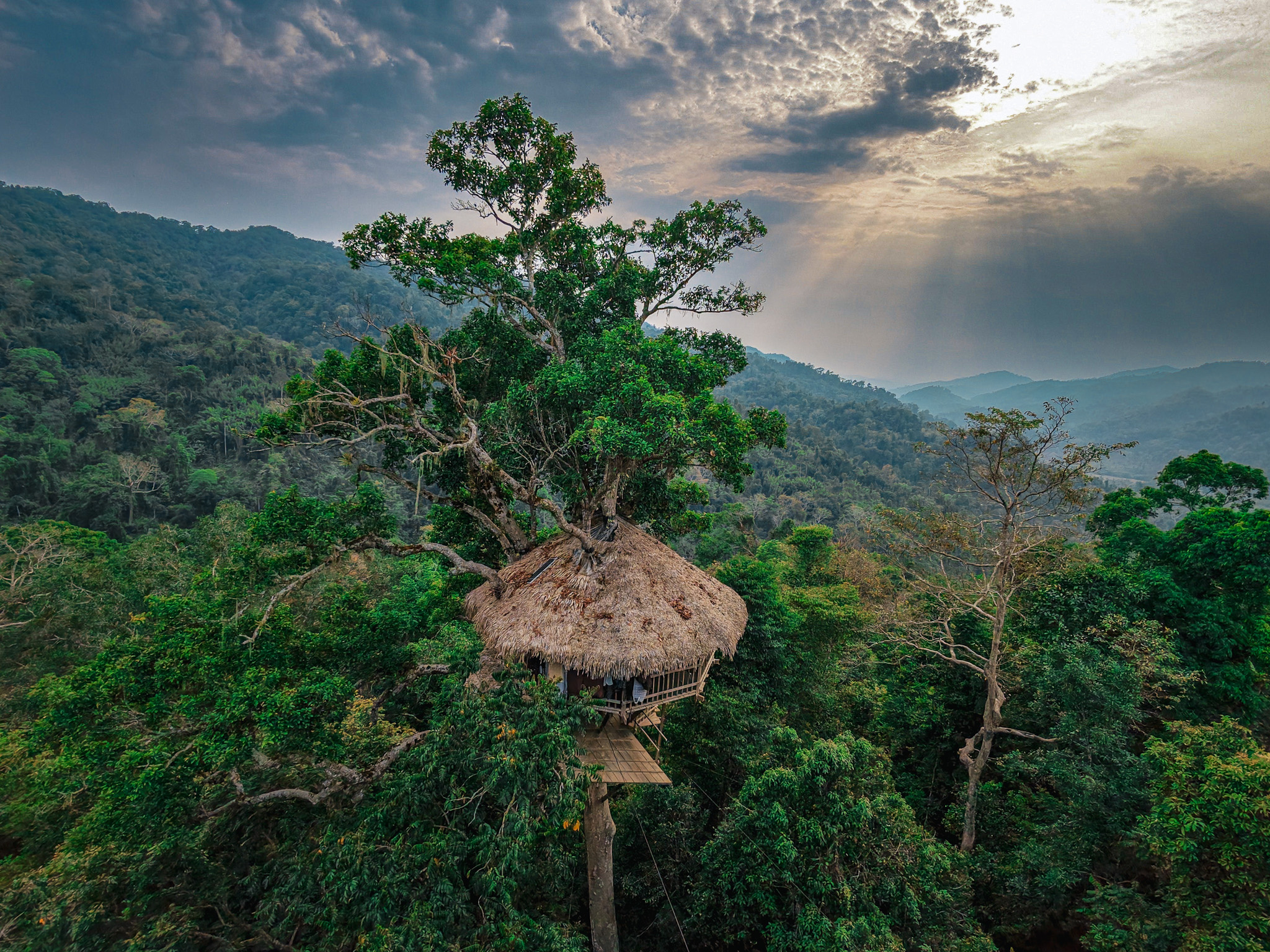
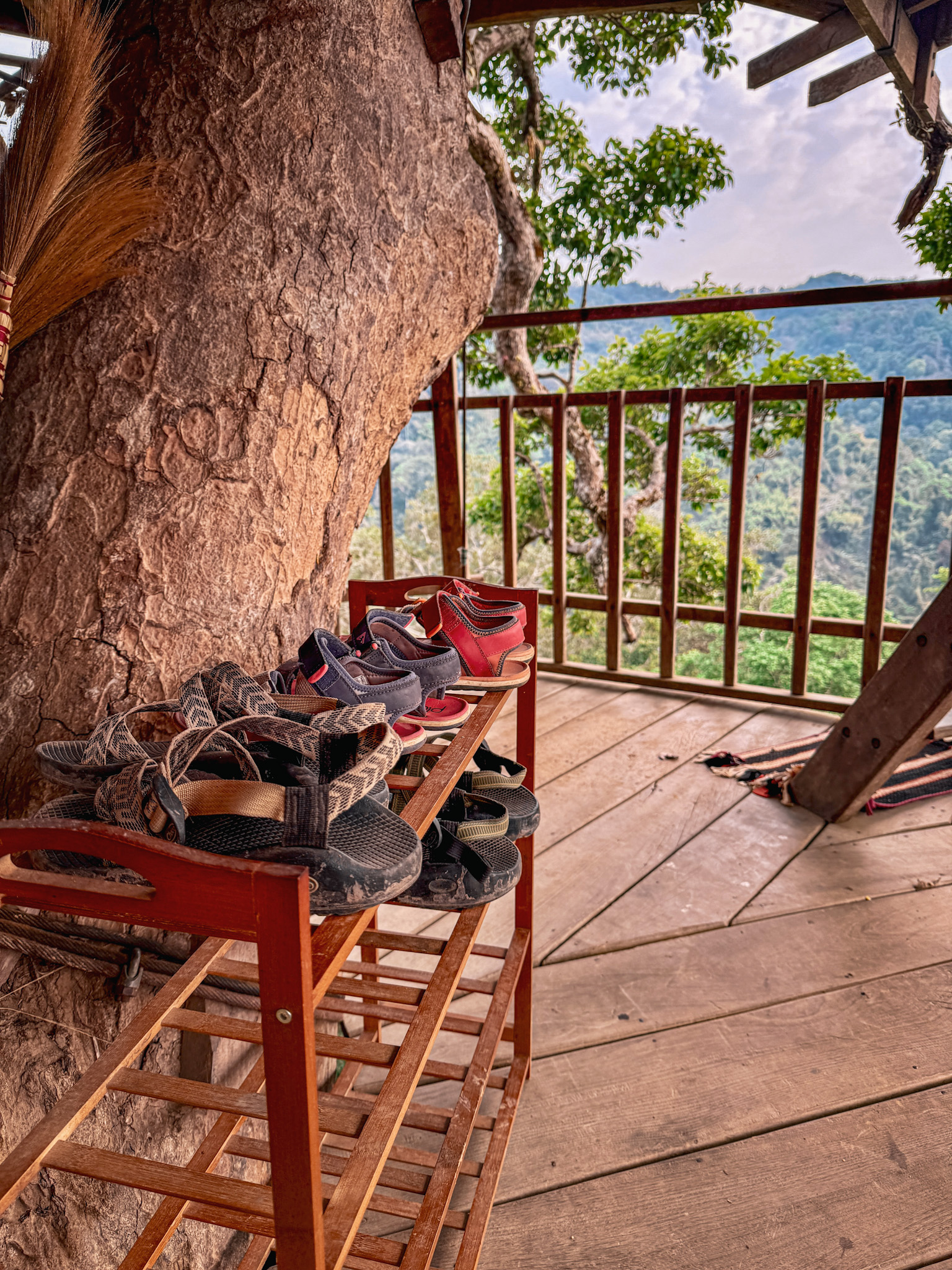
The treehouses at the Gibbon Experience are a thing of architectural wonder, straddling the giant trunks of strangler fig trees, and treehouse four is no exception — a circular platform roughly fifty meters off the forest floor, with a thatched roof, open sides, and views of the canopy in every direction. Max pulled out the drone almost immediately, which turned out to be an adventure of its own. The deep roof eaves that protect the treehouse from rain also made GPS acquisition impossible underneath them, which meant the drone wouldn’t hover properly, which meant the first attempted autonomous launch ended with it flying directly into the ceiling. Max snatched it out of the air before it fell, at the cost of a finger that found the propeller guard. He eventually found a launch point on the lower level clear enough to work with, using Arya and Finlee as spotters stationed at opposite ends of the treehouse to talk him through branches he couldn’t see. We got the footage. We agreed never to speak of how stressful it was. The drone spent the rest of the trip in the bag, where it was arguably more appropriate anyway. People come here to listen for gibbons, not the sound of a small buzzing machine annoying the wildlife.
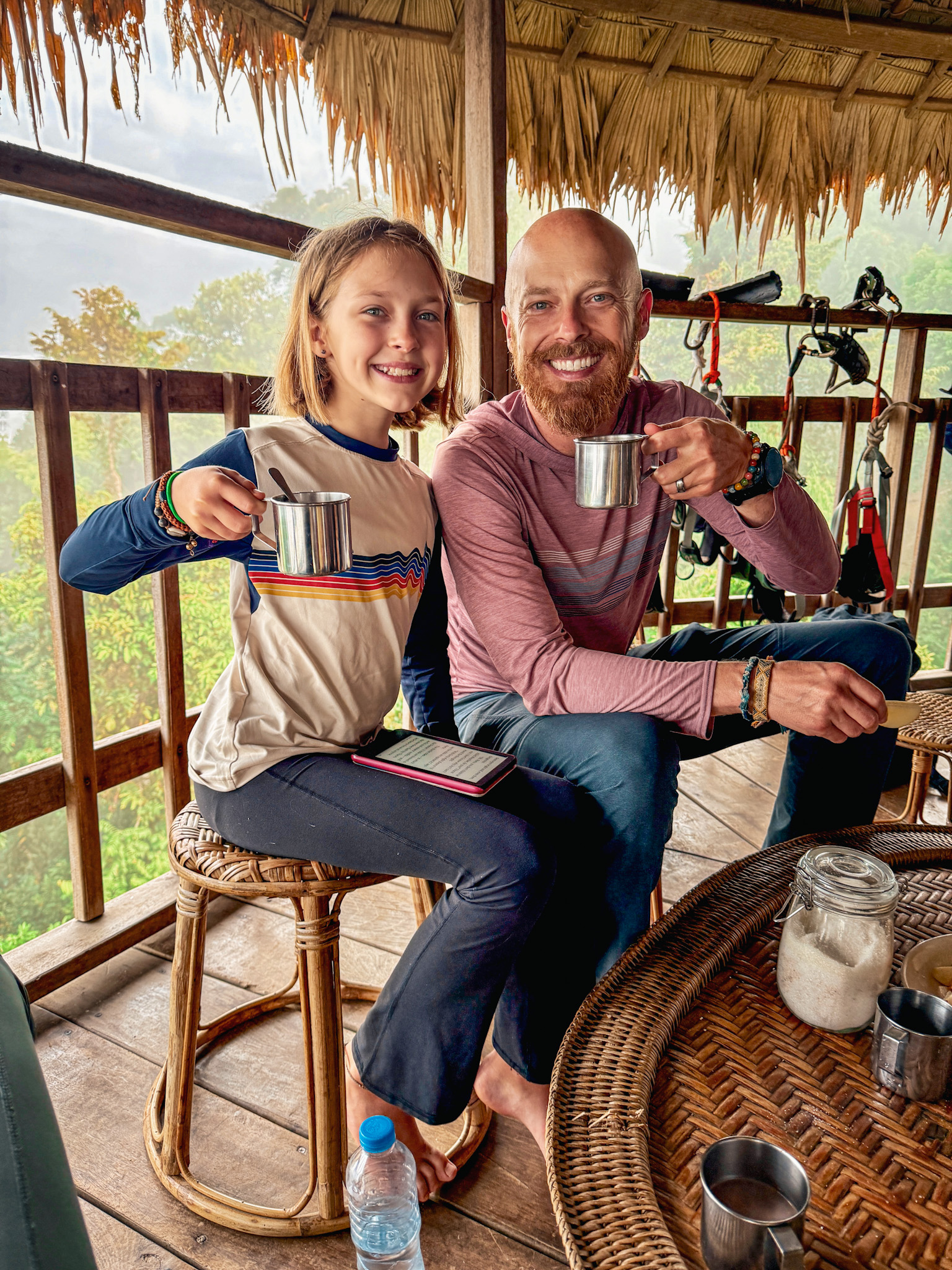
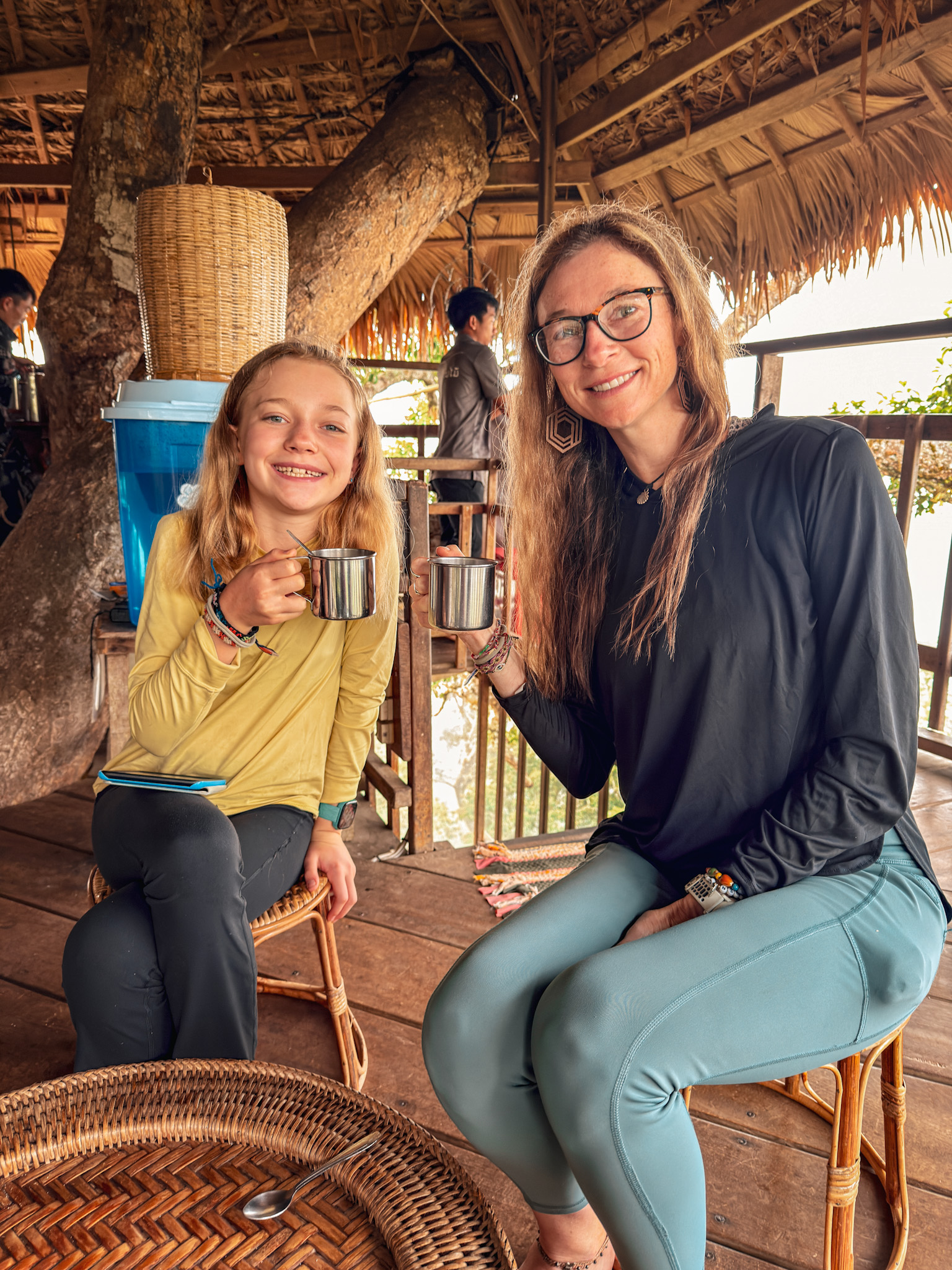
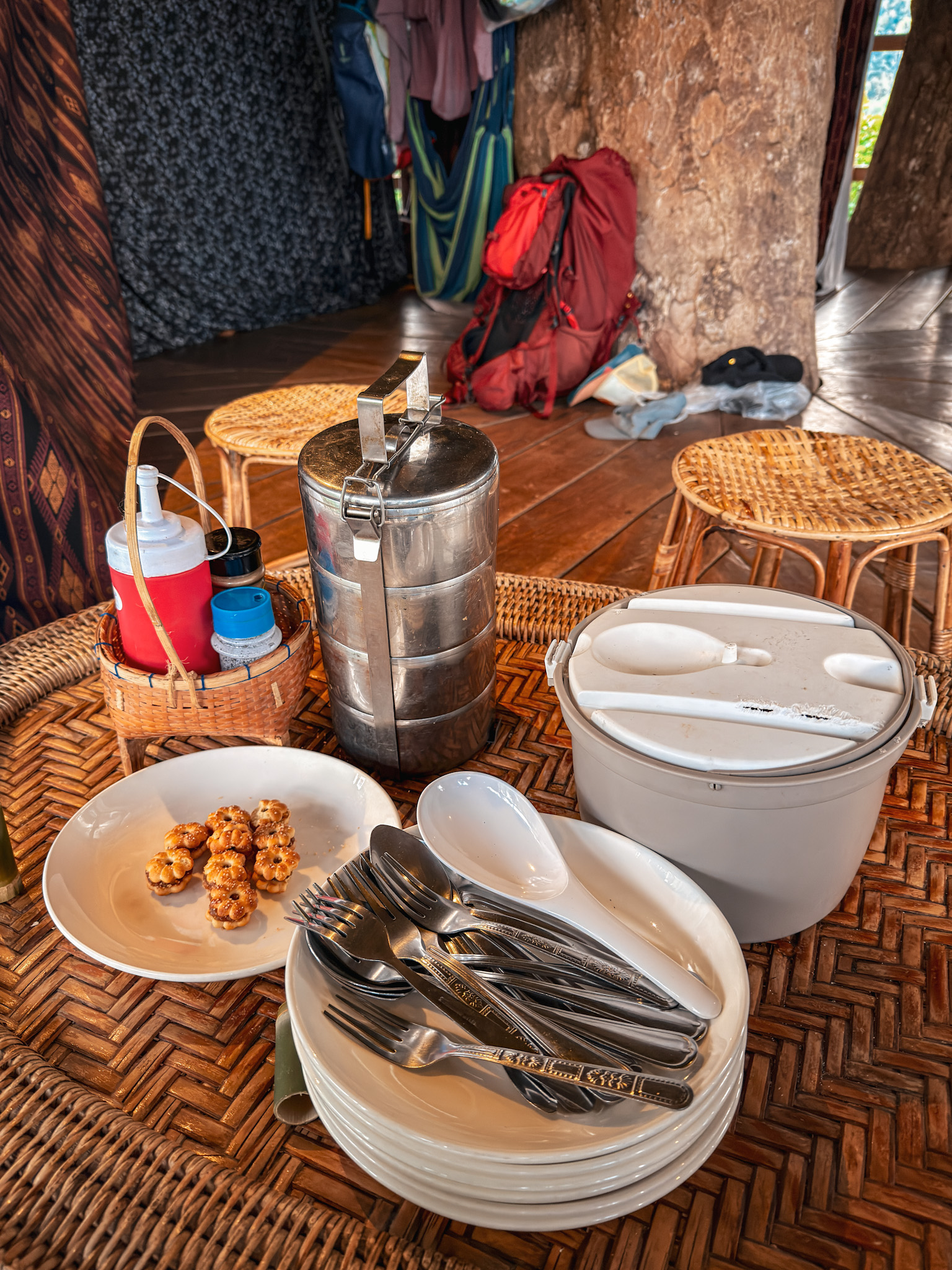
At five-thirty we heard a zip line arriving and looked up to find a young woman coming in across the cable carrying a kettle of boiling water and a stack of metal tins. Dinner had arrived—delivered by zip line, fifty meters in the air—Spring rolls, multiple stir fries, rice, hot tea, and an unmarked water bottle full of of Lao Lao — the local rice whiskey that our guides produced with great ceremony and that tasted, without exaggeration, like turpentine. We drank it anyway, because it was the only hooch in the jungle and the occasion called for something. The girls got hot cocoa that the guides made from scratch, mixing cocoa powder and creamer and what appeared to be an unreasonable amount of sugar into something the girls pronounced one of the greatest beverages they’d ever had.
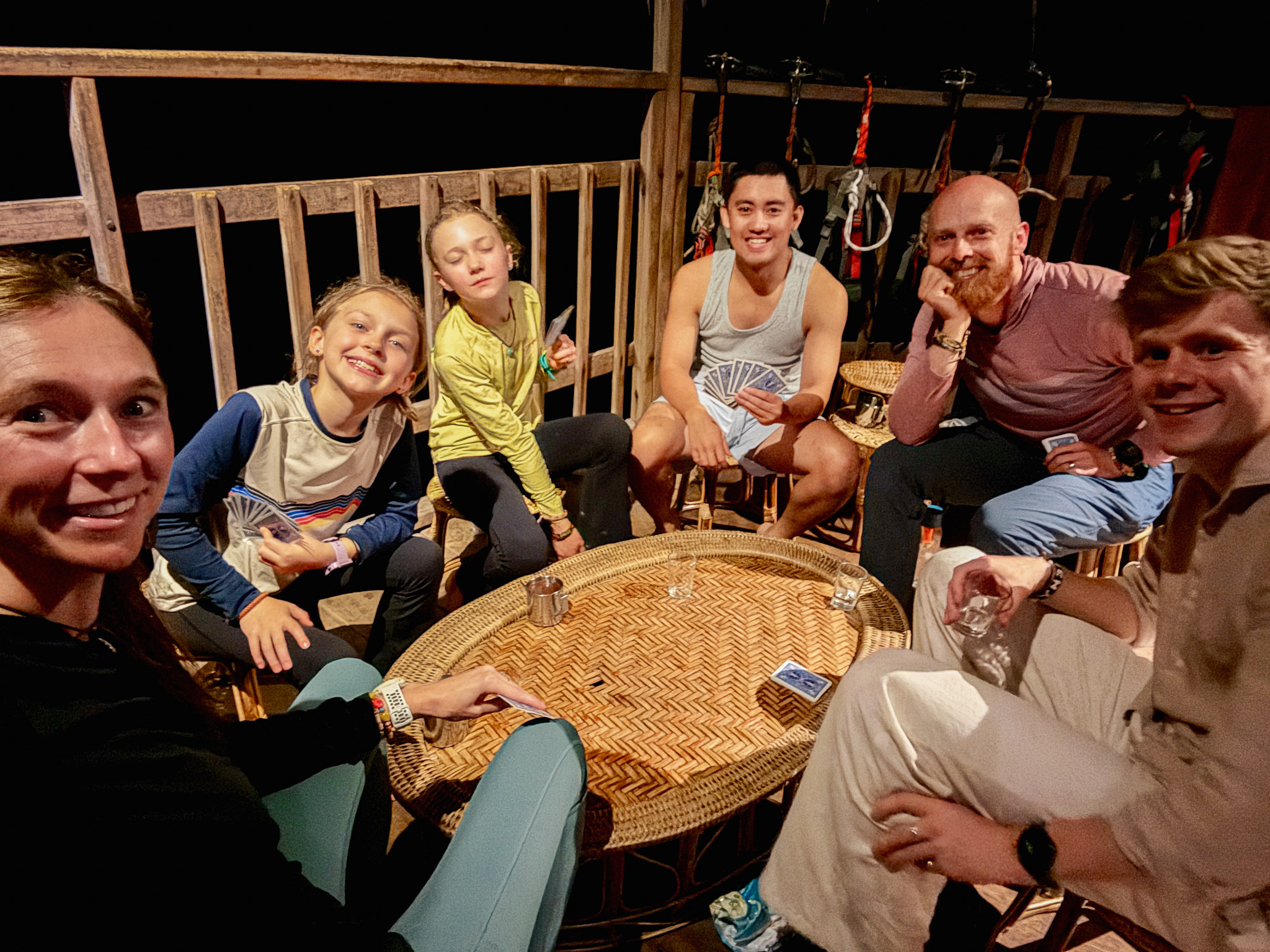
After dinner we cleared the table and the whole group, guides and kids included, stayed up late playing the card game apparently universally known around the world, although by various names: Asshole, President, or as we affectionately call it to our kids, Kings and Cabbages. Dom had a couple of house rule amendments that we initially resisted—we have strong feelings about Kings and Cabbages as we play it—but which turned out to make the game considerably more chaotic and fun by making it harder for the King to hold position and easier for the Cabbage to rise. The laughter when someone in the cabbage seat suddenly finds themselves crowned king is universal and requires no translation.
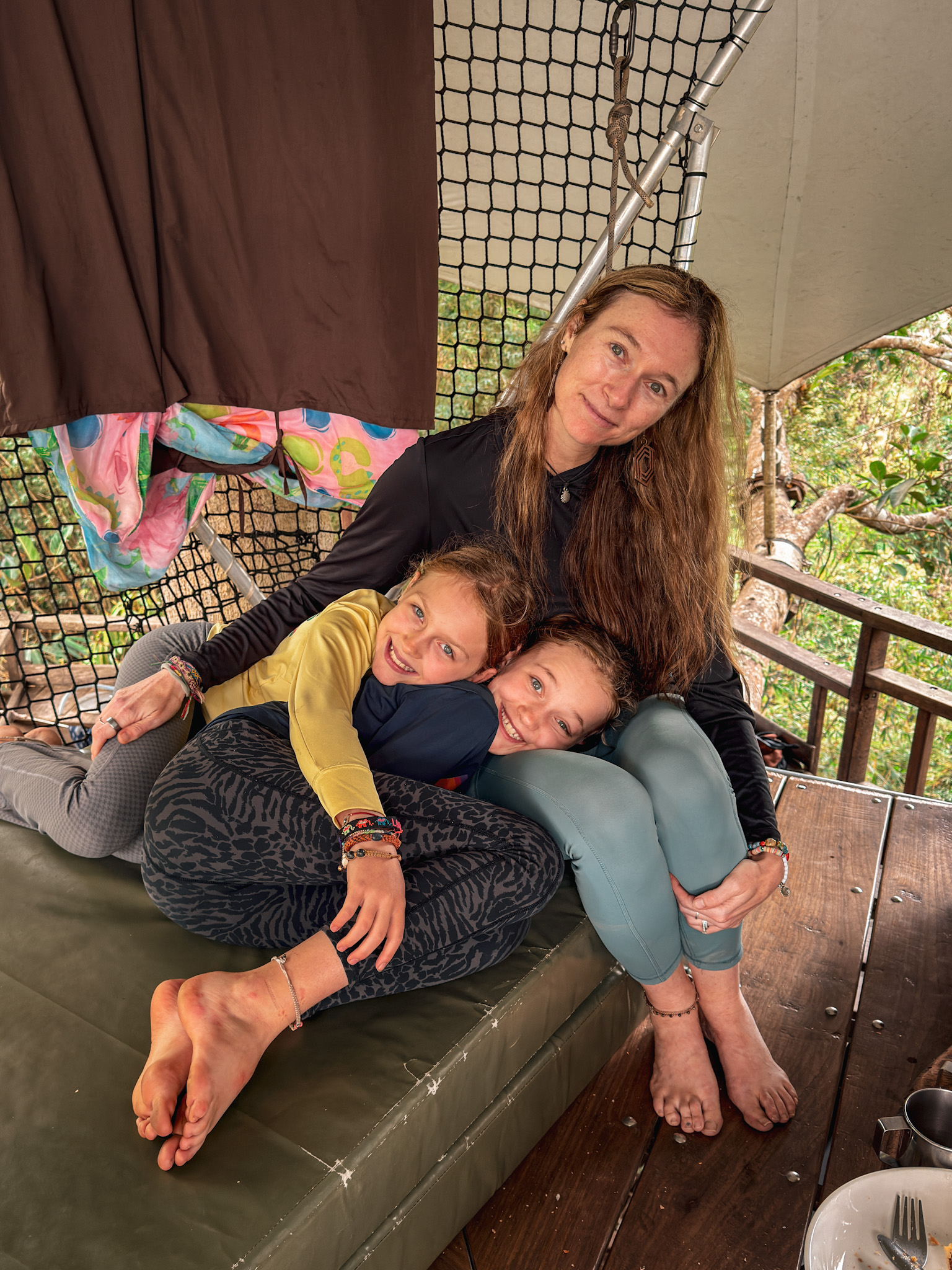
Then bed, such as it was. The foam pads inside their waterproof tarp covers had the give and comfort of a yoga mat laid over a concrete floor. Side sleeping: impossible. Back sleeping: uncomfortable. Stomach sleeping: defeated by the pillow, which was approximately the density of a rolled newspaper. This was compounded by the forest, which is not quiet. It chirps and whistles and clicks in the dark, and our nervous systems received all of these sounds as urgent dispatches requiring attention. Then the rats arrived — audible in the walls and under the sleeping platforms, squeaking and scrabbling with what sounded like genuine urgency. We stuffed in earplugs, achieved complete acoustic isolation from the natural world, and eventually our exhaustion overrode our discomfort. We slept, eventually, in the way that counts but doesn’t exactly restore.
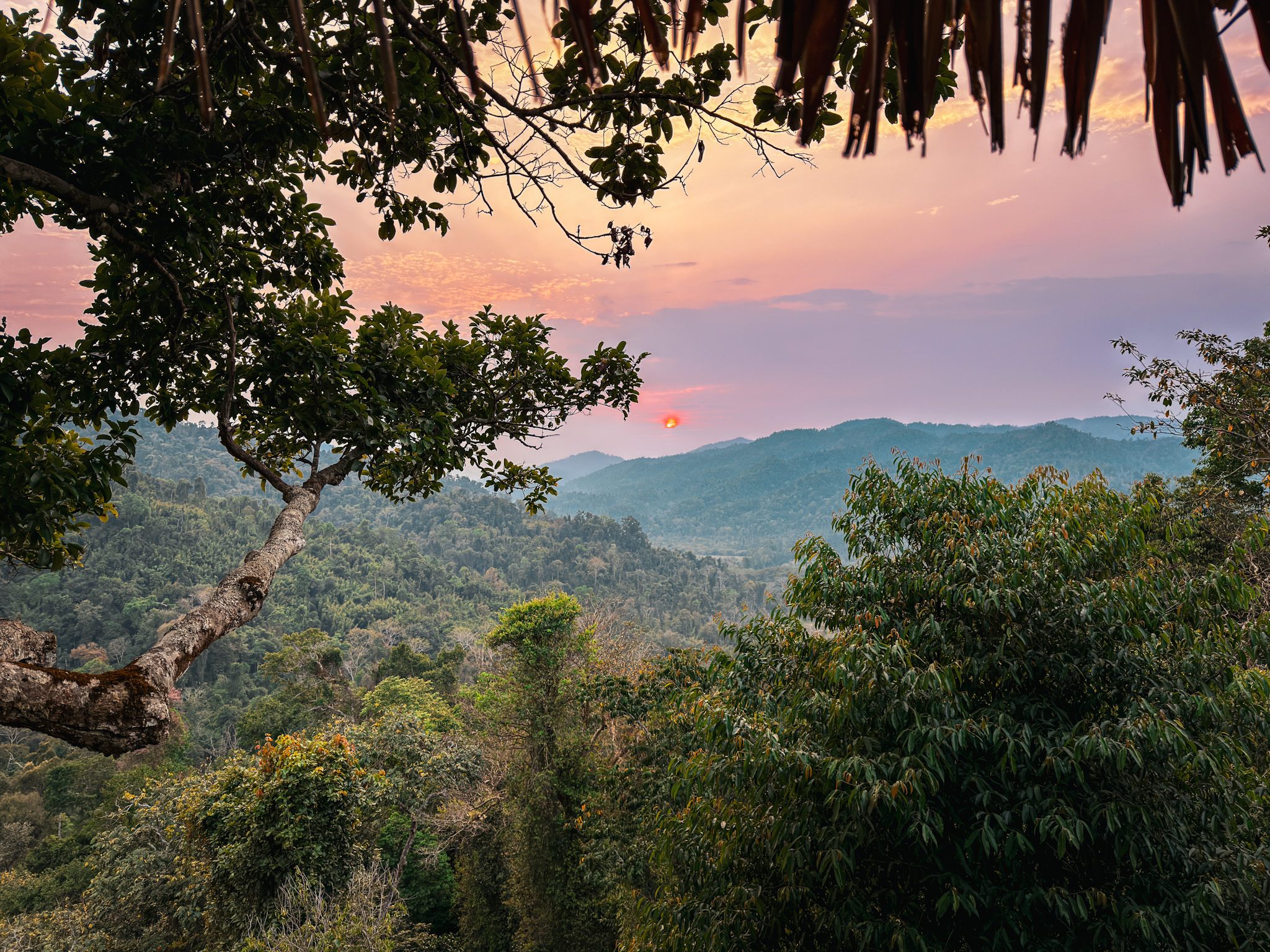
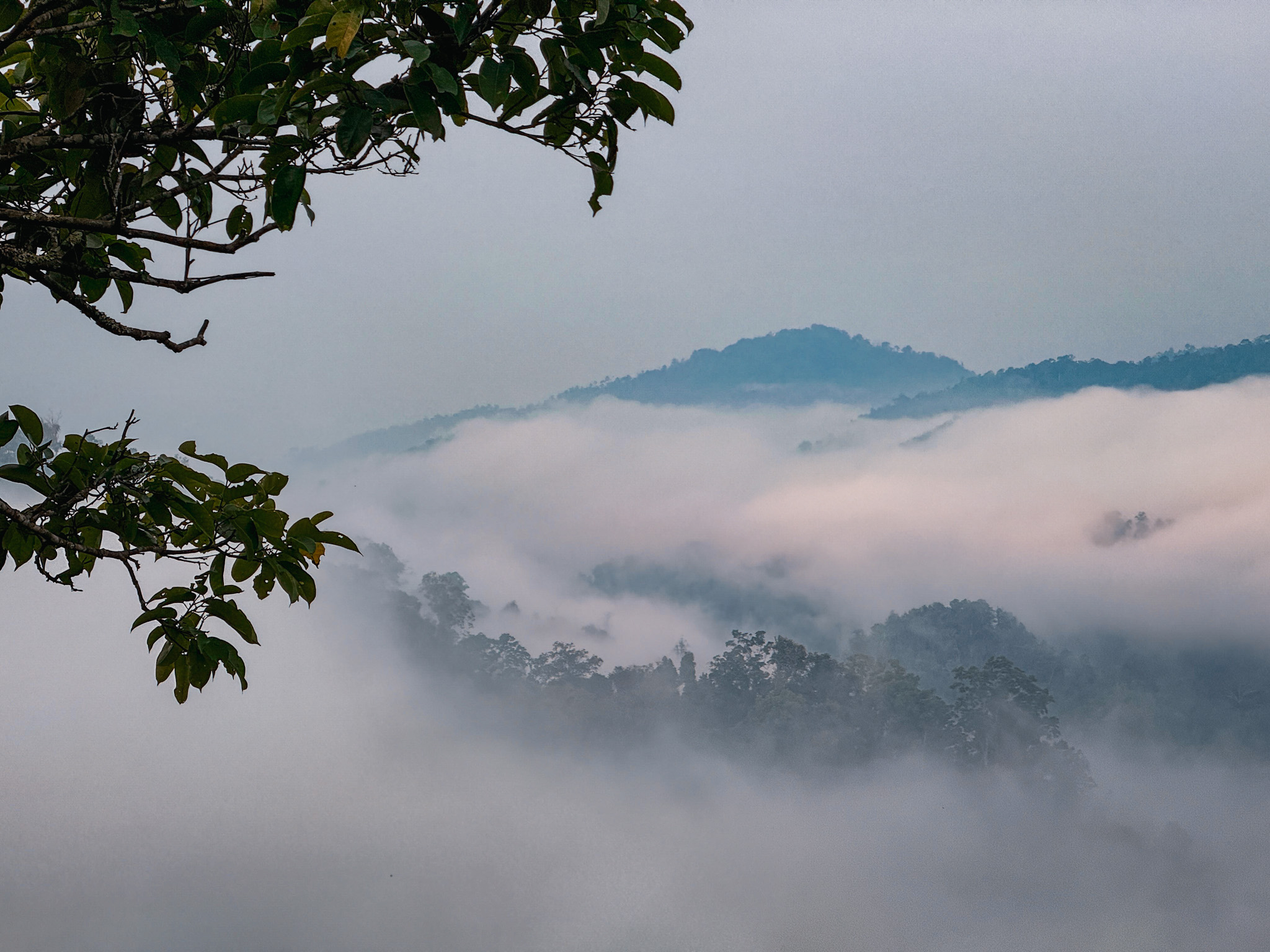
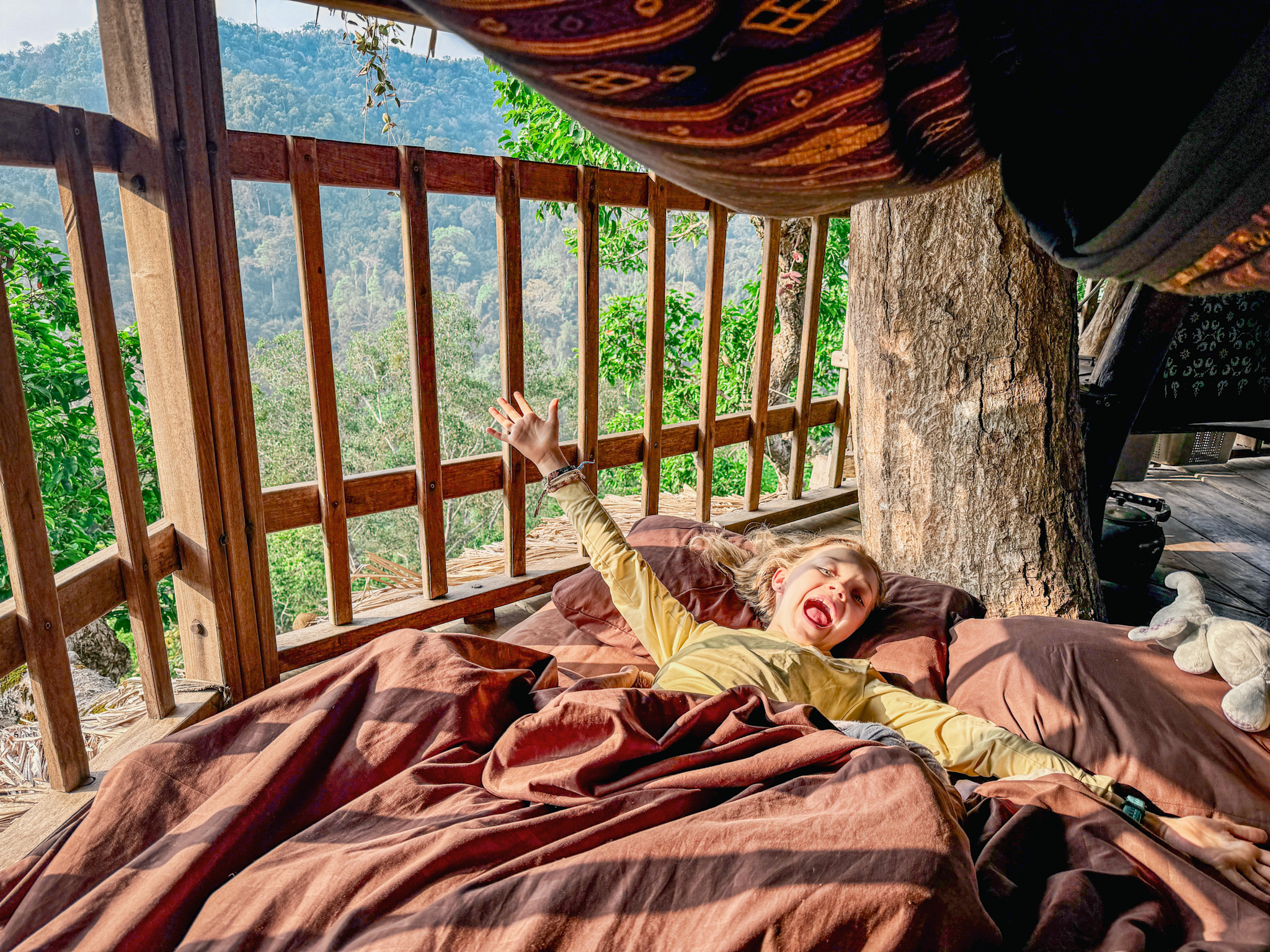
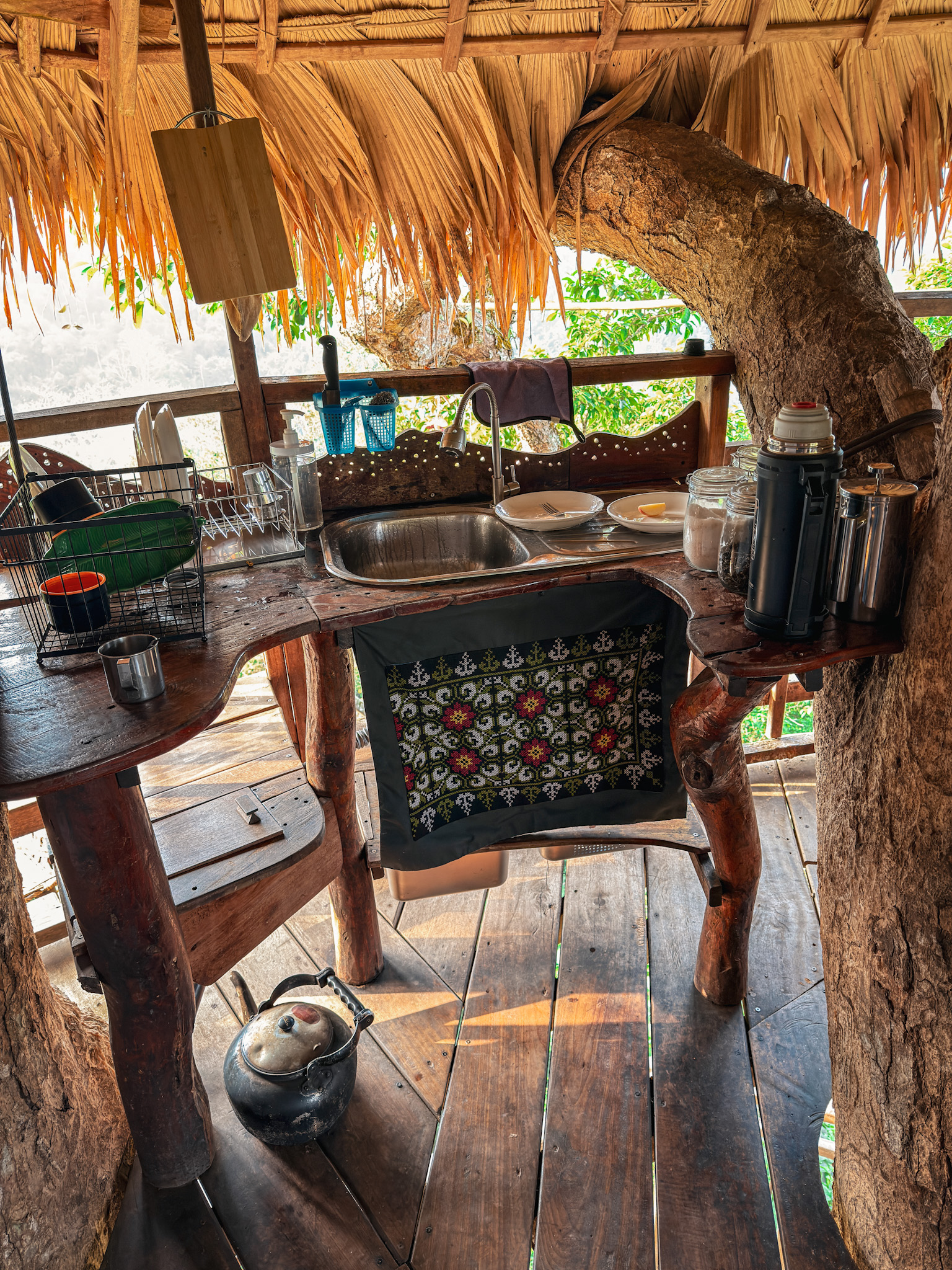
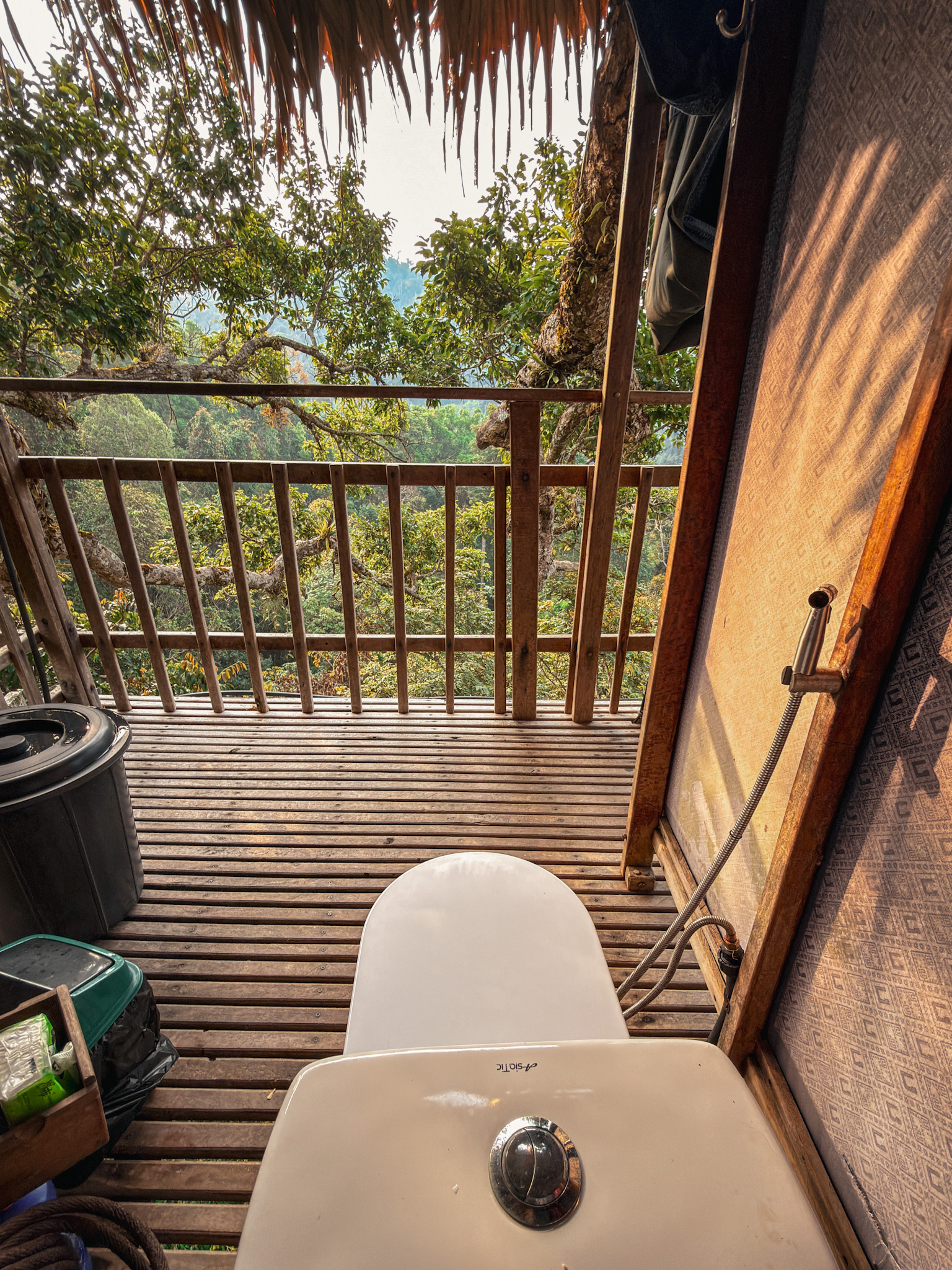
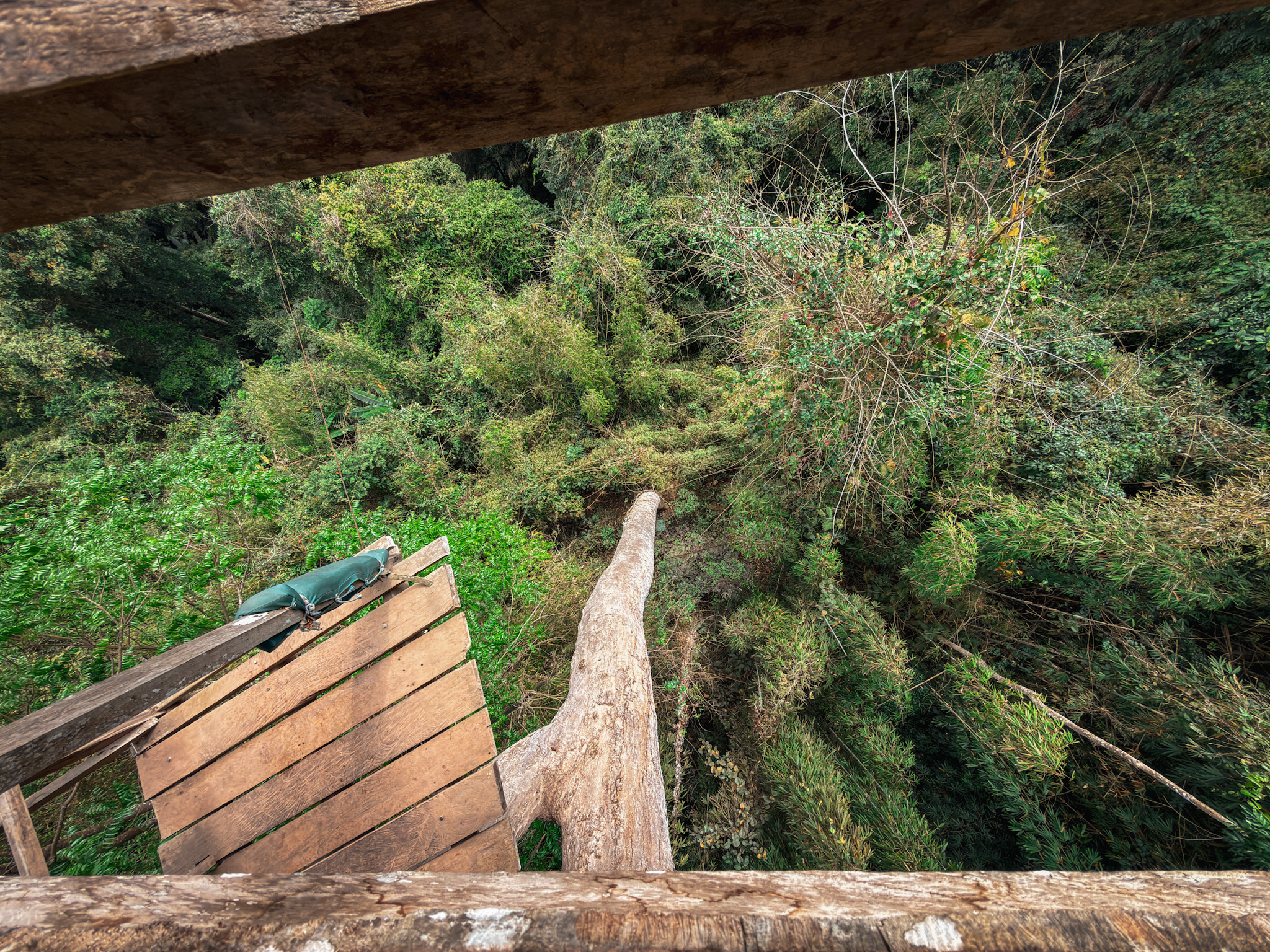
Day two began with a sunrise that was less a dramatic event than a slow negotiation between light and mist. From treehouse four’s circular platform, high above the canopy, we watched the forest materialize out of darkness the way a photograph develops — first the nearest branches, then rolling mist moving across the horizon in long soft waves, then a ridgeline visible for a moment before the mist closed again, and then the mist dissipating faster and faster until, without any single decisive moment, the forest was simply there, all around us, green and enormous and awake. It took maybe forty minutes from first light to full visibility. None of us went back to bed.
The morning was built around exploration: hiking between zip lines, visiting other treehouses, running circuits on cables we’d already done and ones we hadn’t. Somewhere on one of these hikes we reached treehouse five — where Shaina and Max had stayed fourteen years ago. Our memory of it was, we discovered, mostly impressionistic. We knew it was wood, we knew it was high, we knew the general feeling of being there. The specific details had blurred in the way all specific details blur given enough time. But as we sat there, things started surfacing. The most vivid: a small opening in the wall used only by the guides to deliver food, requiring whoever came through it to fold themselves into an improbable shape to avoid slamming into the side of the treehouse. We had a clear image of a young woman doing exactly this years ago, and when Max pulled up old footage from that trip he found a short clip of it happening. Maybe the memory stuck because we’d rewatched the video at some point. Maybe it would have stuck anyway. Either way it was a strange and happy thing to be standing in that same spot again.
Tiger the dog found us somewhere between treehouses — a brindle-coated animal belonging to one of the support staff who apparently ranges freely across whatever territory he has decided is his. He introduced himself by tearing out of the jungle at full speed and leaping at Arya and Finlee, who both screamed and then, upon realizing he was not a predator but simply an extremely enthusiastic dog, immediately became his best friends. He was with us for a while and then disappeared back into the jungle on whatever business he had elsewhere.
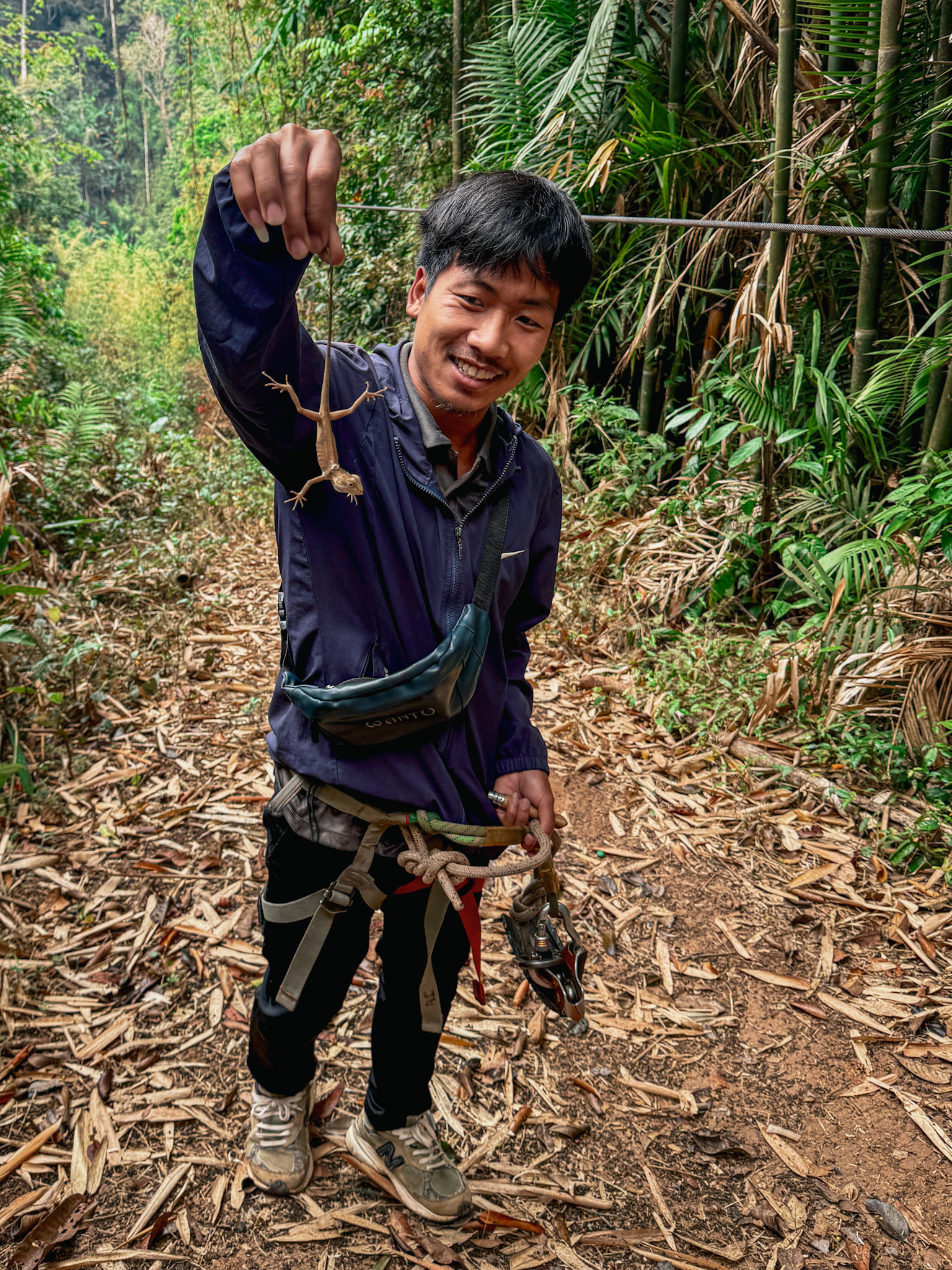
Our guide paused at several points during the hiking to offer things from the forest. A sliced chunk of edible wood cut from just under the bark of a particular tree — soft and with a flavor somewhere between rice and almonds. Leaves with claimed medicinal properties. A small seed like a miniature avocado that tasted faintly of papaya. None of it was exactly delicious, but all of it was interesting, which felt like the appropriate standard for improvised jungle food.
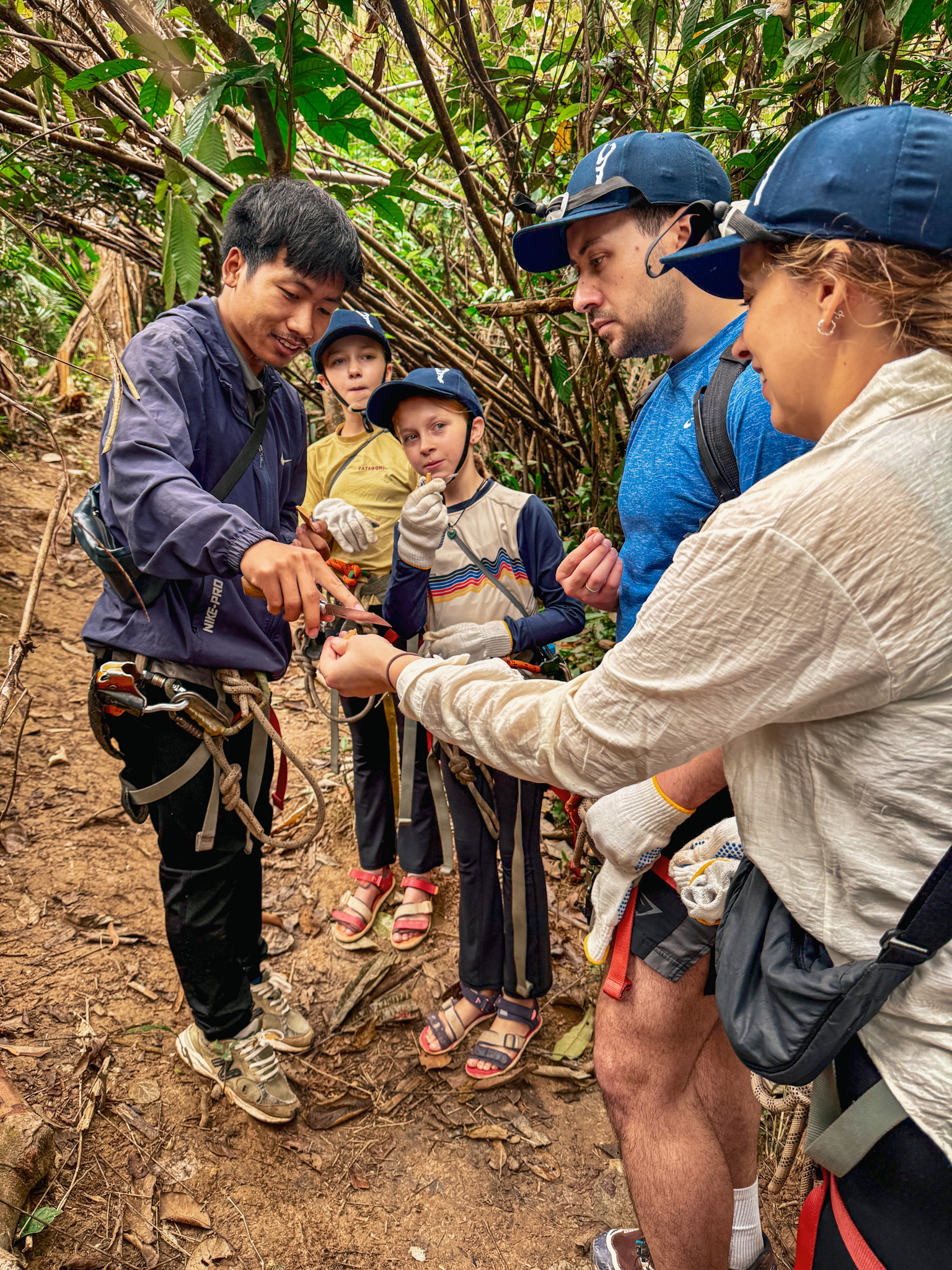
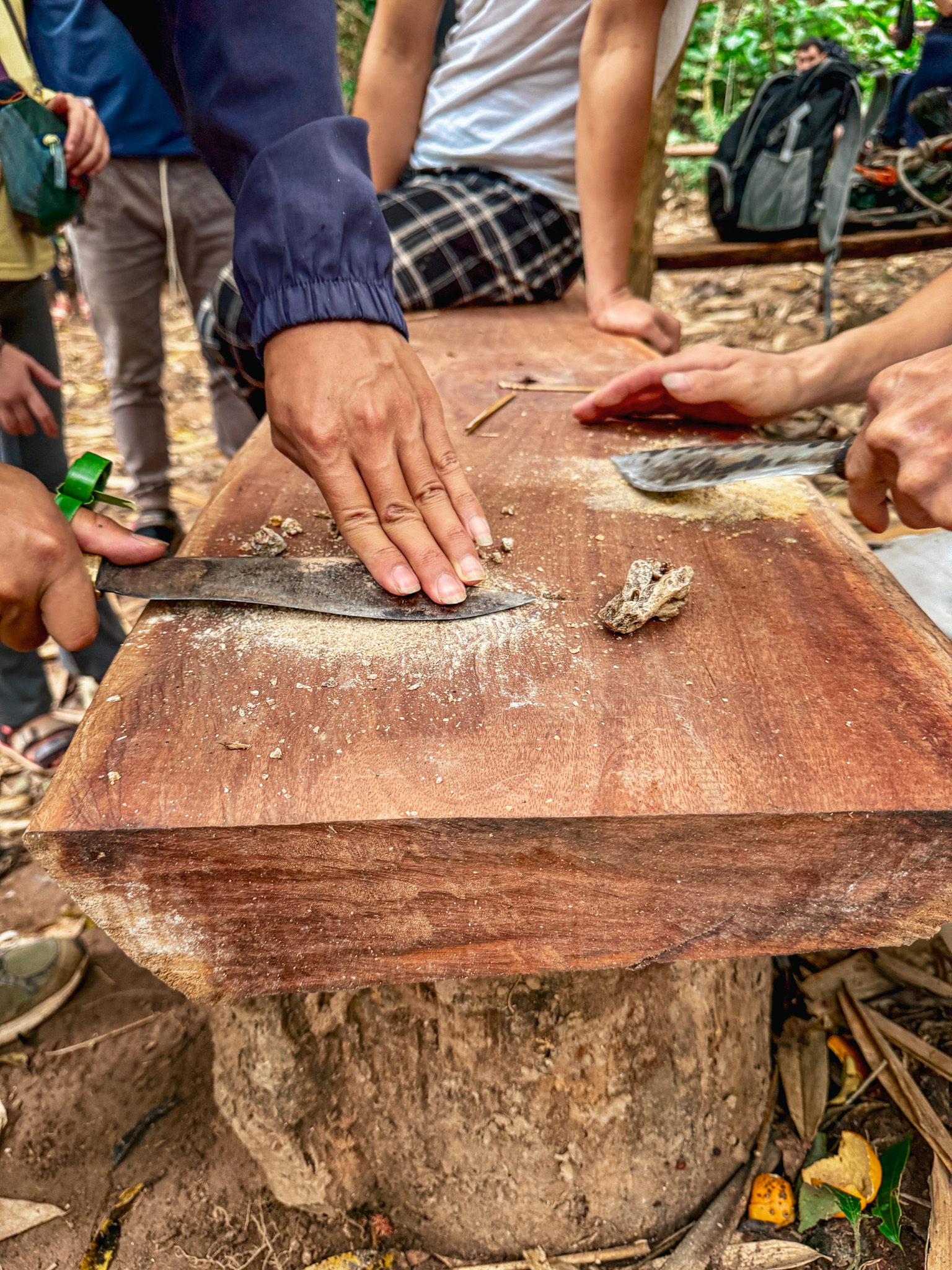
The sap trees were the highlight. There are trees in this forest — similar in look to banyan or ficus, broad and tall with big green leaves — that bleed profusely when cut. The Khmu use the sap in ceremonies. For us the guides had a different application: they smash the dried sap with the flat of a knife until it becomes a fine powder, which you then cup in one hand and release slowly while someone holds a lighter beneath the falling stream. The powder ignites as it falls, producing a ribbon of fire that chases the stream down and, if you open your hand at the right moment, ends in a satisfying poof before reaching you. Arya and Finlee each held a handful, released it over the flame, and felt the heat rushing up toward their palms before the powder burned out. They looked like small fire magicians and they knew it.
The shower at the end of the afternoon was cold water in the jungle fifty meters above the ground. Objectively cold water. Subjectively, after two days of hiking and zip lining in equatorial heat, with an unobstructed view of the verdant canopy below: transformative.
Dinner again by zip line delivery. More Kings and Cabbages. The guides joined again. Dom once again pushed the rules in directions we had to admit were improvements.
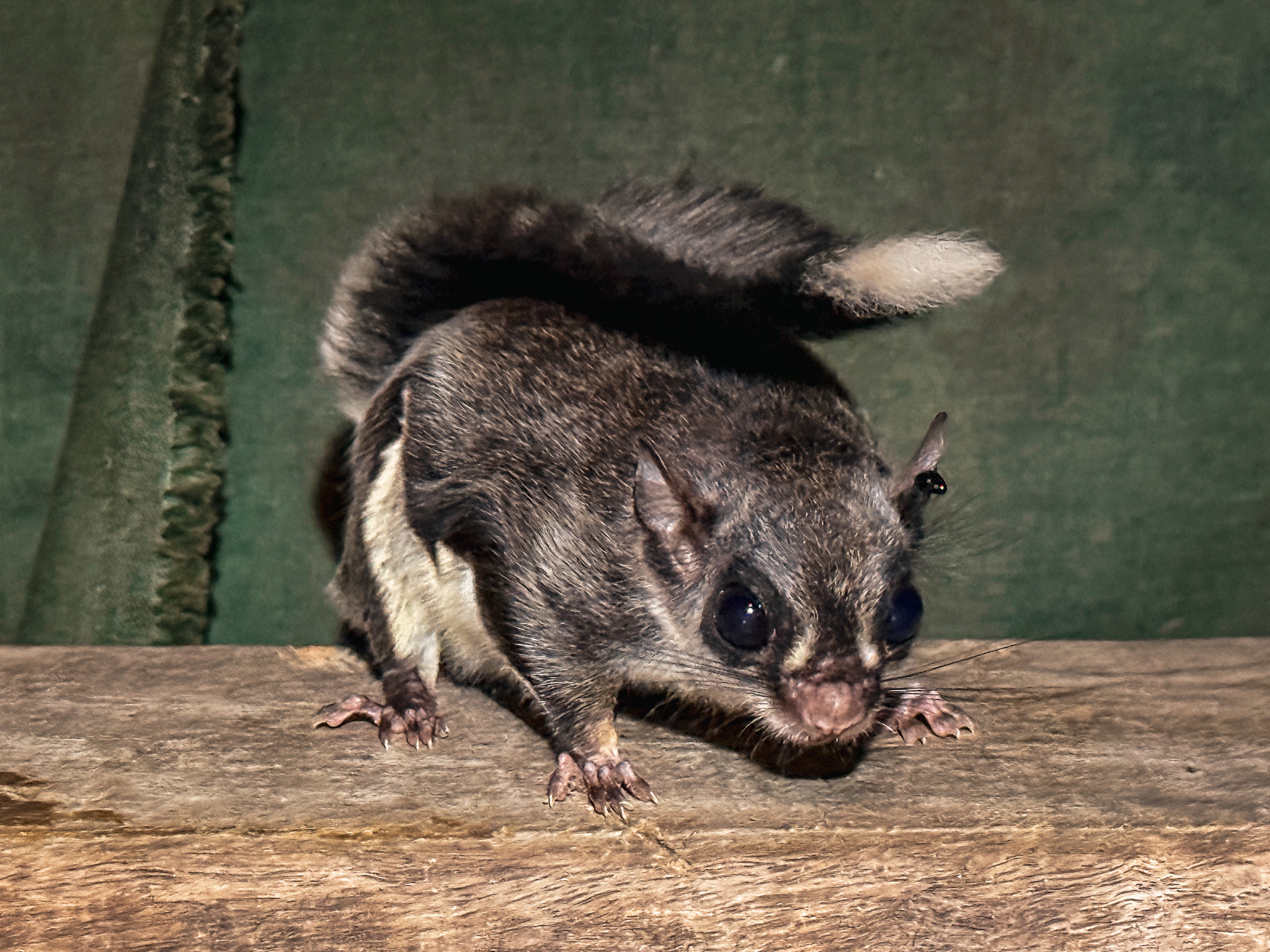
Then Max went downstairs to use the toilet before bed, red light on his headlamp, and heard a soft thunk to his right. Turned to find a creature on the ledge inside the bathroom, staring back at him with complete composure. His first thought was rat, based on recent experience. Then he looked more carefully. Not a rat. Flattened body, splayed feet, a tail that flared at the end, black eyes that reflected red in the headlamp with an otherworldly calm. A flying squirrel. He talked to him. He filmed him. He tried, gently, to encourage him in a different direction. The squirrel chittered at him and held his ground. Max lost the standoff and retreated to his sleeping pad, where he lay awake processing the encounter until exhaustion took over again.
Day three. Alarm before dawn. Coffee for the adults, cocoa for the girls. Harnesses on in the dark.
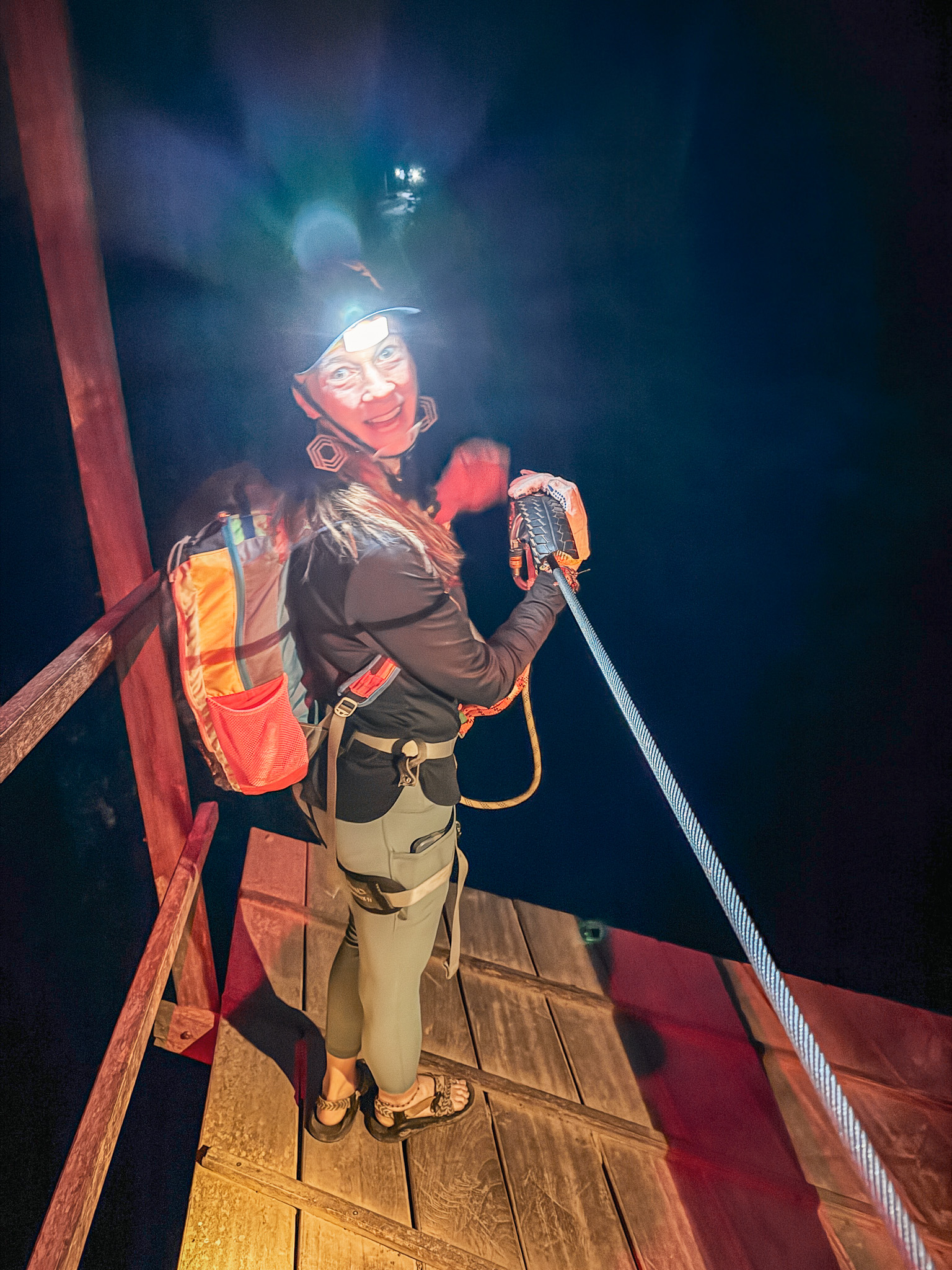
The zip lines in pitch black are a different experience entirely. You can hear the cable, feel the trolley, see nothing. The forest is different at that hour — quieter in some frequencies, louder in others. Headlamps guiding us, we hiked two kilometers from the last zip line arrival point to a viewing platform on a ridge at the edge of a valley, arriving just as the light was beginning. The mist was still moving. We clipped into the safety cable and waited.
As if on cue, within a few minutes of our arrival, the gibbons started singing.
The black-crested gibbon is classified as critically endangered with an estimated population of between 1,300 and 2,000 left in the wild. The song they make is unlike anything we’ve heard from an animal. It starts as a short cry, a whistle, and then begins to undulate and lengthen — rising and falling in pitch, building on itself, reaching a crescendo that triggers a response from another gibbon, and then the two are trading calls back and forth, faster and faster, until the song tips into something frantic and physical: trees shaking, branches snapping, the animals chasing each other through the canopy in a tangle of noise and movement, and then the song ending as suddenly as it began.
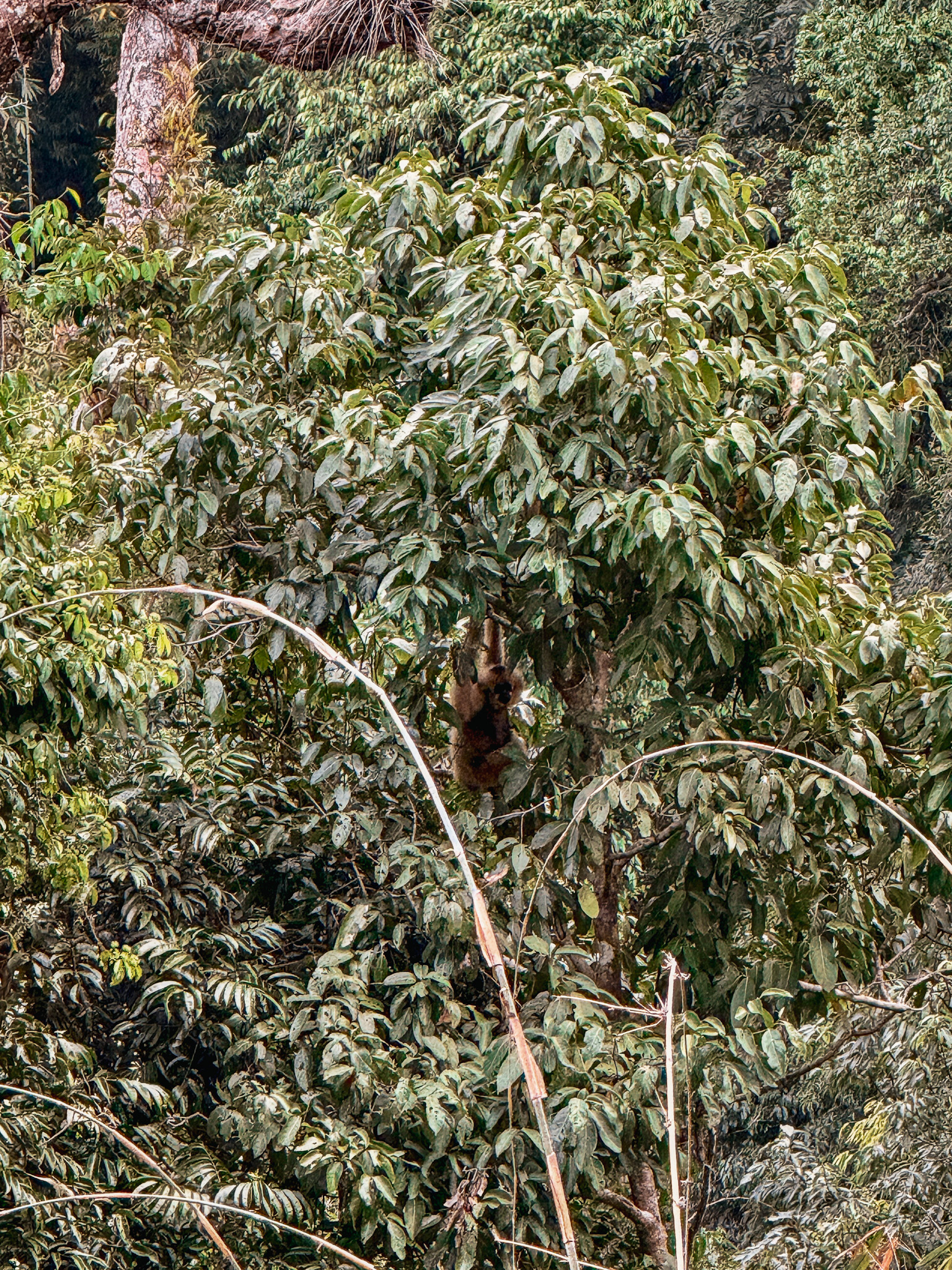
The first few calls we couldn’t locate. Then they moved closer and we could see them — two brownish-black shapes, maybe 300 meters out, visible to the naked eye but far enough to be abstractions. We watched and listened and they moved closer. Then they seemed to disappear, and we realized they were moving toward us behind a cluster of bamboo and a large tree twenty meters in front of the platform. Max turned to Declan, who had rejoined us for the morning, and said: “Wouldn’t it be incredible if they came into that tree right there.” Fifteen minutes later, that is exactly what they did.
Black-crested gibbons: two females and a baby. Twenty meters away. In the wild. Looking back at us.
Fourteen years ago we heard gibbons but never saw them. We came back partly for this and have been waiting for it since December. We’ve tried to think of a way to convey what it felt like to stand on that platform with Arya and Finlee on either side of us, watching these animals look back at us from a tree we could have hit with a stone, and we don’t think the words fully exist. We’ll just say: we hope we never forget it.
The girls didn’t need prompting to understand how extraordinary it was. They were glowing—excited chatter and squeals and laughter and pointing—the kind of response that is completely unperformable and requires genuine awe to produce. It was one of those moments we will pull out and look at for the rest of our lives.
We ran zip line circuits for another hour, ate a proper breakfast of fried eggs and toasted baguettes with tamarind jam at the Honeymoon treehouse, and then did the hour hike back to the dome. On the trail, Shaina spotted a small snake crossing the path, leading to further squeals of excitement from our girls and uncomfortable recoil from some of the other hikers. The guides burned sap one final time for the girls who, having now done it twice, approached it with the authority of experts.
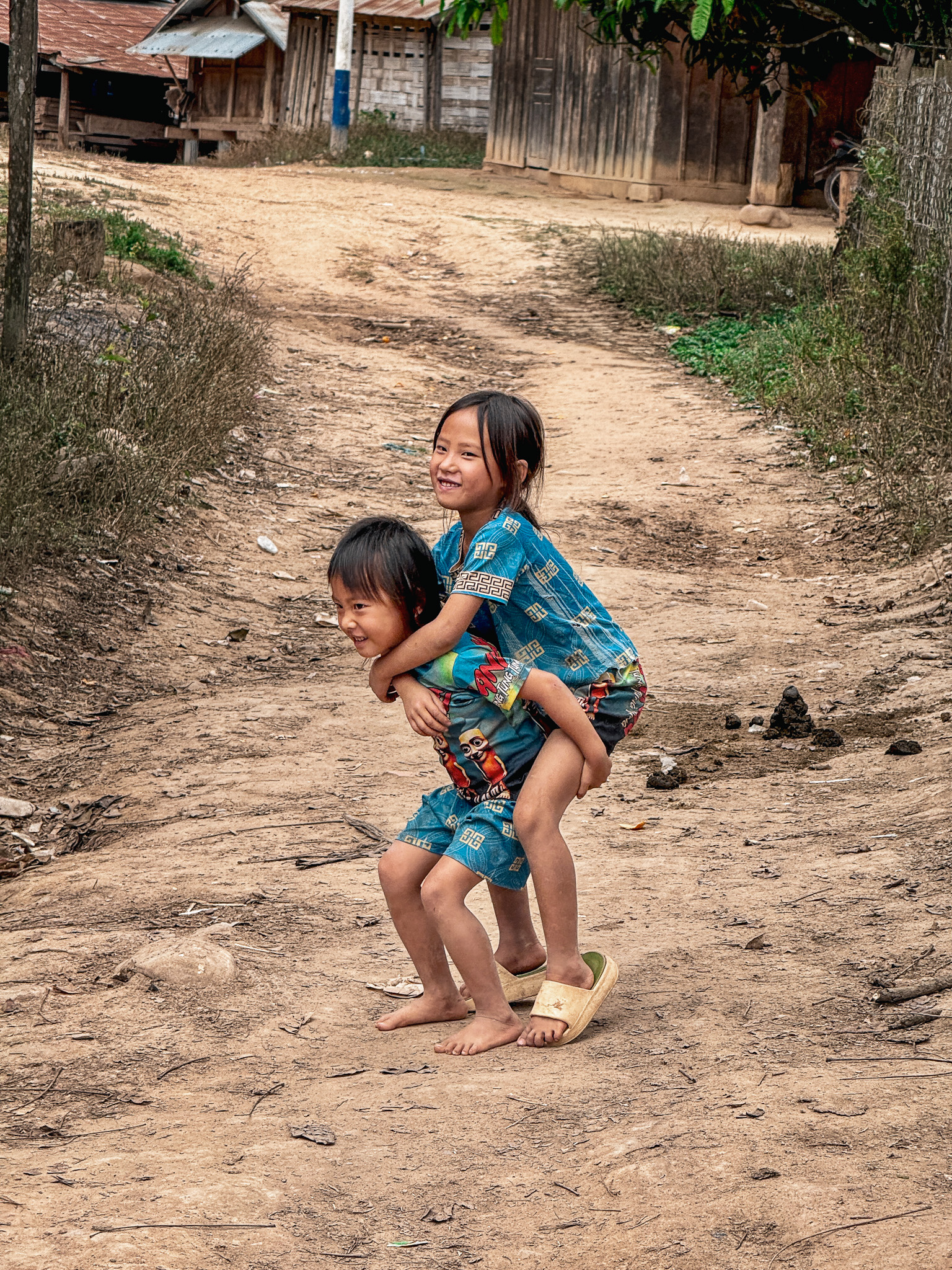
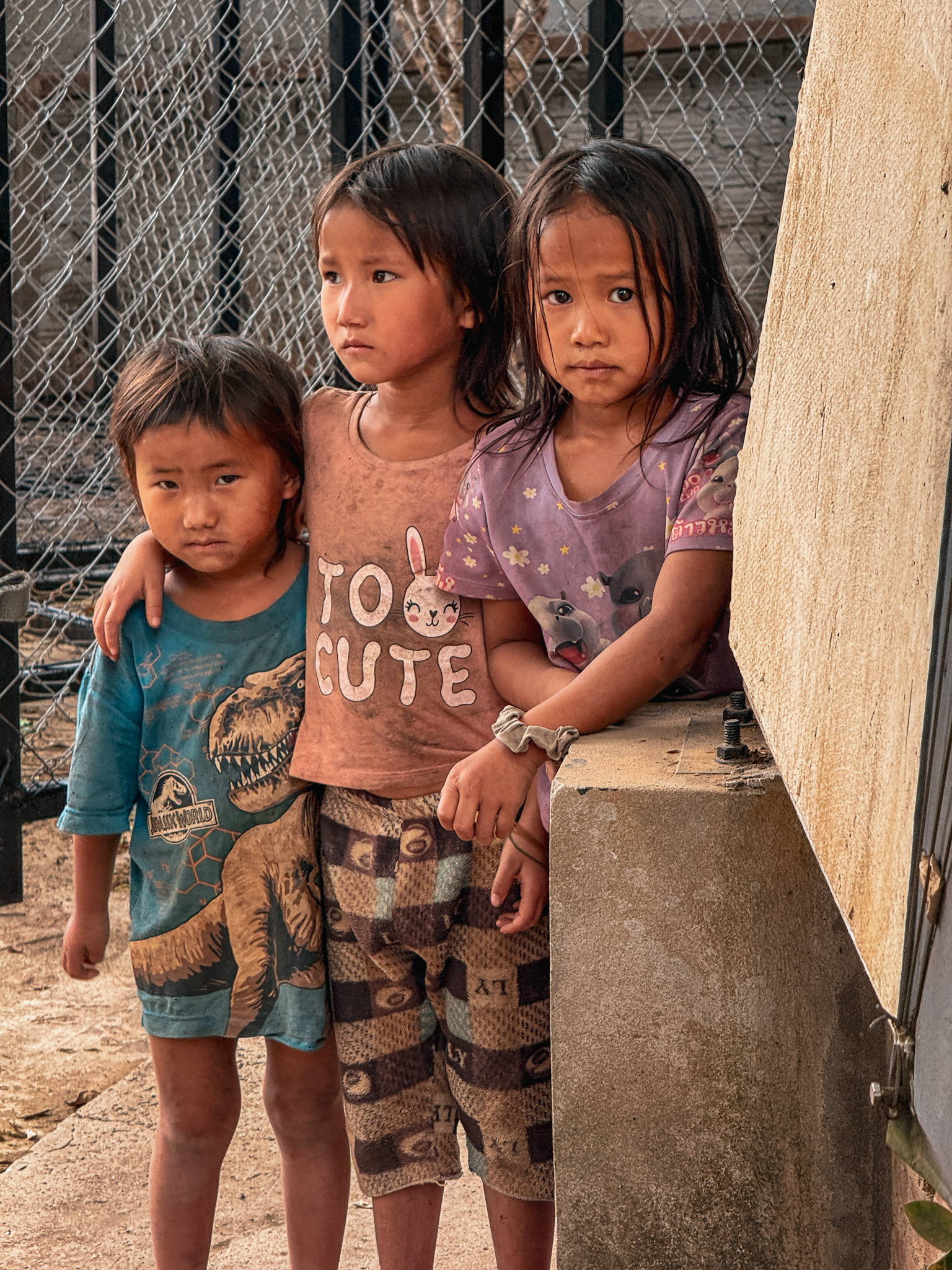
Lunch at the dome, this time at the other long table for those finishing their adventure—a bit of a fishbowl experience, as a gang of village children peered in from underneath the structure to spy on us while puppies tumbled around their feet.
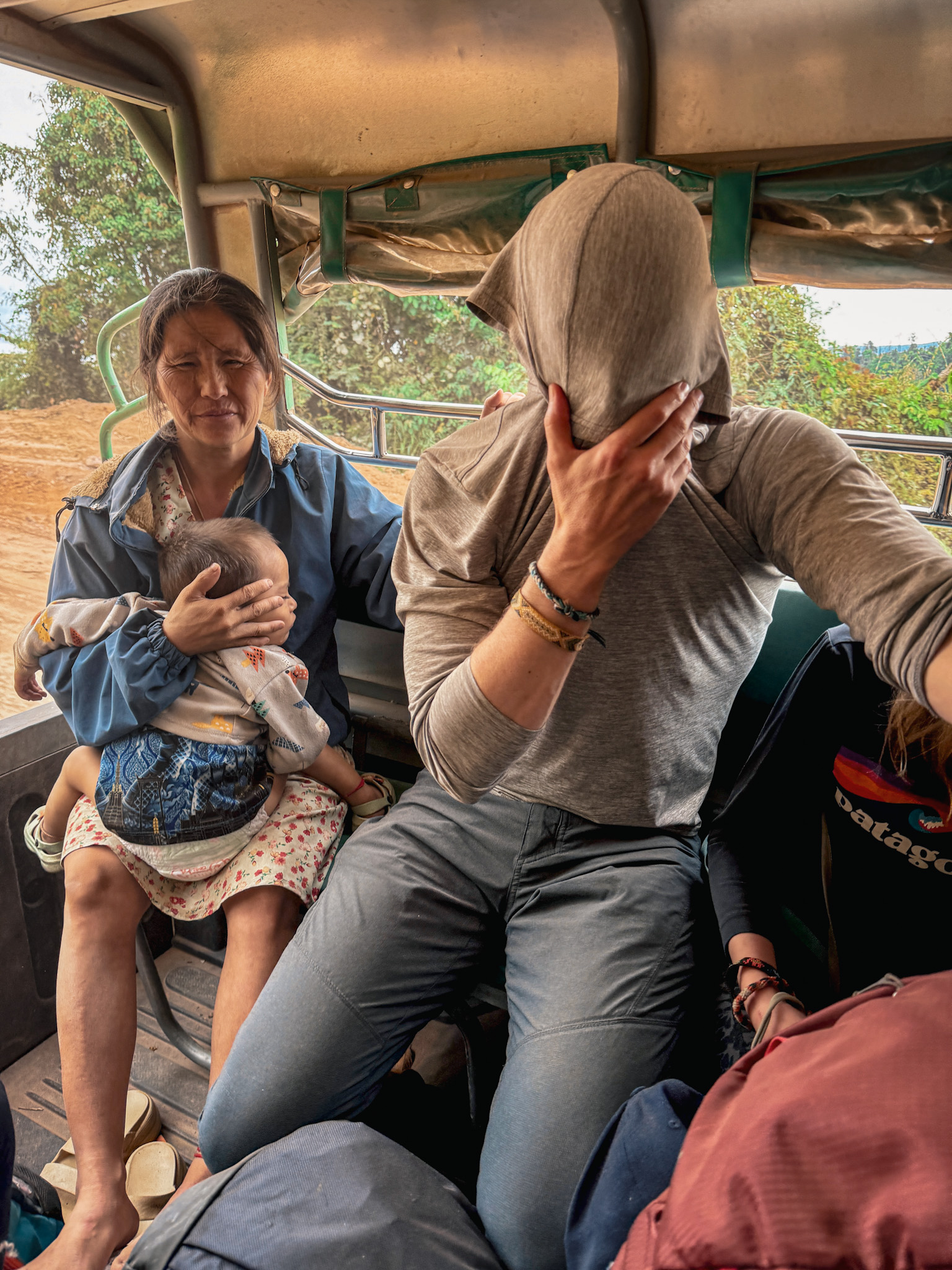
Then the tuk-tuk taxi ride back, which started with a local grandma and two kiddos hopping in to hitch a ride back to the village. The quaint vibe ended there.
The road itself was fine — smooth graded dirt, nothing like the moonscape between Nong Khiaw and Luang Prabang. The problem was the truck ahead of us and the dry season dust it was generating. Not ordinary dust. A fine powder that the truck in front broke up and launched skyward and into the open bed we were riding in, which appeared to actively inhale from behind itself, pulling the cloud directly into our faces. Eyes closed. Breathing through shirts. Katie guarding the little local girl inside her jacket. Conversation impossible. For roughly an hour. It was deeply unpleasant in a way that bore no resemblance to discomfort — it was closer to a mild sensory punishment — and it stands as the single worst part of an otherwise exceptional three days.
We collected our luggage at the office in Houayxay, gave hugs to our new friends and said our goodbyes, and crossed the border into Thailand.
We had worried, going in, that we were chasing a memory. That the memories we’d carried for fourteen years were embellished by time into something the reality couldn’t match. We were wrong about that. The Gibbon Experience is exactly what it is, which is one of the most genuinely extraordinary things we’ve ever done. Doing it the second time with Arya and Finlee — watching them nail zip line after zip line with total composure, hike through jungle without complaint and usually in the lead, hold fire in their hands, and stand on a platform twenty meters from a critically endangered ape while absolutely losing their minds with joy — made it better than the first time.
Team SharXee, signing off from the canopy.
 Pause and Wander
Leave a comment