
Dates: February 28 – March 3, 2026
Place: Nong Khiaw, Laos
Transport days have a way of humbling you.
We were up at 6:00, packed by 7:00, and after a quick breakfast we checked out of the guesthouse and walked down to the Mekong promenade for pickup. The driver had said 8:10. We were there by 8:00.
He showed up at 8:45.
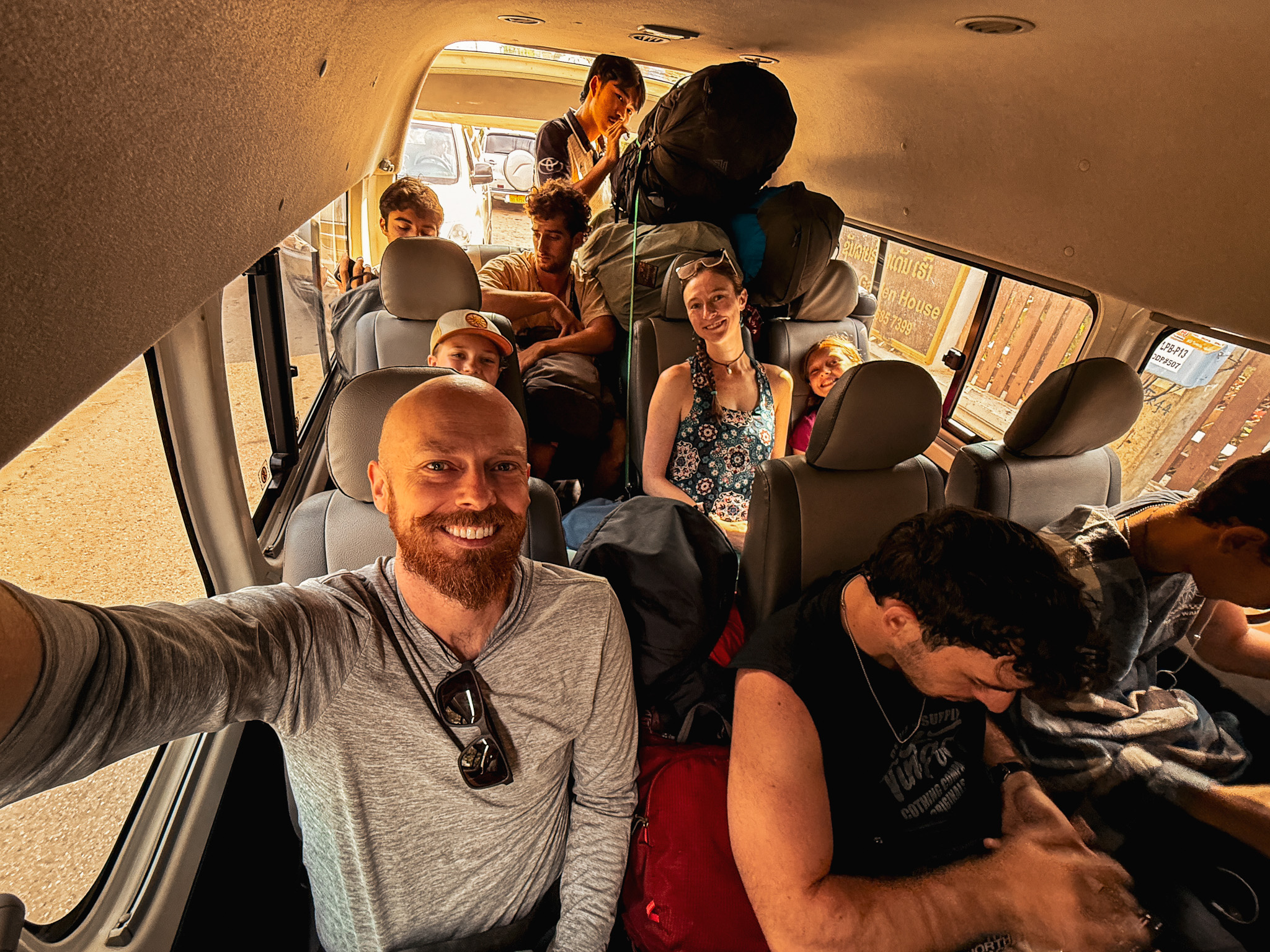
Three Israelis in their twenties were already in the van when we got in. That felt manageable. Then six more Israelis materialized, along with what can only be described as an unreasonable amount of luggage—one to two suitcases each that were easily three times the size of ours.
The driver performed an impressive act of spatial reasoning with the bags, Tetris-ing everything into submission before stuffing the overflow under legs and into the aisle. Calling it uncomfortable would be a significant understatement. But we all technically fit, and the price was dirt cheap, so we hit the road just after 9:00 for what was billed as a four-and-a-half hour drive to Nong Khiaw.
The road was objectively awful. Potholes that deserved to be called craters. Stretches of bumper-to-bumper traffic made worse by massive Chinese semi-trucks—too wide for the road, too heavy for the asphalt, and almost certainly the reason the craters exist in the first place.
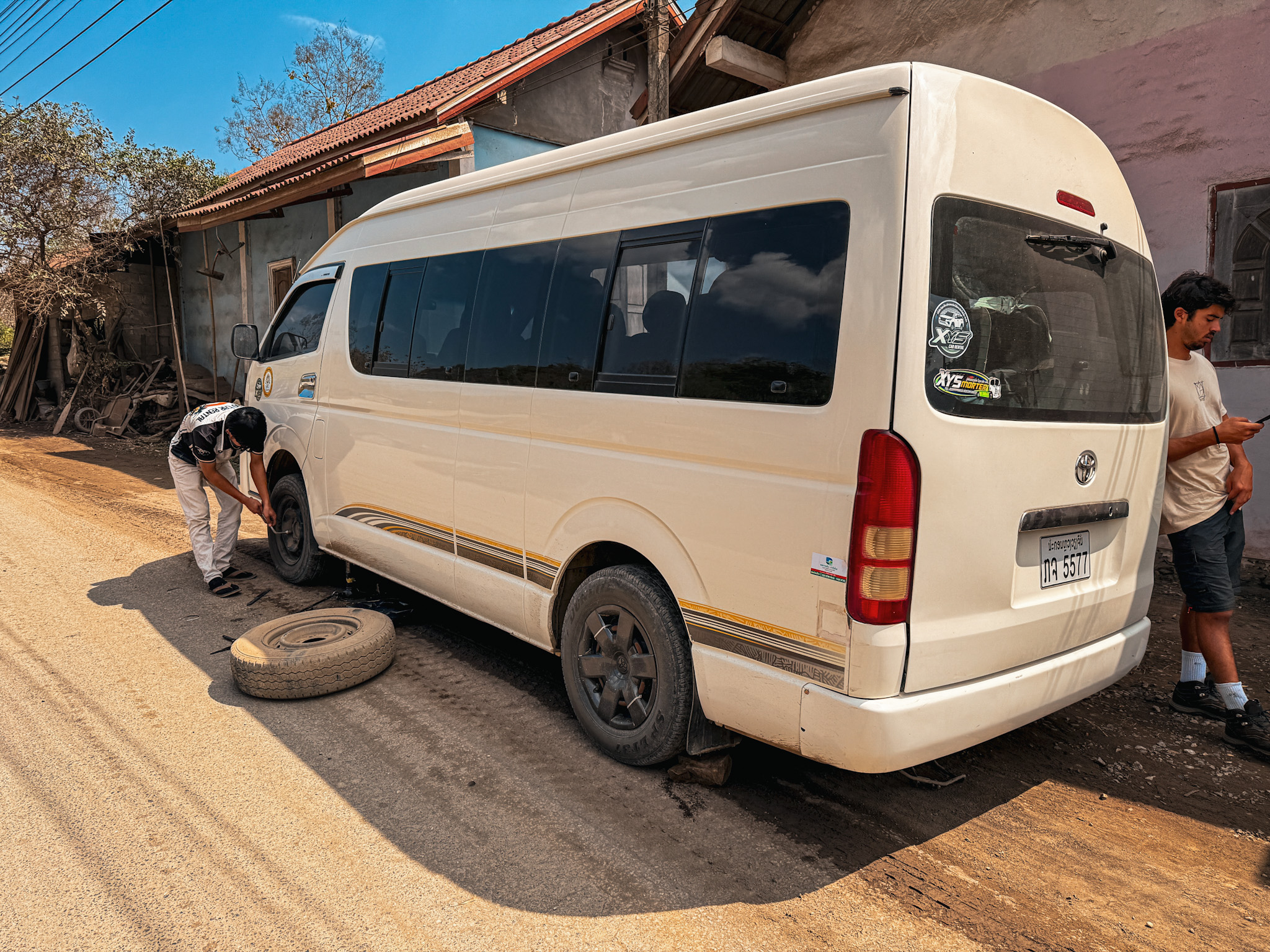
Our driver handled the bad sections reasonably well, slowing and weaving, but then would overcorrect by flying through any clear straightaway he found. Inevitably, this caught up with him. About two hours in, he hit a pothole square on and we had a flat.
Forty-five minutes on the side of the road while he swapped the tire.
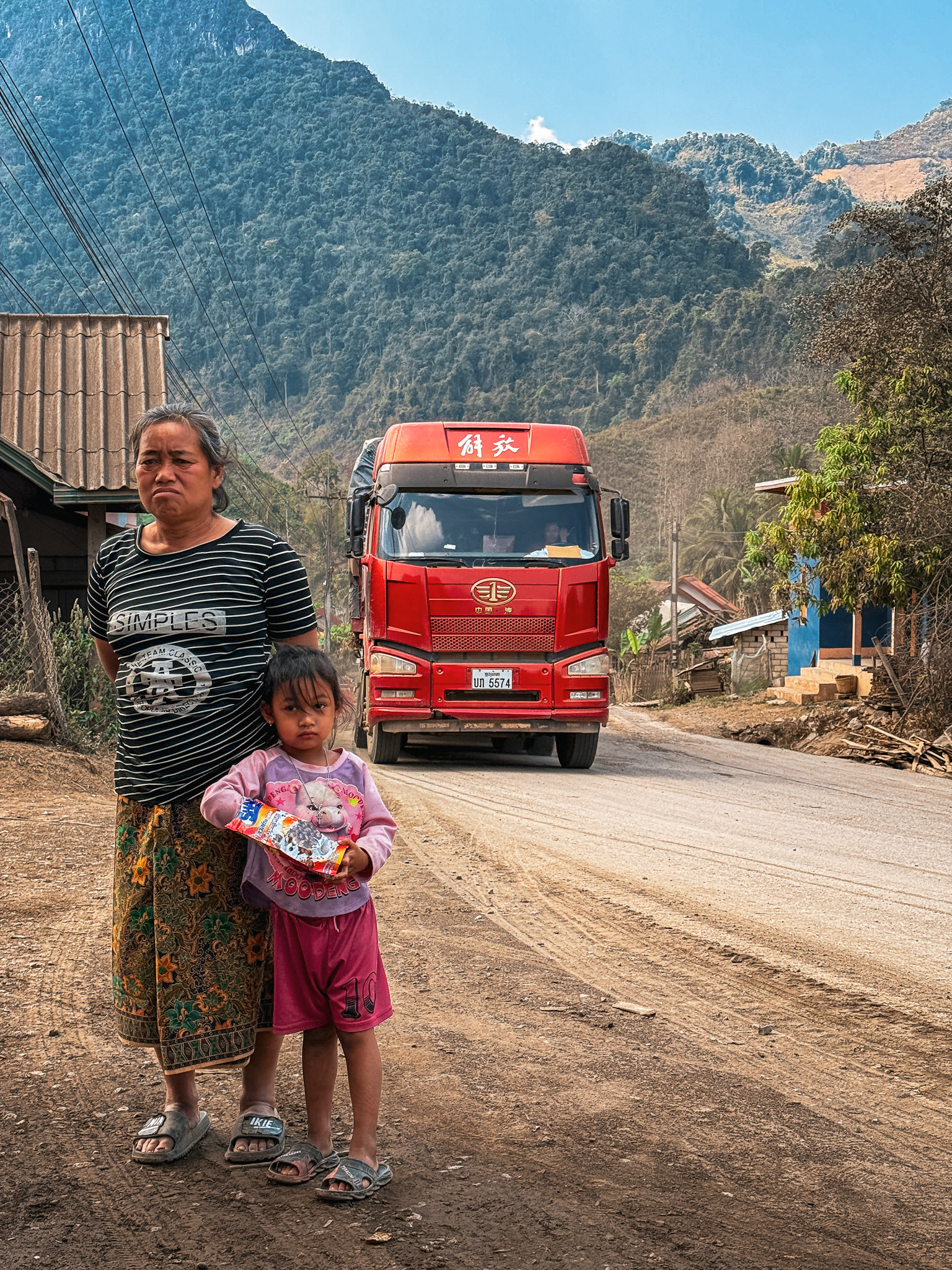
During that time Arya and Finlee needed a bathroom, and by extraordinary luck a Lao grandmother and her granddaughter happened to be walking by at that exact moment. We asked if we could use their toilet. Shaina took the girls inside and came back out with a look on her face.
“Now that,” she said, “is some rustic living.”
The toilet and kitchen shared essentially the same open space, separated by a cloth hanging on a string. The poverty in this part of the country is real and visible, and a flat tire on the side of a construction road has a way of putting you right in the middle of it.
We squeezed back into the minibus and continued. If anything, the road got worse from there. Through the villages the driver barely slowed down, flying through at 50 miles per hour with small children playing inches from the road.
Just shy of six hours after leaving Luang Prabang we arrived in Nong Khiaw.
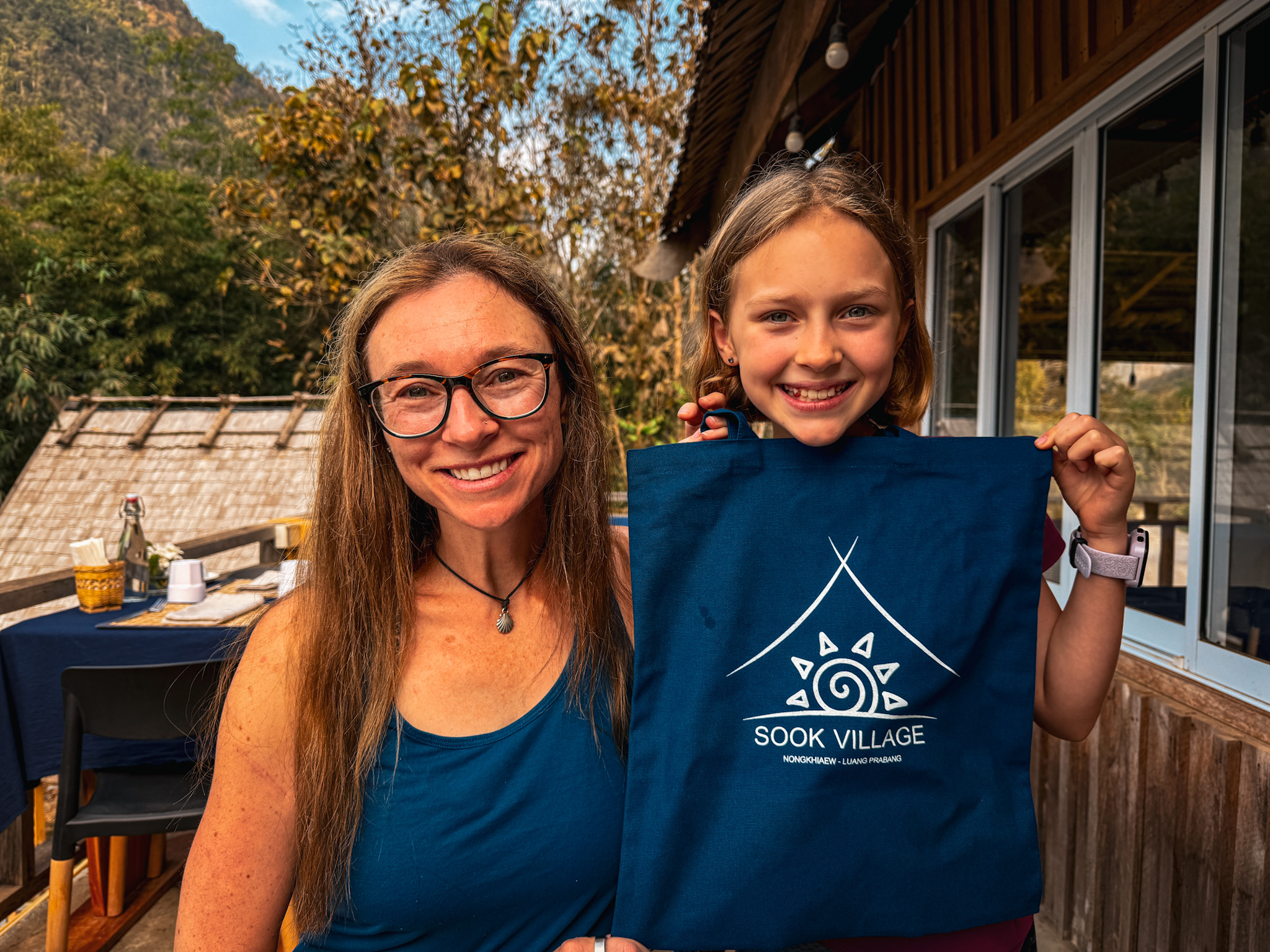
And whatever the journey had cost us evaporated the moment we pulled up to Sook Village.
Paradise Found
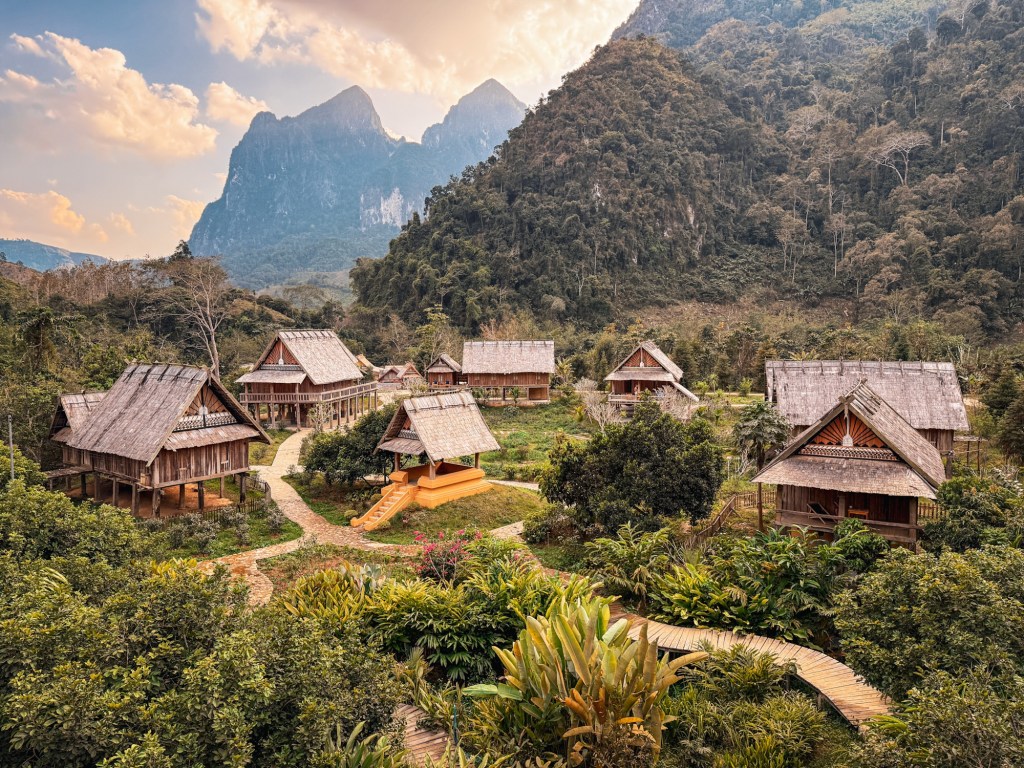
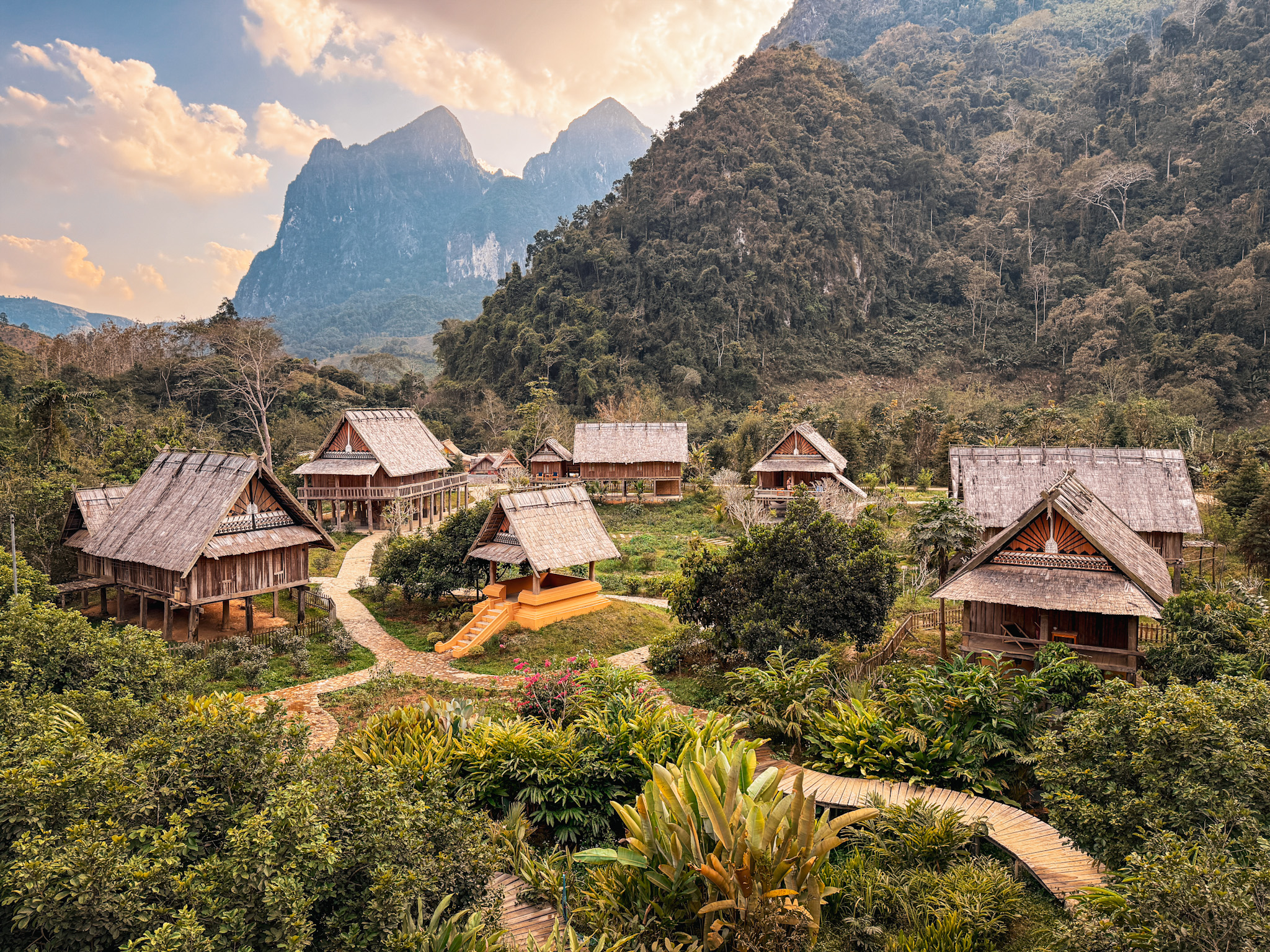
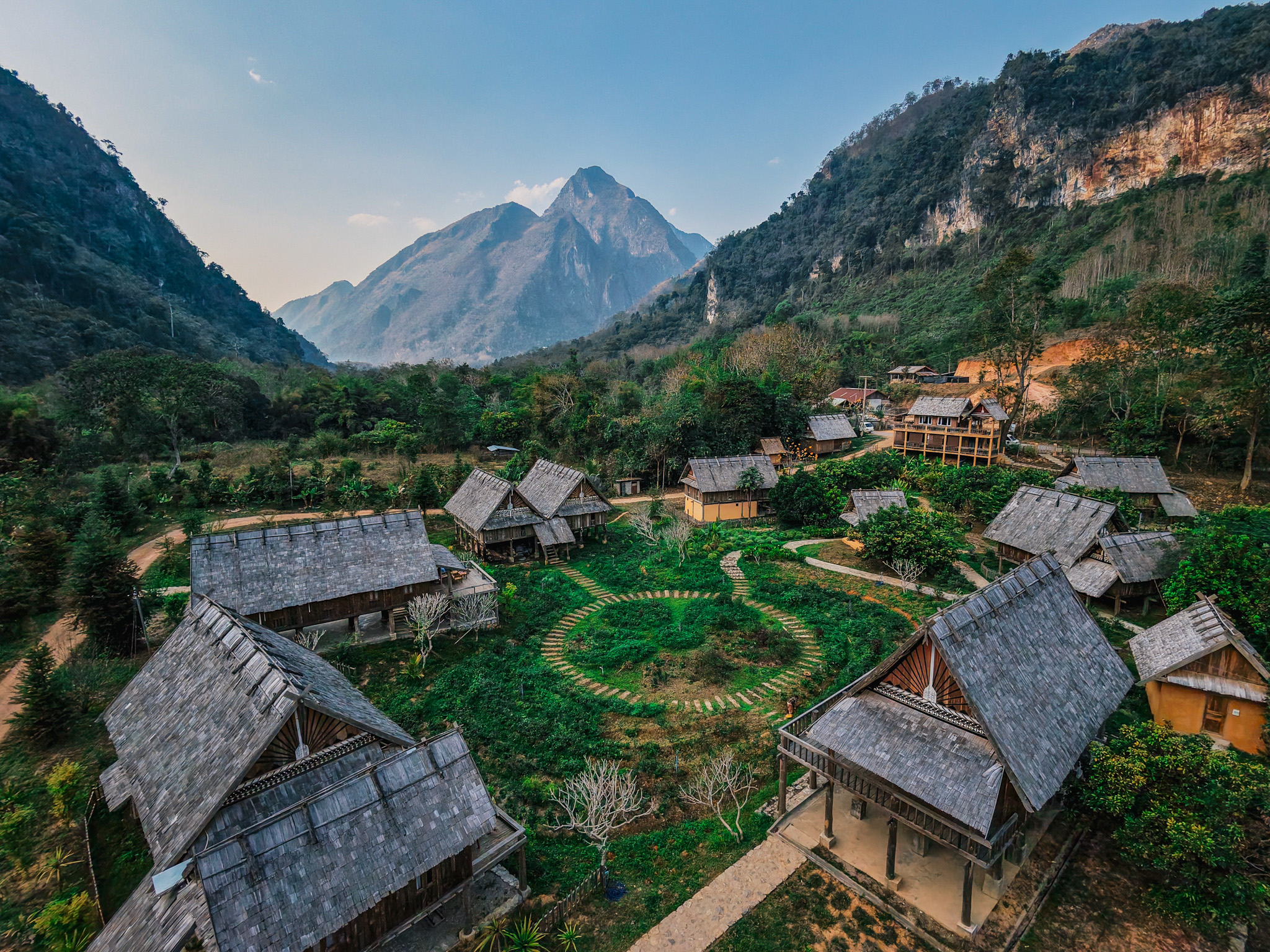
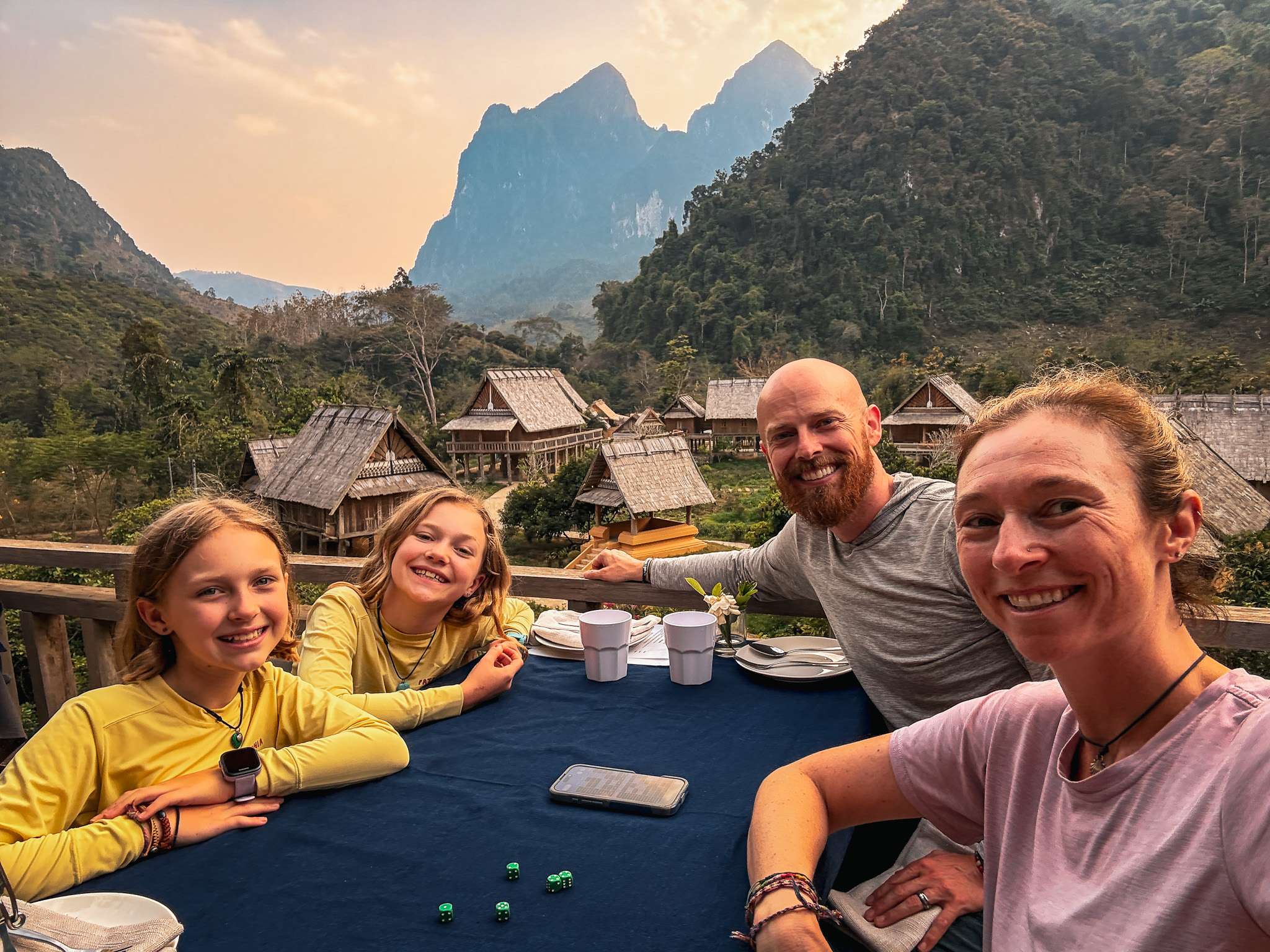
The place sits on the bank of a tributary to the Nam Ou River, surrounded on all sides by steep karst limestone mountains that rise straight up from the valley floor like something from a painting—dramatic, green, implausible.
The resort itself is teak cottages and manicured gardens filled almost entirely with edible plants that supply the onsite restaurant. Our two-bedroom cottage had dark wood floors, a proper modern bathroom, AC, and a balcony facing the mountains.
After that van ride it felt like arriving in a different world.
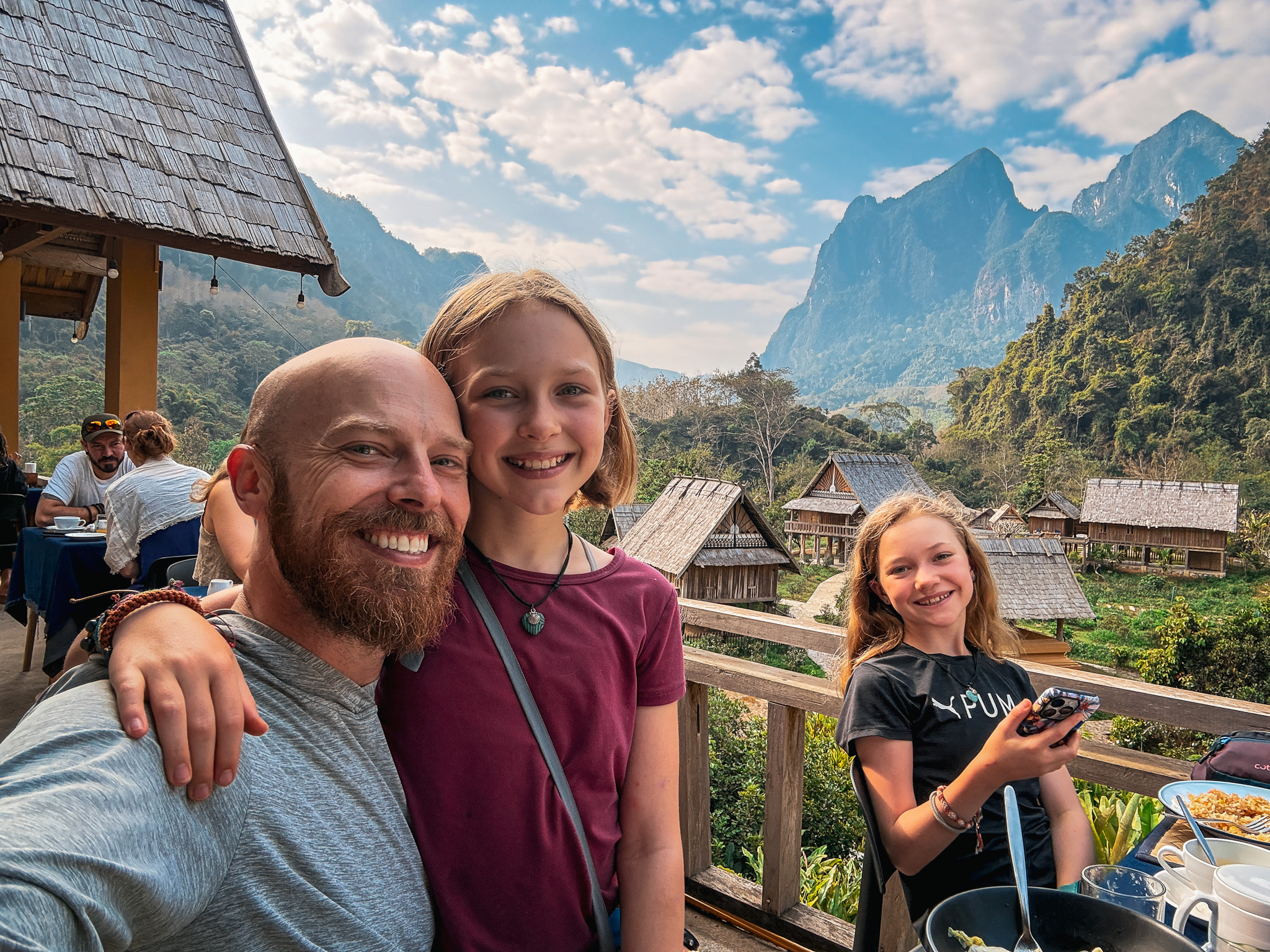
We had a late lunch at the hotel restaurant—samosas, papaya salad, several other things—all of it excellent. The setting elevated everything. We were overlooking the small river with those impossible mountains rising in every direction, and for the first time in hours we could finally exhale.
While we were eating the girls spotted a couple of kids running around the garden playing hide and seek and immediately defected to join them.
The kids turned out to be French—from the West Indies, St. Barts specifically—a daughter named Mia who was nine and a son Nathan who was seven. Their parents, Romain and Marie, were sitting nearby, and we waved from the balcony before drifting down to the garden to properly introduce ourselves.
That’s when we learned they were on the same kind of sabbatical we were on.
One full year. Traveling the world with their kids. Homeschooling on the road.
We talked for an hour about our respective routes, the logistics of keeping kids happy across time zones and border crossings, the challenges and unexpected joys of this particular brand of insanity. Then we moved into the restaurant and had dinner together, still talking. The girls and their kids ran circles around us the whole time, speaking a hodgepodge of French and English, squeezing every last minute out of the evening.
There’s something about meeting another family doing what you’re doing. Not just traveling—anyone can do that for a week or two—but actually living this way for a year. Making the same kinds of trade-offs. Dealing with the same exhaustion and exhilaration. Wondering if you’re doing it right or completely screwing it up.
We didn’t have to explain ourselves. They already knew.
Sadly, Romain and Marie were heading to Luang Prabang the next morning, so a longer overlap wasn’t in the cards. There’s a particular kind of wistfulness that comes with meeting great travel companions at the tail end of their stay rather than the beginning.
At 9:30 Romain called the kids to bed and we all said goodnight and goodbye.
We walked back to the bungalow, got into what might be the most comfortable bed of the entire trip, and were asleep almost instantly.
And Then We Got Sick
Ten hours of sleep should have been the reset we needed.
Instead, we woke up with a tickle in the throat that quickly became a cough. Then body aches. Then stomach cramps. Then all of it at once.
Shaina got it. Max got it. Even the girls were feeling off—not dramatically sick, just… off.
If you’re going to convalesce, though, this is not a bad place to do it.
The weather was perfect for lazing around. We rotated in a slow round-robin between patio chairs, hammocks, and daybeds under the AC like it was an Olympic event in strategic lounging.
From our bungalow patio we could see the whole valley. Steep mountains ringing us in every direction, big gray rock faces rising straight up out of dense Lao jungle. The small river sliding by like it had nowhere urgent to be. Resident water buffalo wandering back and forth across the river below us. At one point a few of them just lay down midstream and chilled out, splashing their ears and heads in the water like oversized, meditative hippos.
Hard not to feel some affection for a creature that large behaving that lazily.
Here’s the thing about getting sick while traveling: at home, with your own bed and your own medicine cabinet and your own couch, it’s unpleasant. On the road it’s a different category of miserable entirely.
But here’s the other thing: Nong Khiaw wouldn’t let us be too miserable about it.
The setting was too beautiful. The pace too slow. The whole place calibrated for tranquility in a way that made pushing through illness feel less like suffering and more like… well, still suffering, but suffering with a view.
We spent the day doing essentially nothing. Reading. Journaling. Watching the light move across the mountains. The girls got through a solid chunk of homework. Finlee learned about ancient Chinese thought and relished telling us about Confucius, how he emphasized the importance of following rituals and traditions as a key to happiness.
There’s something poetic about hearing that lesson delivered from a hammock in northern Laos.

The Decimal System
By late afternoon we were feeling slightly less wretched and decided to walk into town for dinner.
Against Max’s better instincts, Shaina convinced him we should go to a place called “Pizza and Pasta.”
It had 4.1 stars on Google.
Now here’s the thing. In Max’s experience, when analyzing Google reviews for restaurants or hotels or Airbnbs, the first number doesn’t matter. If you’re looking at anything below 4 stars, that’s insanity. Shouldn’t even be considered.
So you only look at the decimal.
Everything is graded on a scale from 4.01, which is essentially awful, to 4.99, which is transcendent.
By that metric, 4.1 is barely clearing the bar of mediocrity.
We should have known.
But the allure of a tasty hamburger for Finlee and Arya and lasagna for Shaina and Max was too strong. We went against the system.
The meal wasn’t completely awful. The French fries were… fine. But Max would never recommend this place to anybody, nor will he probably remember it in a few days.
What he will remember is that his new grading curve lives in that final decimal point, and he is not breaking his own rules again.
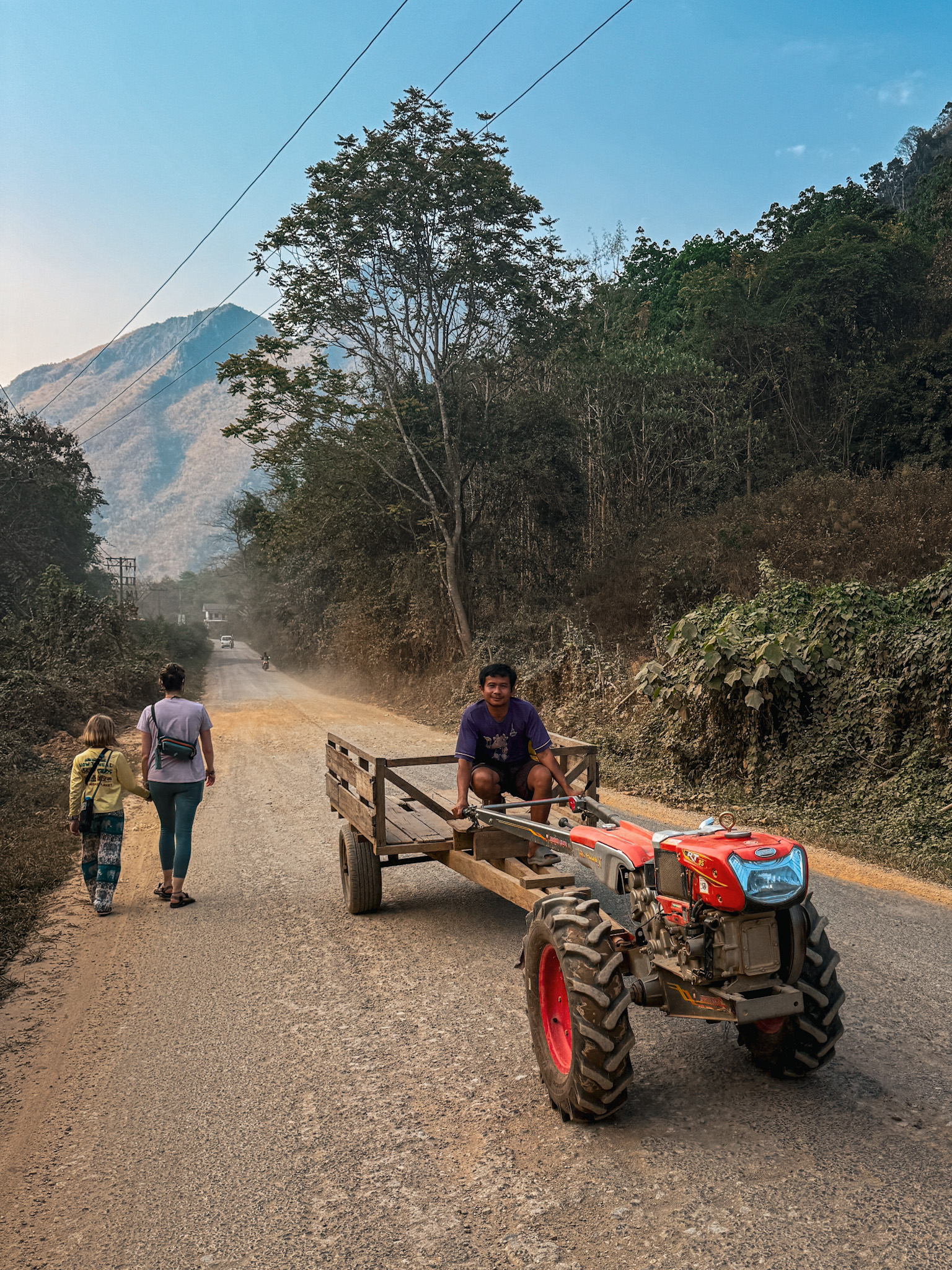
The walk back to Sook Village was lovely. Perfect temperature. Hardly any traffic on the dusty road. The moon just rising and looking nearly full.
Why is this place so magical?
It must be a combination of the geography and the atmosphere. The mountains enclosing us. The dryness of the air. It gets warm during the day, up to about 32°C, but at night it drops to around 16°C, which is a huge swing compared to so many humid corners of Southeast Asia we’ve been in. The cool air settles in after sunset and everything just exhales.
The fact that we could sit there and notice all of that felt like a good sign. We were actually improving.
Before lights out, we let the girls convince us to watch the first half of Harry Potter and the Deathly Hallows Part Two.
Tomorrow was our last full day here. And despite having not fully recovered, we had a mountain to climb.
The Climb
Nobody wanted to get up. That much was clear.
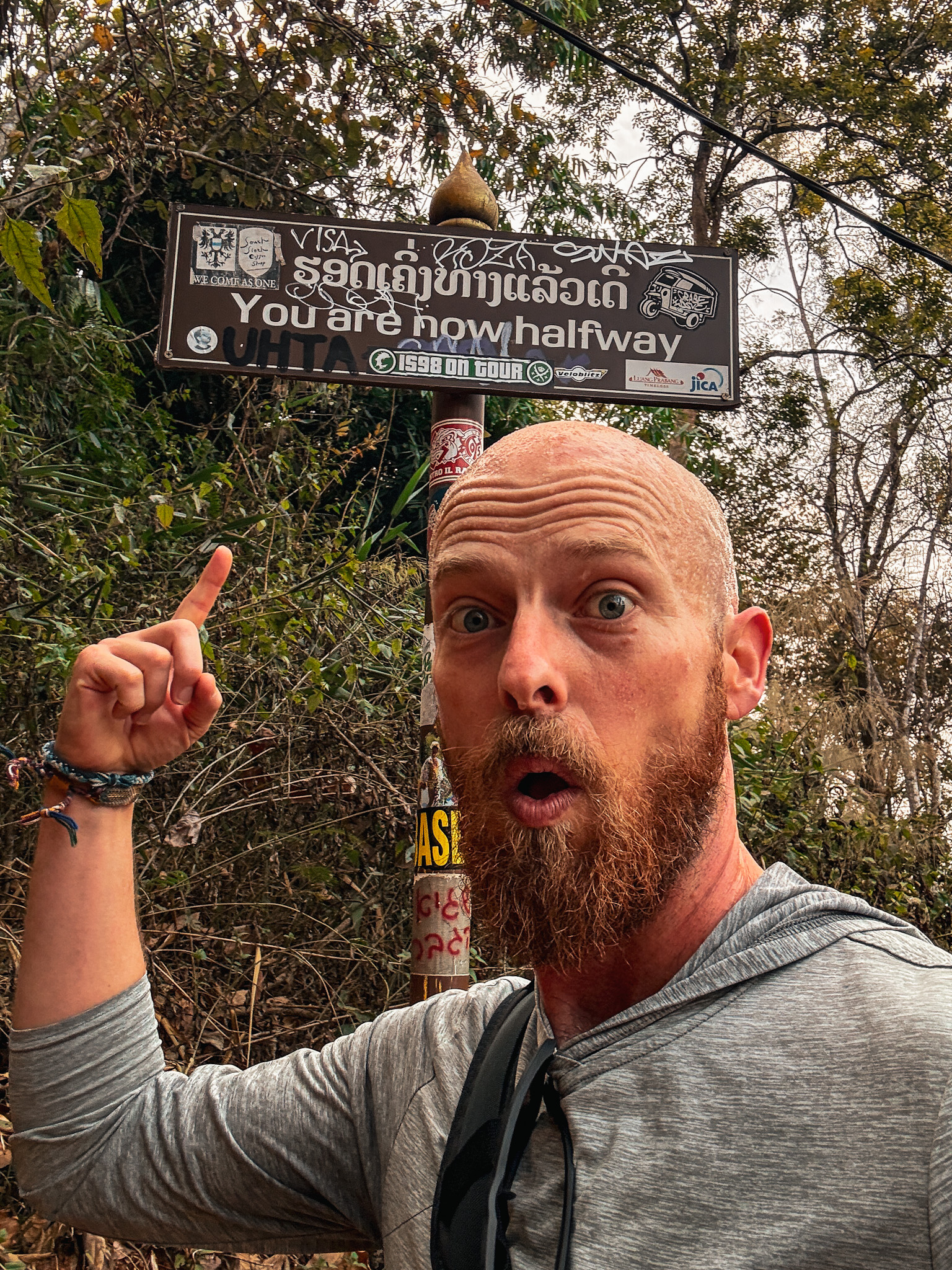
The alarm went off at 5:30, got snoozed until 5:50, and the only thing that actually got us out the door was the knowledge that today was our last full day here and the viewpoint hike was half the reason to come to Nong Khiaw in the first place.
Max was the engine this morning. Sometimes that’s just the role.
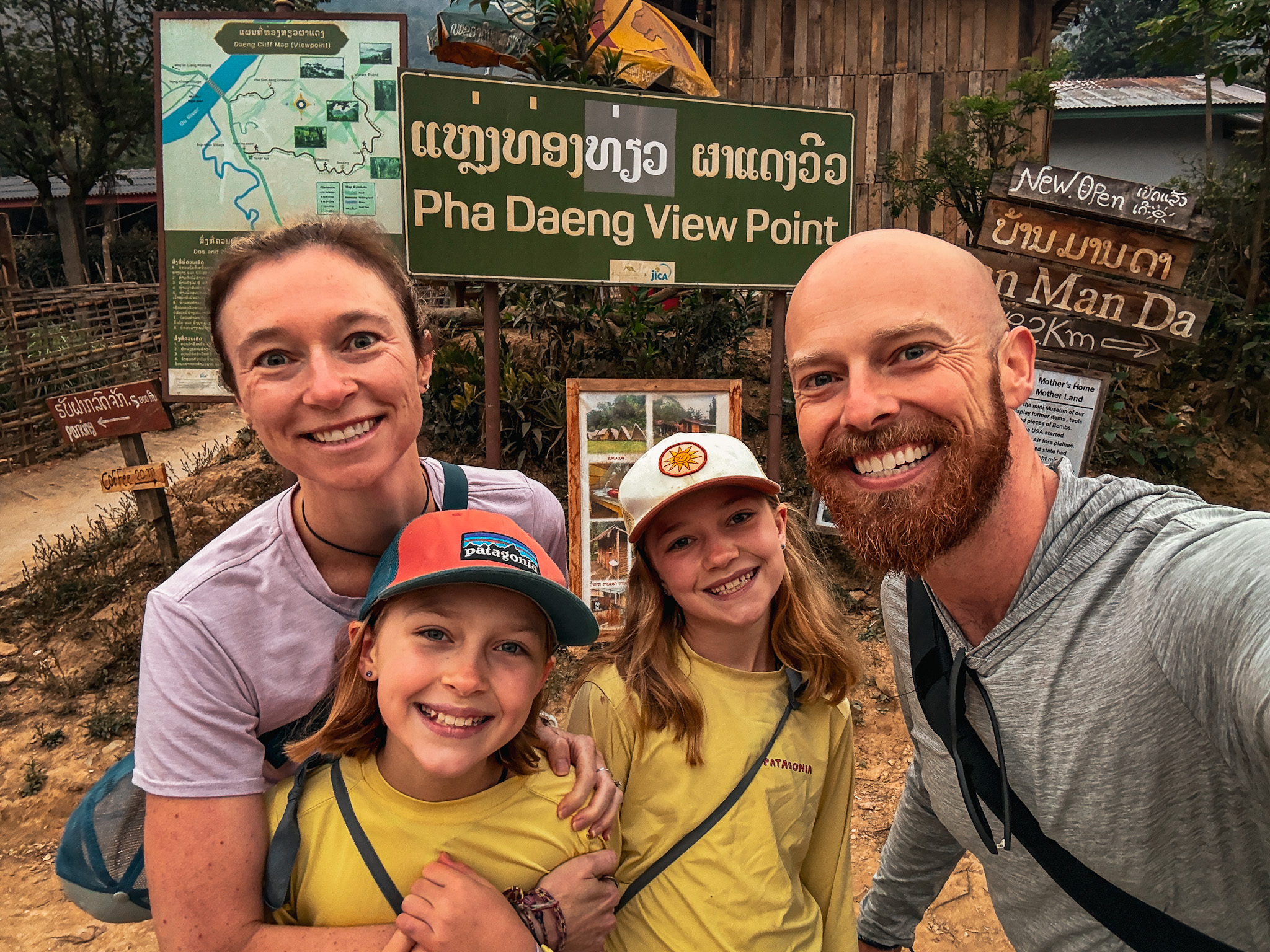
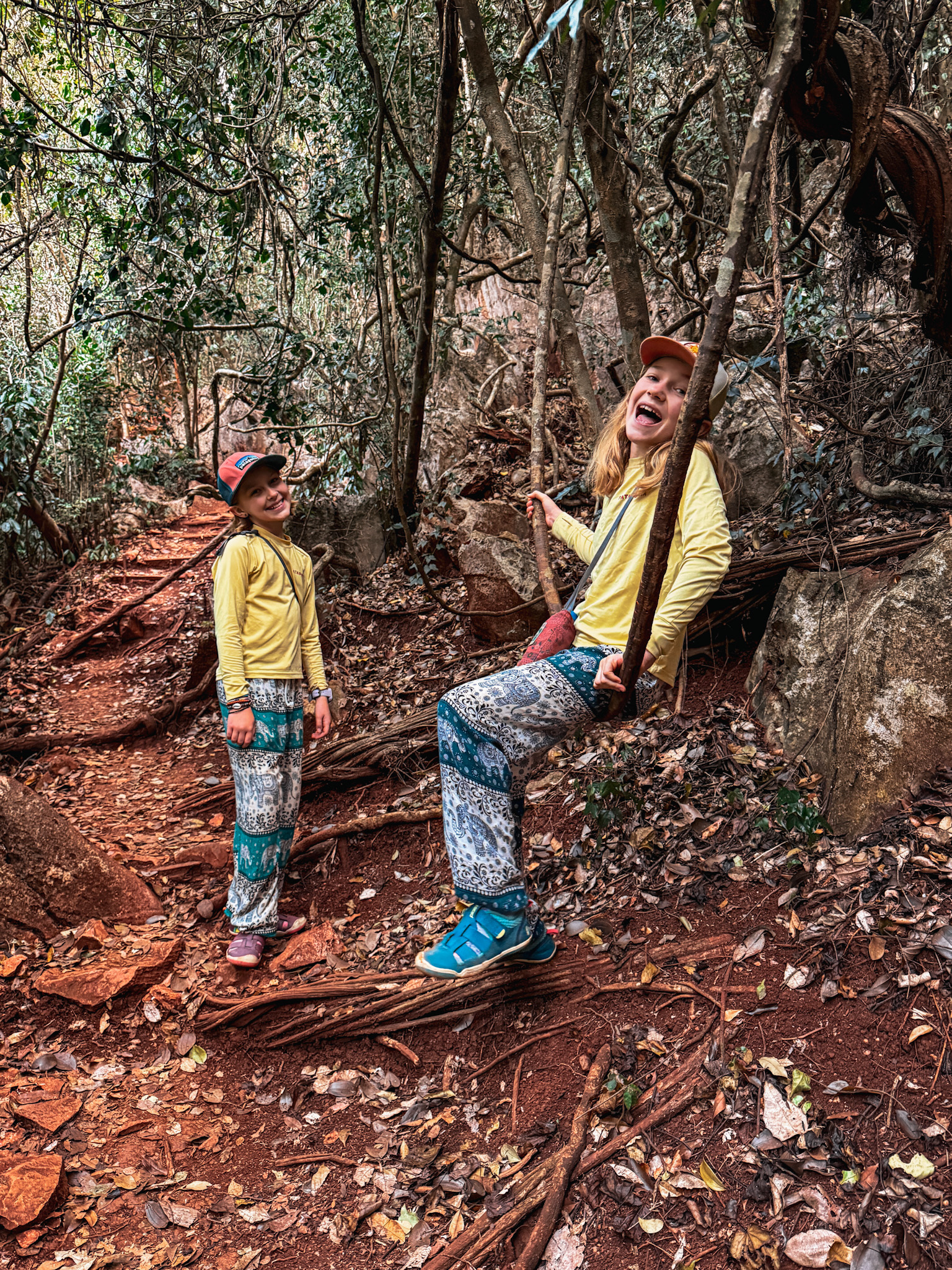
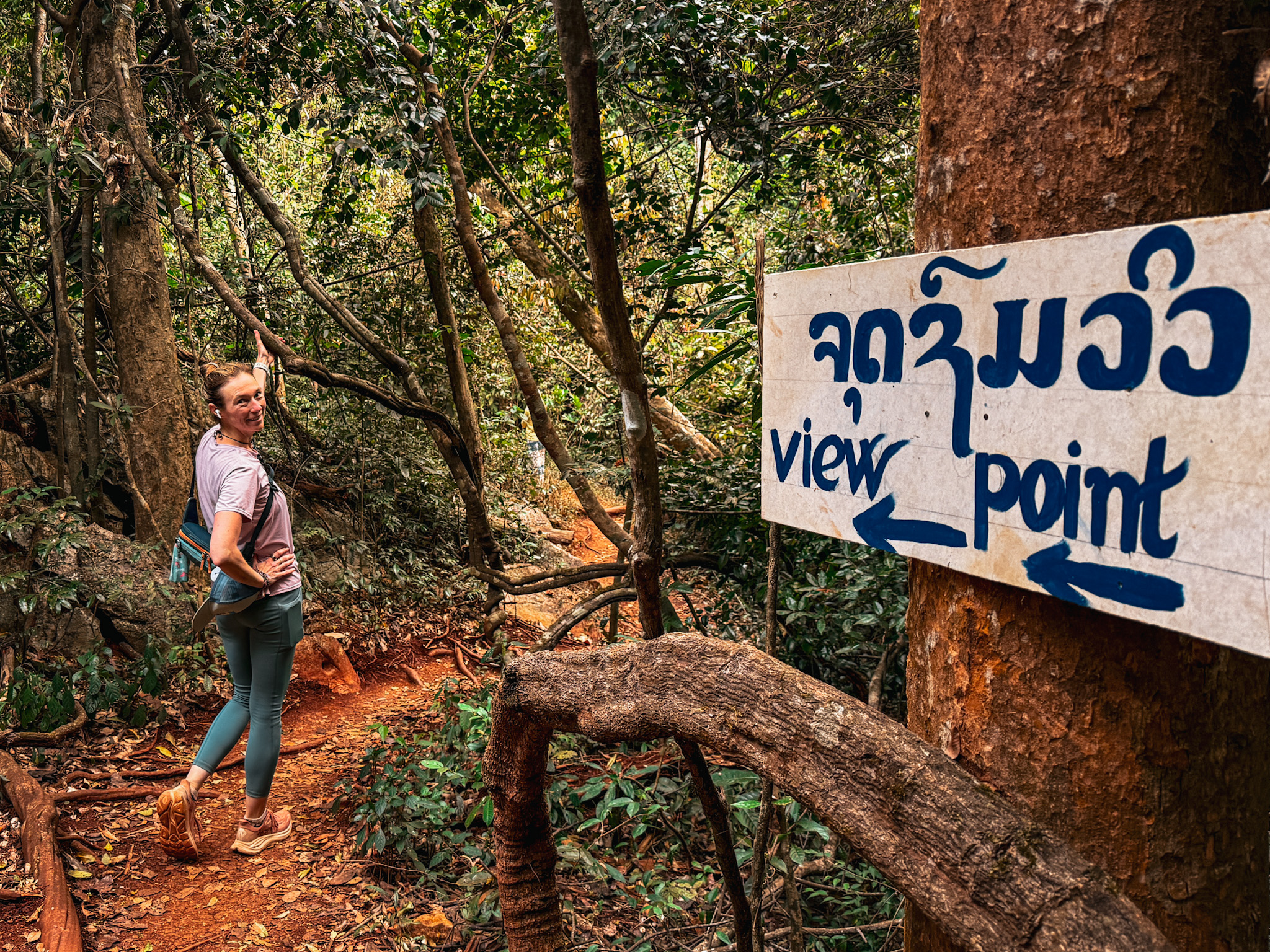
We were out the door just after 6:00, walked a little over a kilometer to the trailhead, and started climbing.
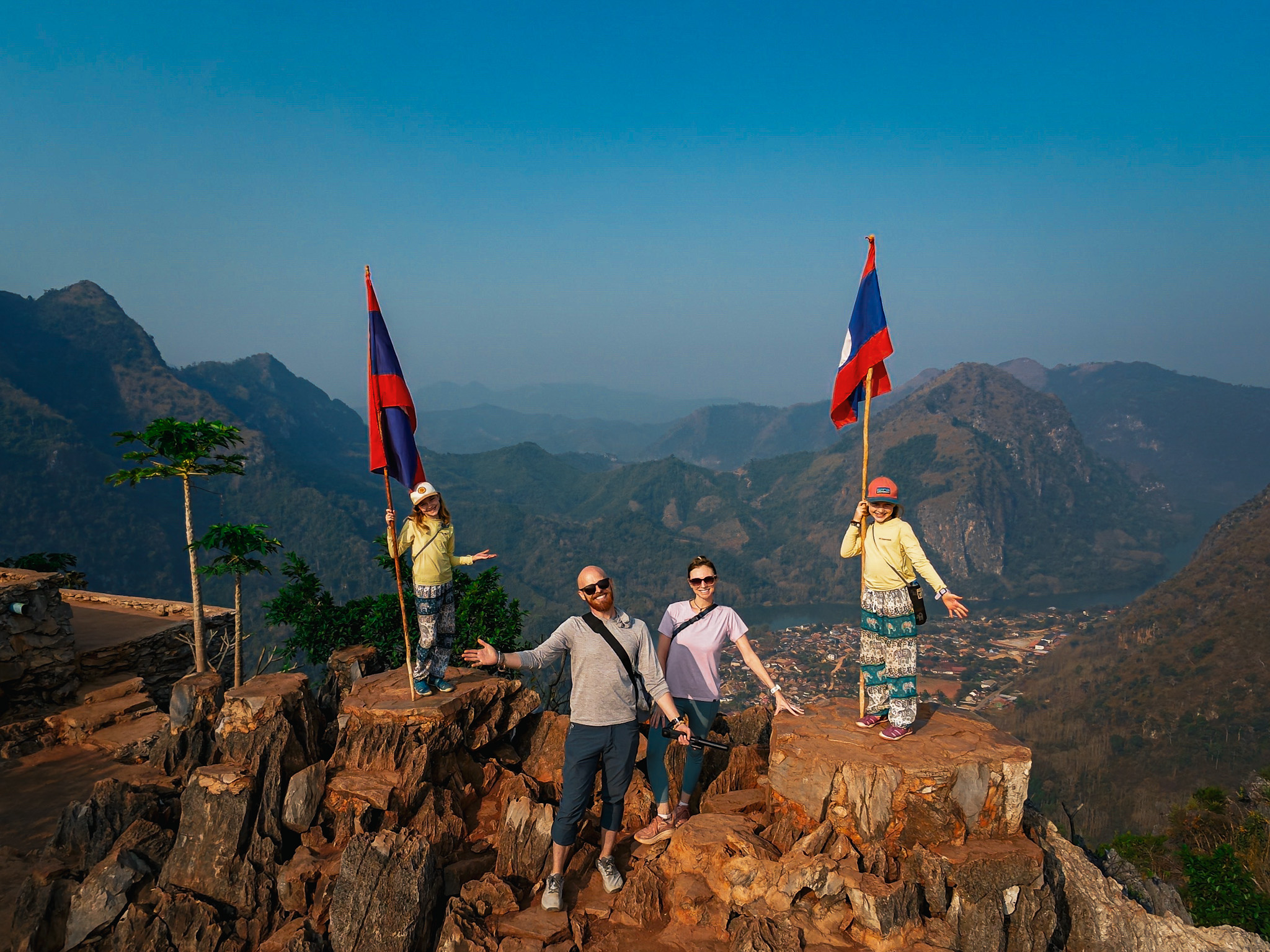
Pha Daeng Peak rises straight up from the valley floor—515 meters over 2.3 kilometers, with sections steep enough that ropes have been fixed into the rock to help you scramble through. At the ticket booth there’s an old bomb casing sitting out front, a quiet reminder that this entire region was one of the most heavily bombed places on earth during the Vietnam War, and that straying off the marked path is still genuinely dangerous.
We did not stray.
Shaina was struggling from the first switchback. Cold sweats, a touch of nausea, her stomach turning in that way that makes every uphill step a small negotiation.
She pressed on anyway and made it to the top—all 515 meters—without stopping except to catch her breath.
Good job, Shaina.
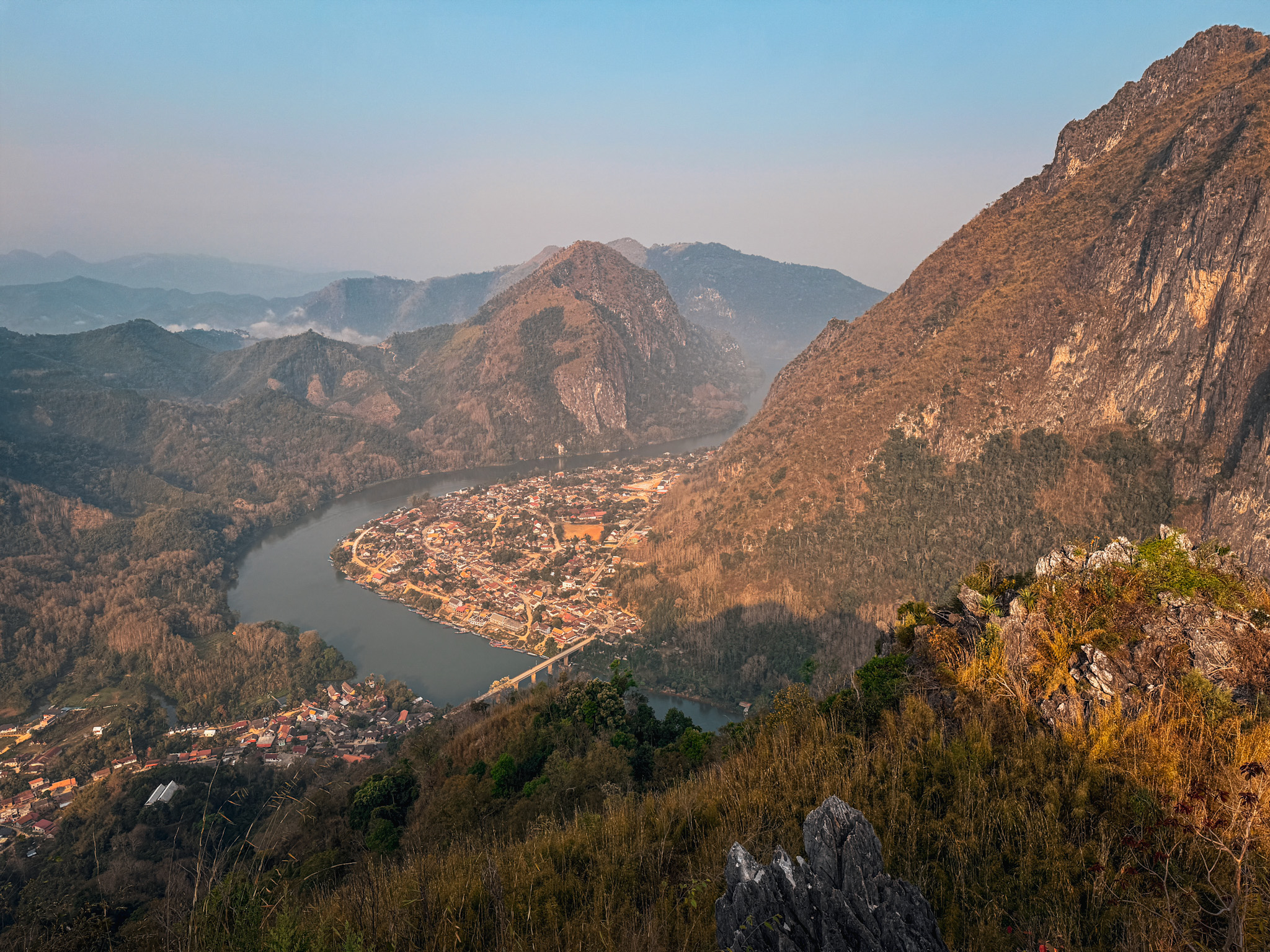
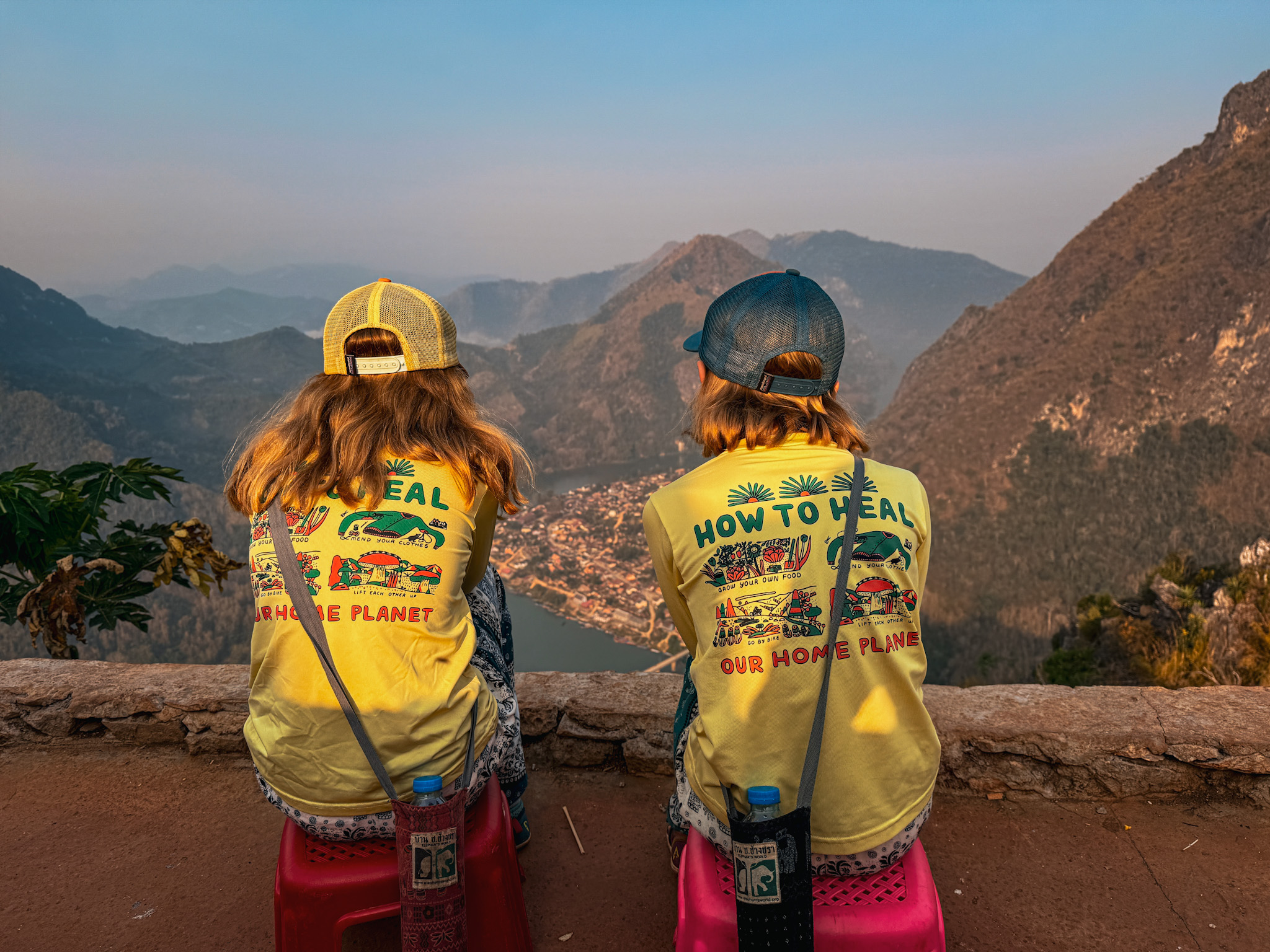
The views earned every hard step.
Nong Khiaw spread out below us in miniature, the Nam Ou River threading around it, and in every direction the karst mountains punched straight up into a clear sky. A large Lao flag marks the very top, which made for solid photos.
Max got the drone up for a long winding helix pulling back to reveal the full scale of the valley, the kind of shot a still photo simply can’t capture. The mountain slowly filling with other early risers around us as the mist burned off.
The descent was a different experience entirely—technical in places, but so much less demanding, the legs loose and the pressure off. The girls bounced down singing songs to each other while Shaina and Max had one of those good, unhurried conversations that long downhills seem to produce.
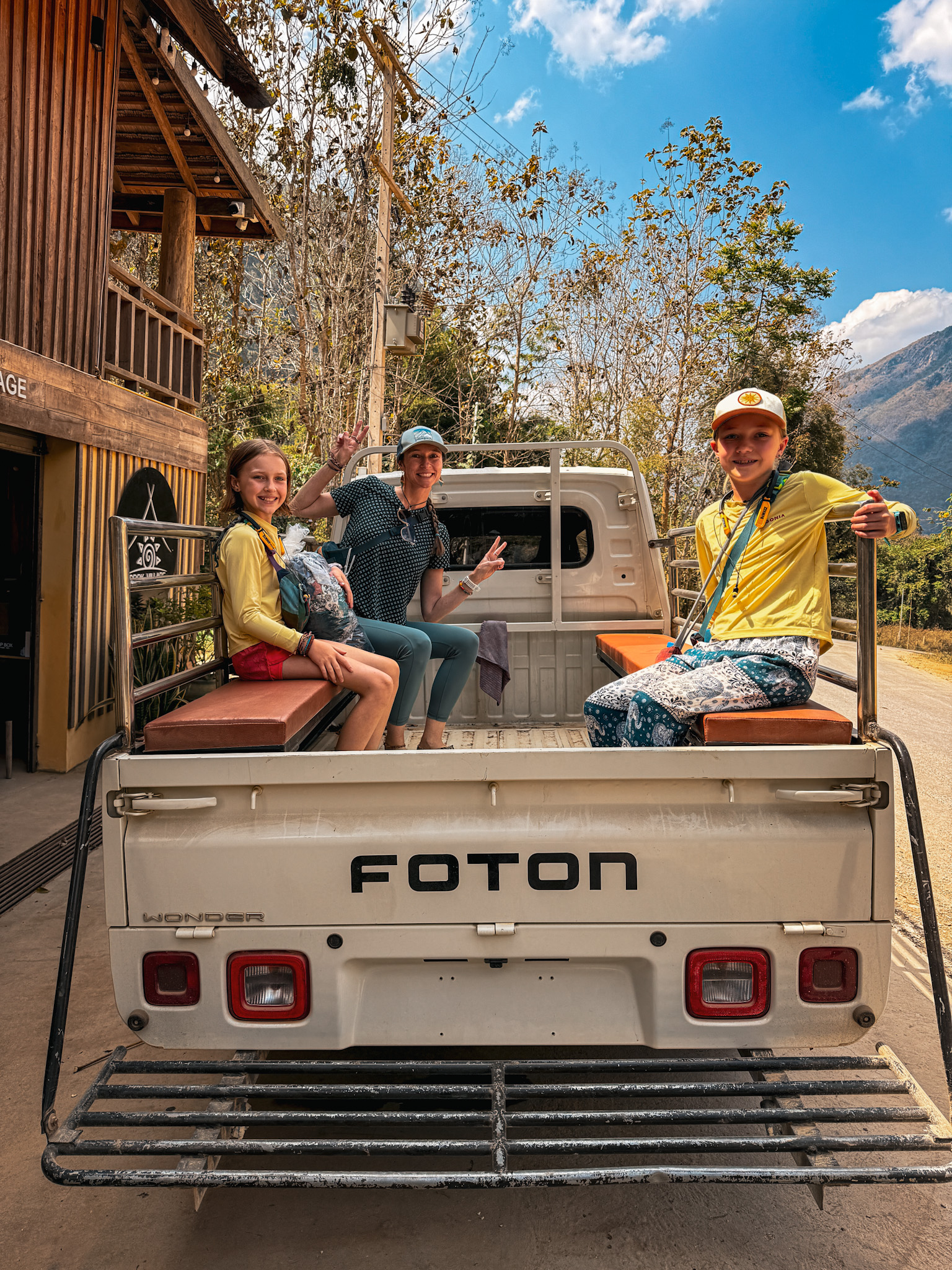
The hotel tuk-tuk met us at the main road—we’d called ahead, knowing we’d be cutting it close for the included breakfast—and ten minutes later we were sitting in the garden at Sook Village with coffee and fruit and the whole beautiful valley laid out in front of us.
A water buffalo worked through a nearby haystack. Sun rays came streaming over the ridge.
There was nothing missing from that picture.
What Nong Khiaw Gave Us
The rest of the day we gave fully to the hammocks. The girls got through homework. We read and journaled and took the occasional photo and watched the light move across the mountains.
Dinner at the hotel restaurant, and then an epic game of Yahtzee that Shaina won by two points. Then back to the bungalow to finish the Harry Potter series.
Tomorrow we leave Nong Khiaw and Sook Village, and we already feel a little of what we’ll miss about it.
Here’s what this place taught us:
Sometimes the worst journey delivers you to exactly where you need to be.
Sometimes getting sick is the universe’s way of making you actually stop and notice where you are.
Sometimes you meet people for twelve hours and feel more understood than you do after months with others, because they’re living the same strange, beautiful, exhausting adventure you are.
Sometimes you climb a mountain while feeling like garbage and the view from the top makes every miserable step worth it.
And sometimes paradise is a teak cottage on the Nam Ou River with water buffalo in the shallows and karst peaks rising into a clear sky and absolutely nothing you need to do but heal.
Nong Khiaw gave us all of that.
And when we think back on this trip years from now, we’ll remember the hellish van ride and the 4.1-star pizza and Shaina pushing through nausea to reach the summit and Romain and Marie understanding exactly what we’re doing because they’re doing it too.
But mostly we’ll remember the hammocks. And the mountains. And the light.
Tomorrow the road calls again. But tonight we’re still here, and that’s exactly where we want to be.
 Pause and Wander
Leave a comment