
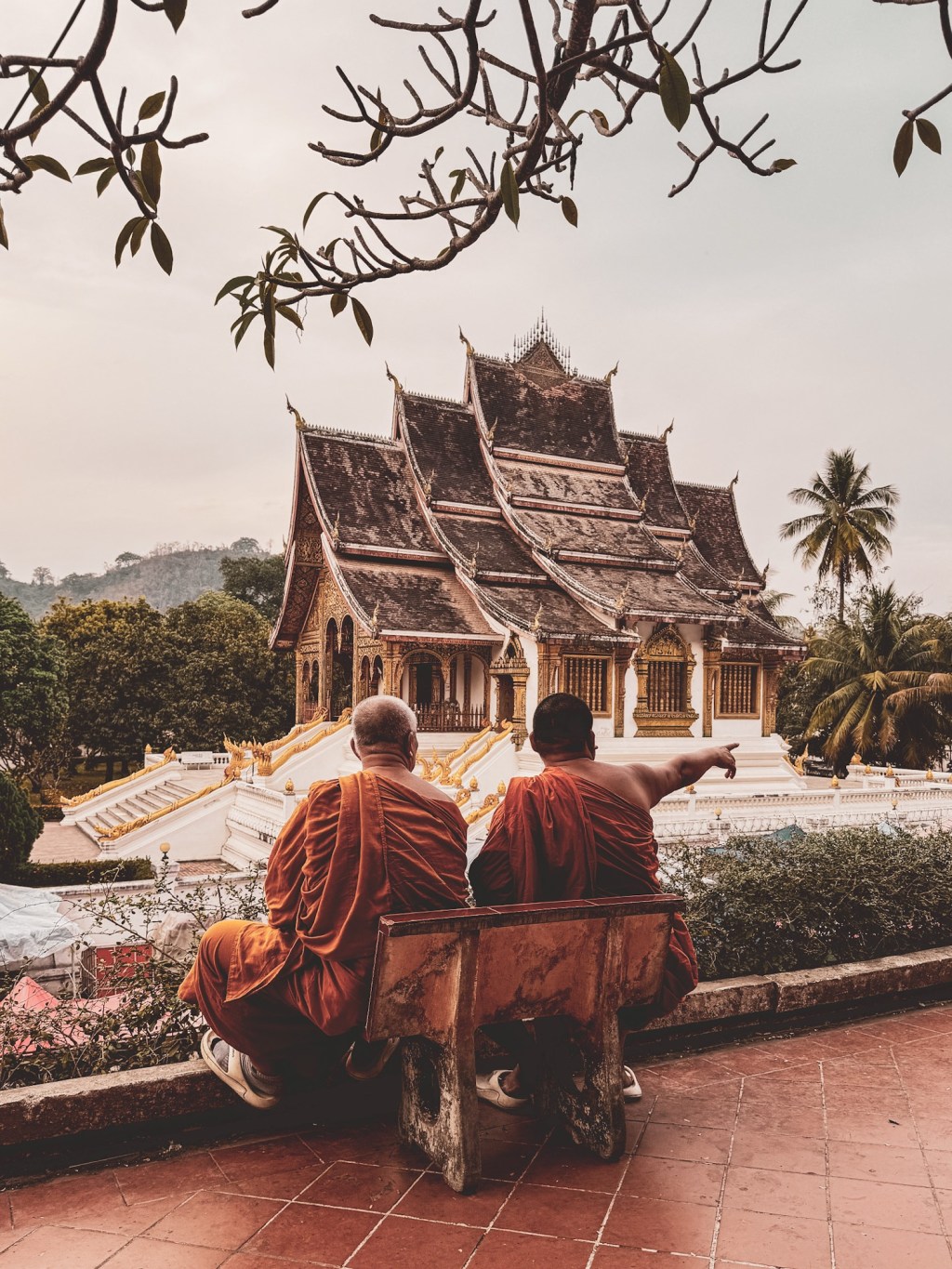
Dates: February 24 – March 7, 2026
Place: Luang Prabang, Laos
We arrived in Luang Prabang with a plan to see the city. What we didn’t plan on was falling completely in love with a piece of fabric.
But we’re getting ahead of ourselves.
First Impressions
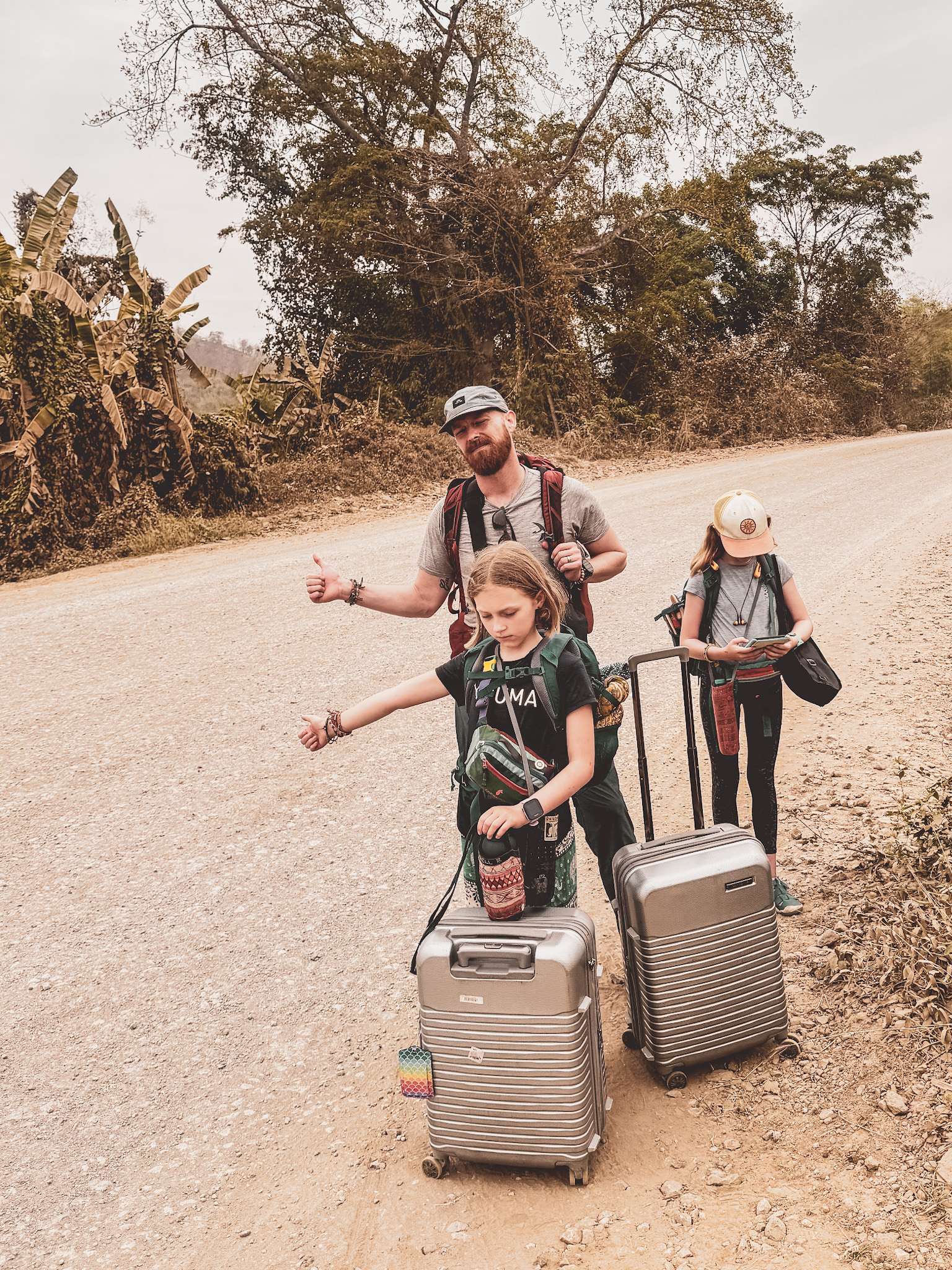
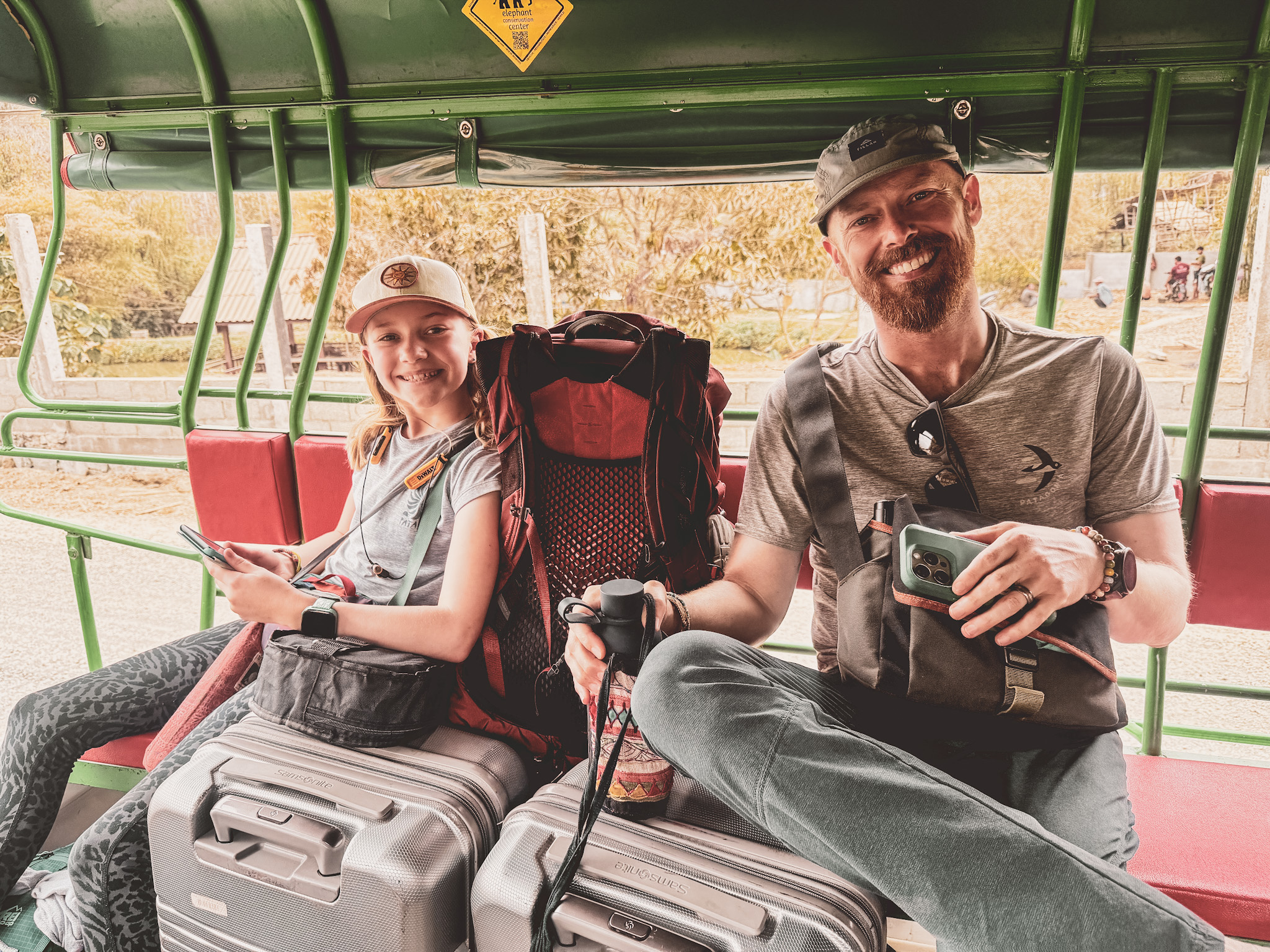
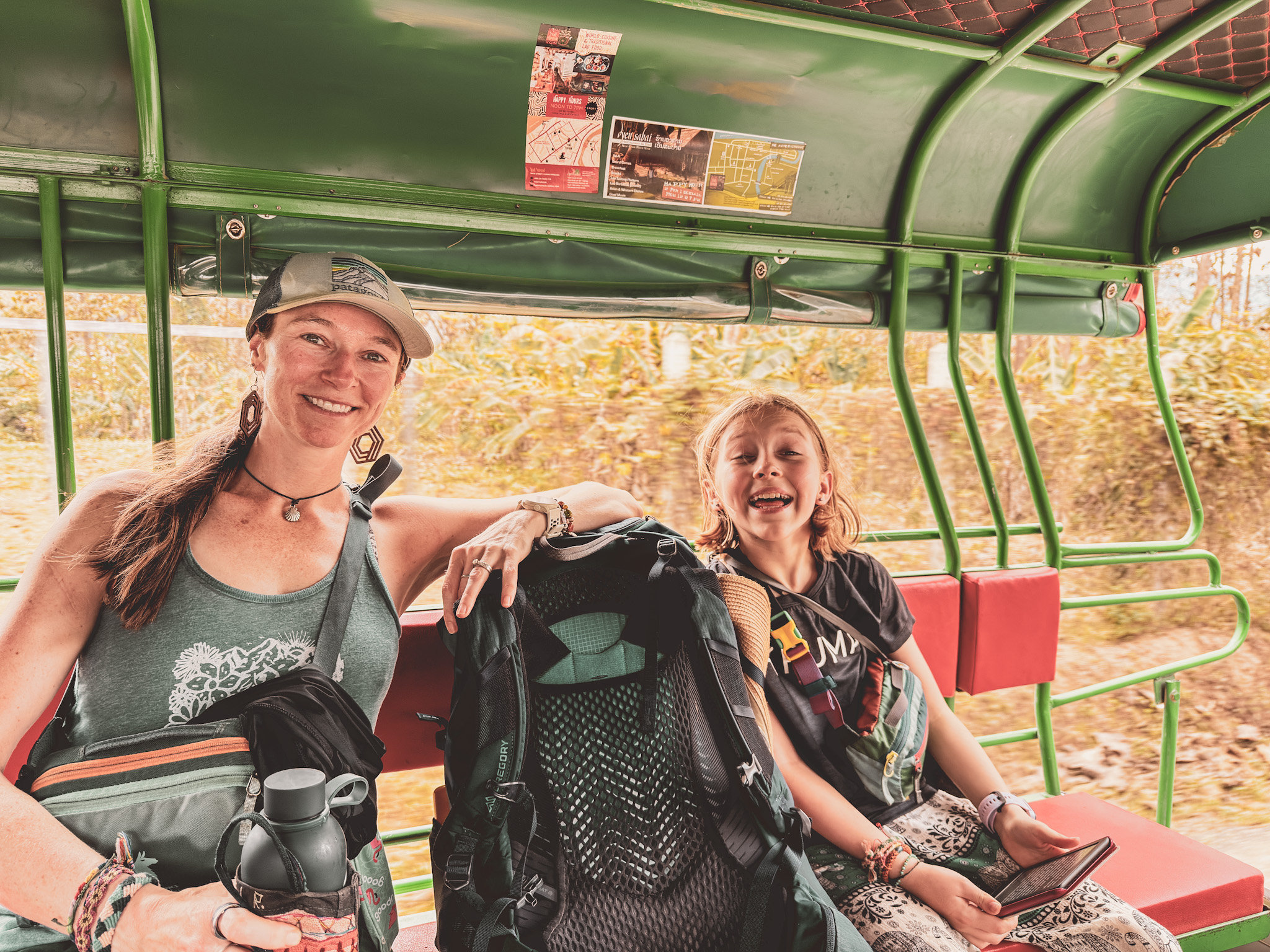
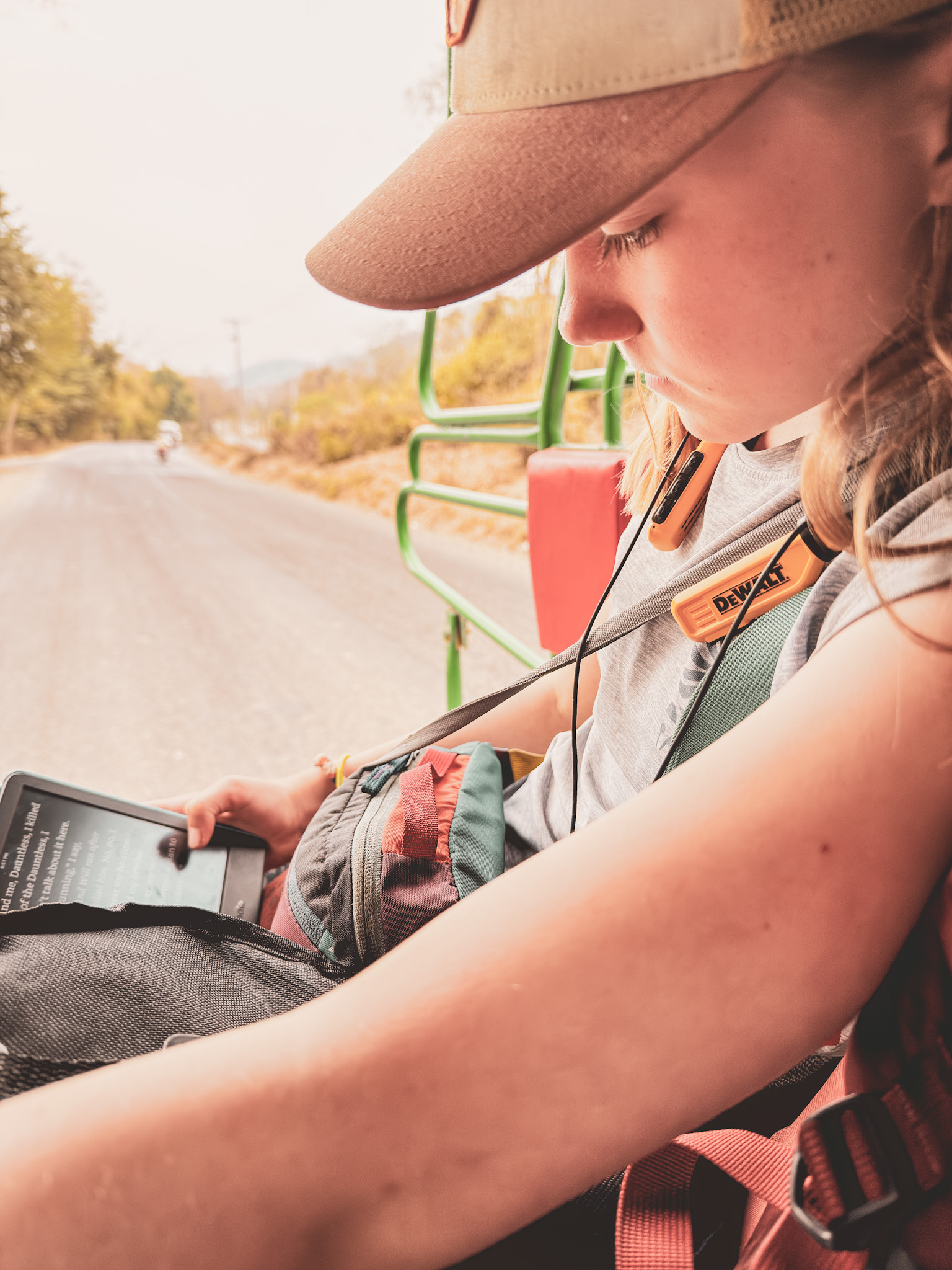
After an adventurous hitchhiking trek from the countryside into town, The Luang Prabang Residence Hotel was a welcome sight. An old Lao and French colonial mashup with white walls and exposed timber beams, it also featured gardens running along the sides and front of the property, with tropical plants and flowers kept in perfect order around a small koi pond. After two nights at a rustic farm stay without a proper shower, we were ripe. We took turns standing under hot water for as long as felt decent. That particular luxury, after a couple of days of roughing it, is hard to overstate.
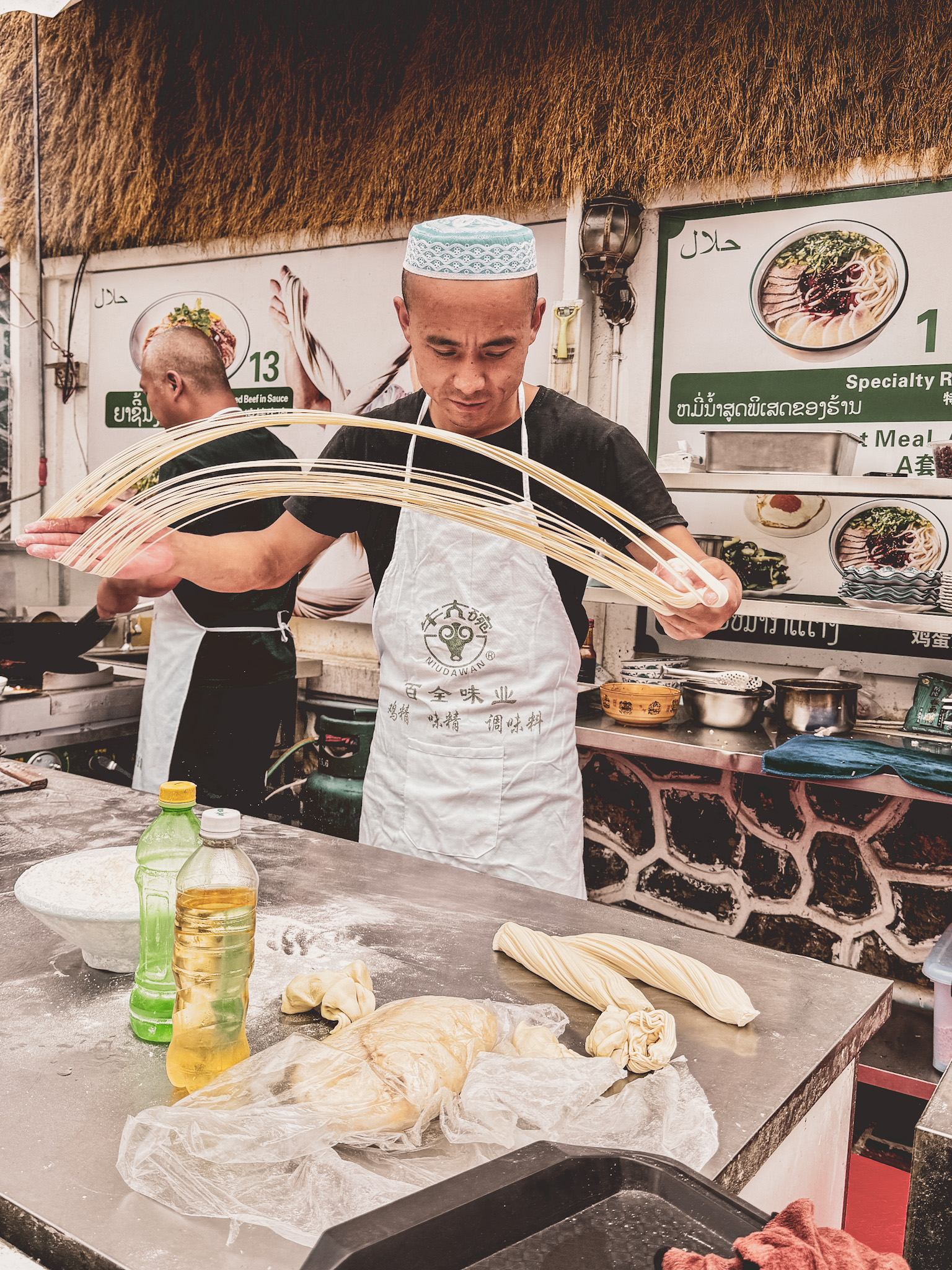
Once homework was done we headed out to eat. A quick search turned up a Lanzhou noodle shop nearby. Lanzhou-style hand-pulled noodles, a tradition out of northwestern China where the noodles are stretched and folded to order, then served in a rich beef bone broth. We watched the noodles being pulled fresh right in front of us before they disappeared into a deeply spiced broth with braised beef.
So. Good.
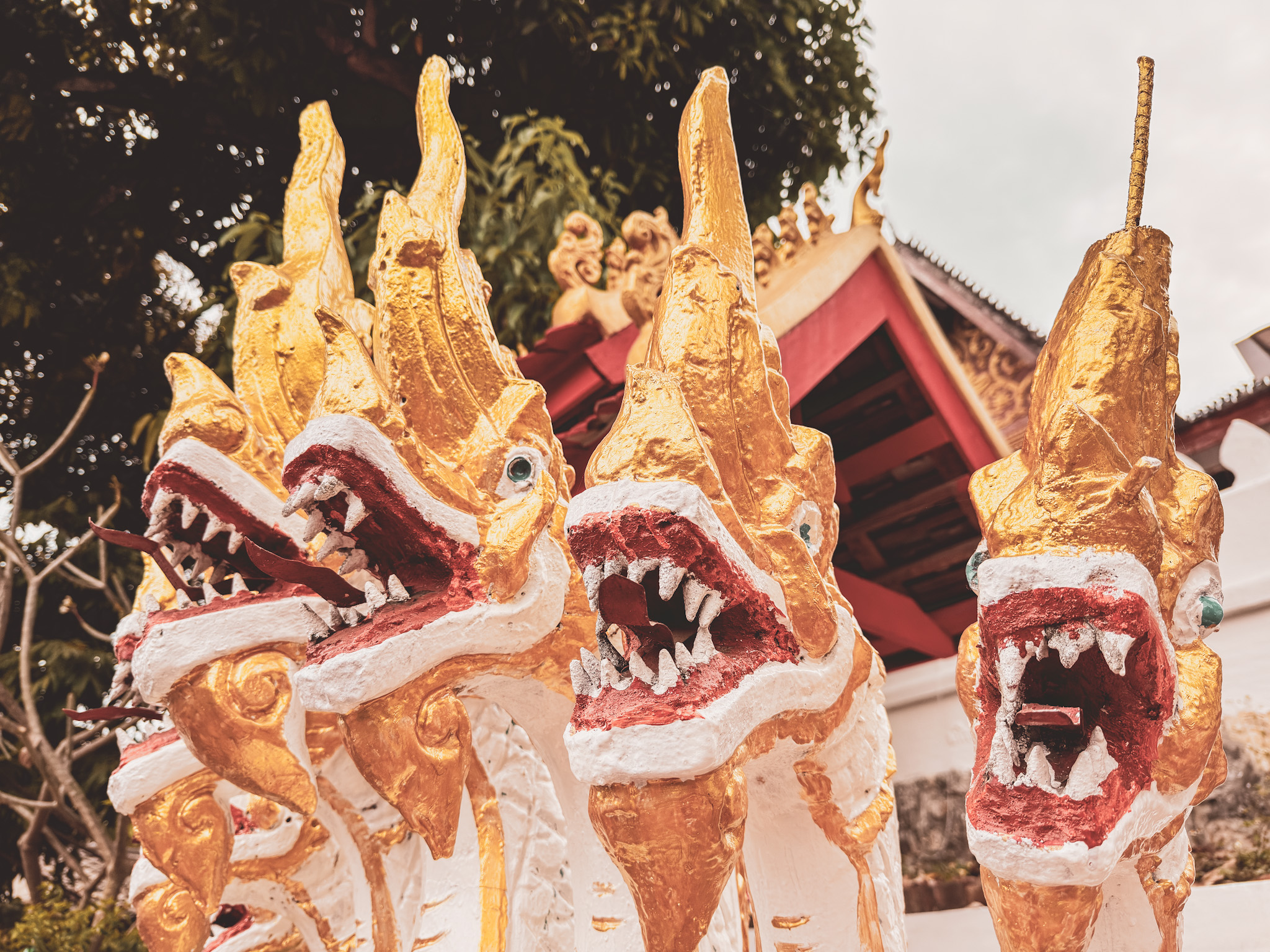
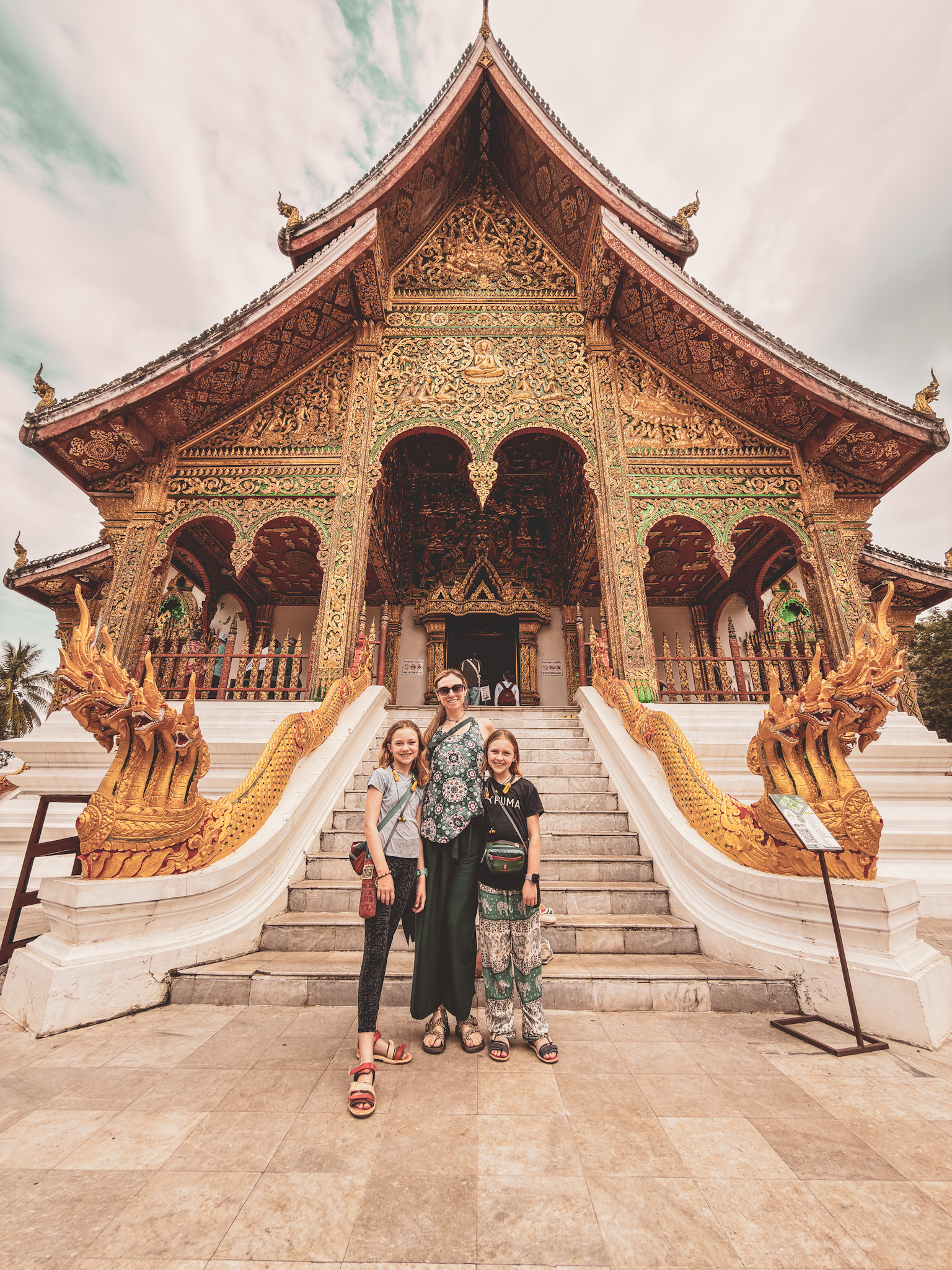
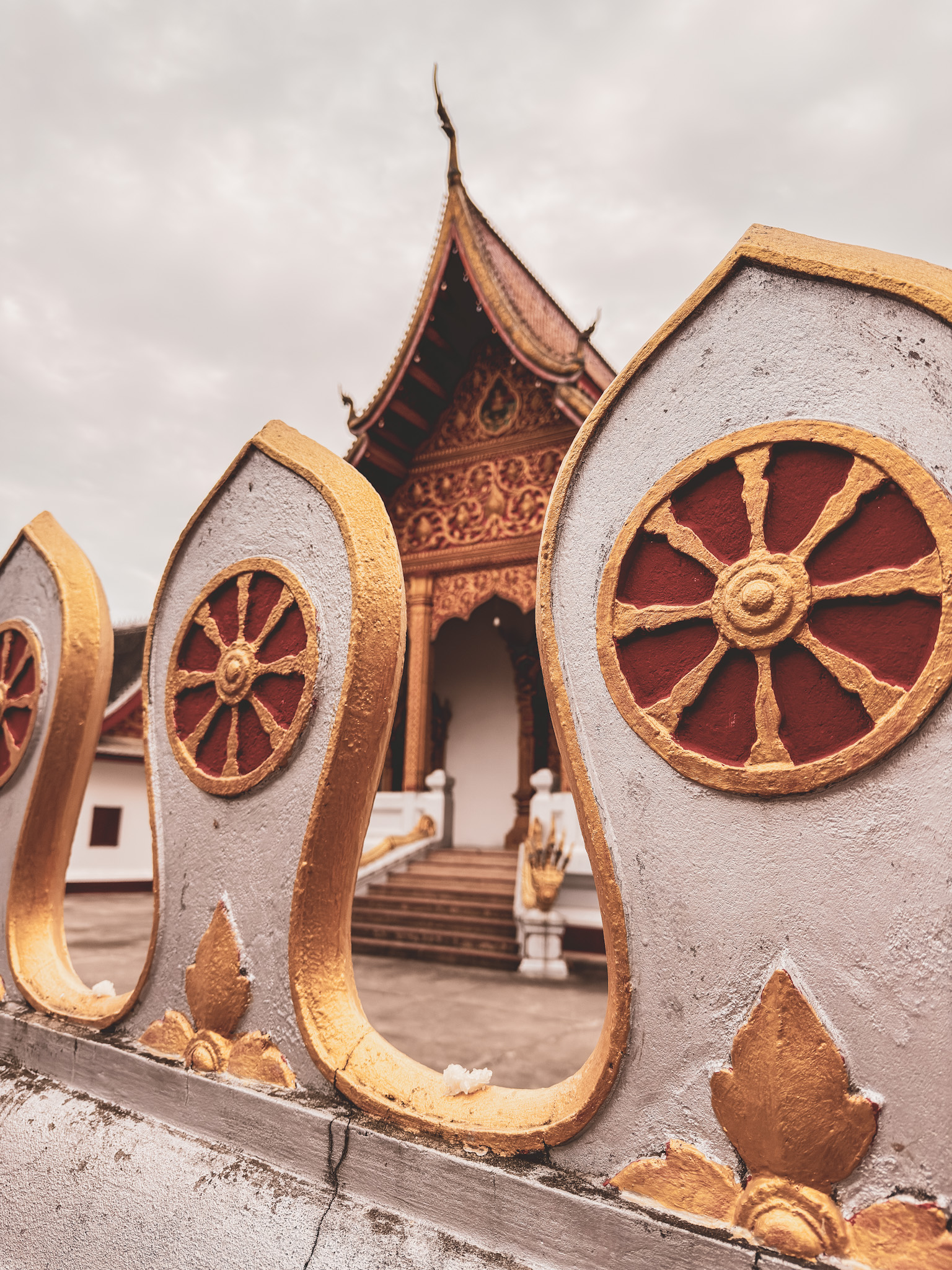
We meandered from there with no real agenda, which is the best way to move through a new city. A local bakery sold us a sweet mango bread that served as dessert while walking. Rounding a corner, we stumbled into a small wat, deeply saturated with red and trimmed with gold everywhere the eye landed. We stood there for a while just taking it in.
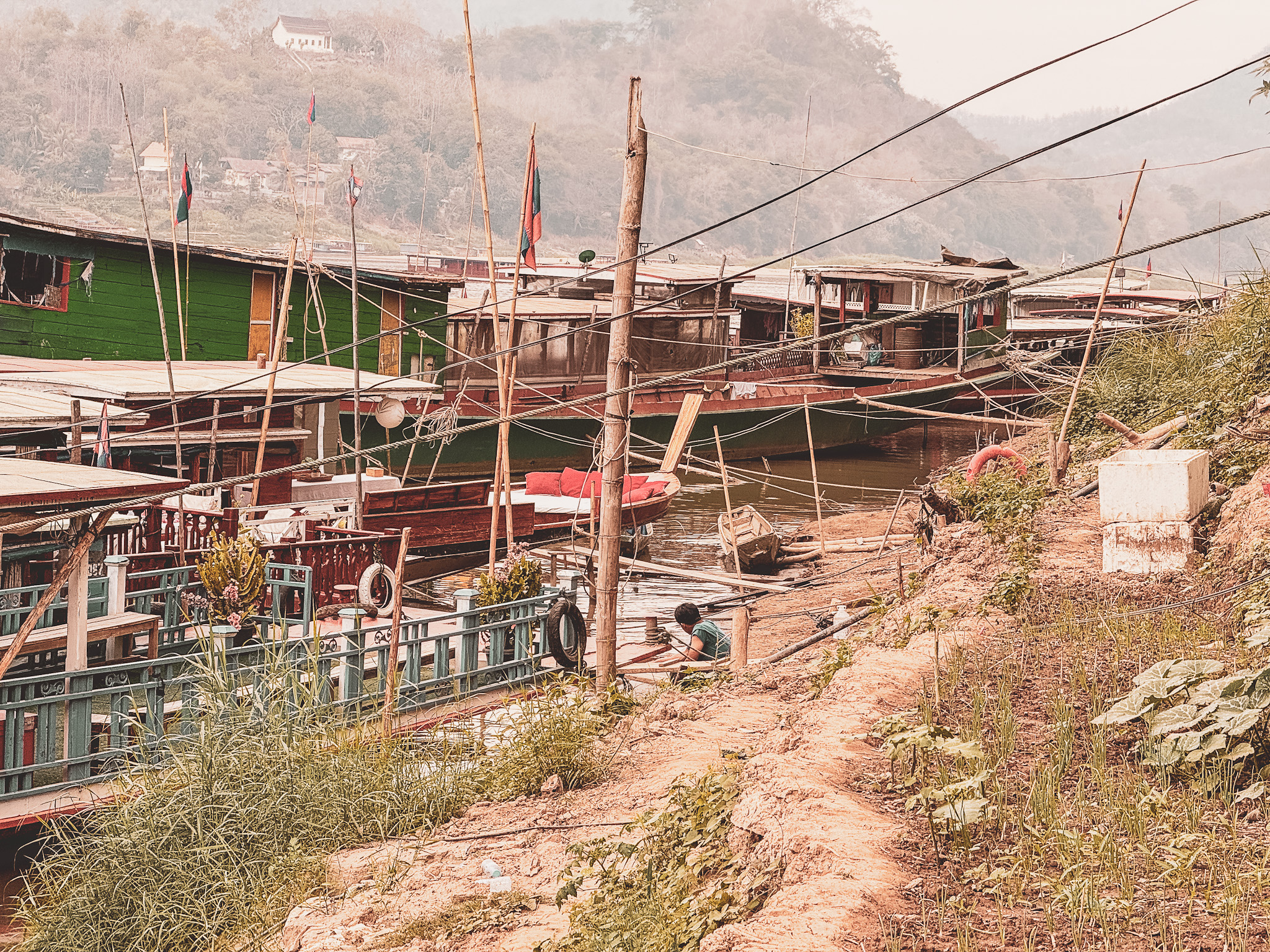
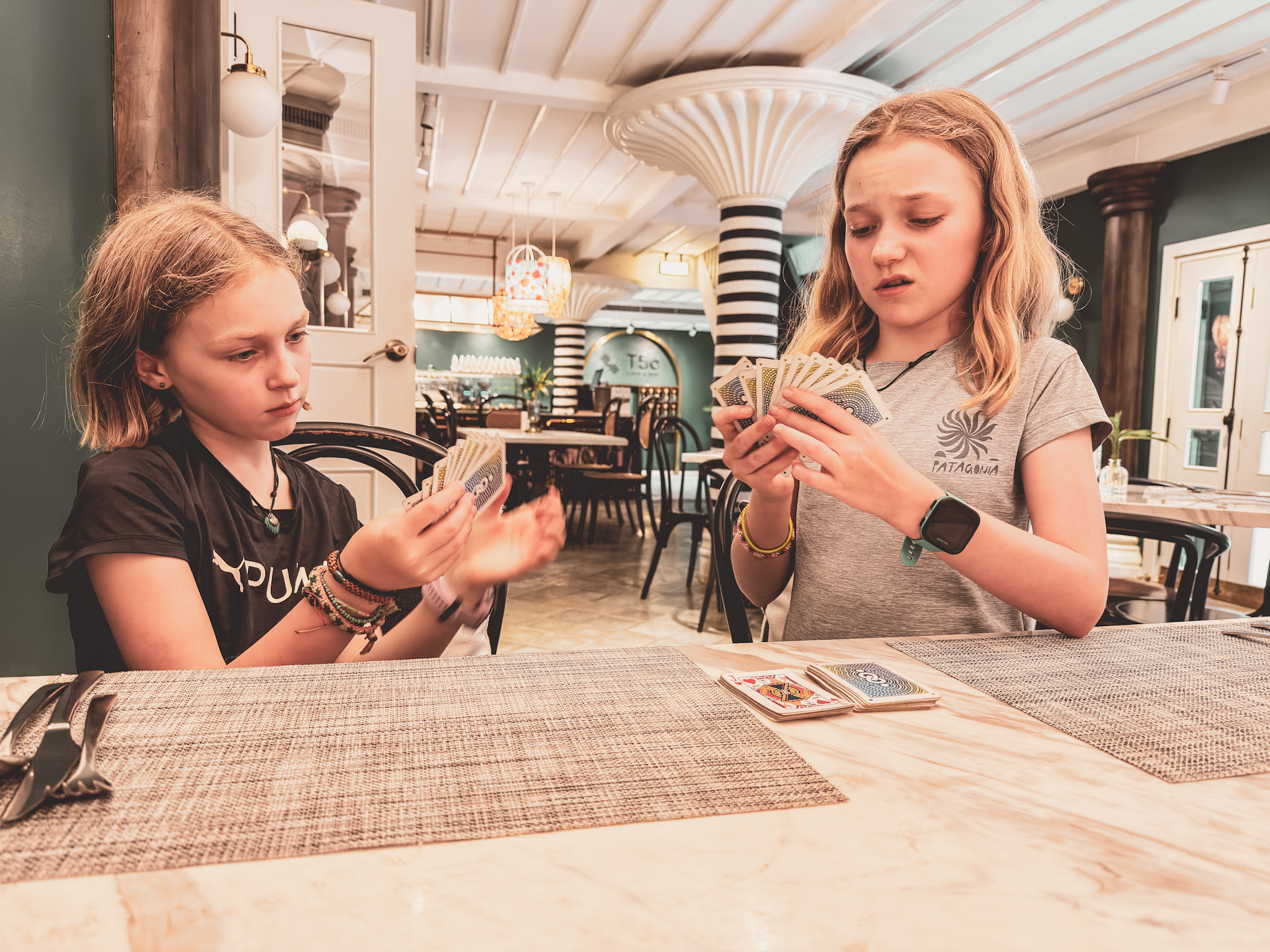
Further along we found ourselves at the Mekong River, where the evening boat cruises were starting to load up for their sunset runs. We followed the riverfront until we came across T56, a café and bar set in a heritage building right on the water. We had cocktails; the girls had smoothies, both adorned with fresh flowers. We busted out our casino-quality cards from home and played gin while we spread out our maps and finalized plans.
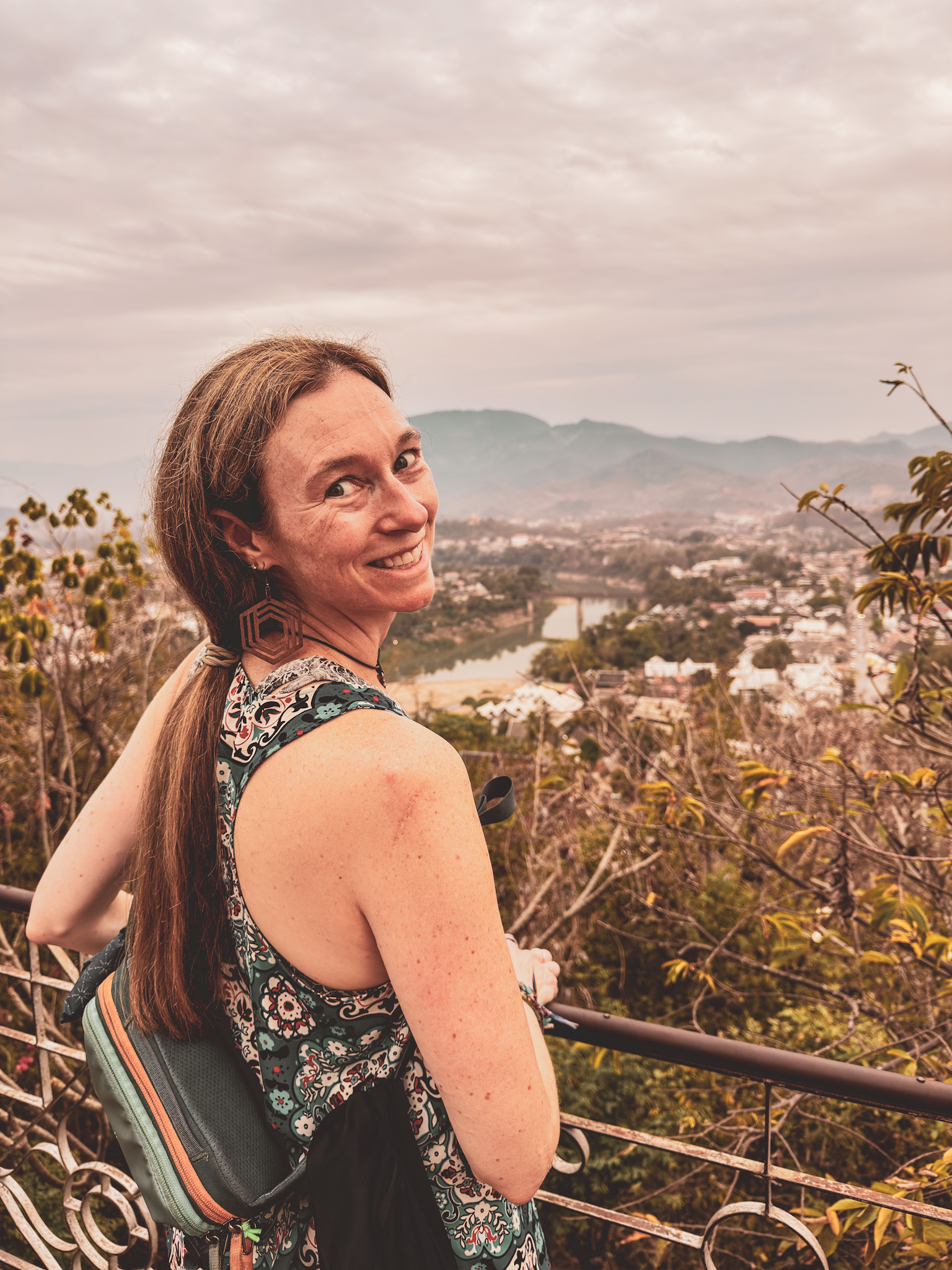
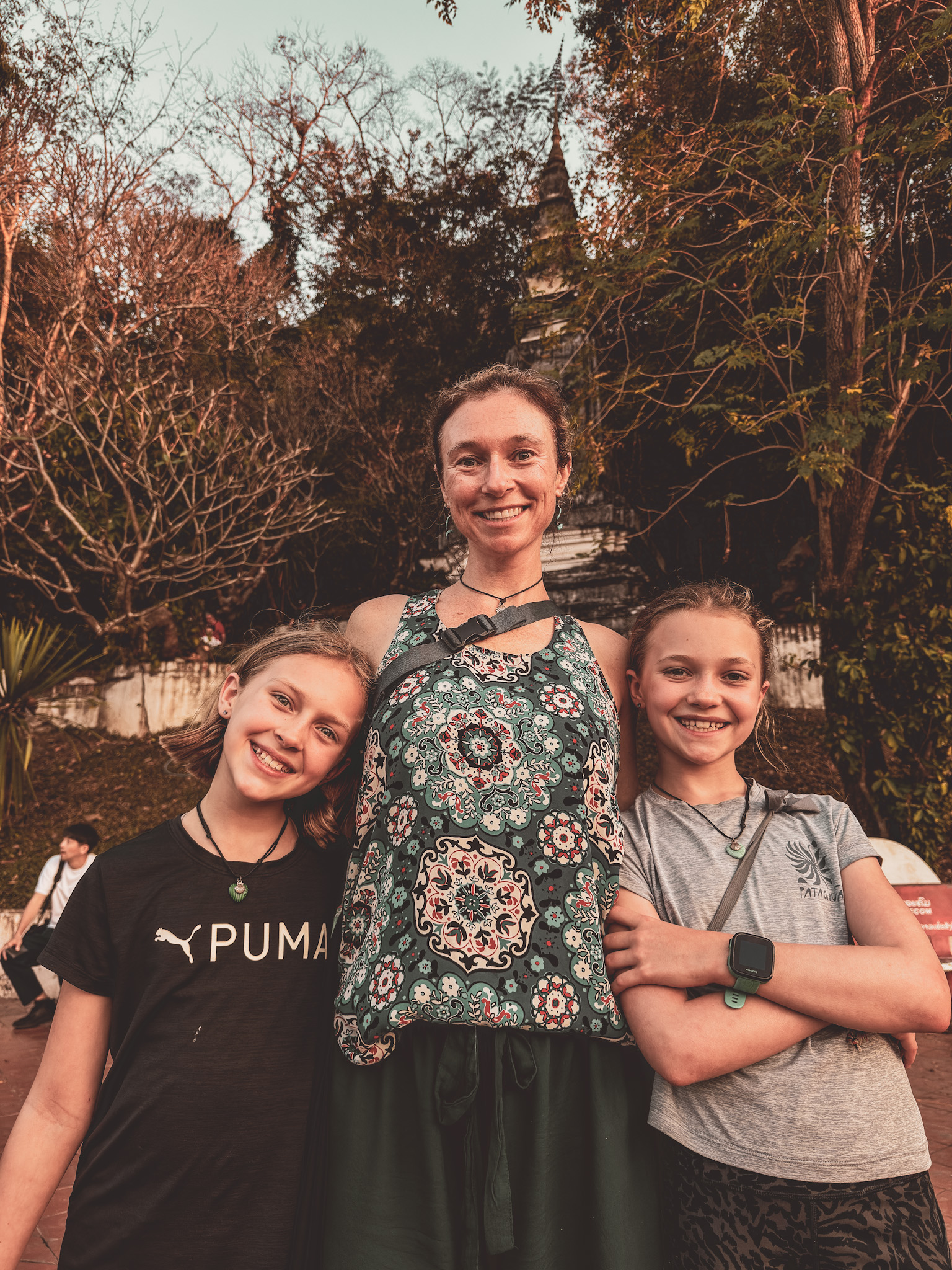
First on the list: Phousi Hill for sunset. Phousi, which translates roughly to “sacred hill,” rises about 100 meters from the Old Town peninsula, right at the confluence of the Mekong and the Nam Khan rivers. At its summit sits That Chomsi, a slender but imposing golden stupa built in 1804.
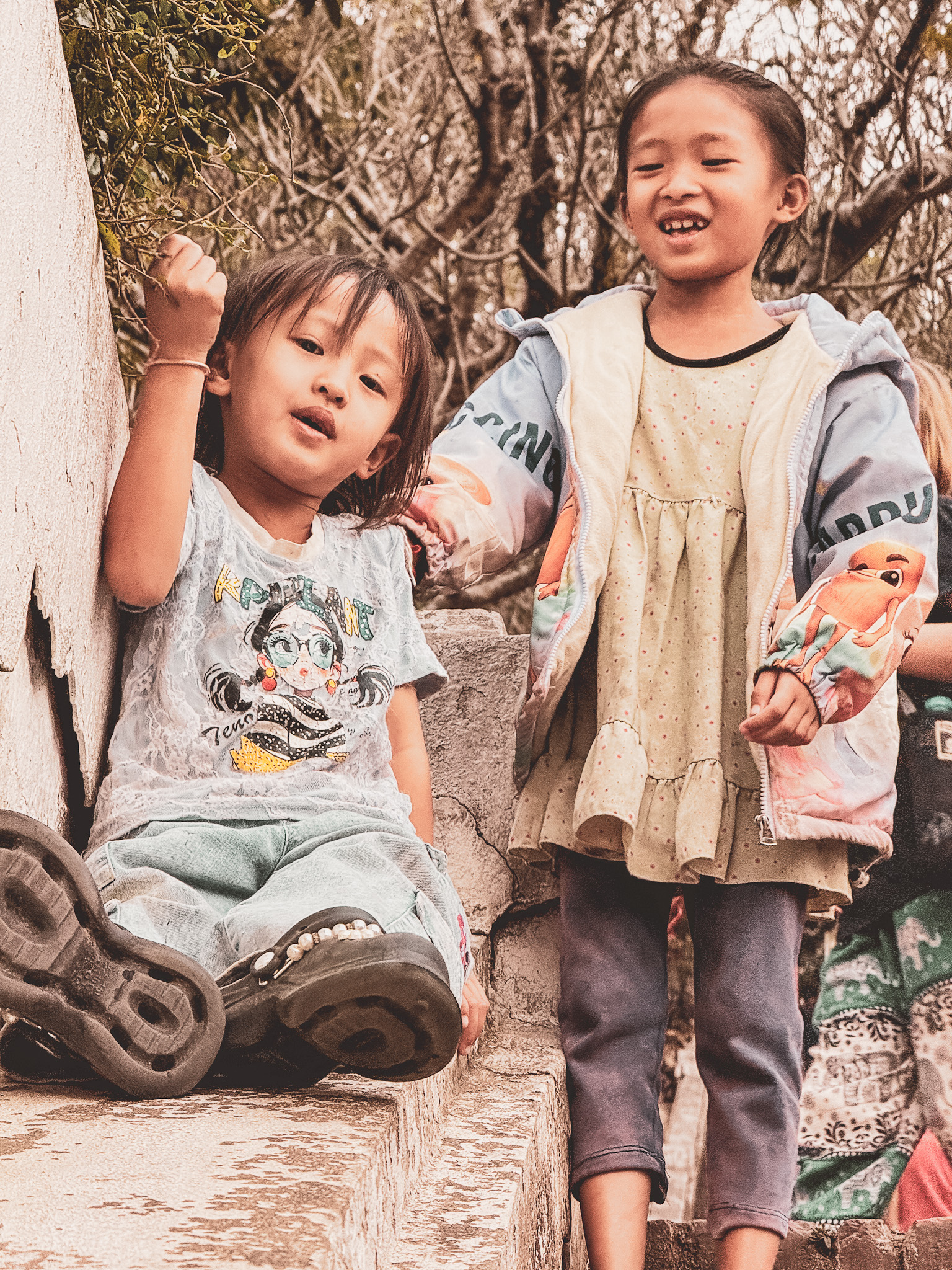
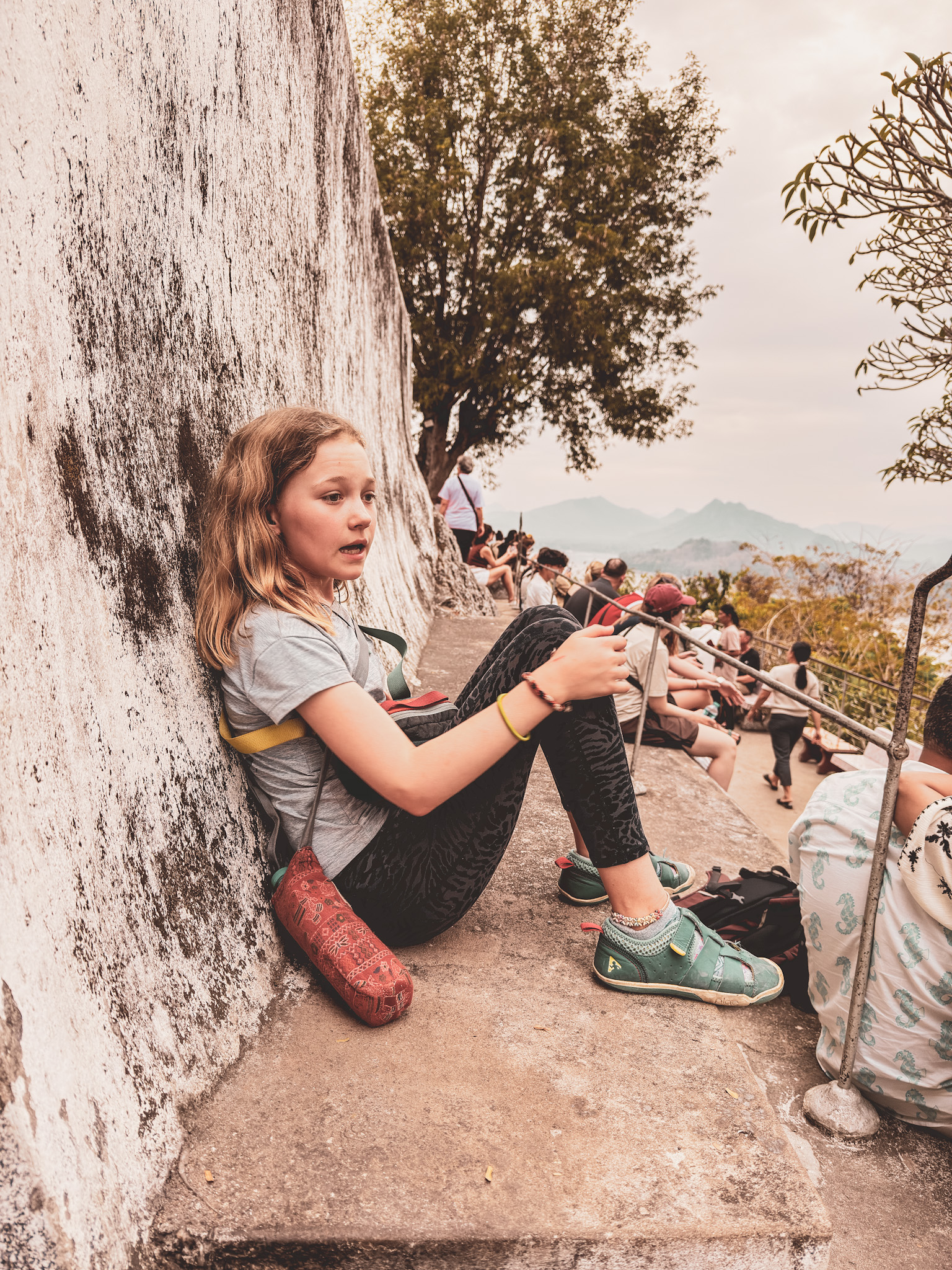
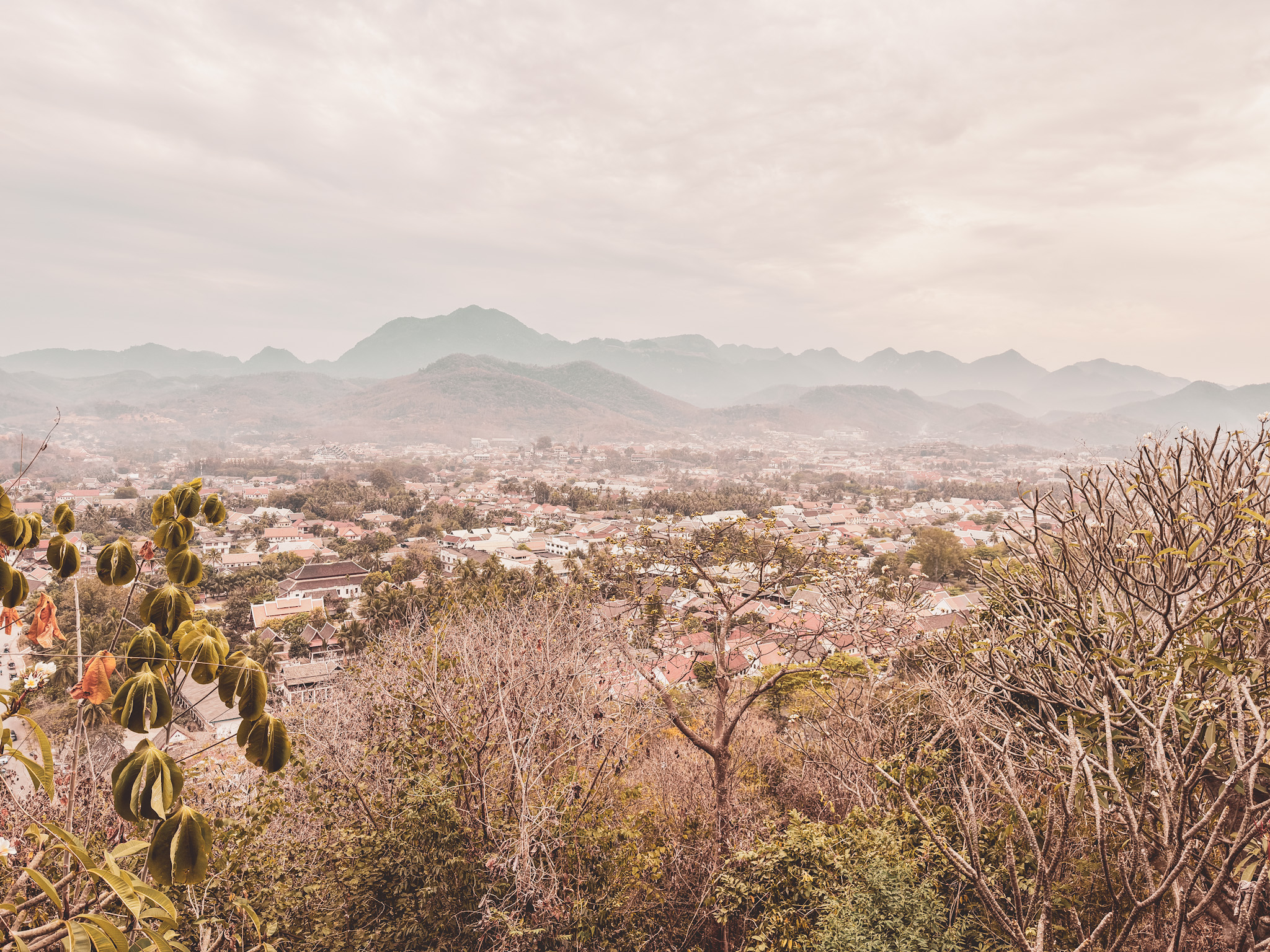
We paid the entrance fee and found the staircase. Three hundred and twenty-eight steps in total. The girls basically ran up while we set a more sensible pace, stopping to catch our breath with each landing. The top delivered on its promise: a narrow terrace wrapping the stupa, with unobstructed 360-degree views over the city, the Mekong bending around it, the Nam Khan shimmering on the other side, and the jungle-covered mountains in every direction.
The cloud cover meant the sunset itself was a bit of a wash, but the panorama needed no help from the sky.
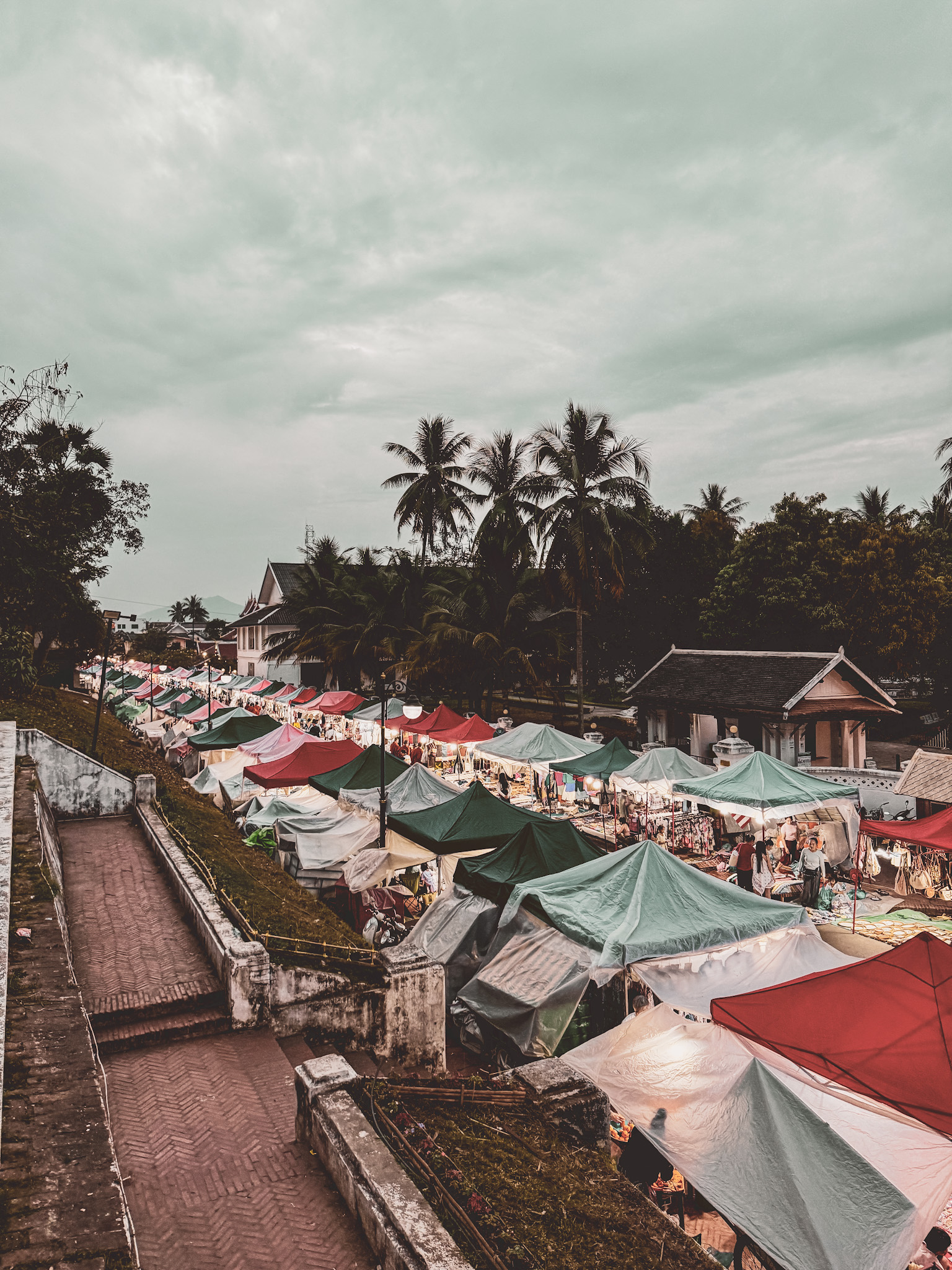
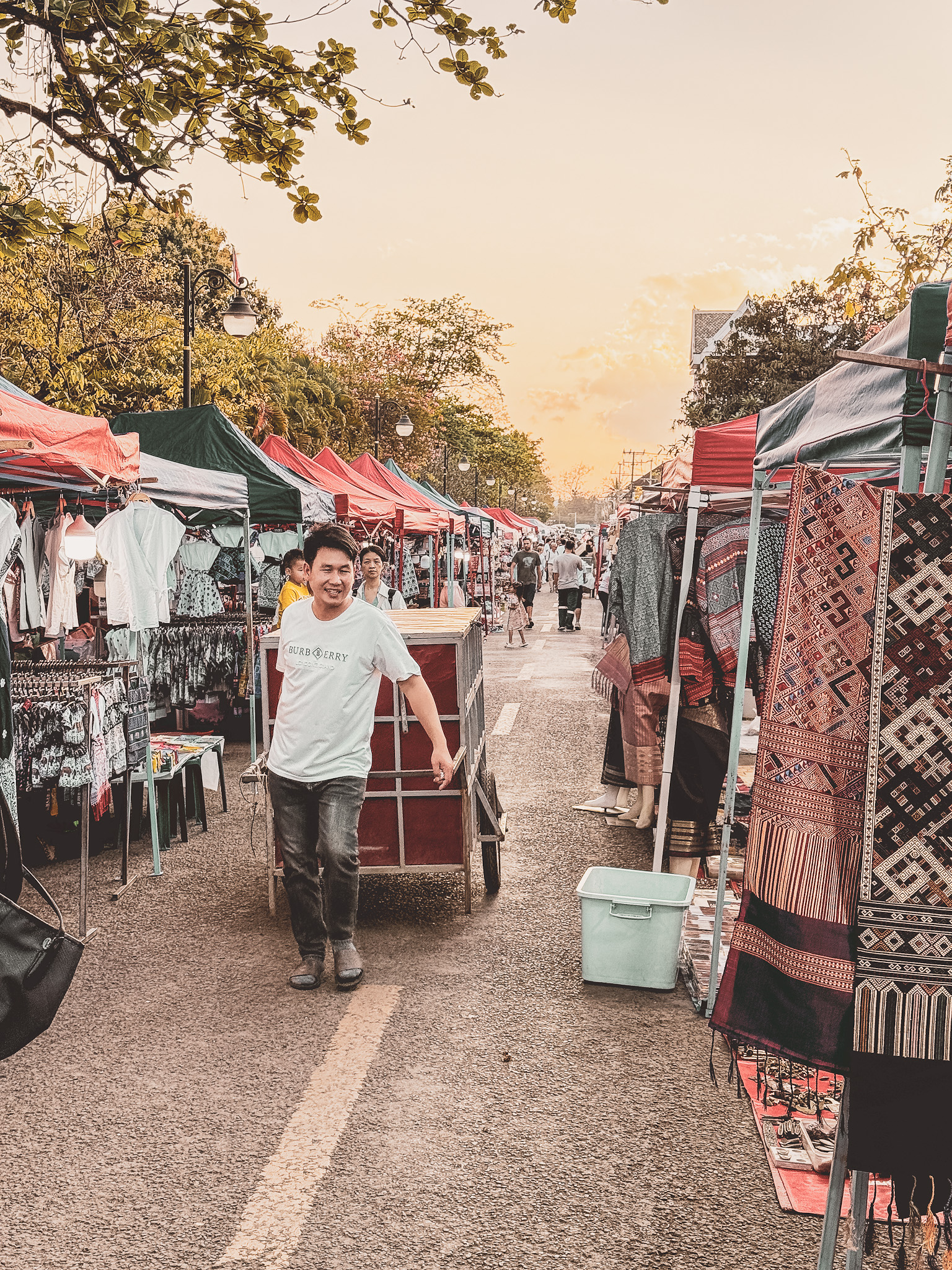
We descended the hill and emerged onto Sisavangvong Road, the main artery of the old town, named for King Sisavangvong who ruled Laos for more than half a century. In the hour that we’d been climbing, the street had completely transformed. What had been an ordinary thoroughfare full of tuktuks and motorbikes, was now a full night market, dense with vendors and lantern light.
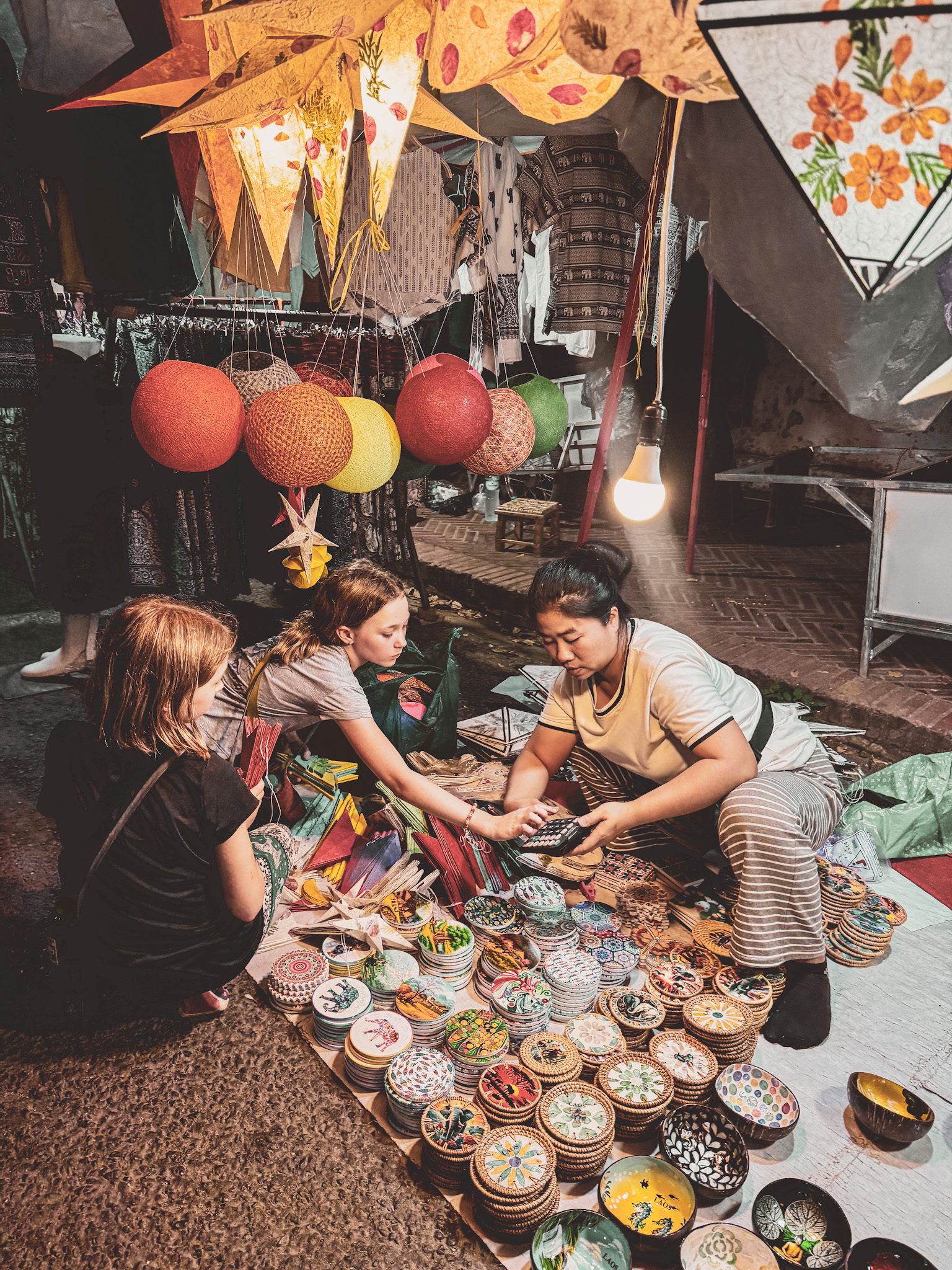
The girls had fresh spending money and put it to work: paper lanterns and a couple of truly beautiful paintings made on handmade paper. Arya negotiated hard, down to less than half the original asking price, which was a sight to watch. Finlee sat beside her as moral support without saying a word, then calmly turned to the vendor once the deal was struck and said, “Same price, me too.”
Both of them walked away with the discount. We were proud.
By that point our feet had earned a rest, so we found a foot massage place and spent an hour in a row of reclining chairs, saying very little. Overall, we had a good first day in Luang Prabang.
The Brocade
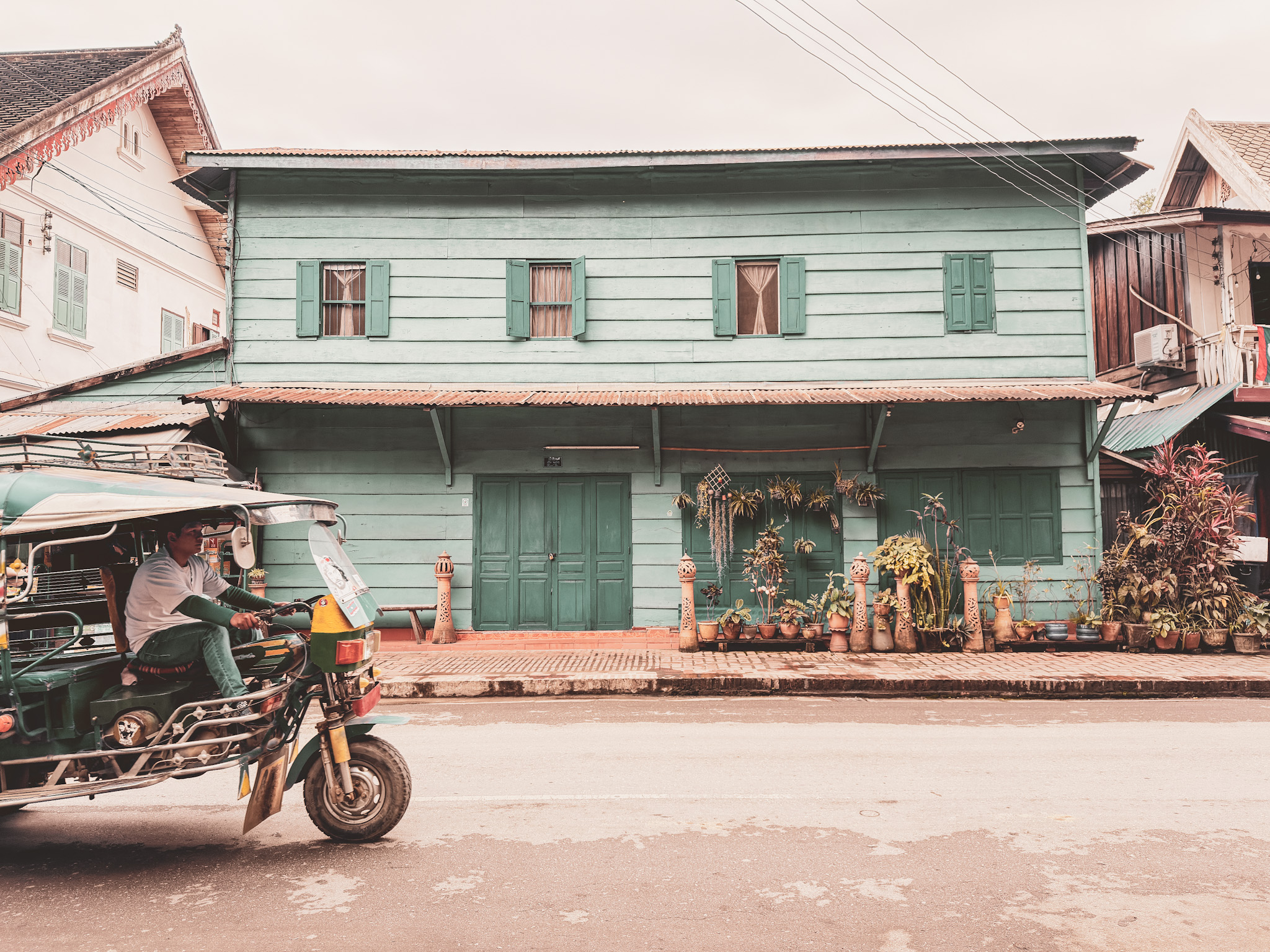
The next morning we set out on foot with no particular agenda beyond covering as much of the city as we could. Luang Prabang’s entire old city peninsula is a UNESCO World Heritage Site, a place where French colonial architecture and traditional Lao temple design exist side by side with such ease it no longer feels like a contrast.
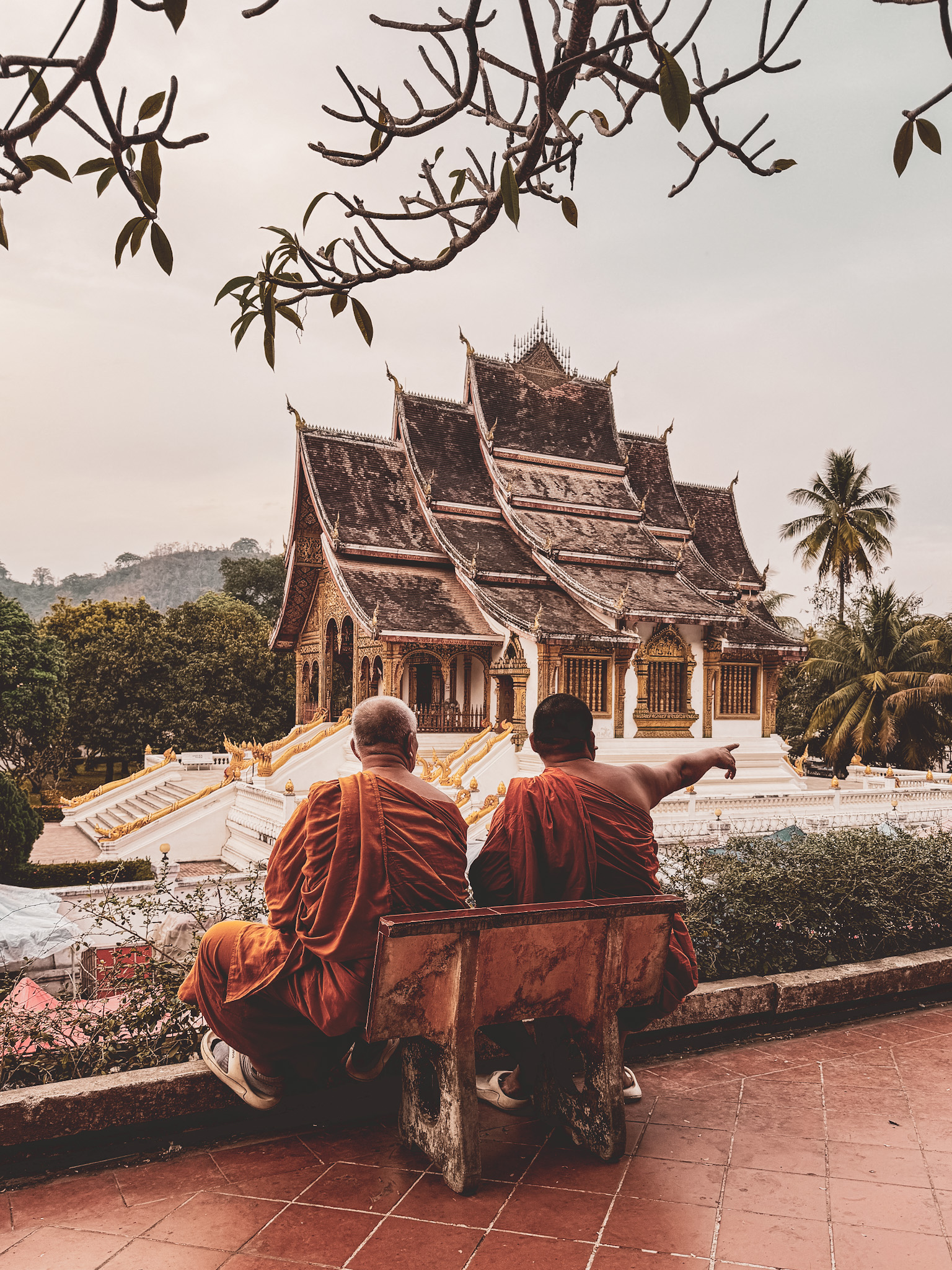
Our first deliberate stop was the Royal Palace Museum, known locally as Haw Kham, the “Golden Hall.” Built between 1904 and 1909 as the official residence of King Sisavangvong during the French colonial era, it’s a confident architectural hybrid of French Beaux-Arts and traditional Lao design.
On the palace grounds stands the Haw Pha Bang, the ornate royal chapel built to house Laos’s most sacred object: the Phra Bang Buddha, which roughly means “holy Bang statue”, The statue itself is small, 83 centimeters tall, cast from a gold and silver alloy, but its significance to the country is enormous. The city of Luang Prabang takes its very name from this statue.
From there we walked. The morning was still cool and the old quarter unfolded slowly around us. We eventually found our way down to the Mekong and a café called Mademoiselle Ny, perched high on the riverbank with slow water views. We settled in, ordered crepes and smoothies and coffee, did a stretch of homework and journaling, watched the slow boats crawling up and down the river, and did our best impression of people with nowhere to be.
After homework we followed the backstreets to the tip of the peninsula and arrived at Wat Xieng Thong, the Temple of the Golden City, which sits right at the confluence of the Mekong and the Nam Khan. Built in 1559, it served for centuries as Laos’s royal temple. It is arguably the finest example of Luang Prabang-style Buddhist architecture in the country, with its roofs sweeping down in multiple tiers so dramatically low they seem to nearly touch the ground.
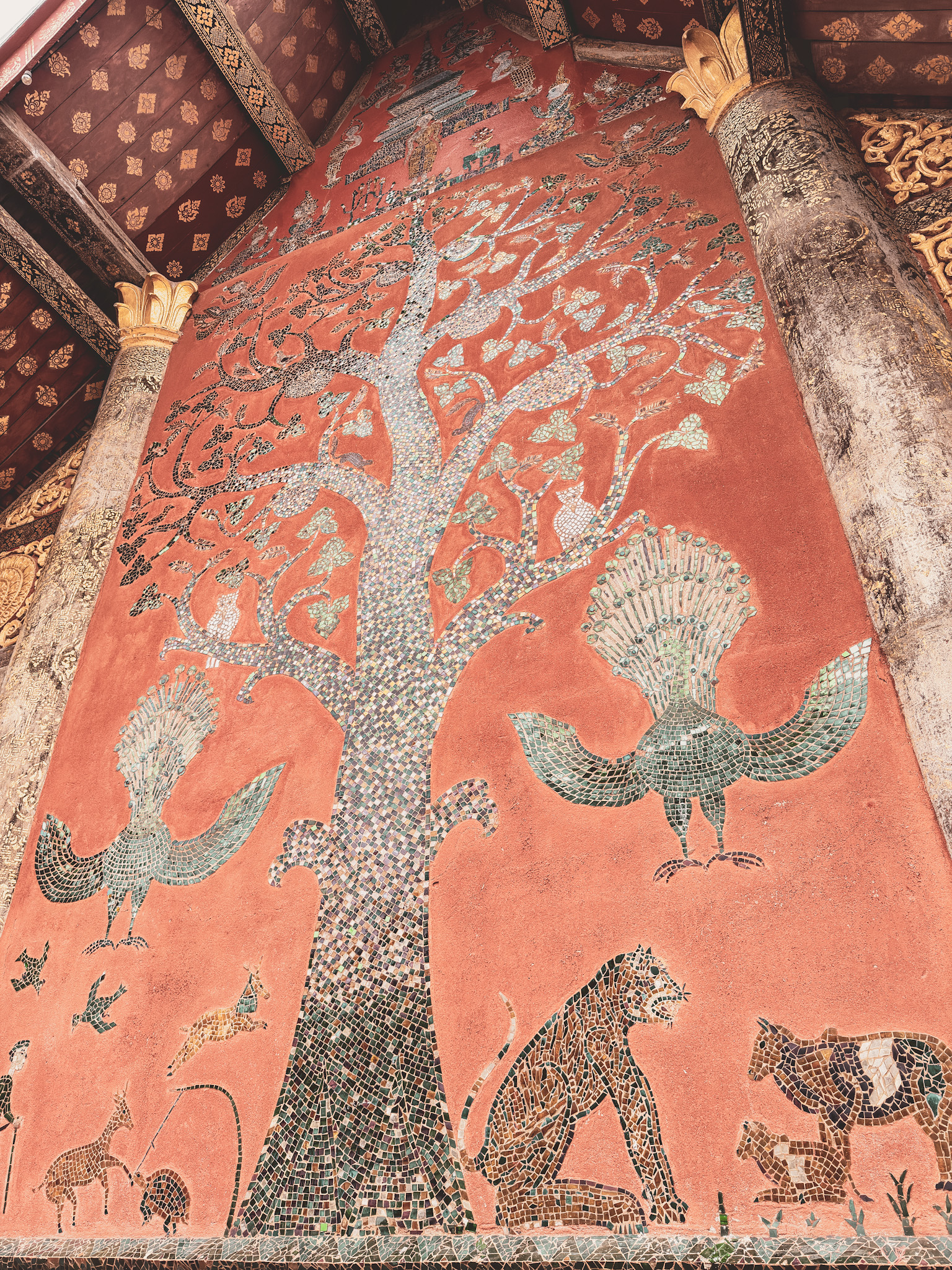
We recognized it the moment we walked in. We had been here in 2012, and in the years since, out of everything we saw on that trip, the image that stayed sharpest was the mosaic on the rear wall of the Sim: the Tree of Life. Created in the 1960s from thousands of fragments of colored glass set against a rich red background, it depicts a flame tree that local legend says stood at this site when the city was founded.
Standing in front of it again after fourteen years, we understood why it was the thing we remembered. We did our best to mimic the same self portrait we’d taken long ago, before kids entered our lives.
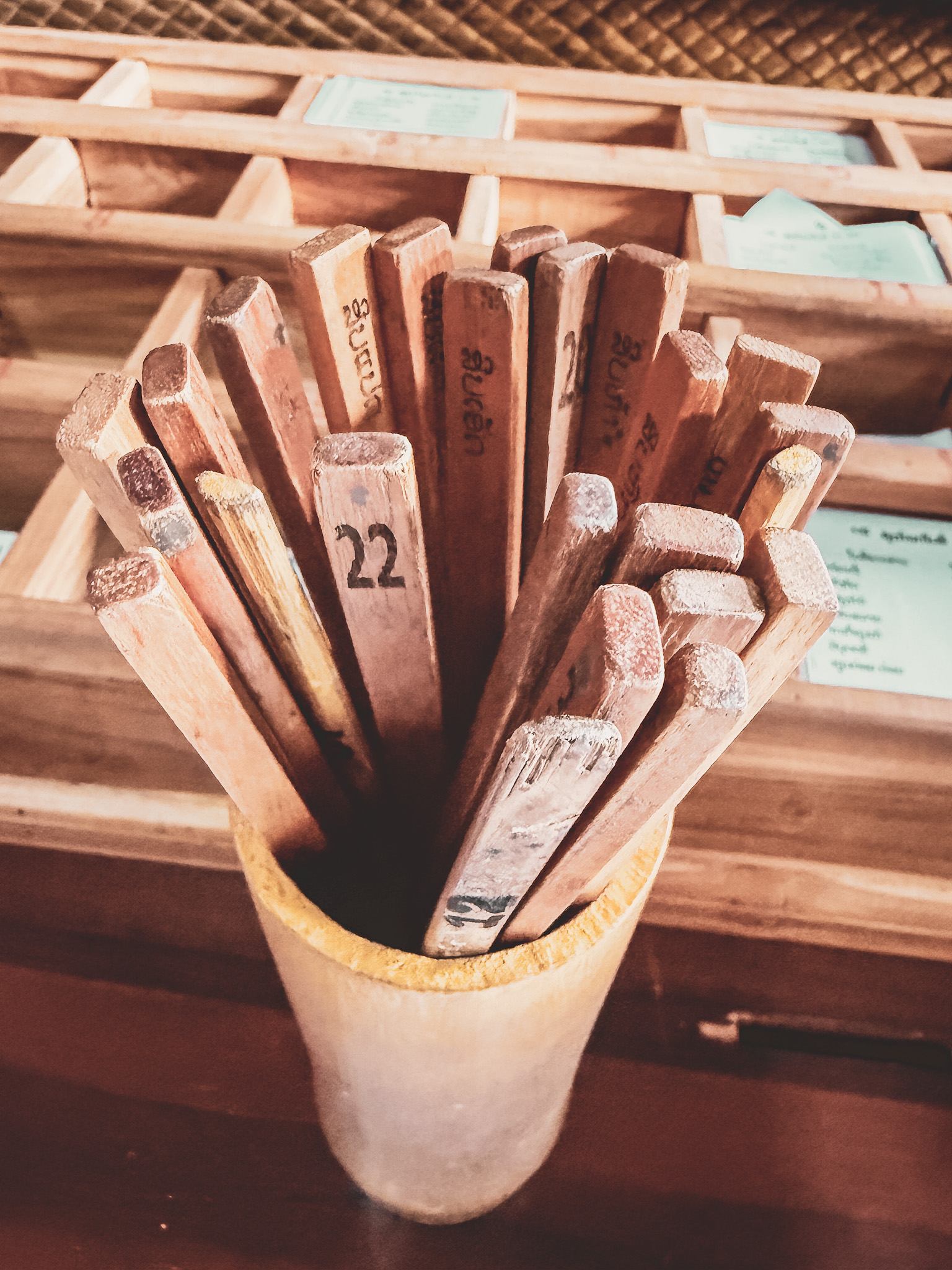
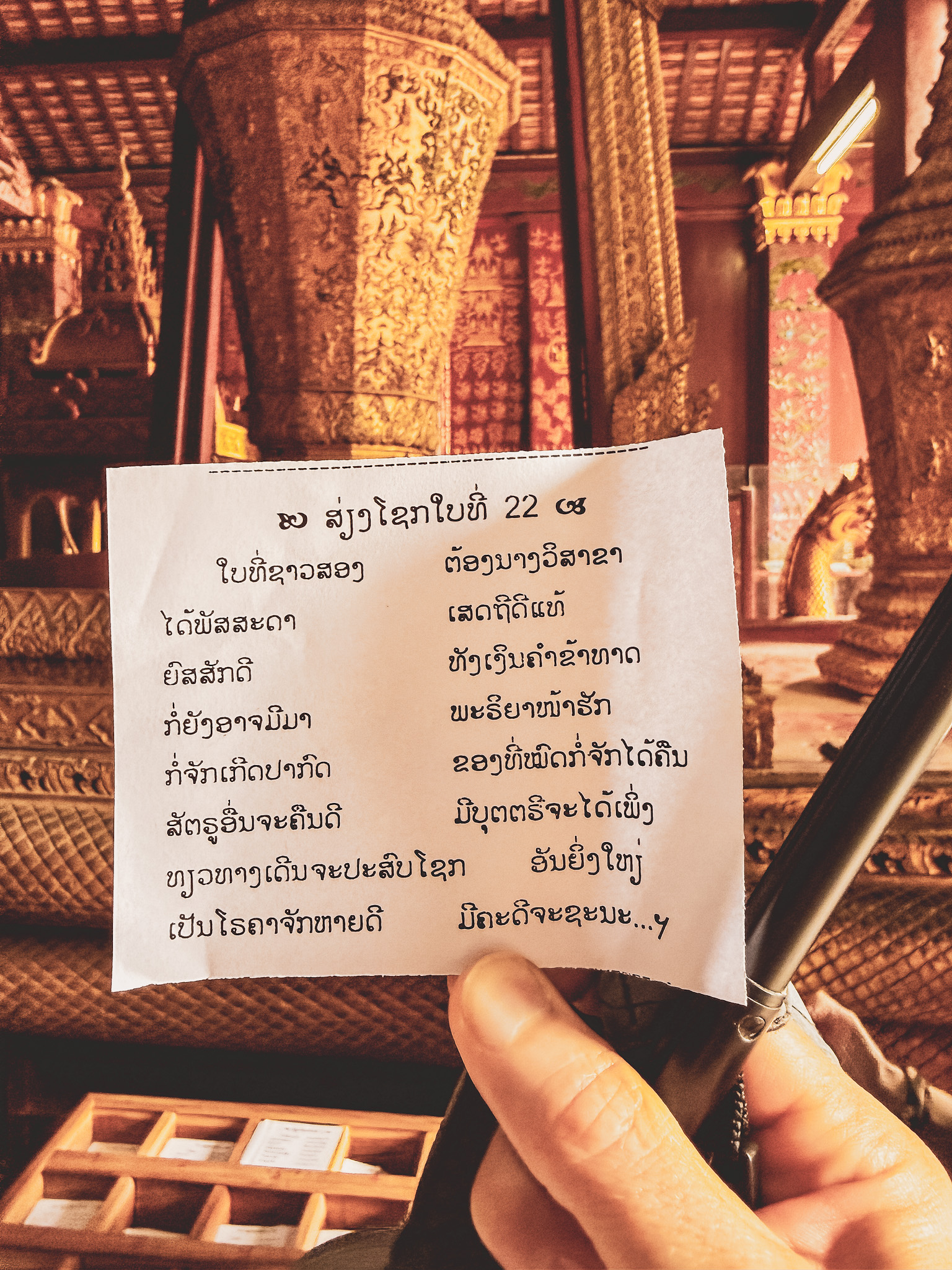
In one of the smaller chapels on the grounds we found a fortune-telling corner. A cylinder filled with numbered wooden sticks. You shake it, a stick falls out, and the number directs you to one of twenty-four small drawers, each containing a slip of paper with a fortune written in Lao.
Max’s stick was number 22. The translation, courtesy of Google, came out garbled and strange. But after sitting with it for a while, here’s what emerged beneath the machine translation:
Fortune 22:
“You stand in a season ripened, yet still becoming. The road beneath your feet leans kindly toward you. Your wealth is not counted in coins, but in merit earned and hands that reach for yours. Old tensions loosen. An inner knot unties. Children rise like strong pillars, holding more than you can see. Healing moves slowly—not lightning, but dawn. What was lost will not return unchanged, yet in its place something wiser takes root. This is not thunderous luck. Not shadowed warning. It is steadiness. It is balance. It is alignment—In the quieted mind this is enough.”
A nice set of thoughts to carry forward. Shaina and the girls had equally discordant collections of words and phrases to take home and ponder, waiting to find the profound within the poetic pot-pourri.
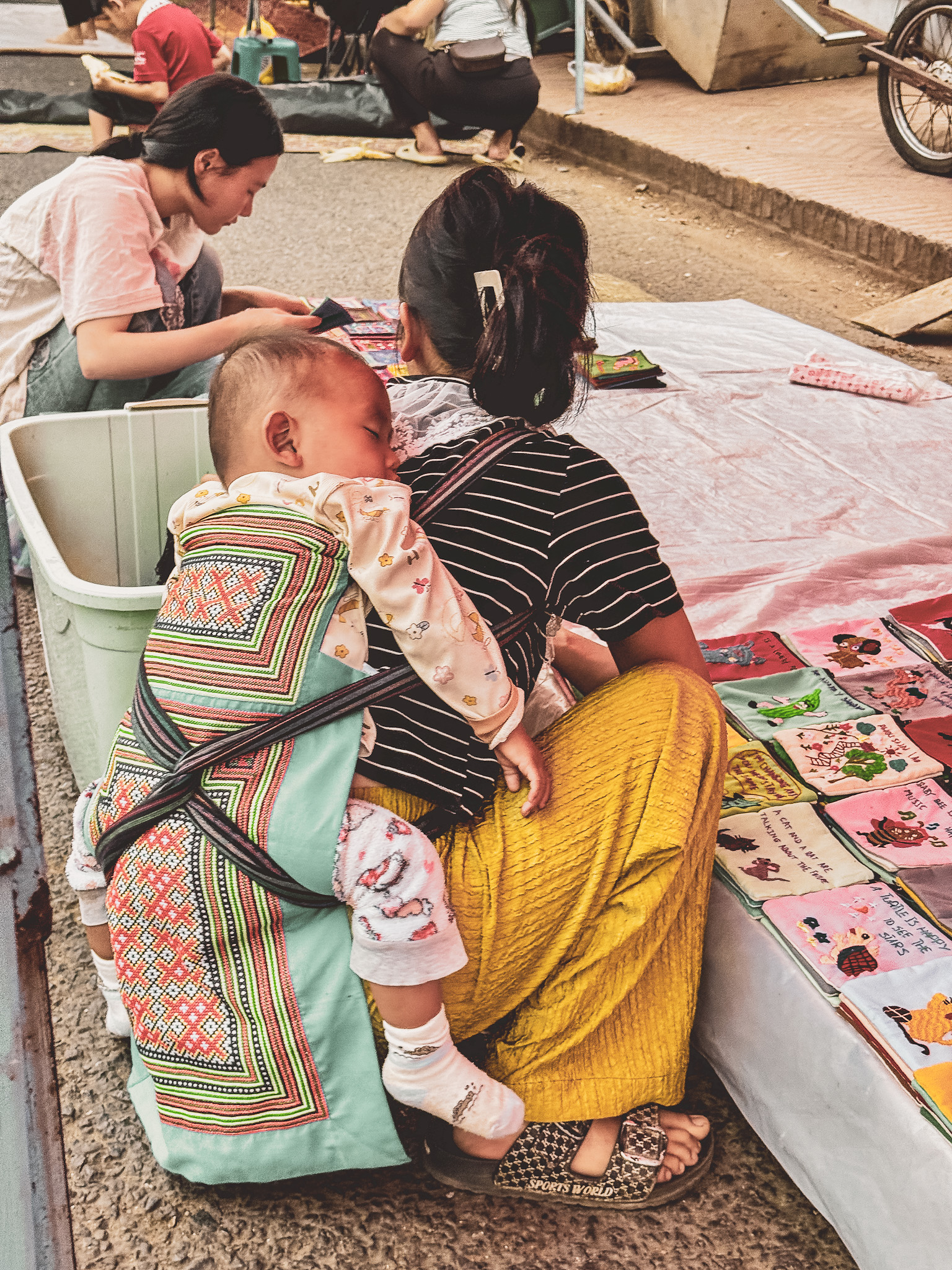
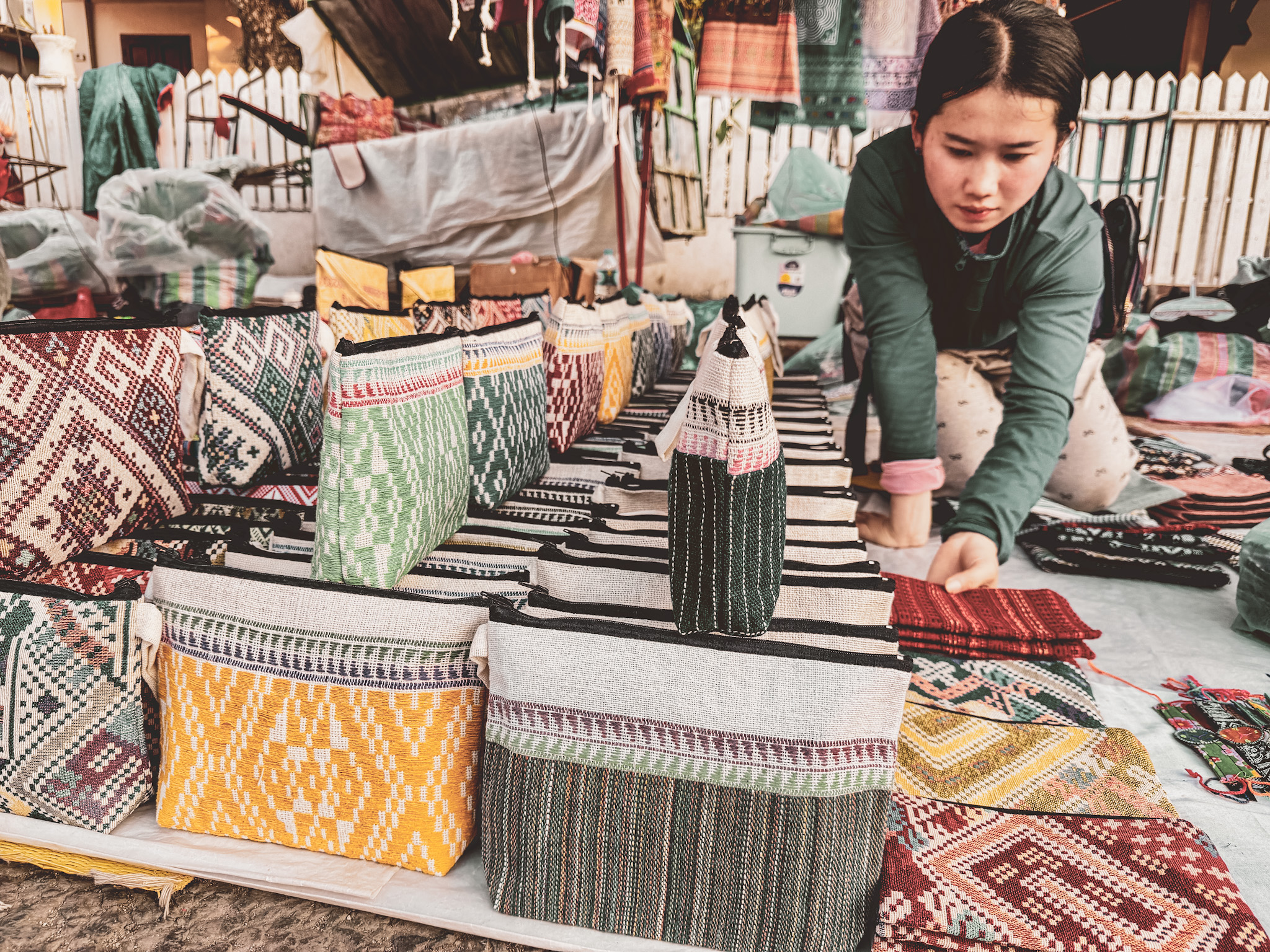
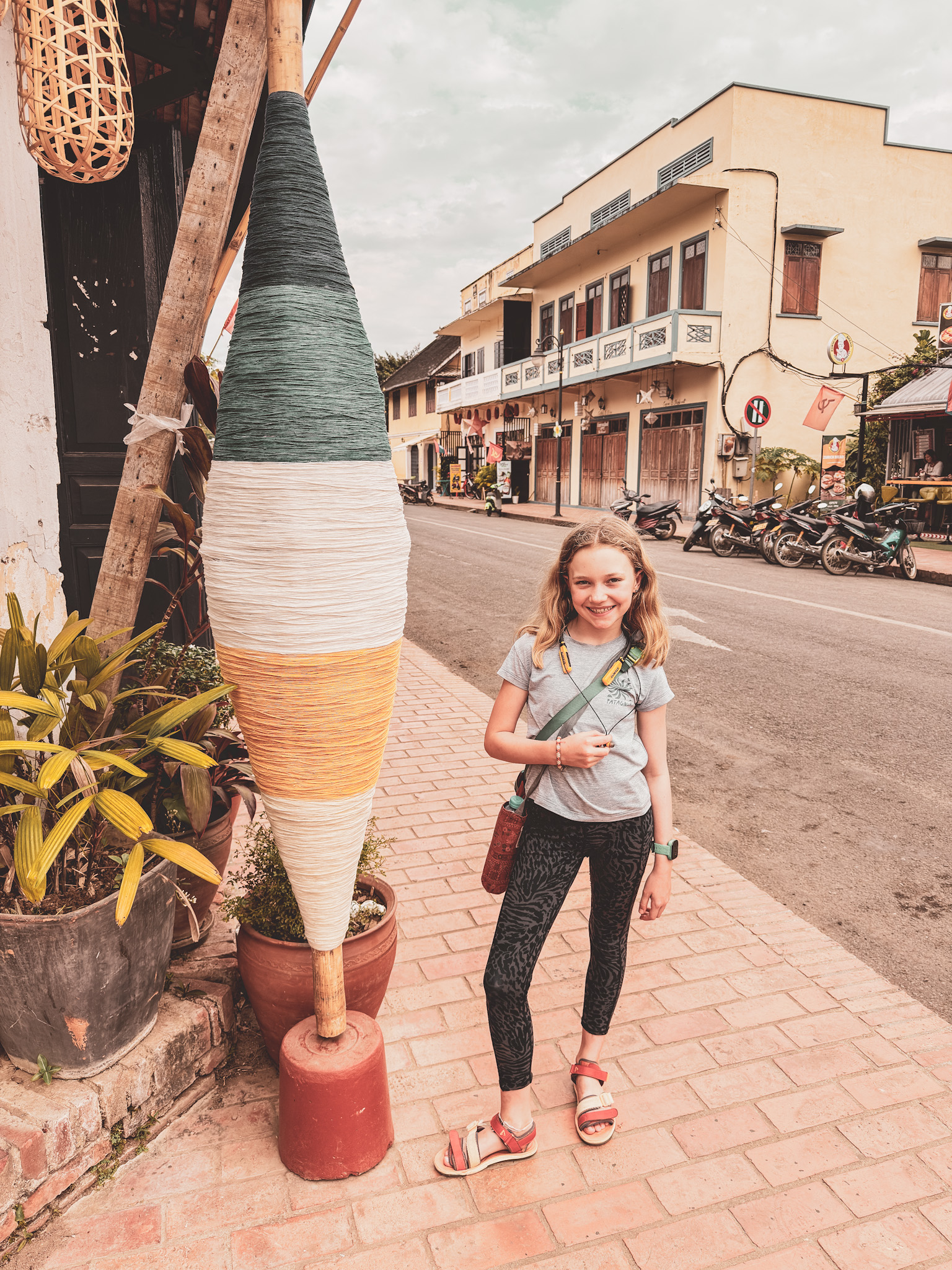
From there we spent an unhurried hour on the main street dipping in and out of shops selling the traditional handcrafts for which the region is known—intricately woven silk and cotton brocades, carved wood, finely worked silver jewelry.
That’s when we saw it.
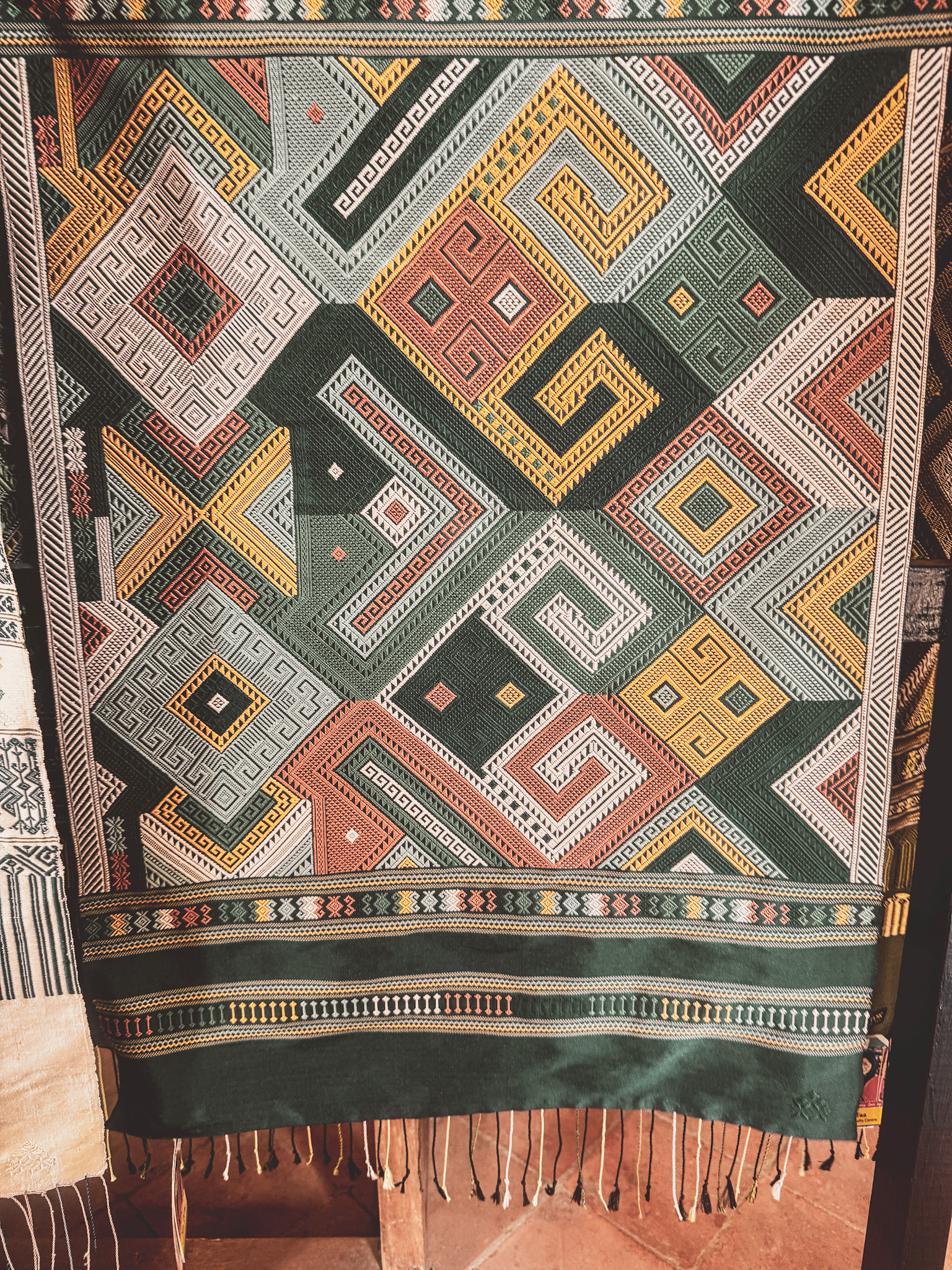
A silk brocade hanging in the window of Ock Pop Tok. Deep blues, greens, and terra-cotta geometric patterns that somehow felt both traditional and modern, handwoven by artisans from ethnic minority villages. We stopped. We stared. We noted the price.
Eyes wide, we kept walking.
But we kept thinking about it too.
The Stories That Explain Everything
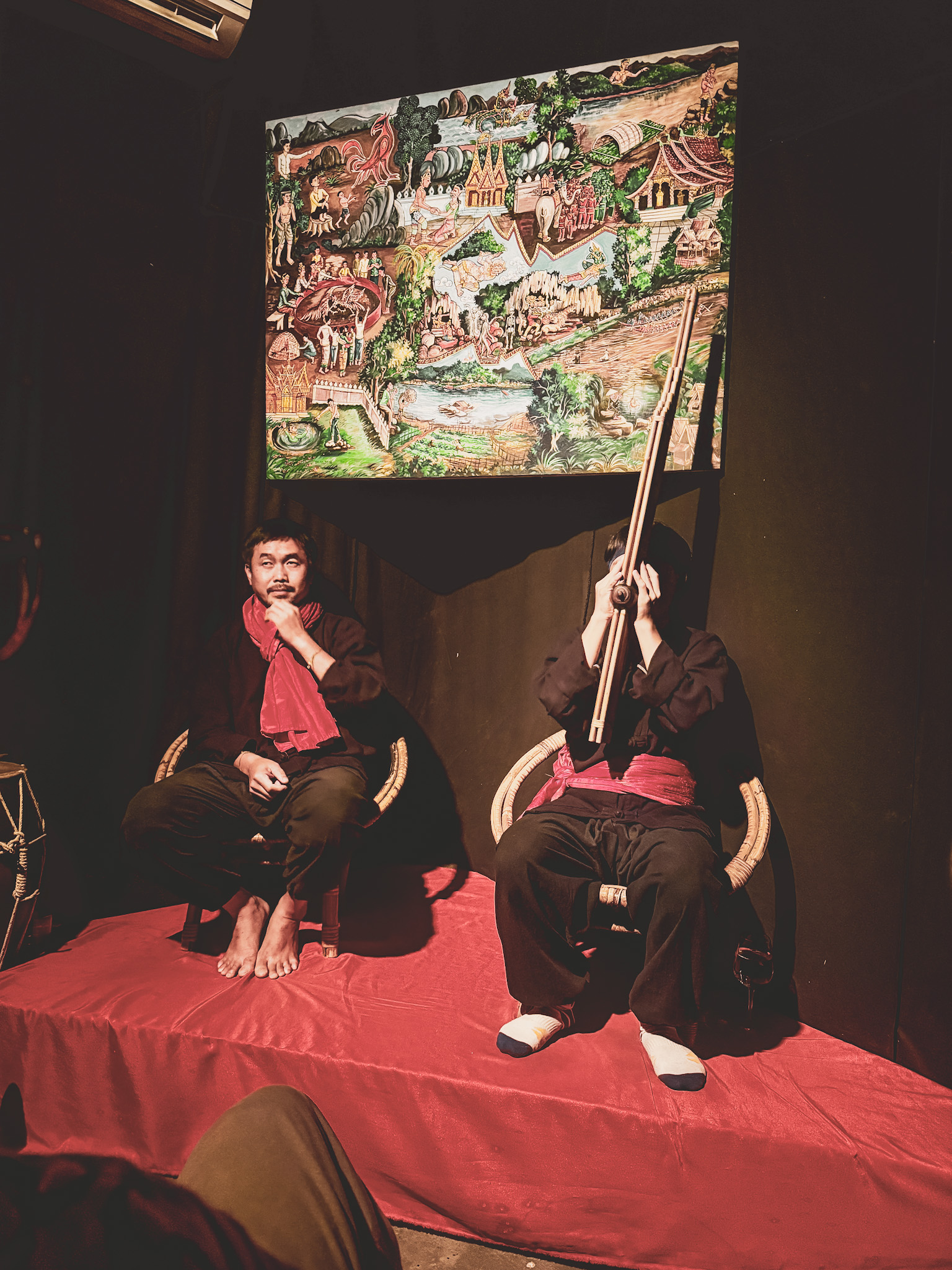
On something of a whim, we ended an afternoon at Garavek, a name that translates to “magical bird” in Lao, a small theater dedicated to preserving traditional Lao storytelling. The venue holds maybe twenty people and the AC runs cold, which in this heat felt like part of the deal.
The show is two men: a storyteller and a khene player. The khene is a handmade bamboo mouth organ, two rows of bamboo reeds set into a hardwood sound box. It has been described as the sound of Laos, because no traditional folk music is without it. It sounds unlike anything we’d heard before: breathy, reedy, both ancient and immediate.
The storyteller, Si Phan, also a co-founder of Garavek, speaks excellent English with an endearing Australian accent and commands the room completely. In one story, a clever trickster maneuvers a blustering king into walking fully clothed into a pond, and Si Phan plays both roles with such commitment you feel the indignation and the satisfaction simultaneously.
The stories cover the origins of local landmarks: how Phousi Hill came to be, why the Mekong bends the way it does, as well as the legends of famous Lao characters like Xieng Mieng, the archetypal trickster, and Fa Ngum, the first king of Lan Xang.
We had no real expectations walking in, and came out feeling like we’d been handed a key we hadn’t known we were missing. The city makes more sense after Garavek.
After the performance ended we talked with Si Phan for a few minutes. He offered his services as a driving tour guide and storyteller. Apparently he takes people around the region this way, and we swapped WhatsApp contacts with a genuine sense that we’d be back in touch.
Learning Through Doing
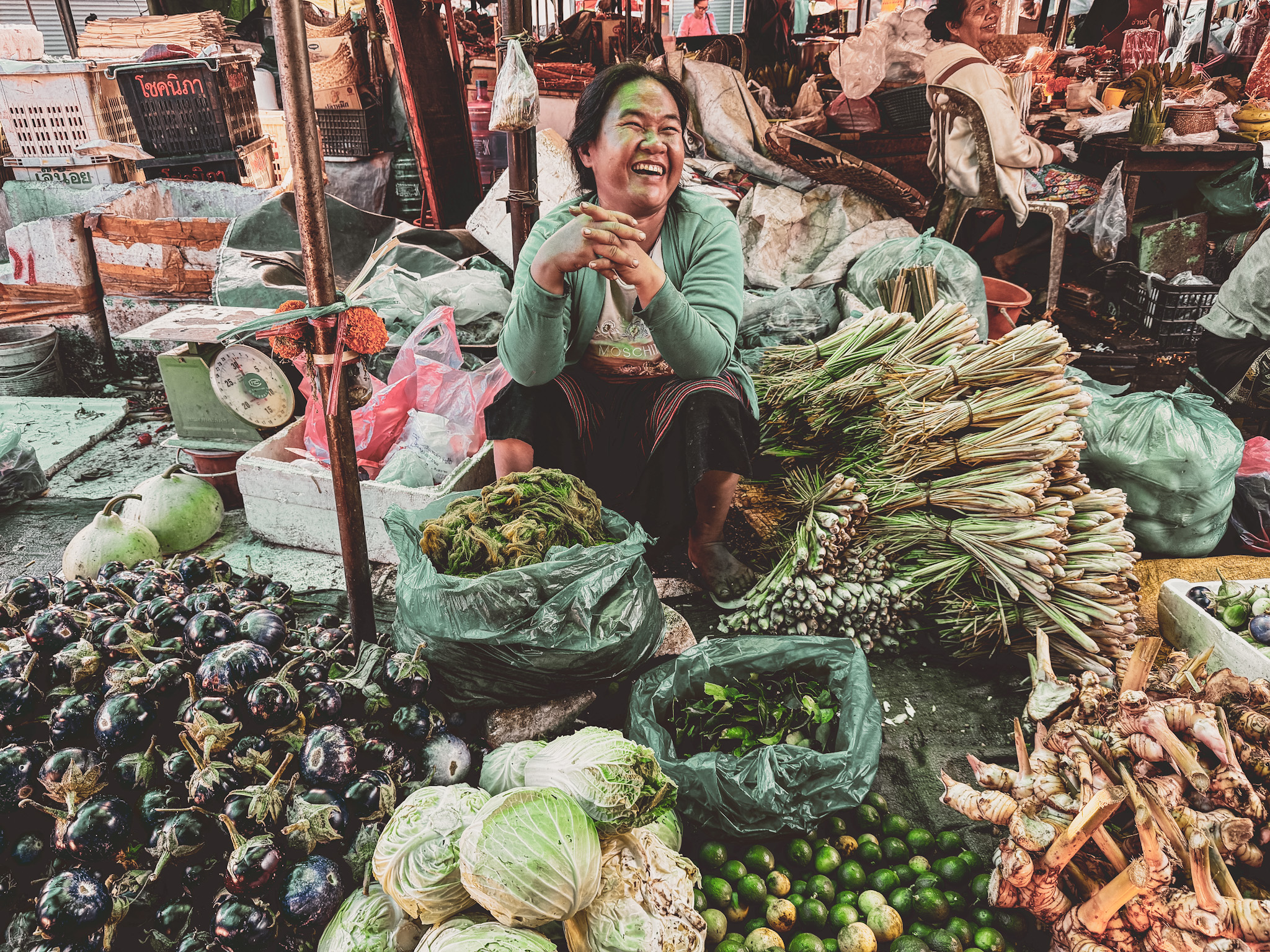
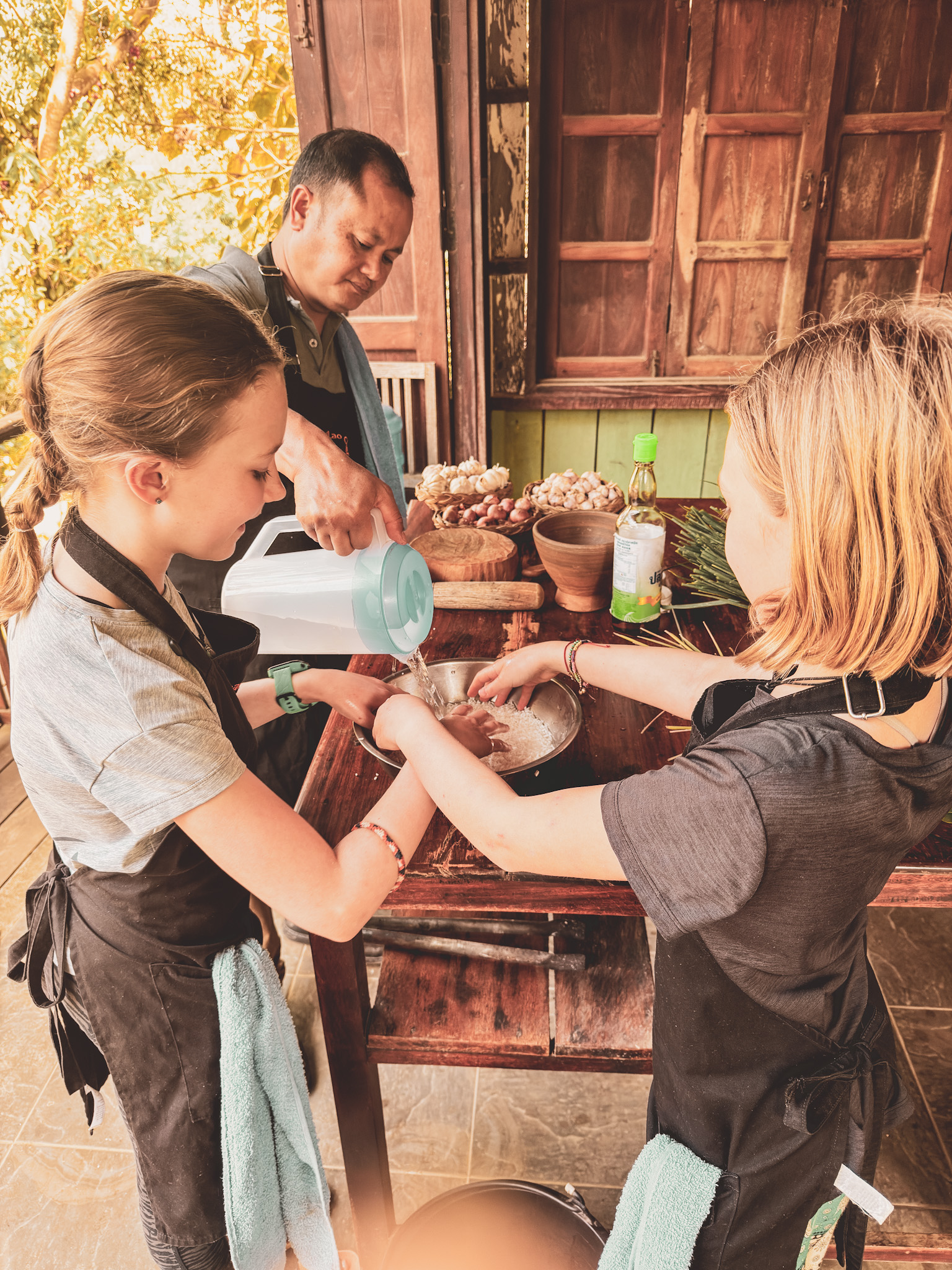
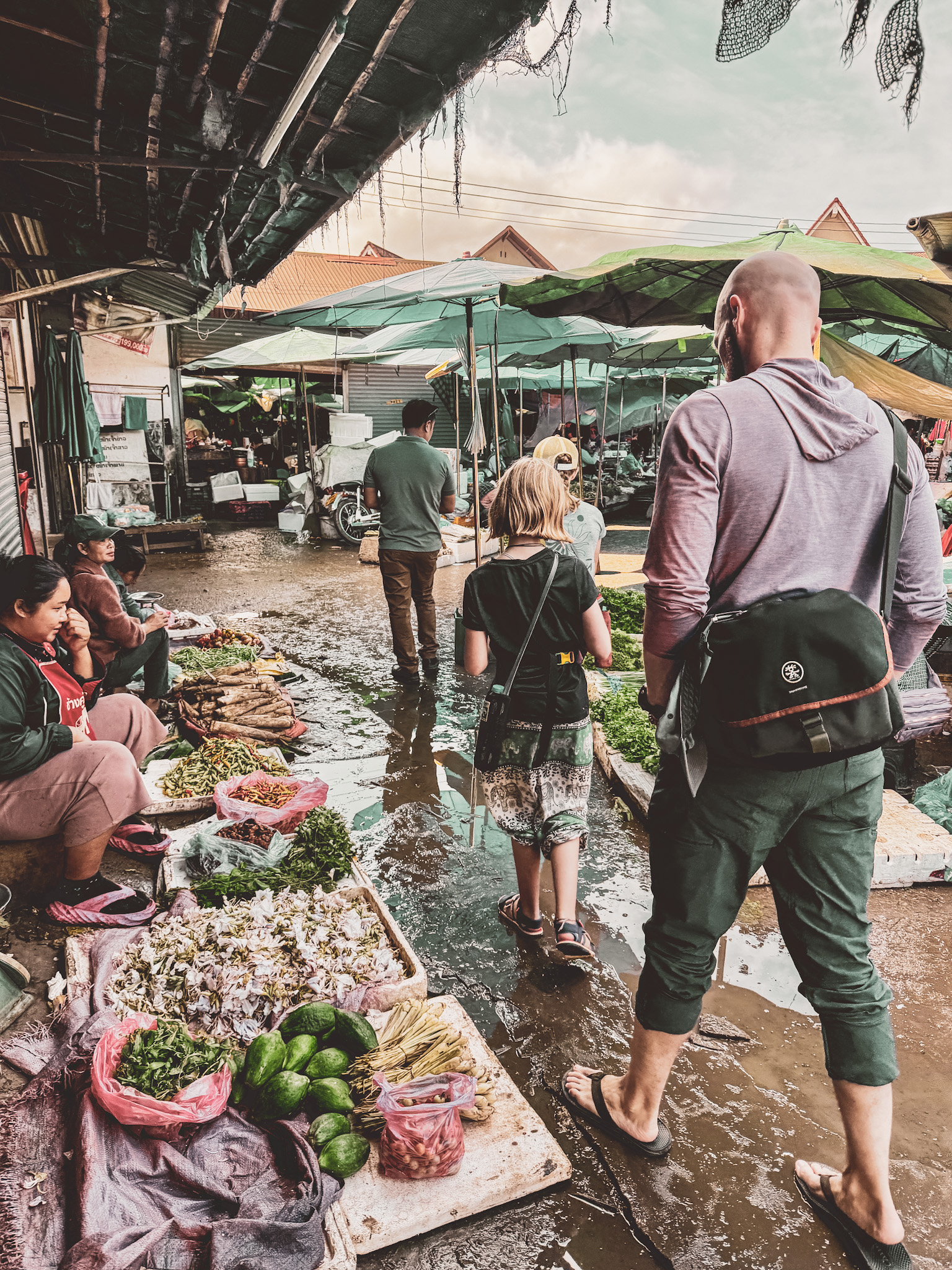
But first we enjoyed our first-ever private family cooking class, which began with a market tour. Not the small street market that appears each morning, but Phosy Market, the largest market in Luang Prabang, open from 5:00 AM until late afternoon and serving as the main supply hub for the entire town.
We worked our way through it with our chef-guide, Joy, picking up ingredients and snacks for the day ahead: deep fried bell peppers, bamboo shoots, and, this requires some explanation, “cat poop”.
Which is not cat poop. In Laos, khao nom maeo translates loosely to “cat feces candy,” a name that exists purely to describe its appearance: small, dark, lumpy coconut confections that look alarmingly like exactly what they’re named for and thankfully taste nothing like it. The girls were delighted.
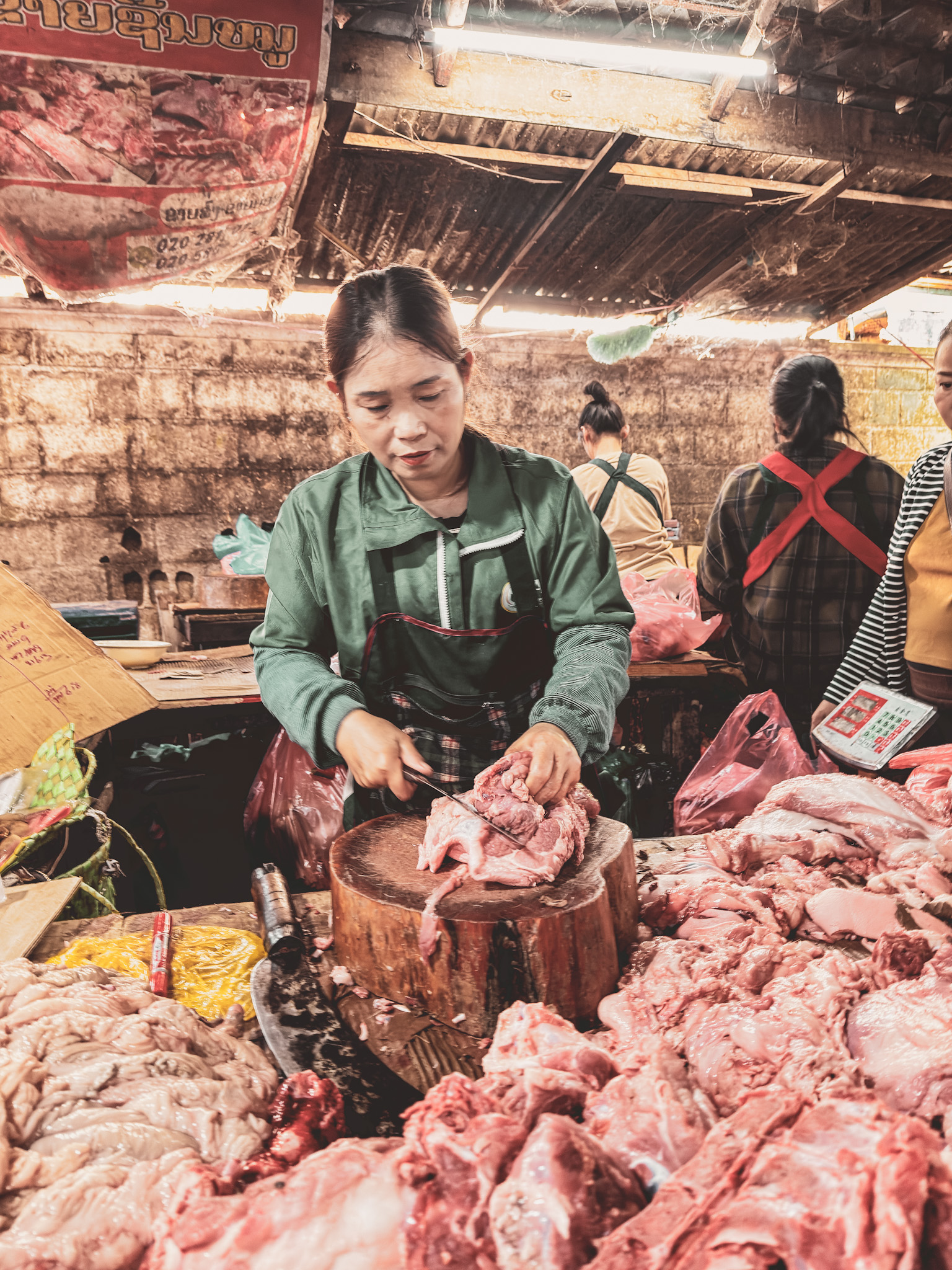
The meat section was something else. Fish, chicken, pork, beef, water buffalo. But what set this apart from any market we’d visited before were the secondary animal products. Fermented fish sauce that smelled like someone had left a bait bucket in a hot car for a week. Literal buckets of blood. Reused plastic water bottles filled with bile. Trays of fat. Strips of hair-covered buffalo skin laid out flat and matter-of-fact. No part of a slaughtered animal went unused in Laos, one of the poorest countries in Southeast Asia.
The girls cycled through a sustained series of “oh my gods” as we moved through it.
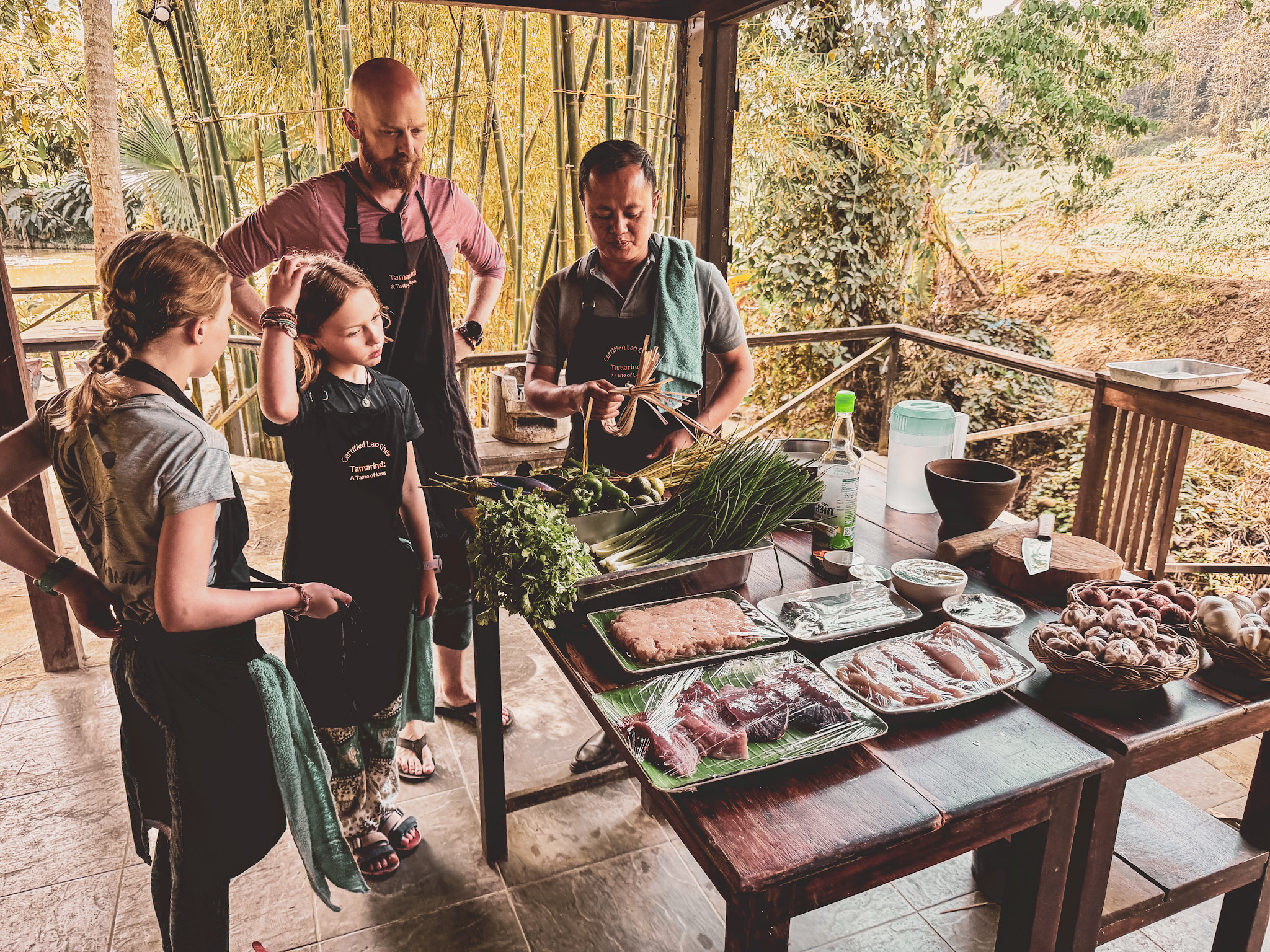
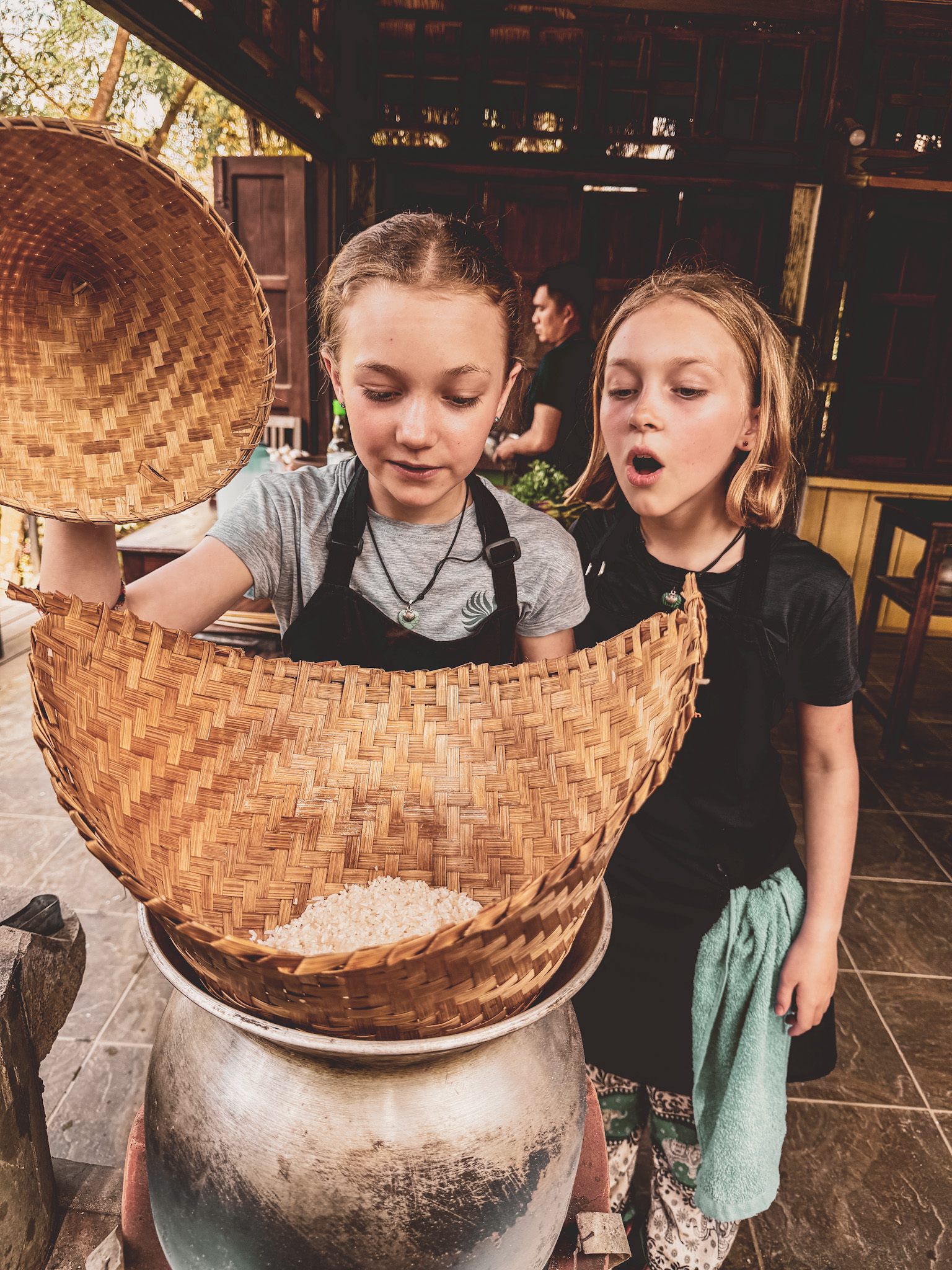
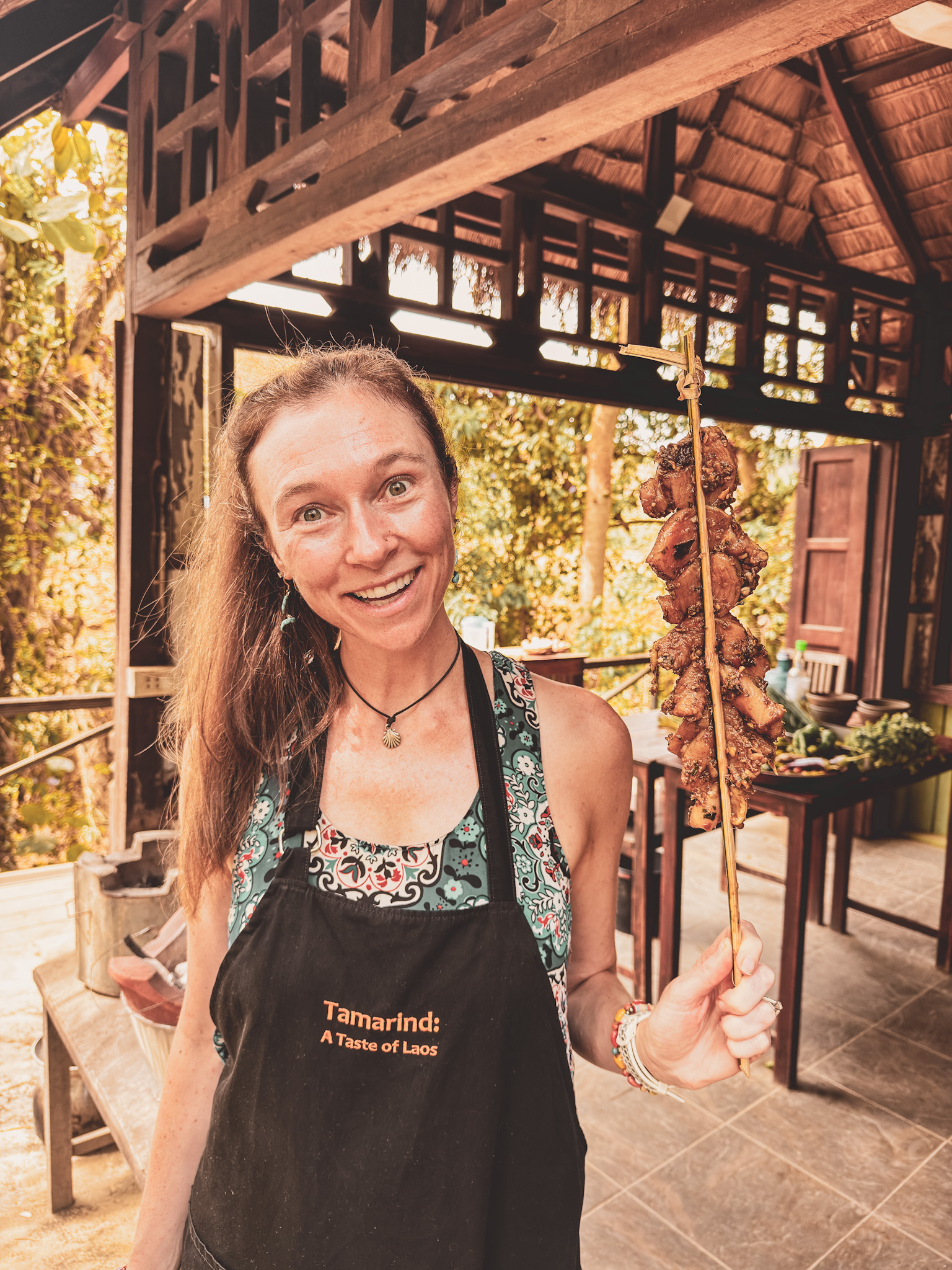
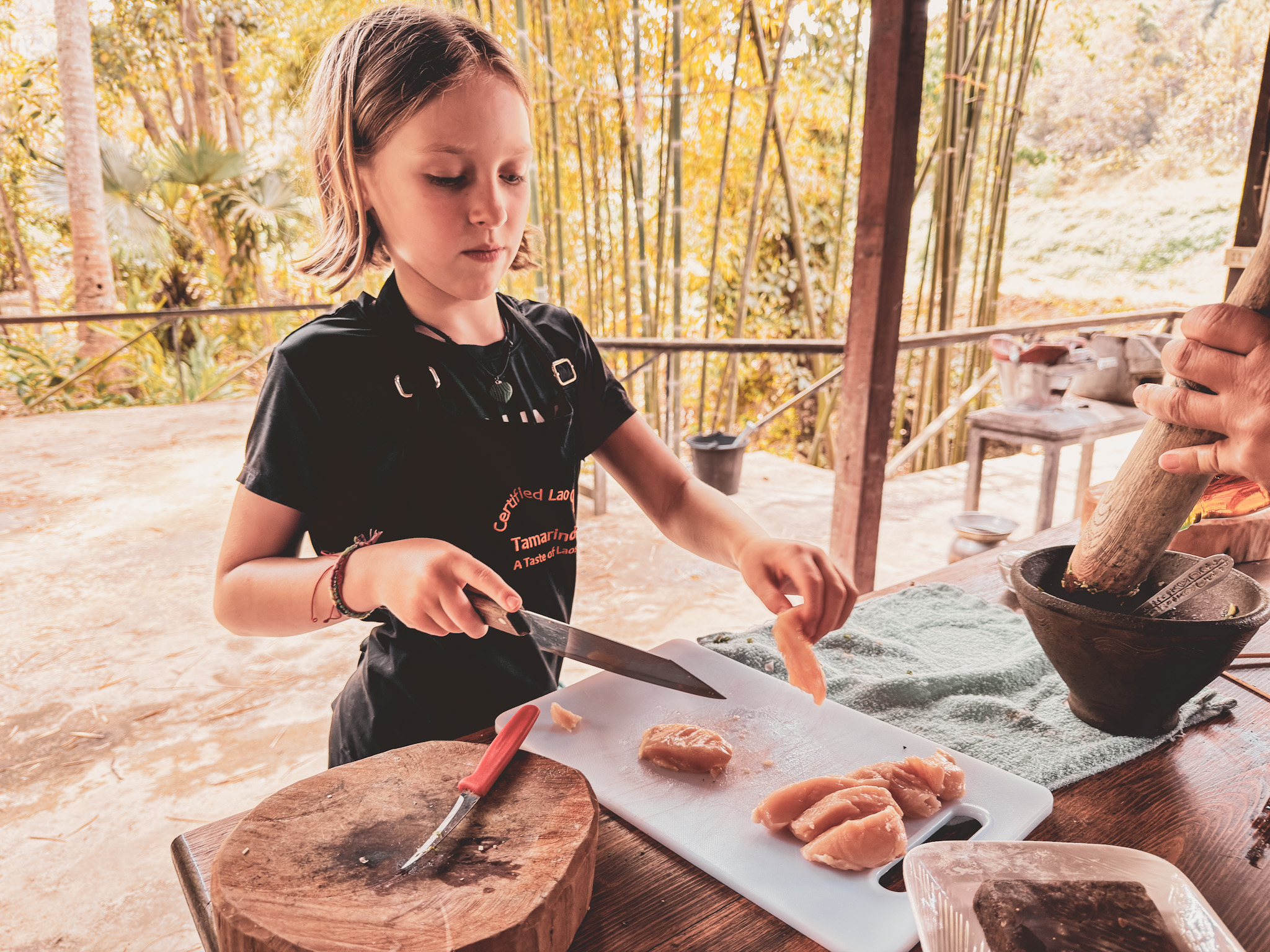
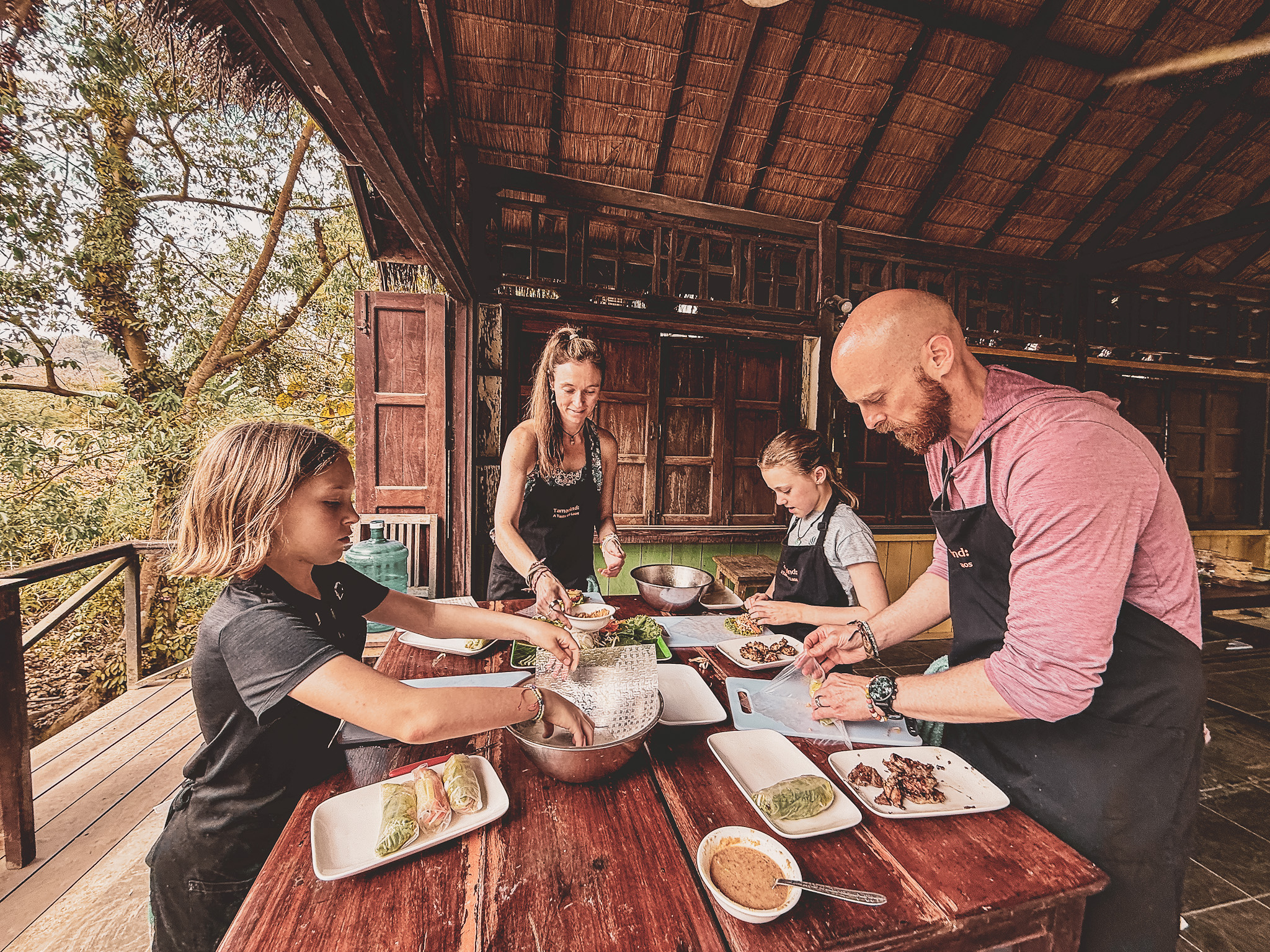
After gathering everything we needed, our guide loaded us into a van and drove us about twenty minutes out of town to Tamarind’s dedicated cooking school, a grass-roofed open-air sala set among lily ponds in the countryside. Joy Ngeuamboupha, Tamarind’s head chef and the same man who once cooked alongside Gordon Ramsay for a National Geographic episode, walked us through the plan for the day.
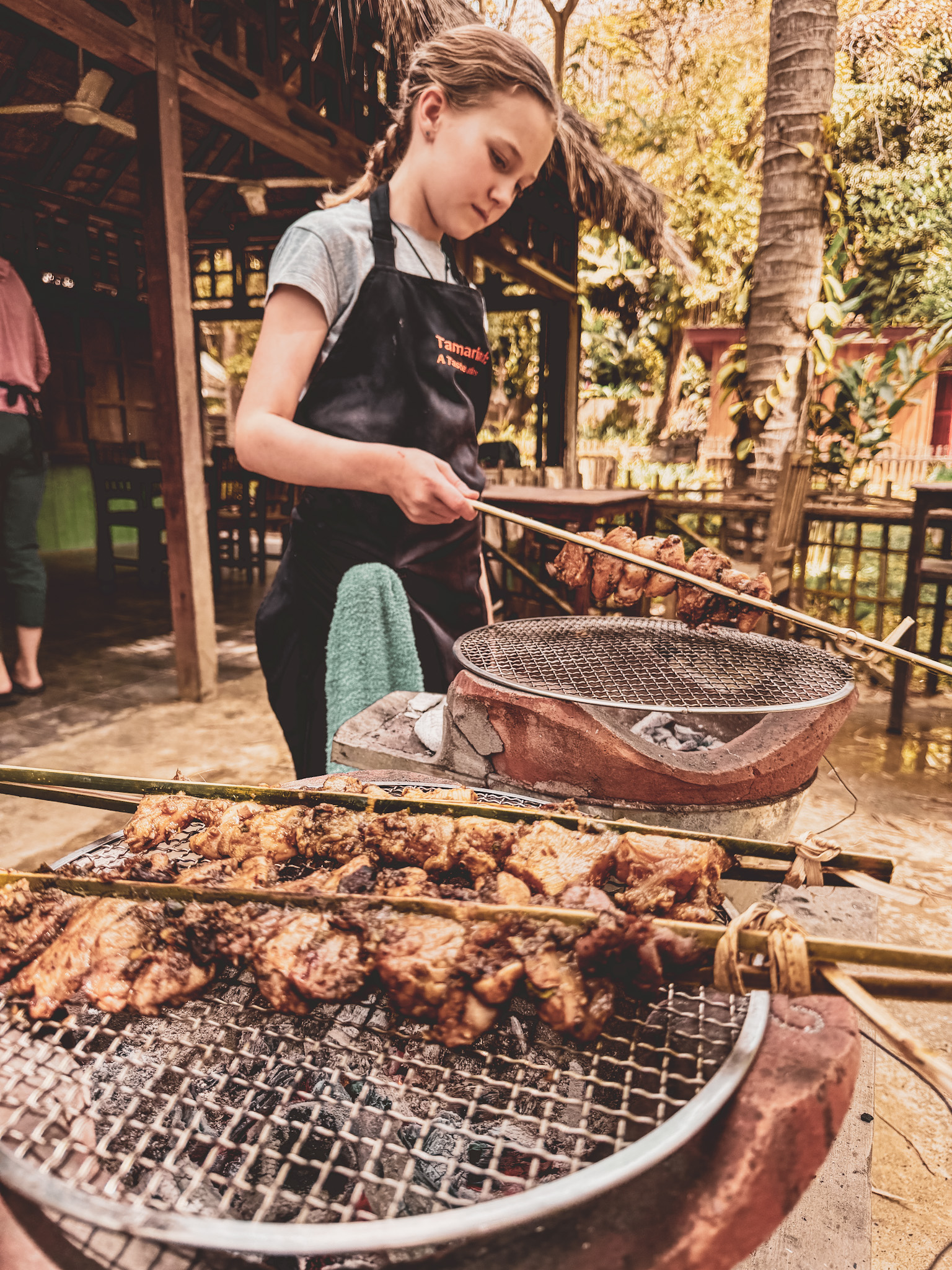
Four dishes: jeow mak keua (roasted eggplant dip), ping moo som (grilled soured pork), feuang sot (fresh spring rolls), and kai sap yat sai takai thot (deep-fried lemongrass stalks stuffed with seasoned ground chicken).
The girls were remarkable. They had their own stations from the start, did all their own prep and knife work, assembled everything themselves, and handled most of the cooking without asking for help.
Watching them work seriously and confidently in a real kitchen, in Laos, making dishes they’d never heard of, was one of those moments that catches you a bit off guard.
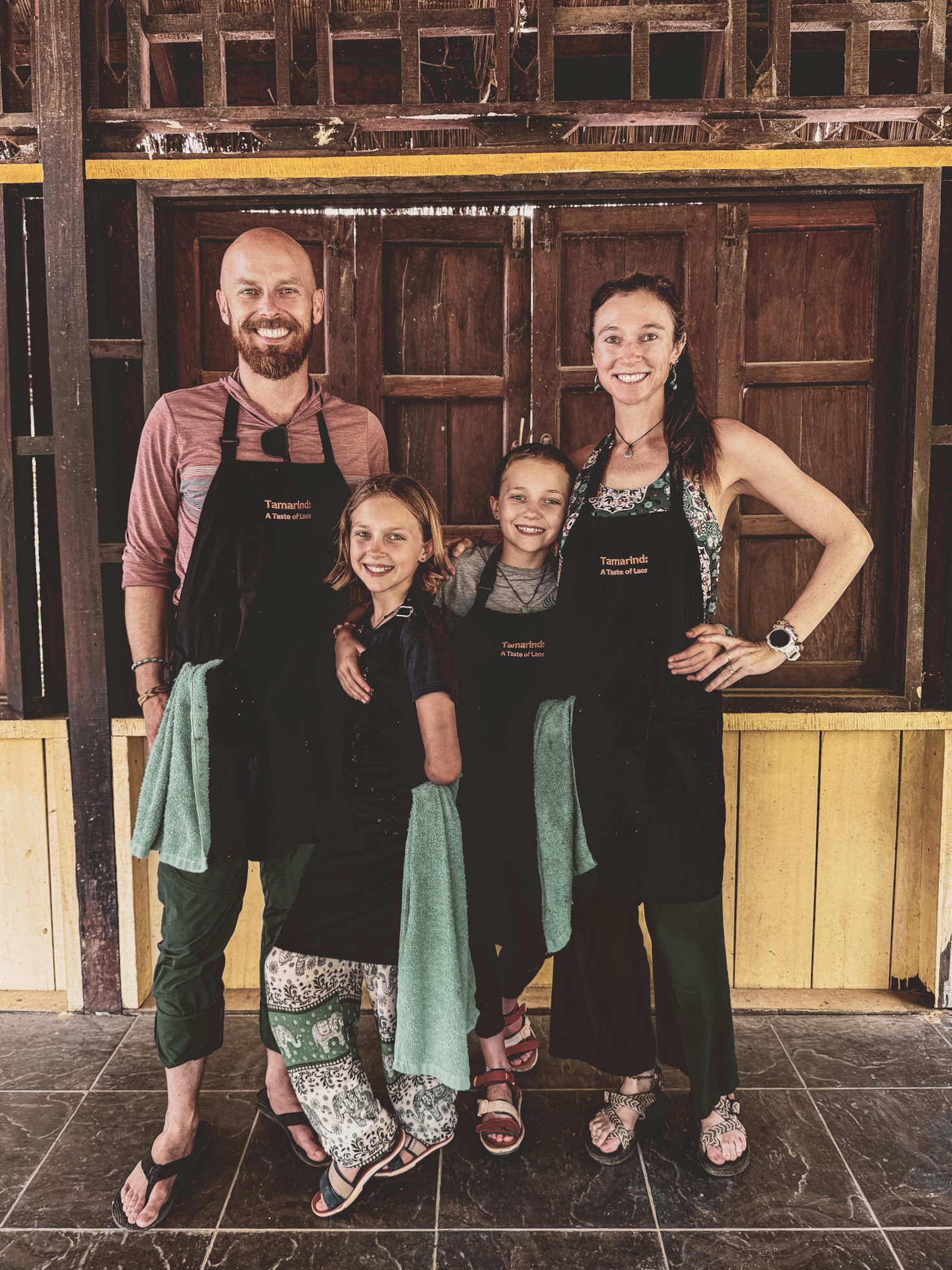
Two hours later we brought everything to the table and ate until we absolutely should have stopped, and then kept going. The ride back into town with full bellies and smiling faces was evidence of a good day.
The Morning Alms
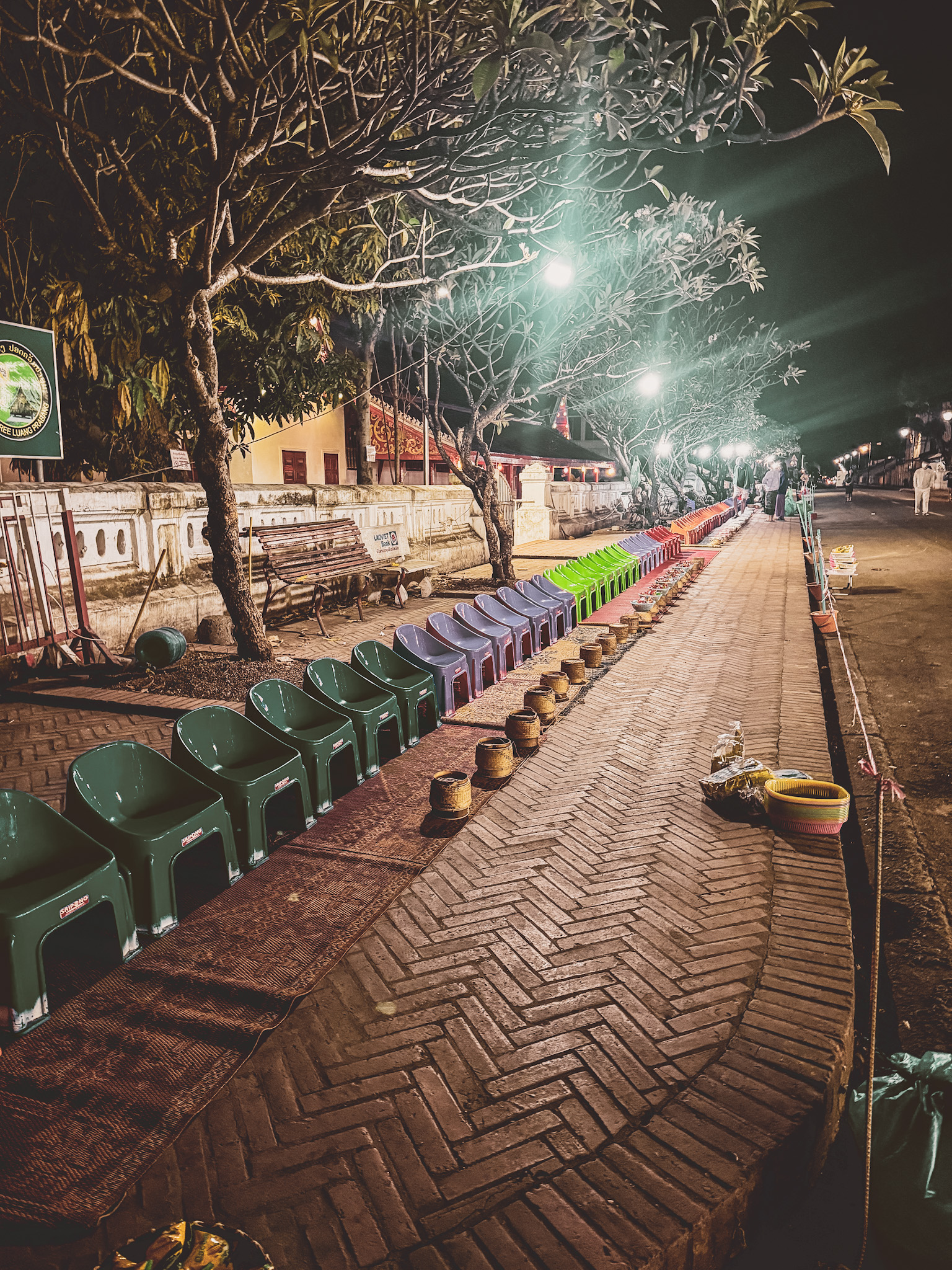
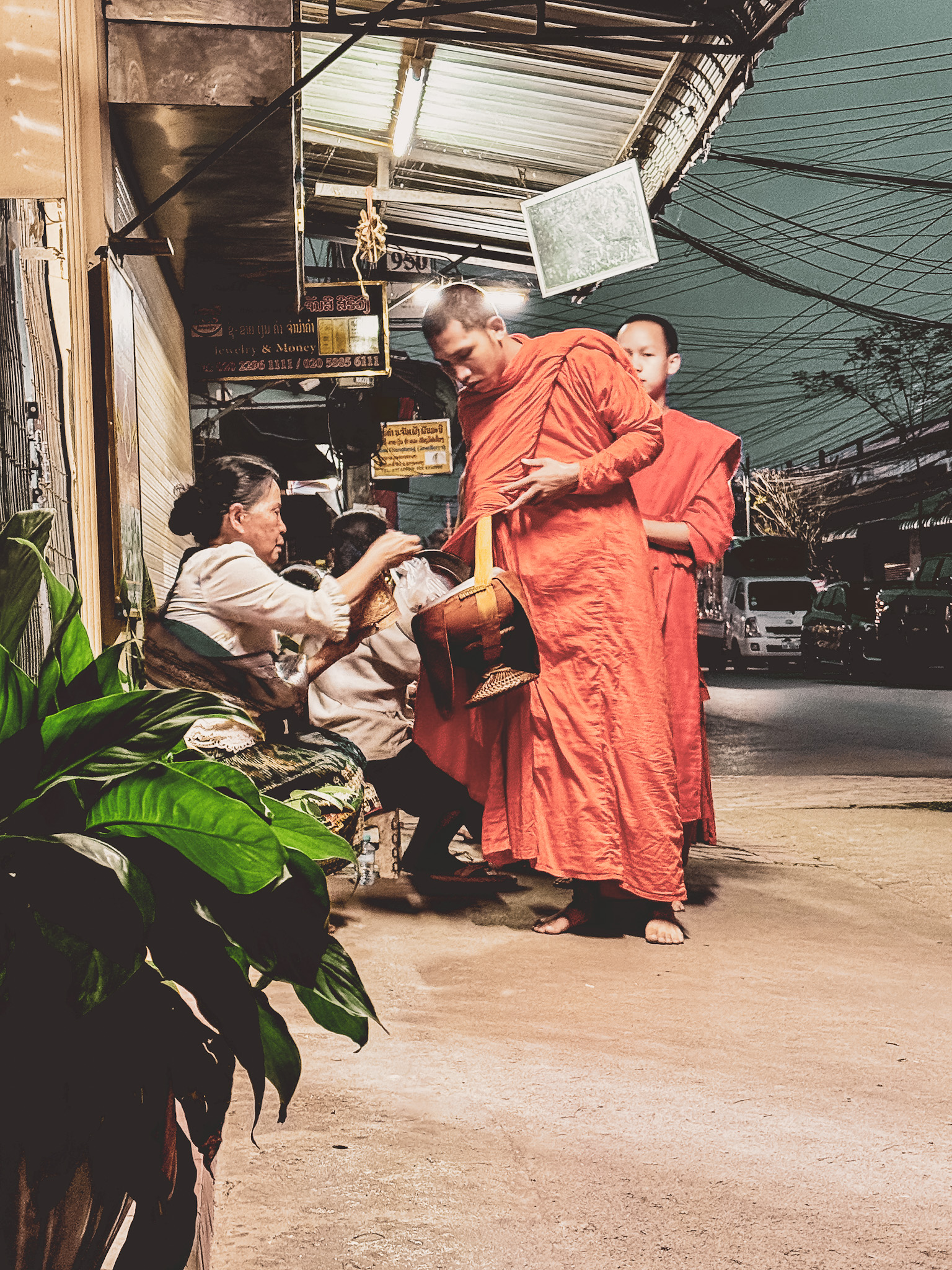
One morning we actually made it out of bed at 5:00 AM for the tak bat, the morning alms procession.
We chose Wat Wisunnarat, a lesser-known temple we’d picked specifically to avoid the crowds that descend on the more famous spots. We wanted something that felt real rather than staged.
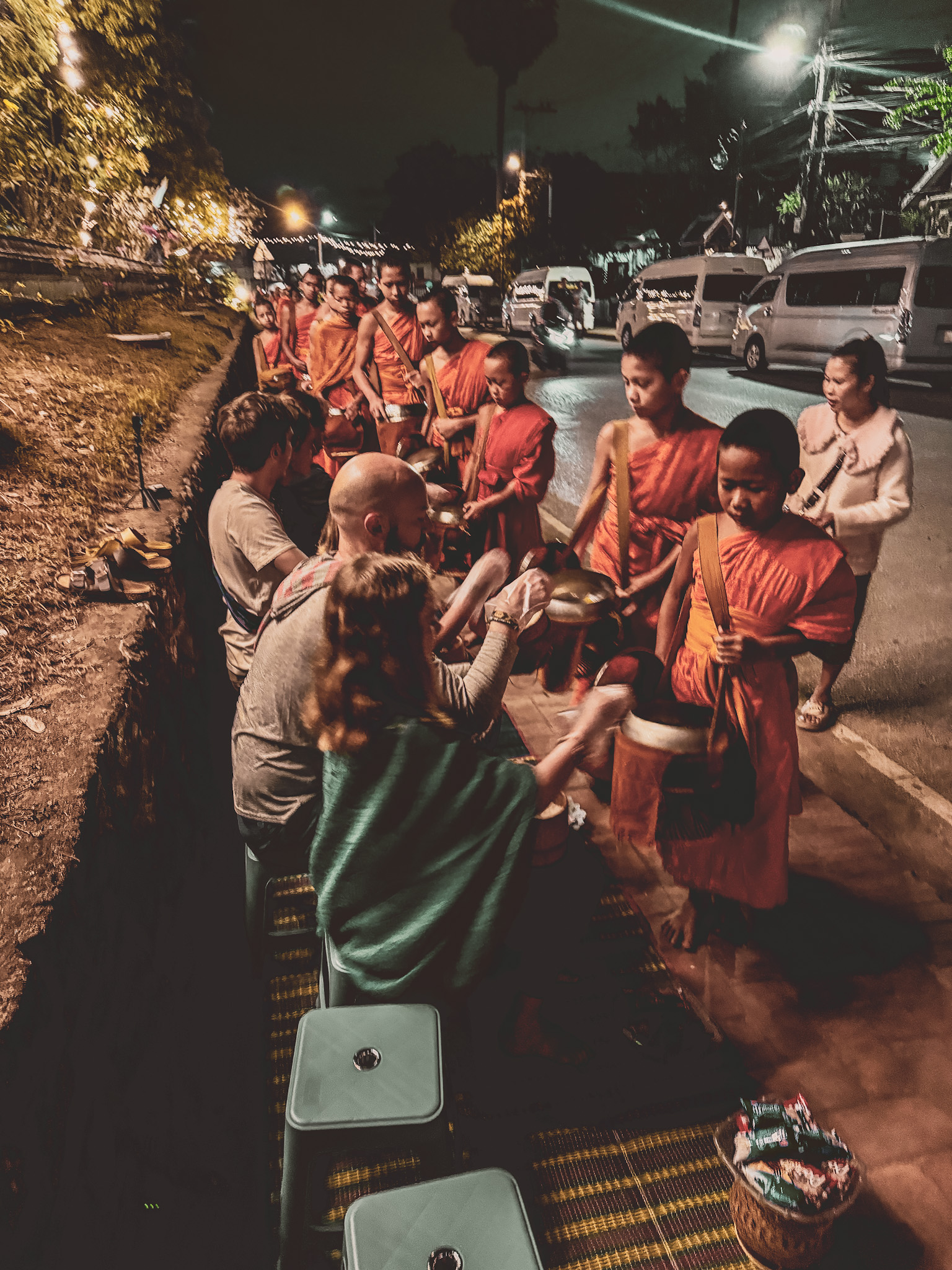
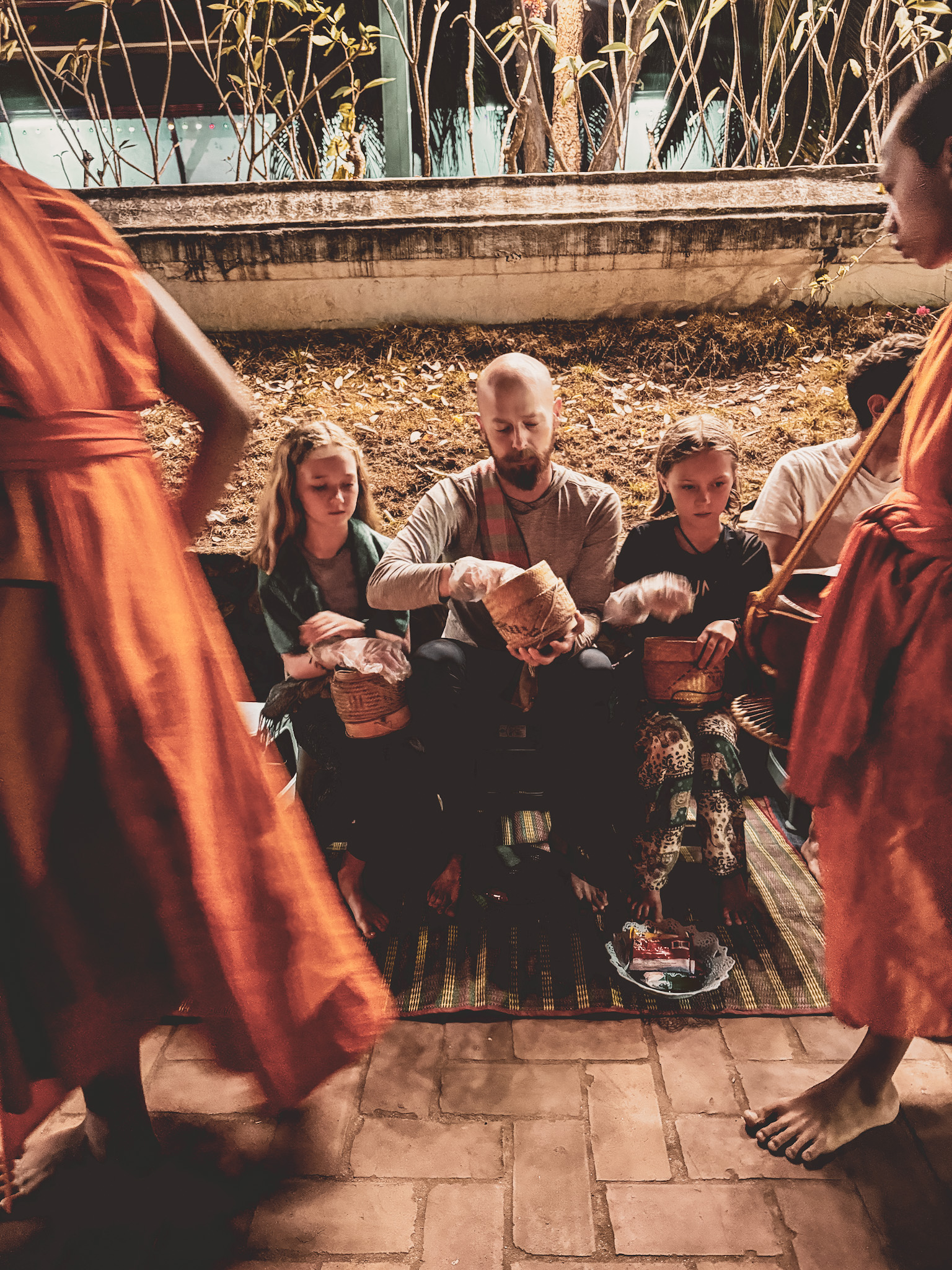
We paid a few dollars each to a local woman who had set up a mat on the sidewalk with small plastic chairs and supplied us with baskets of sticky rice. Then we sat in the dark and waited.
Slowly, gold-robed figures began to materialize from the darkness. The only sounds were the shuffle of bare feet on the sidewalk and the soft metallic clink of alms bowl lids being lifted and replaced. As the monks reached us, we pulled out small balls of sticky rice to place into each outstretched bowl.
The line was long. You had to pace yourself. Arya ran out first, then Max, and finally Finlee placed her last ball of rice into a bowl, and we pressed our palms together and bowed as the remaining monks passed.
Just like that, it was over.
There’s always a question about whether it’s appropriate to participate in a ceremony like this when you don’t claim to be a Buddhist yourself. But we’ve settled on this: as long as we’re respecting the tradition and the spirit behind it, there’s no harm, and maybe even some small good.
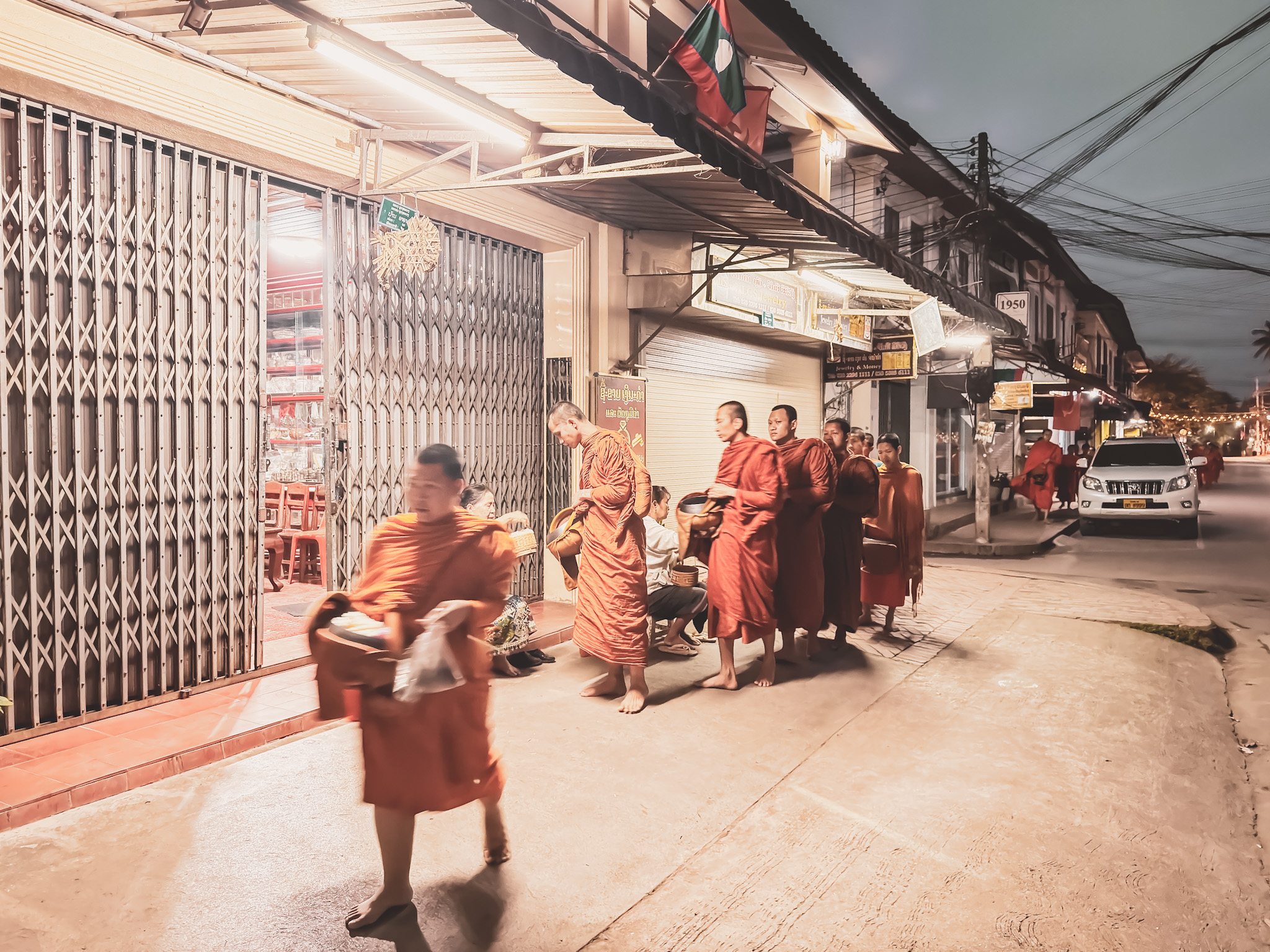
We took a meandering route back toward the guesthouse, and that’s when something unplanned happened. On a random backstreet we turned a corner and found a small group of older women sitting in front of their shopfronts, preparing to receive a line of monks.
After all the monks had received their offerings, instead of moving on they turned and lined up facing the women. Then they began to chant.
The chant is a Pali blessing, the monks giving back to the people who gave to them, offering protection and merit for the day ahead. The women bowed their heads with what can only be described as deep, unhurried gratitude.
The rhythmic rise and fall of the chant gave us goosebumps. To these women it was probably just another Thursday morning. To us it felt like a rare thing, uplifting in a way we’re still struggling to put words to.
And then, as quickly as it had started, it was done.
It wasn’t even 7:00 AM. The morning had already delivered more than most full days.
The Brocade Returns
We kept walking past Ock Pop Tok.
Every time we were on Sakkaline road, we’d slow down near the window. We’d look. We’d talk ourselves out of it. We’d keep walking.
We checked the night market for something similar. We checked every boutique on the main street for a comparable textile. Nothing came close.
The brocade had taken up permanent residence in our heads. We kept telling ourselves that the budget just didn’t have room for it, and we kept walking away.
Dyeing to Learn
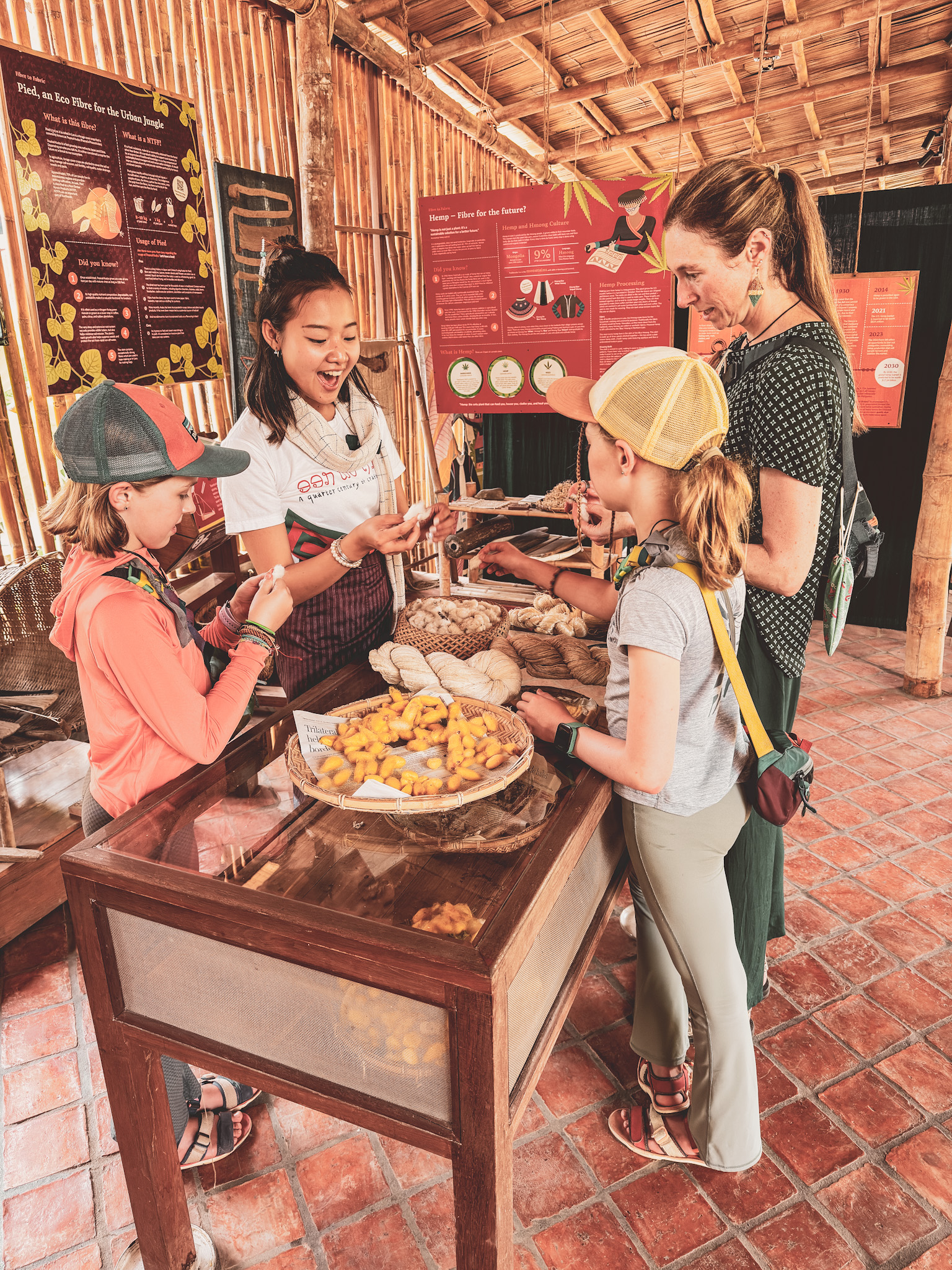
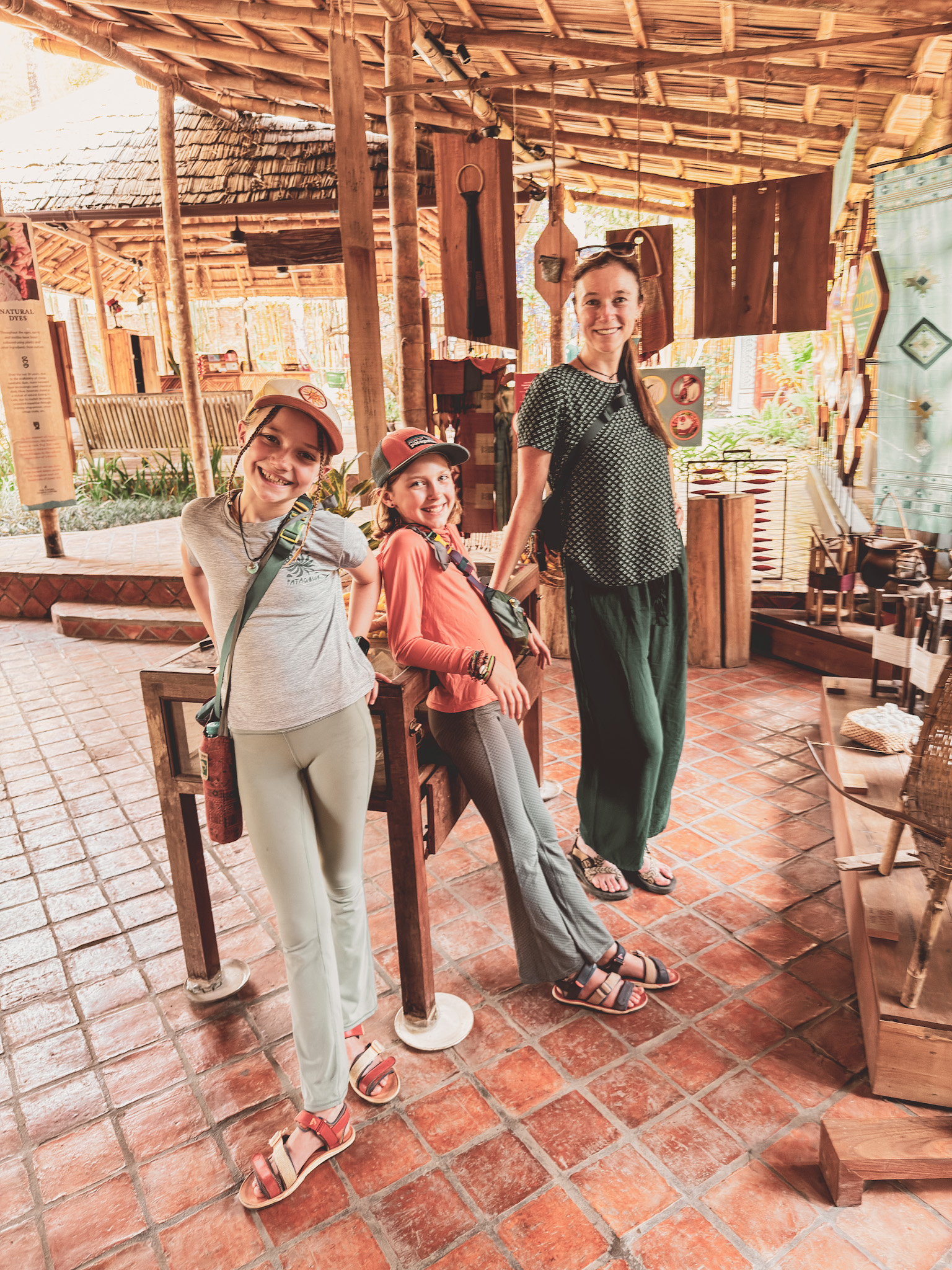
One afternoon we took a class at Ock Pop Tok’s Living Crafts Centre on the Mekong.
Ock Pop Tok means “East Meets West” in Lao, a name that reflects its origins as a partnership between British entrepreneur Joanna Smith and Lao weaver Veomanee Douangdala, established in 2000. More than 400 women from ethnic communities and minority villages across 11 Lao provinces have come through their Village Weavers Project, which works to keep disappearing techniques alive.
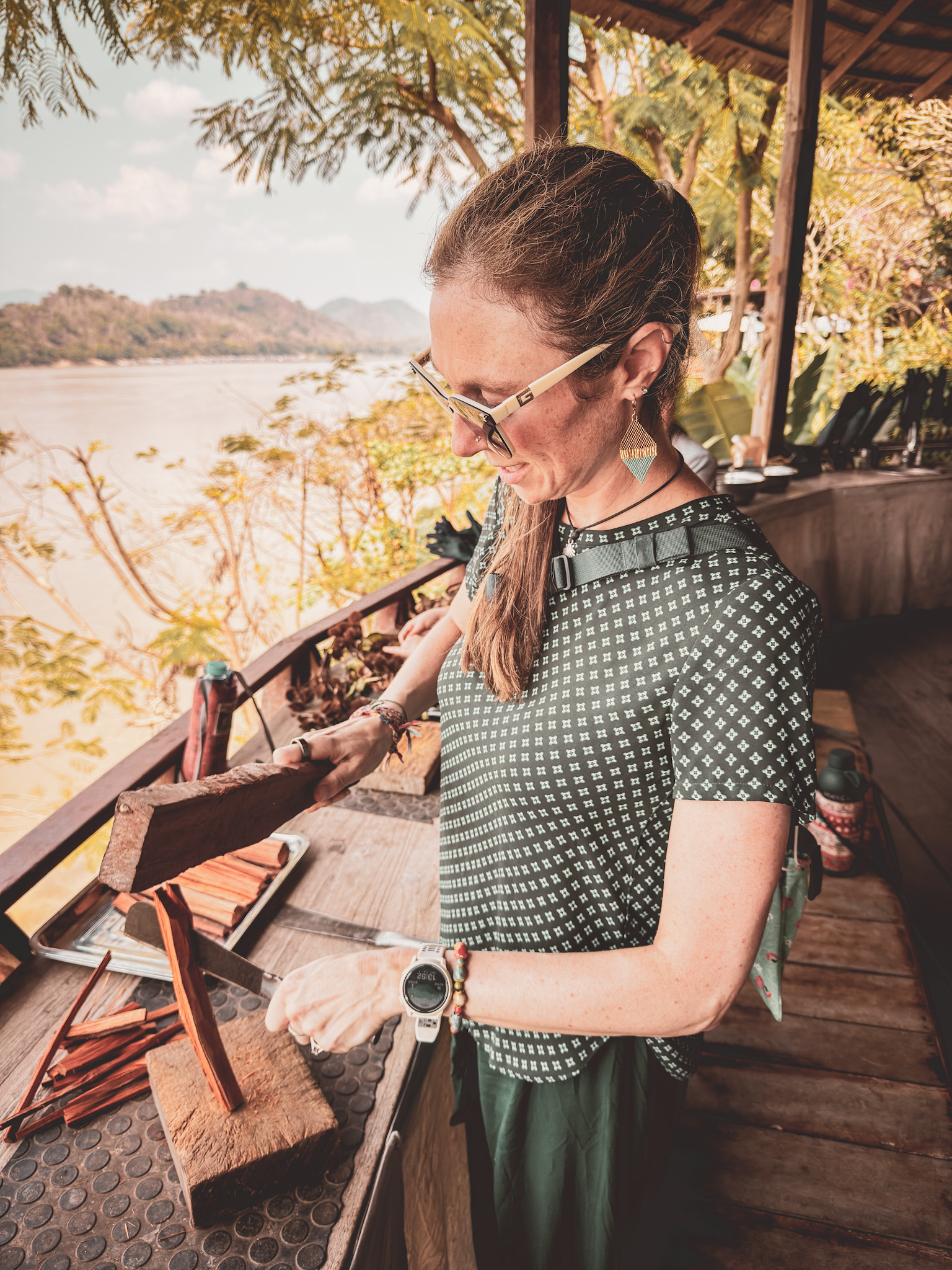
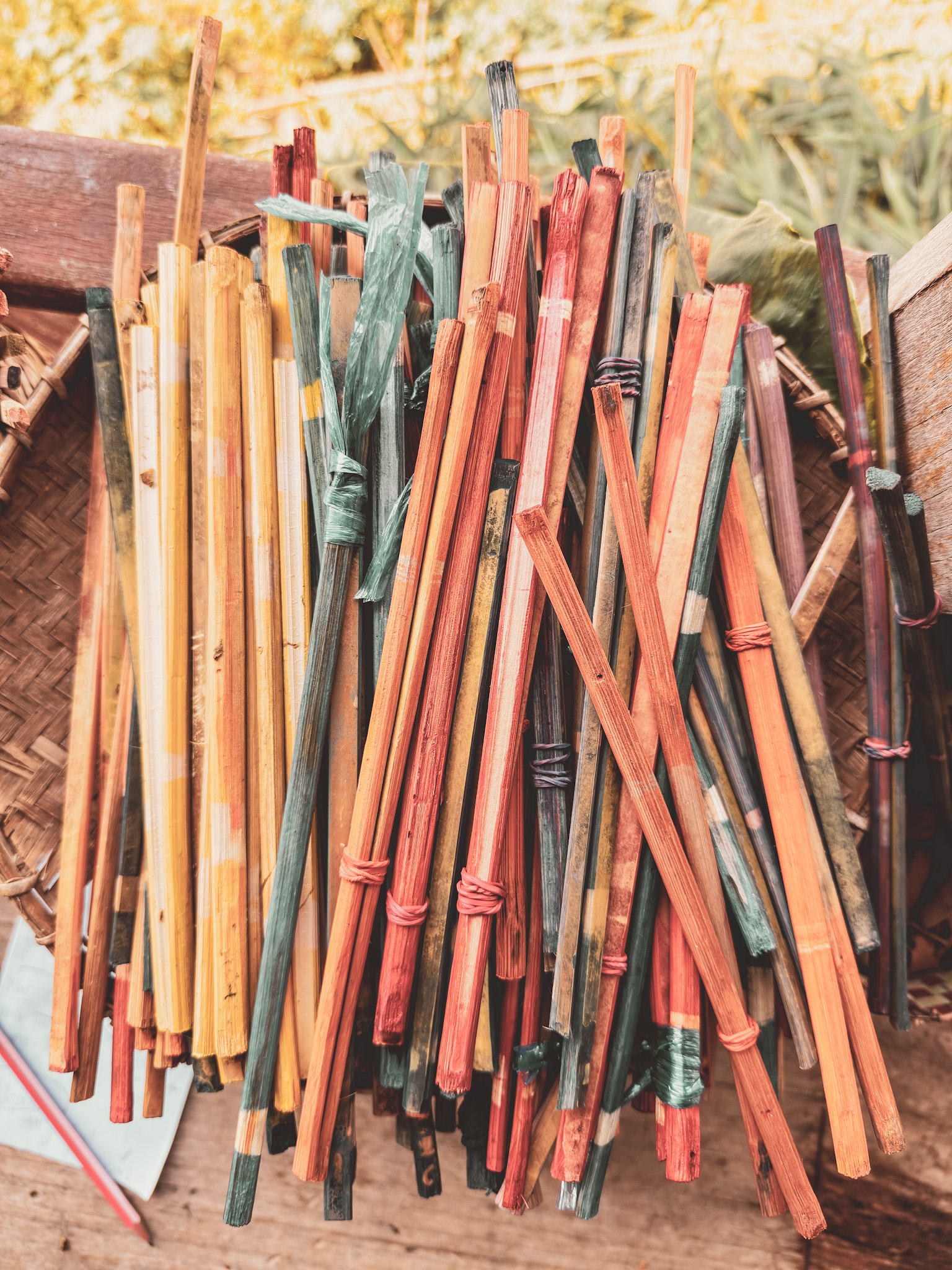
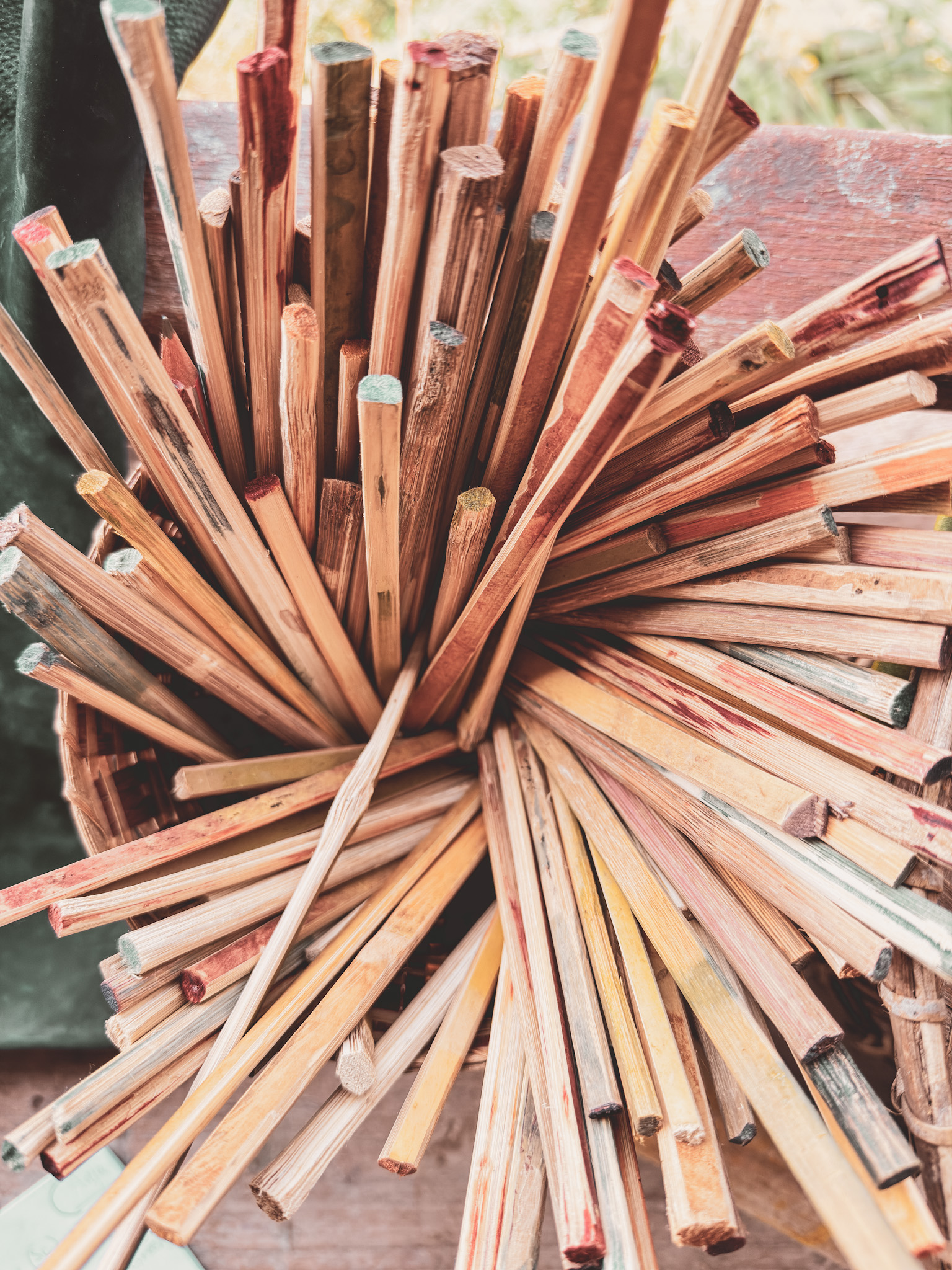
The afternoon class covered the full arc of Lao textile production: silk, hemp, cotton, and kudzu vine—starting from the source with plants and silk worms and finishing with the natural dyes that give Lao textiles their distinctive palette.
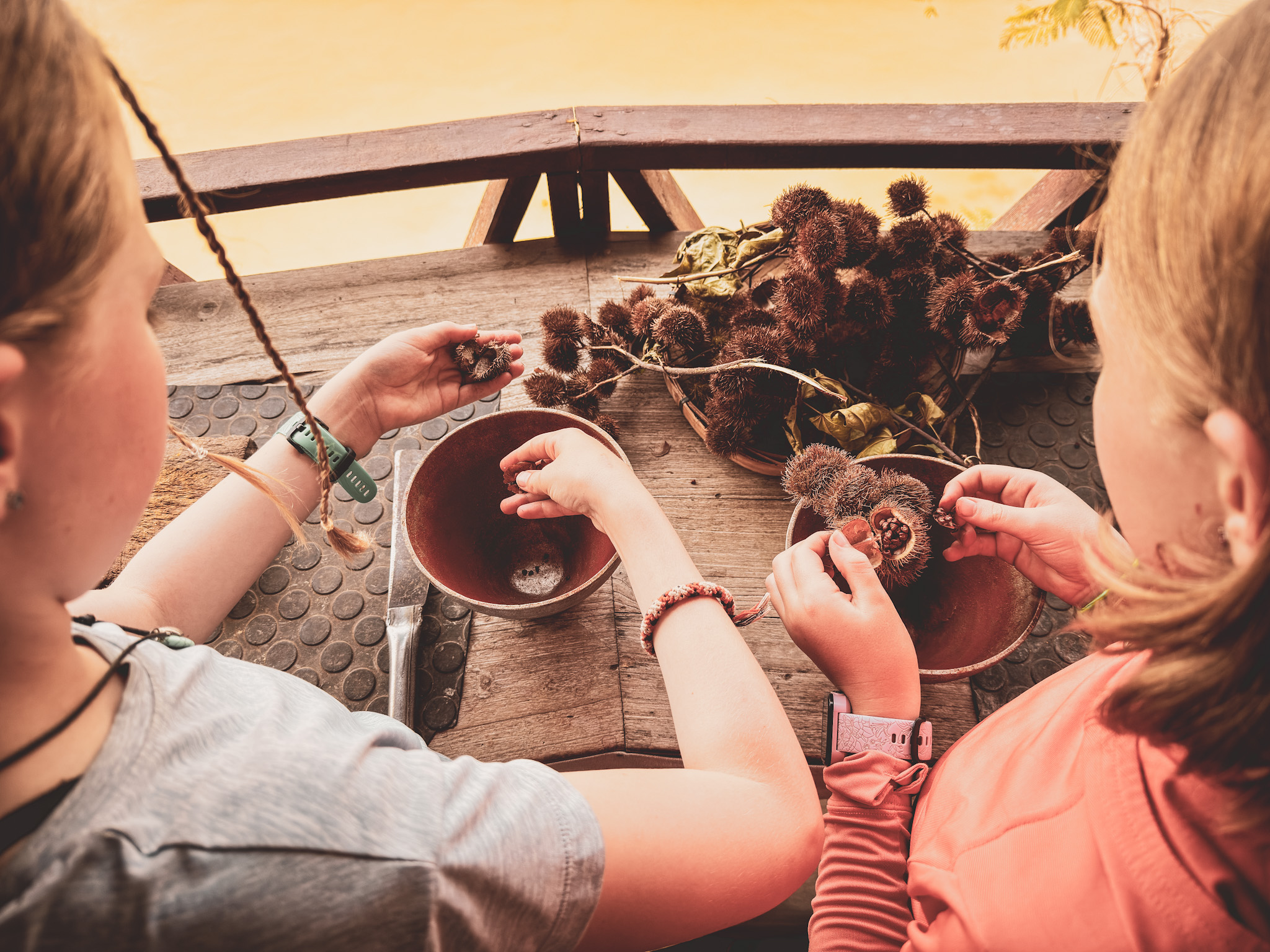
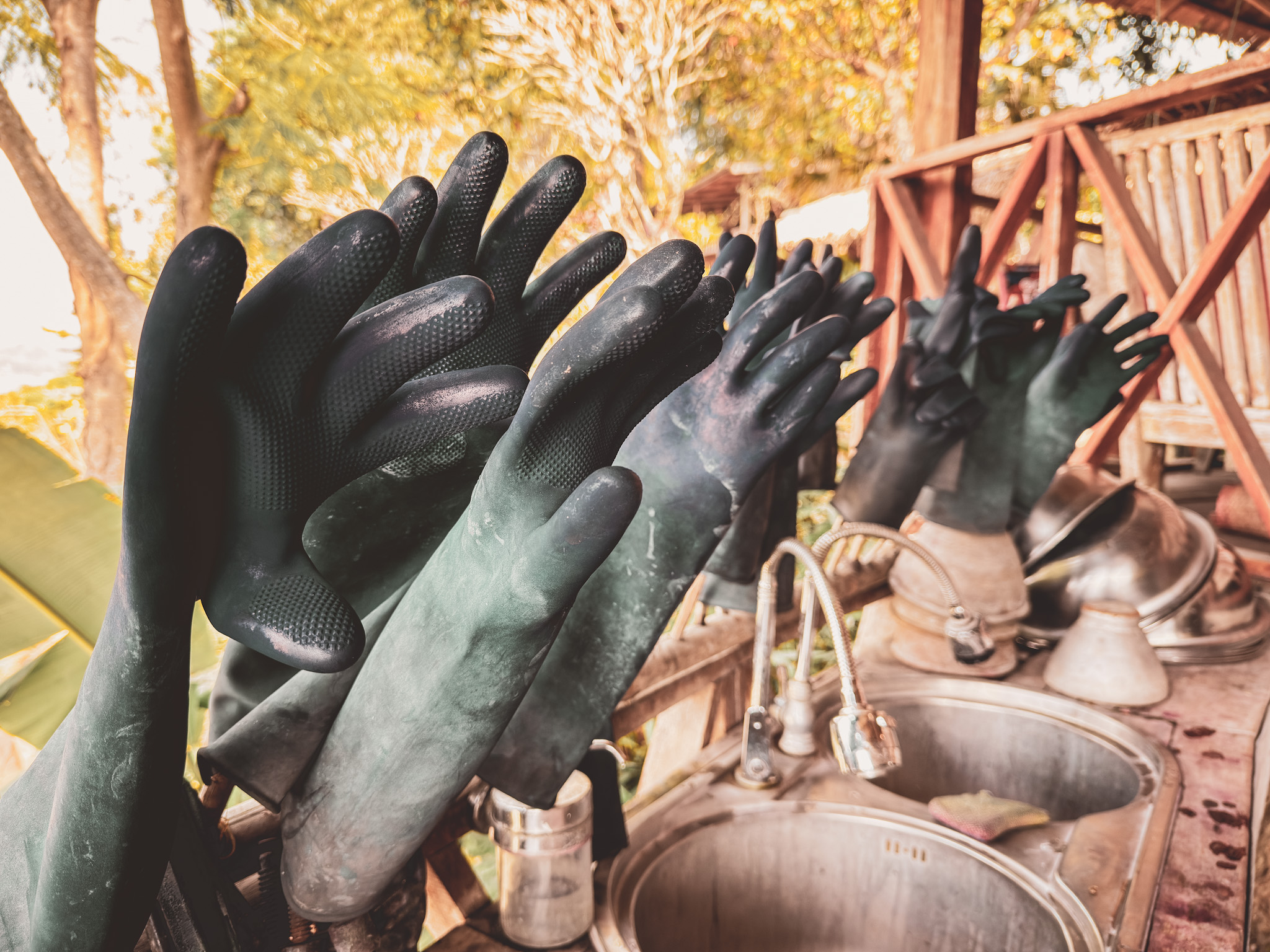
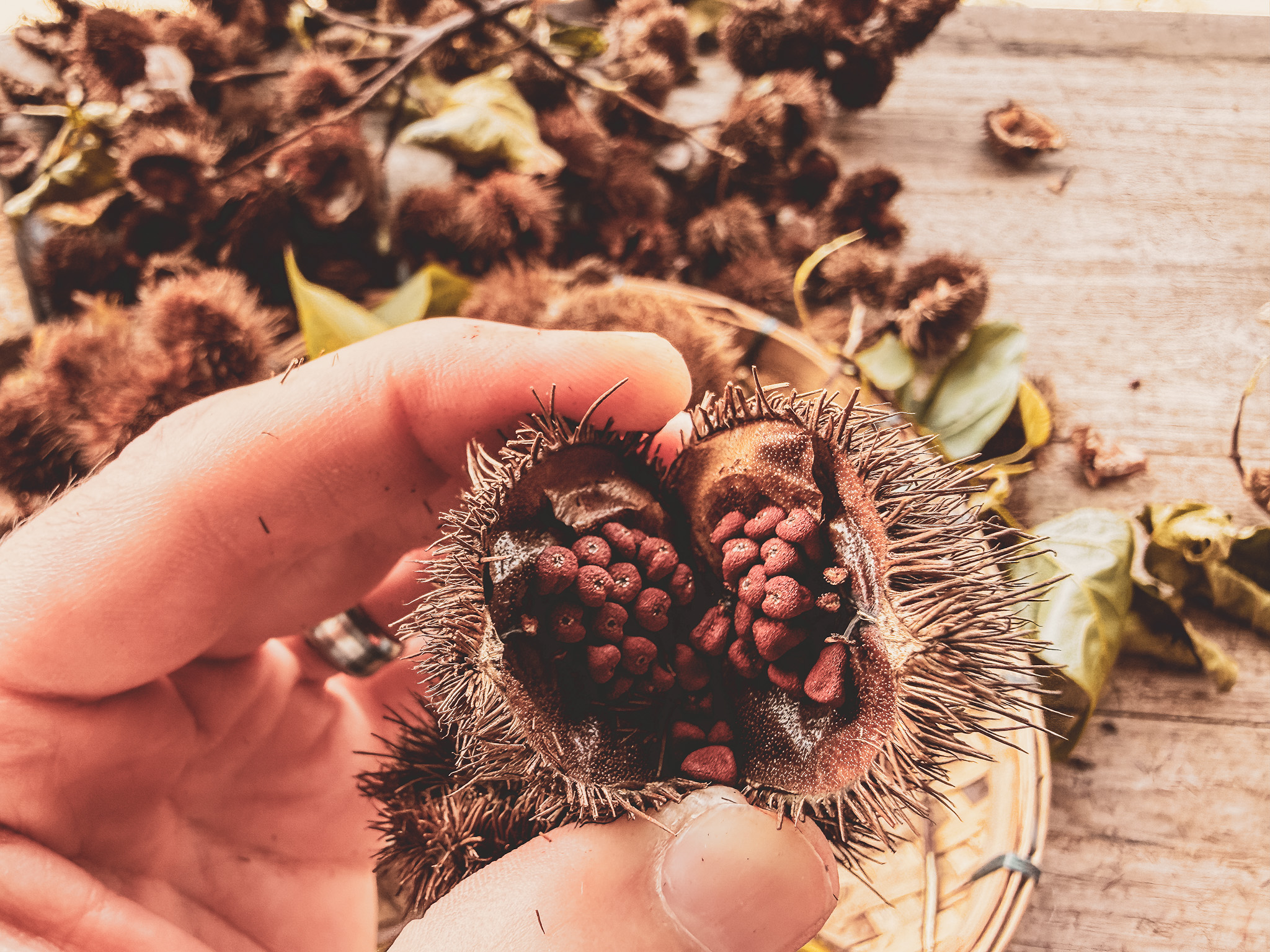
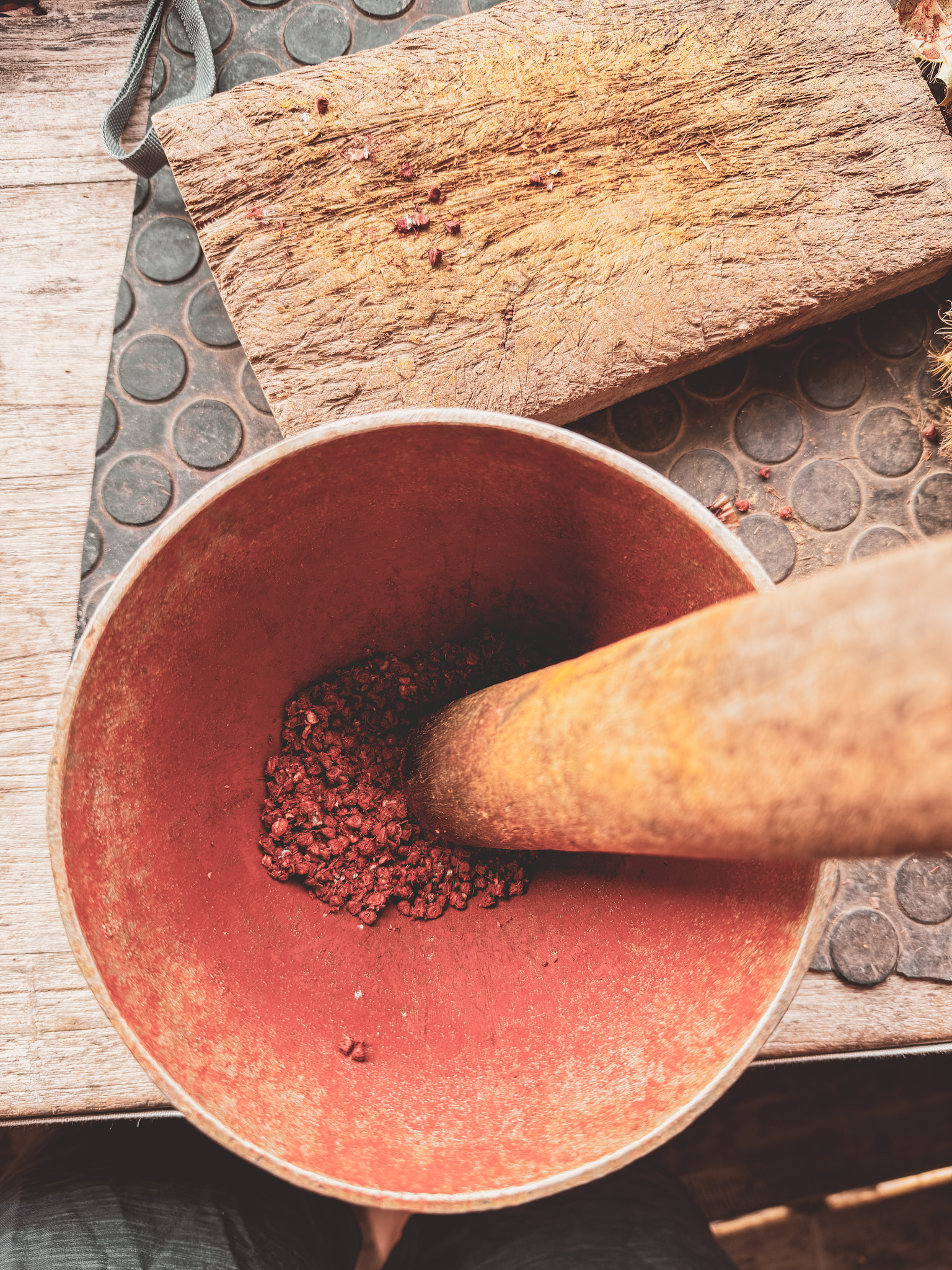
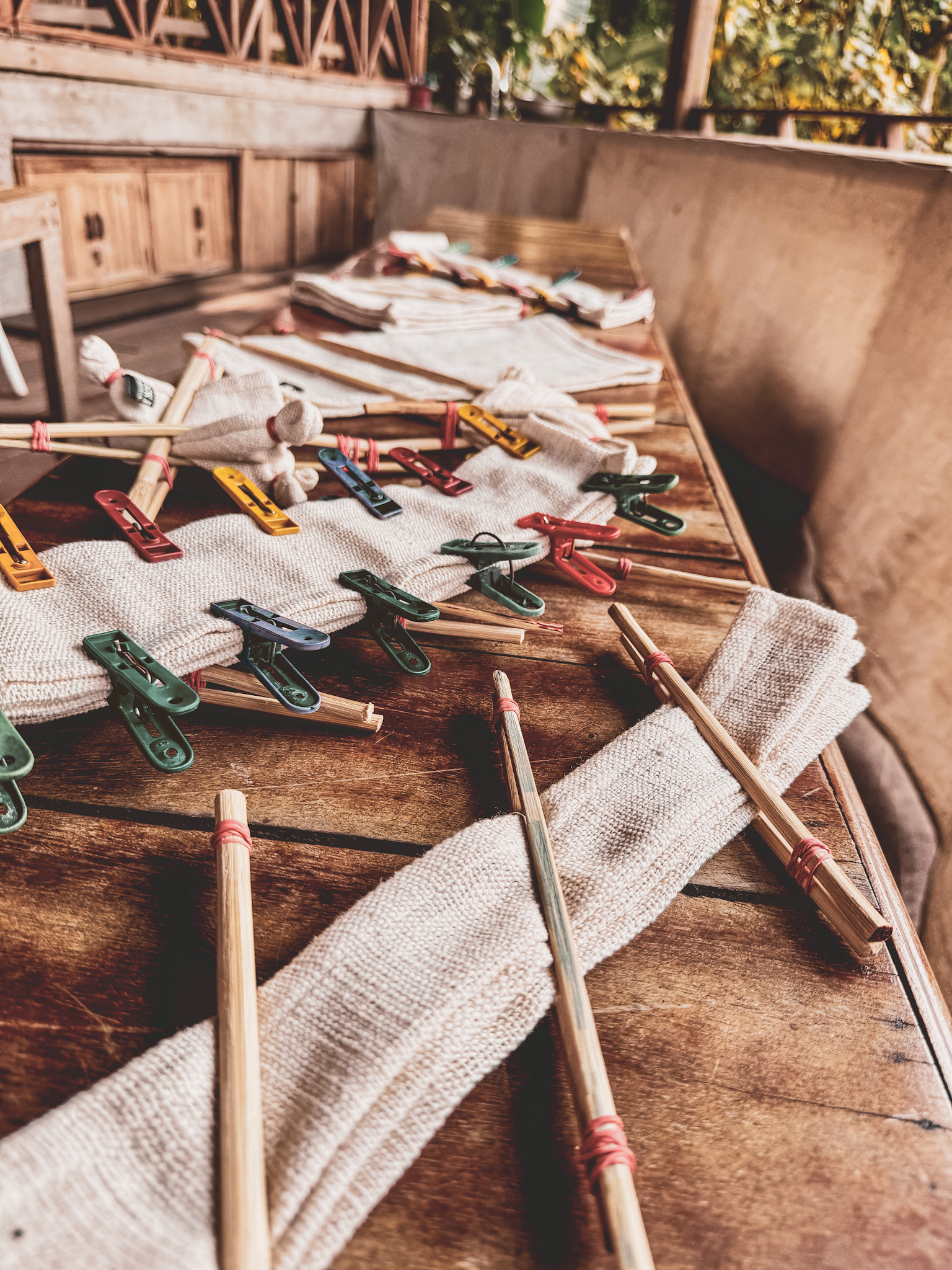
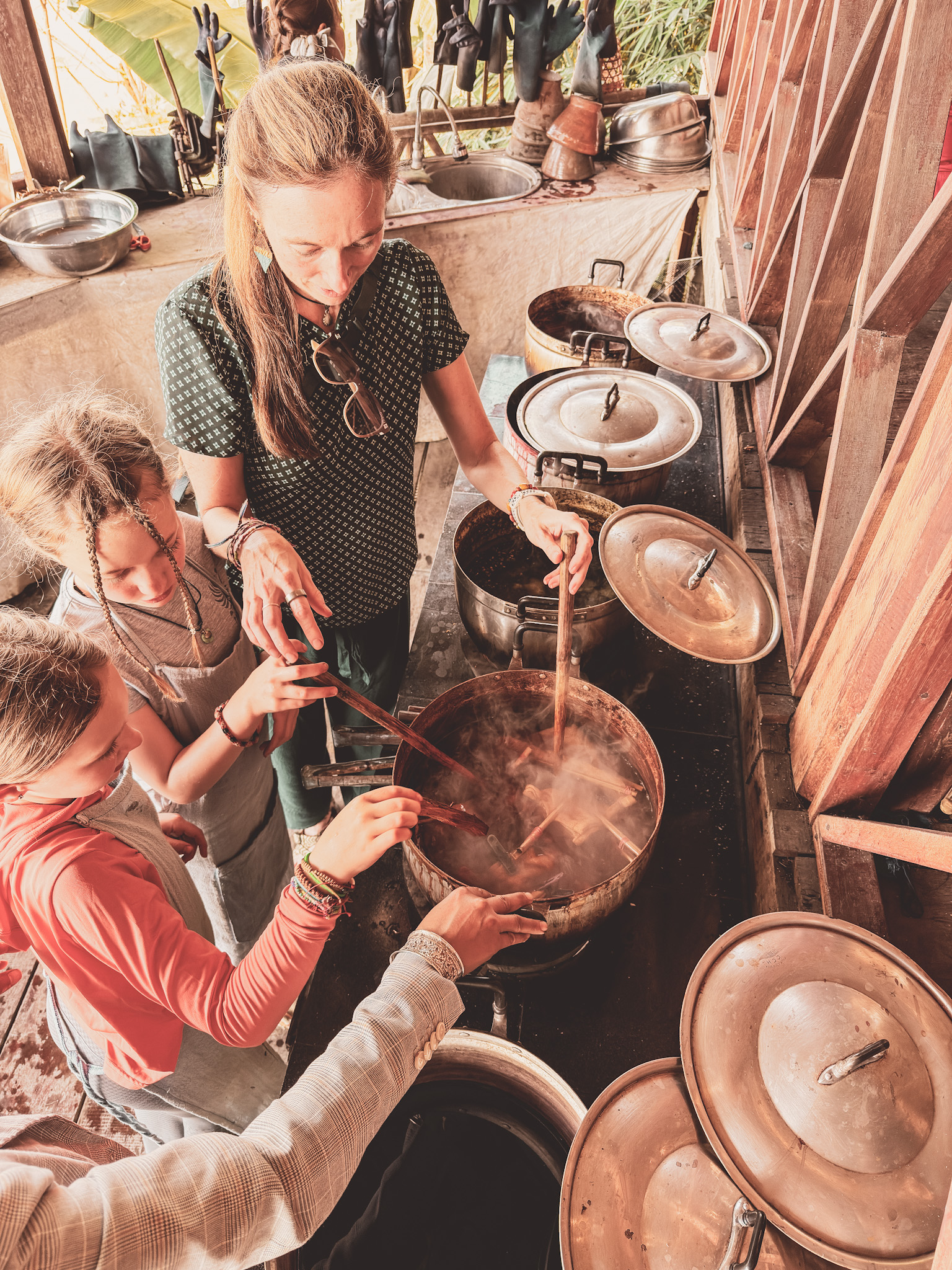
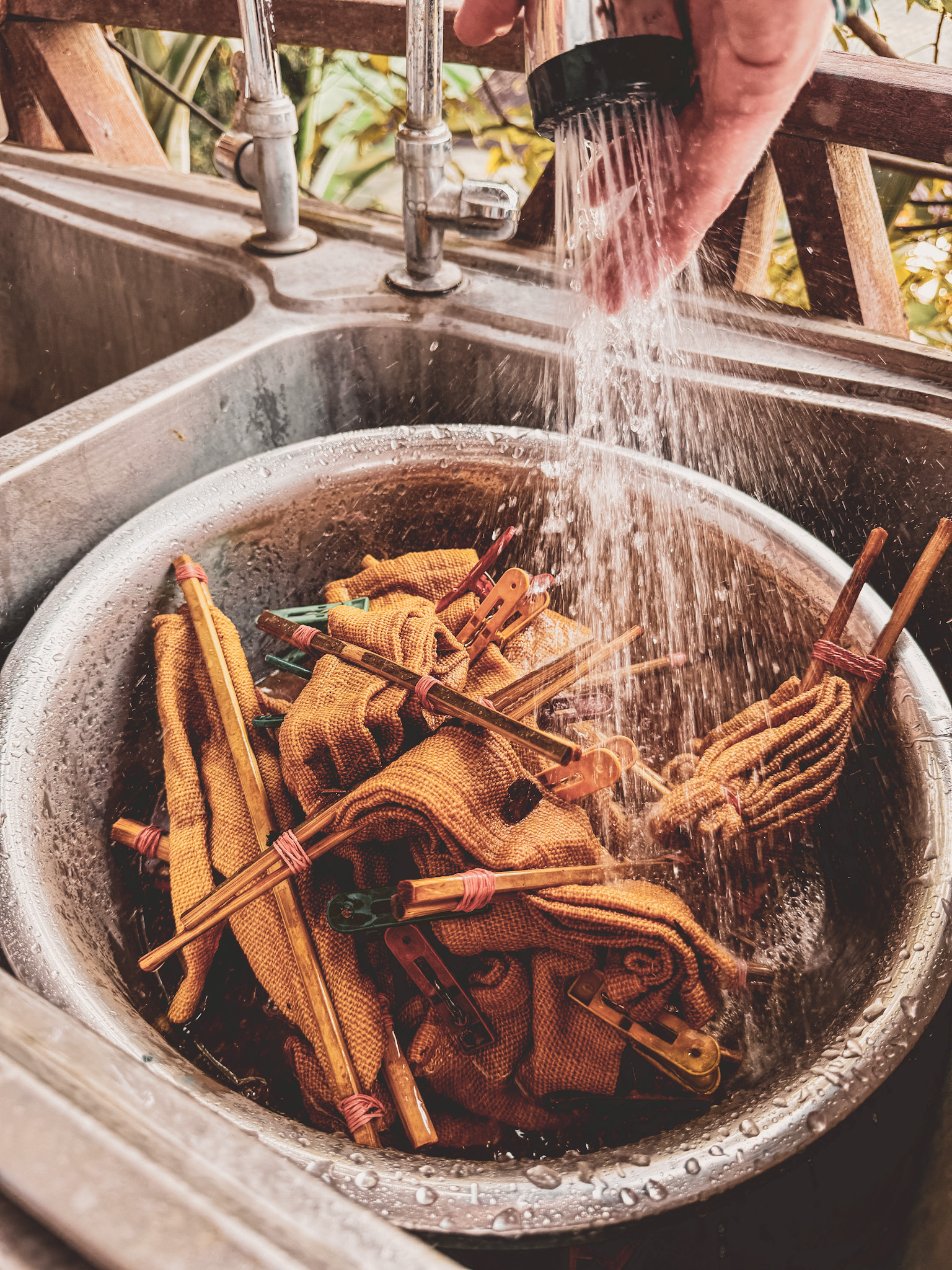
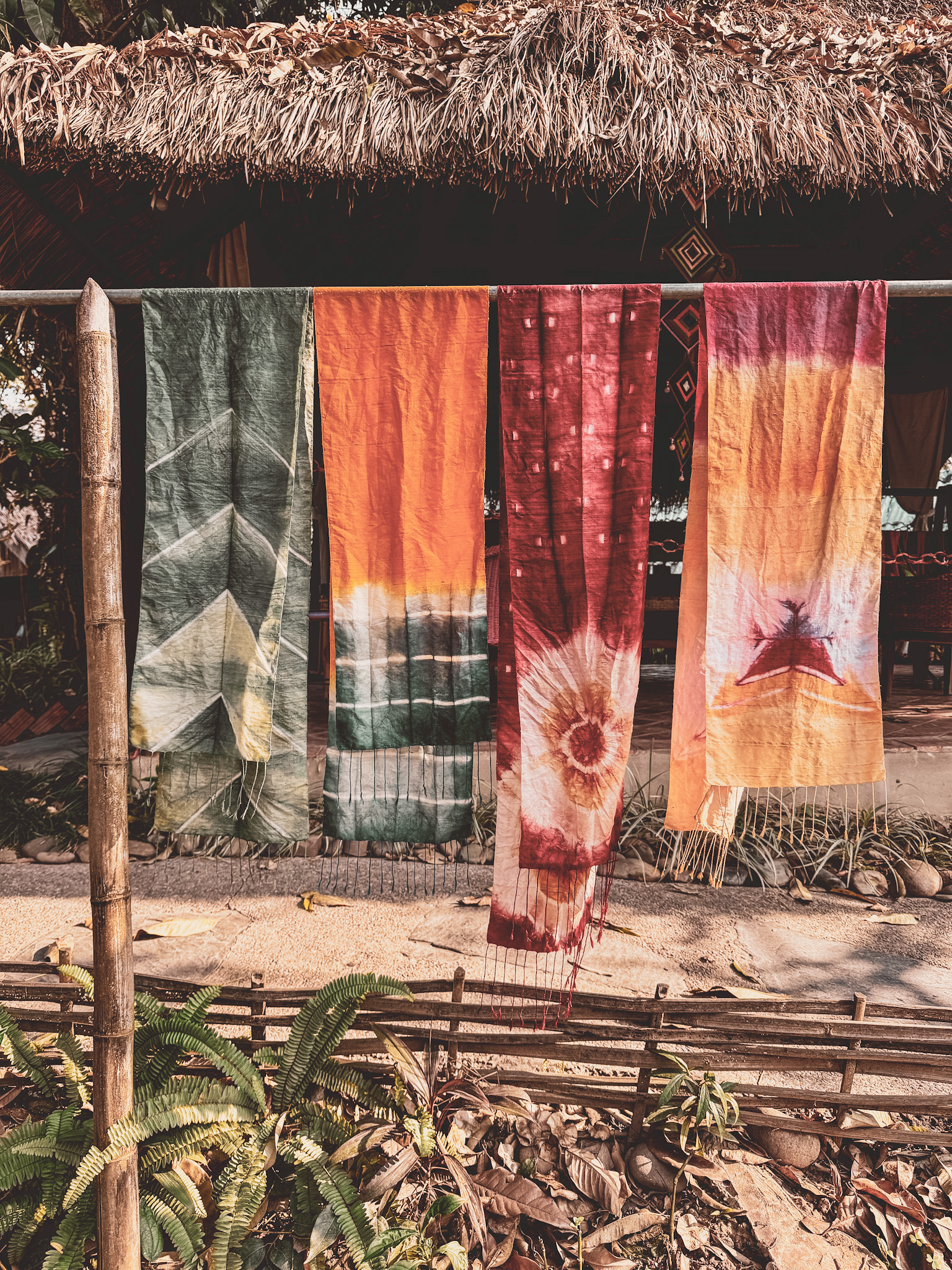
We worked with four dyes: indigo, jackfruit wood, annatto seeds, and sappan wood.
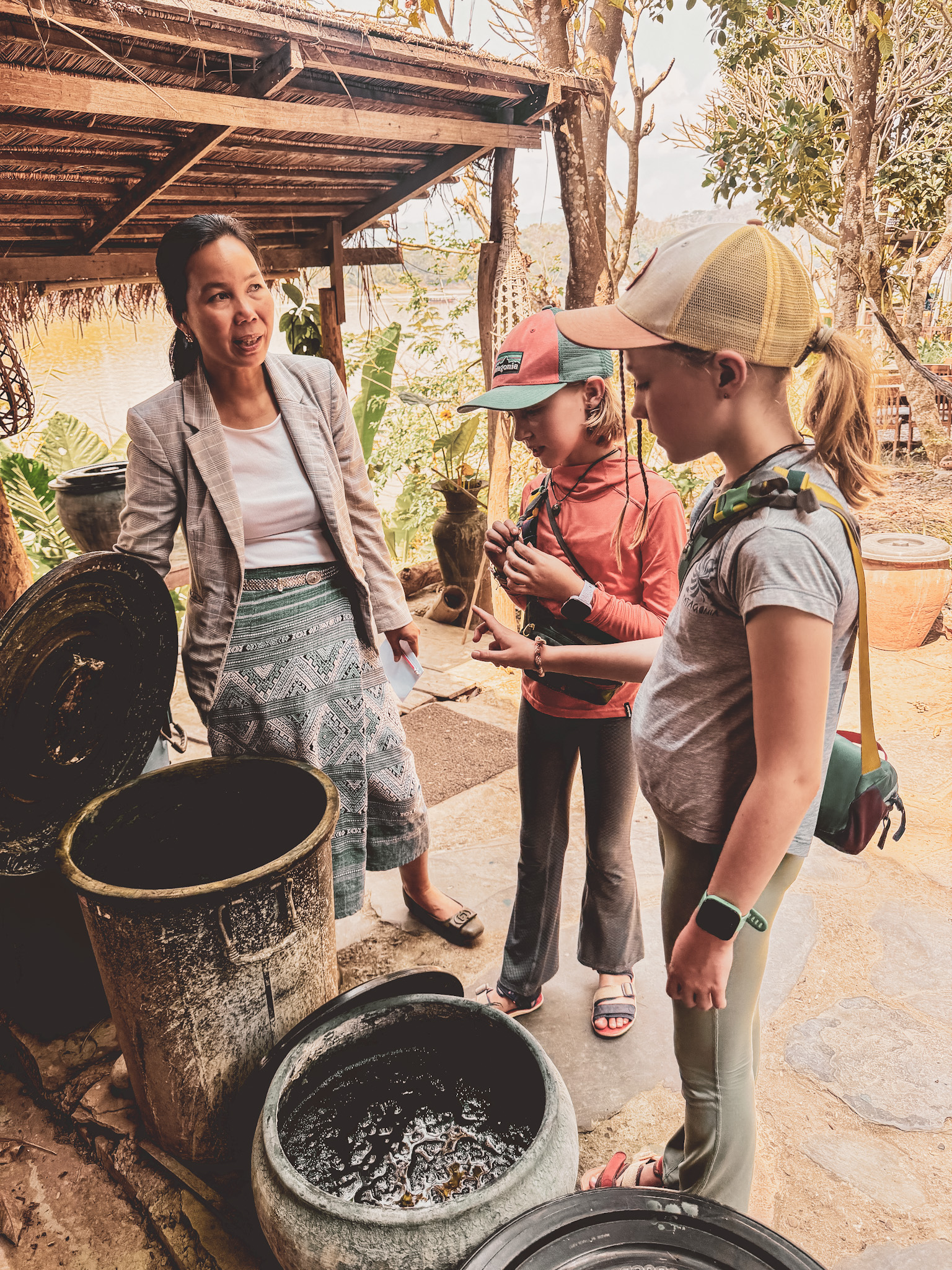
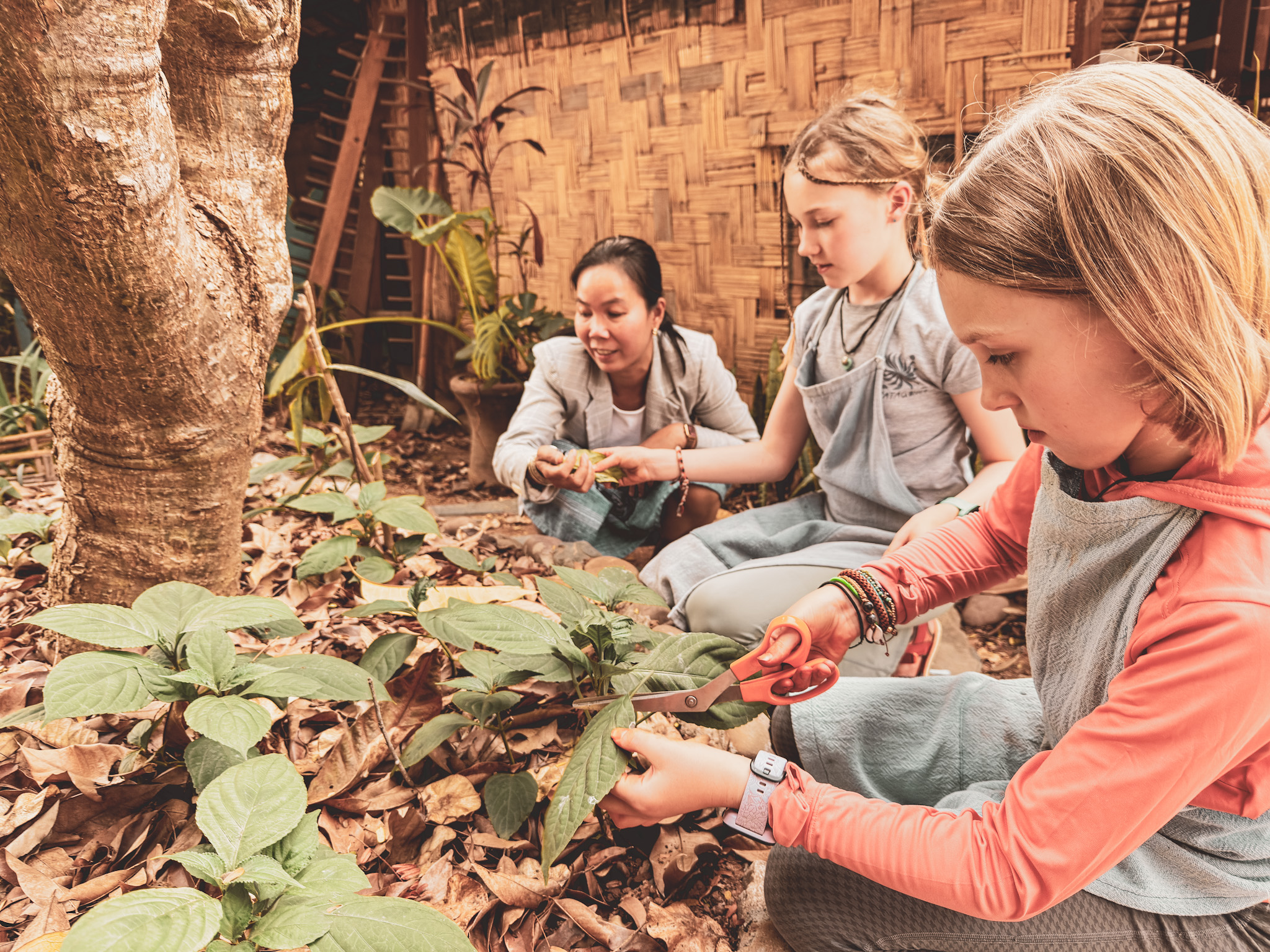
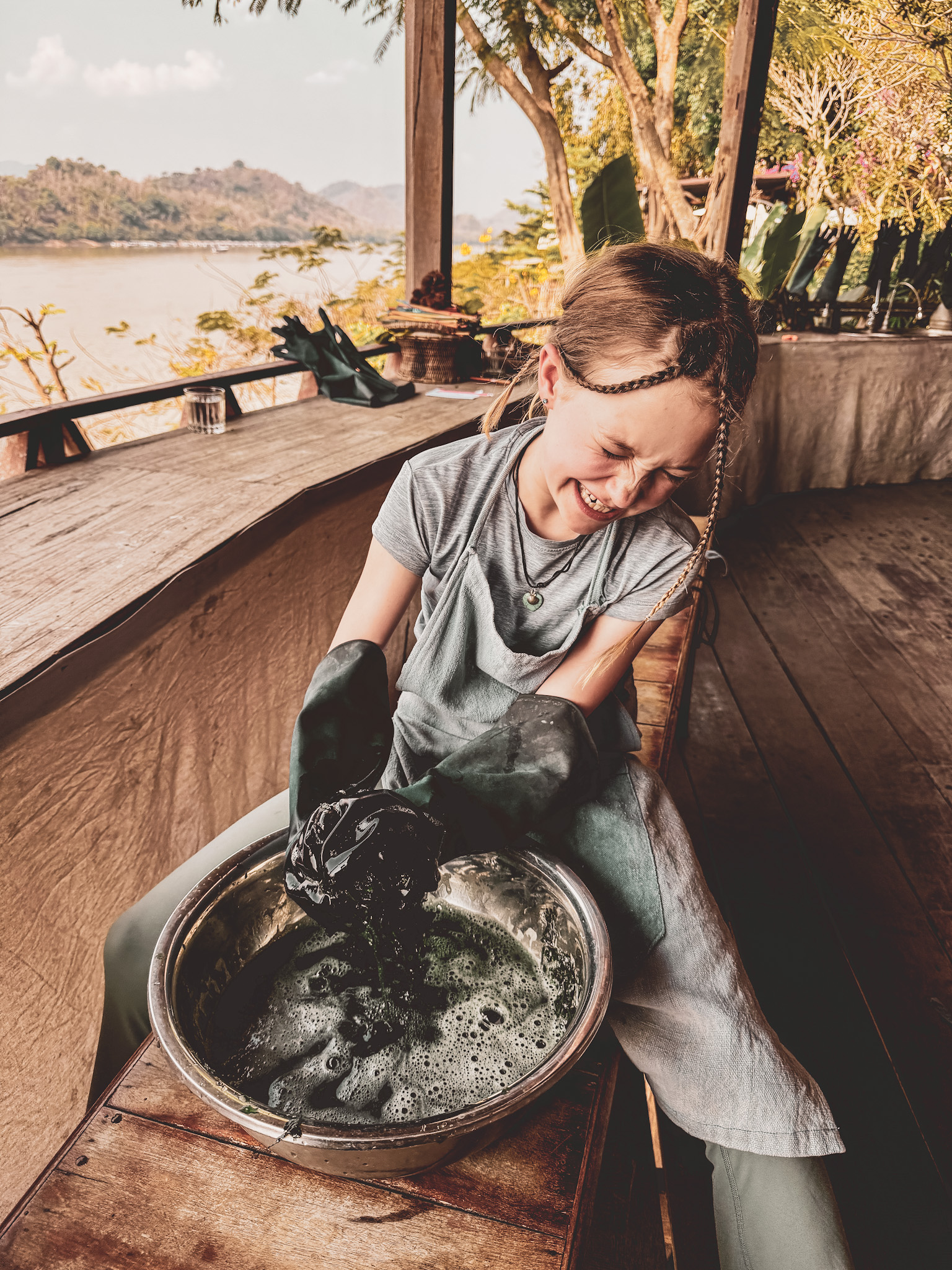
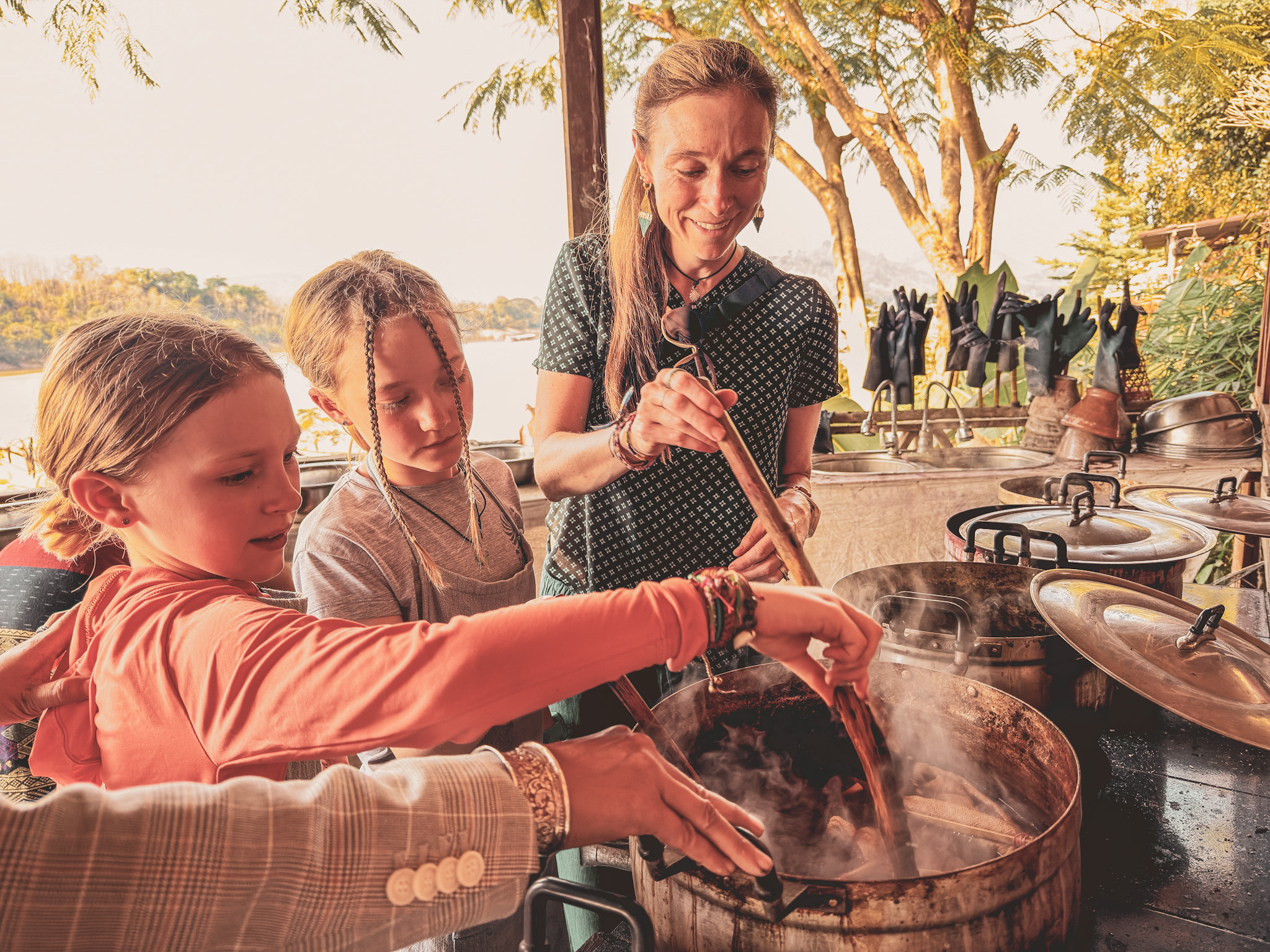
The indigo was the revelation. We went into the garden and clipped what looked like completely ordinary green leaves from the indigo plant, then smashed them into a pulp with a mortar and pestle. The result looked like a muddy green soup.
But then our instructor had us agitate the mixture with water and work it into a froth, and something remarkable happened: the bubbles turned blue. Proper, vivid, iconic indigo blue.
What’s happening is oxidation. Something in the green mush reacts with oxygen as it’s exposed to air and transforms. Watching blue appear out of what looked like lawn clippings felt genuinely close to magic.
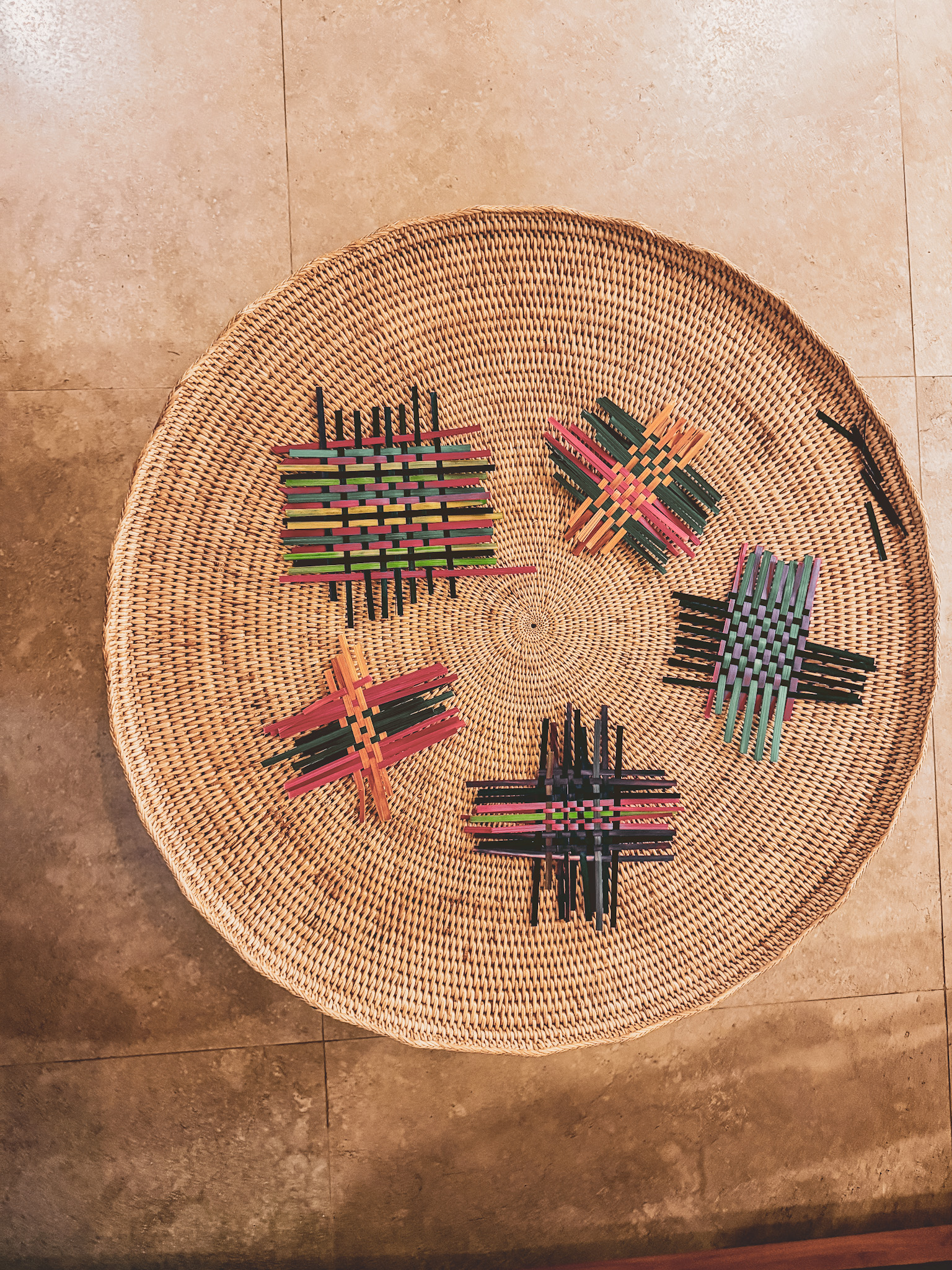
We dyed cotton napkins and silk scarves. The napkins we did as a group project with a matching golden dye from the jackfruit wood but each with different tie-dye designs. The silk scarves were where things got interesting. Each of us went our own direction entirely, and honestly, all four came out looking like things you could actually sell.
After the class, we walked back through the shop.
We stood once again in front of the brocade weaving.
We’d checked everywhere. Nothing came close.
Some things are specific, and this was one of them.
They offered us a cute 15% discount for International Women’s Day (a full blown public holiday in Laos), and we leapt. We blew an entire day’s budget without much deliberation and have zero regrets. A piece of handwoven Lao silk that will eventually go on a wall back home in Reno feels like exactly the right souvenir for this chapter of the trip.
Third Time’s the Charm
We’d tried to get into a locally recommended restaurant Khaiphaen three times.
The first time we didn’t realize it had weird daytime hours. The second time we didn’t realize we needed a reservation. The third time we were smarter.
Named after the popular Laotian crispy river weed snack unique to Luang Prabang, Khaiphaen is a vocational training restaurant operated by a cookery school that trains former street youths and marginalized young Laotians from nearby villages. Their 18-month program provides at-risk youth with culinary, service, and language training, safe accommodation, and work placement.
All of which makes it a place worth going to on principle. And then the food makes it a place worth going to on its own terms.
We ordered broadly and shared everything: fried khaiphaen (the namesake river weed, pressed into thin sheets during the dry season when the river recedes, then flash-fried, sprinkled with sesame seeds and served with puffed rice), Lao sausage, green beans in garlicky brown butter sauce, garlic bread with eggplant paste, tofu green curry, and Mekong tilapia fish and chips.
Everything was traditional Lao with precise, light-handed western tweaks, and all of it landed. We finished with coconut fried bananas and coconut chili ice cream, which Max barely experienced because by that point he had eaten himself into a state of reduced consciousness.
Worth the wait. Worth all three attempts.
What We’re Taking With Us
Luang Prabang taught us a few things.
Not facts, exactly, though we learned plenty of those. More like ways of understanding.
We learned how indigo dye comes from green leaves that don’t look blue until oxygen touches them.
We learned that sometimes the most meaningful moments arrive unplanned, on a random backstreet where monks chant blessings for the women who fed them.
We learned that our daughters can hold their own in a real kitchen making food they’ve never heard of.
We learned that when you find the thing you’re looking for, you stop searching and you just buy it.
And we learned that sometimes a city gives you exactly what you need, even when you didn’t know you needed it.
The brocade is rolled up carefully in our luggage. The scarves we dyed are folded between clothes. The memory of those monks chanting in the morning light is somewhere we can’t pack but will carry anyway.
Tomorrow the slow boat takes us up the Mekong. But tonight we’re still in Luang Prabang, and that’s exactly where we want to be.
 Pause and Wander
Leave a comment